p.3 #1 · How are Wedding Photographers shooting with Flash on Camera
rollsman4 wrote:
BUT when you have dark walls or colored walls you cant bounce off them. That's the reason I posted this to see what methods are used. Especially when going from Horizontal to vertical shooting.
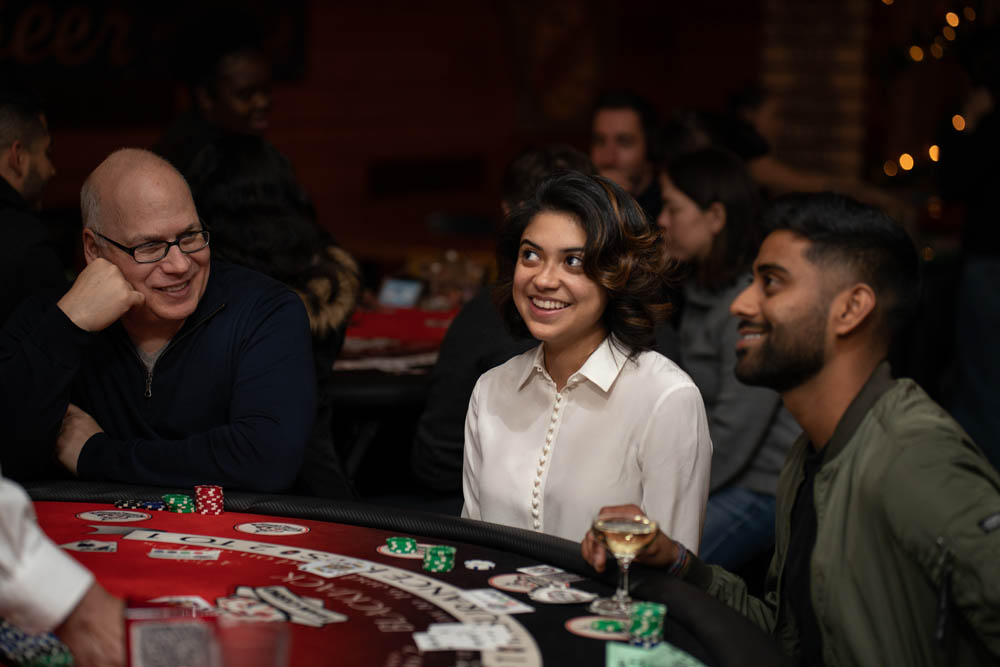
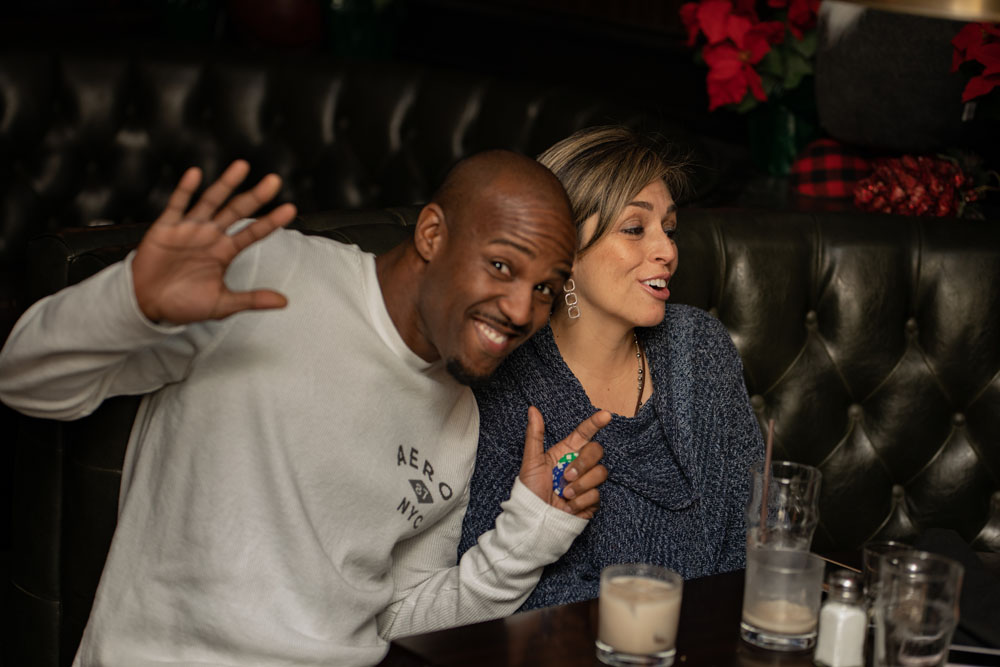
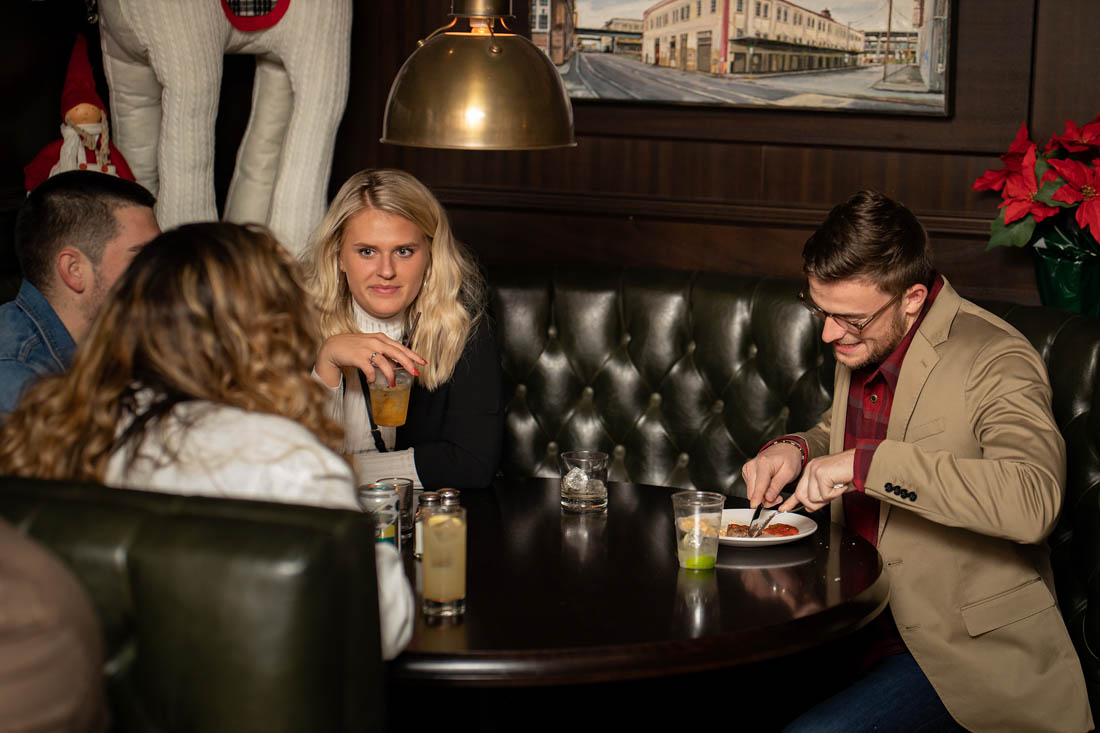
Apparently a light ceiling helps. This is a holiday party in Porltand for a company where our son works. I dug out these images because I remember the very dark walls. I would photograph a wedding reception the same way. I think I was using the "robo" flash Canon makes. I have other speedlites and Godox 360s, but opted to try this light for fun. Much was bounced to the ceiling with some spill from the flash to the people. These are unedited. I like these as-is ...
p.3 #5 · How are Wedding Photographers shooting with Flash on Camera
I don't shoot weddings, but I do shoot rather lovely private parties which tend to have very complex and difficult lighting arrangements in big venues.
Apart from the formals which get multi-strobe treatment, I shoot with on-camera flash and an assistant with a speedlight on a pole.
If I am careful, I can get a very natural image - by balancing ambient to ETTL with just enough punch to accentuate the subject. I run the assistant's light as a backlight and set this to fully manual which I can control from my camera.
I've never been a fan of having fixed strobes in the corners of a room. It makes me feel that it becomes a photographic experience rather than my client's event. Whilst for more subtle things I may bounce my flash of a white wall of ceiling, my needs tend to require the ability to retain atmospheric lighting (and colours), so bounce in these cases just tends to wash thing out too much.
I use a Lumiquest Kwikbounce, not for any bounce effect, but because it places the speedlight in a better place when shooting portrait, but also because it places the light source a little bit higher. Let's not forget when we're nervous about on-camera lighting, that often just a bit of extra height can make all the difference - after all, the use of a beauty dish on-axis doesn't upset anyone.
With a little care, the above can give incredibly natural results.
p.3 #6 · How are Wedding Photographers shooting with Flash on Camera
If you get stuck shooting grip-n-grins, the Joe Demb flip panels have always been a fav. Just like the pull out white panel on flashes, but also work in a vertical (or diagonal in my case) mode.
We use the little Canon 430RT speedlights on-camera (600RTs off-camera) and the Demb PJ model works well when you need basic on camera flash. Small, less cumbersome.
p.3 #7 · How are Wedding Photographers shooting with Flash on Camera
mdvaden wrote:
Apparently a light ceiling helps. This is a holiday party in Porltand for a company where our son works. I dug out these images because I remember the very dark walls. I would photograph a wedding reception the same way. I think I was using the "robo" flash Canon makes. I have other speedlites and Godox 360s, but opted to try this light for fun. Much was bounced to the ceiling with some spill from the flash to the people. These are unedited. I like these as-is ...
what are the camera settings and the flash settings?
p.3 #8 · How are Wedding Photographers shooting with Flash on Camera
Flash manual, varying power levels for each room or ceiling height. Doubt I used more than 1/2 power with the flash at any time. My aperture was f/2 - ISO 400 and 1/160th sec.. Used a Tamron 85mm 1.8 VC on the EOS R
p.3 #9 · How are Wedding Photographers shooting with Flash on Camera
I do not make enough to have an assistant around for 10-12 hours setting up monolights or the equivalent lighting. I do use an assistant for the group shots, indoors and outside, using off camera Quantum Qflash and light modifiers, but after the group photos are done I cut the assistant loose.
I use a Custom Brackets bracket and flash on one camera with a 24-70mm lens and a on-camera flash and no bracket with the 70-200mm lens. The flash is used for fill lighting and to provide catchlights in the eyes of my principle subjects and to provide separation from the background. Indoors bouncing the on-camera flash works quite well but can result in color casts from the light off the ceiling but is is usually not a problem.
I use the flash for fill light and the overall exposure is from the available light present at the location. The available light at venues varies from bad to terrible and the flash helps correct the color balance for the images. If the use of flash is evident in the images then that is the fault of the photographer and not the flash.
p.3 #10 · How are Wedding Photographers shooting with Flash on Camera
Retired wedding photog here.
I recently shot a large birthday party in a dimly lit old bar with relatively low ceilings. I normally don't use flash but felt I needed to for this occasion. I was shooting m4/3 at ISO 6400. I know m4/3 is no good at high ISO but I used Topaz Denoise so I got results that were better than I ever got when using film in low light. Not suggesting that you do this as the processing time would kill you but I have time to burn.
I used a small Godox flash, 350 I think. Used on TTL with the diffuser cup pointing up to the ceiling. My exposures were the normal exposures I would use without flash, Aperture mode.
The take away is that I was astounded by the quality of the images, better than I did 20 years ago with med format. By that I mean that I was able to catch very candid moments quickly, more natural photos, not better in technical terms. Very few bad exposures. There was no flashed look. Images looked like a non flash photo except that they were cleaner, no bags under the eyes, and the backgrounds had some detail in them. Sharper because of the flash stopping power. What impressed me was the backgrounds. They were not inky black because the high ISO allowed them to get some exposure.
The small, I mean small flash, had plenty of power even when I shot groups. I hardly noticed it on the camera. Recycle time was very fast.
You guys have it made. I remember 6 pound battery packs, cumbersome flash brackets, setting exposure manually, and slow recycle times. Afraid to bounce because lack of power, color casts, and uncertainty about exposure settings.
I remember standing in a large dark ballroom and thinking to myself. Someday I will be able to take pictures in this room without flash and the camera will focus itself. Pie in the sky. That day is here.
p.3 #11 · How are Wedding Photographers shooting with Flash on Camera
LeeSimms wrote:
I don't use much on-camera light, but when I do 80% of the time it's a 3/4 bounce over my right shoulder (which is perfect when you turn the camera vertical - don't have to change tilt direction).
10% of the time I'll just bounce straight up with the little pull out card for catch lights
10% of the time I'll smash light into a window or neutral wall for a nice blending side light.
Haven't used a bracket since going digital in 2005. If you're used to the bracket look and living in a world of constant fill-flash, then shooting with more natural light for grip-n-grin moments might seem weird but with modern cameras/sensors it's more appealing (provided the ambient temperature is consistent). Just a different way of shooting casual portraits and small groups. I prefer it as if something good starts happening with the subject(s) you can get off a few frames with reactions and not throw anyone into epileptic fits....Show more →
The problem is that in most venues there is a mix of fluorescent and tungsten lighting and that is terrible for skin tones or even the dresses of the bridesmaids. If it is during the daylight hours and the reception is indoors then I need flash to avoid having the outdoors seen through the large windows being blown out entirely.
I also want catchlights and to avoid raccoon eyes when there is not enough light on people's faces. I also by lighting a person or couple that are close to the camera I have the background darking and this provides better separation of the people from the background.
Outdoors I usually have the wedding party and other group shots done with the bright sun coming from behind and to one side and I need flash to light their faces. If done properly the flash is never evident but the lack of flash is nearly always quite apparent.
I do appreciate that the use of flash requires more technical skill on the part of the photographer but for those who are intimidated by flash I highly recommend the books by Neil van Niekerk.
I did a few wedding using mono lights but then realized that I could not charge more for the additional time needed to do the setup and that I would be needing to stay longer to do the take down. Some brides like the pictures that look like something from Hollywood stills of the 1930's but not enough to matter. And add in the problems of working around the cheap color light bars so commonly used by DJ's at receptions and mono lights are not worth the additional time entailed.
p.3 #12 · How are Wedding Photographers shooting with Flash on Camera
I think I've read Neil refer to 'find the light' several times, and that's what applies here.
> The problem is that in most venues there is a mix of fluorescent and tungsten lighting and that is terrible for skin tones or even the dresses of the bridesmaids. If it is during the daylight hours and the reception is indoors then I need flash to avoid having the outdoors seen through the large windows being blown out entirely.
Agreed. For these, I photograph outdoors, finding the best combination of light and background. Of the 100+ weddings I shoot a year, 20 are in a church, and for those, I'll light a few family groups with off-camera flash on stands (never on). Even at those events, I'm always angling to get subjects outside to open shade with a non-distracting background.
End-of-night sendoffs I still shoot with an on-camera bounce panel pointing at the couple going through the gauntlet. That's about it. If I incorporate an on-camera flash in reportage, I'll use 3/4 bounce (often mixed with stand-mounted speedlights).
> I did a few wedding using mono lights but then realized that I could not charge more for the additional time needed to do the setup and that I would be needing to stay longer to do the take down. Some brides like the pictures that look like something from Hollywood stills of the 1930's but not enough to matter. And add in the problems of working around the cheap color light bars so commonly used by DJ's at receptions and mono lights are not worth the additional time entailed.
A few of our photographers bring monolights and will use (with high-speed sync) one or two for specific big-scene/little-people shots when the goal is to darken intense Colorado skies. On and off over the years, I've used battery-powered monolights for the same effect. Currently, I'm not but might add it back in for 2021.
The Hollywood 1920's hard light glamour look is something worth pursuing if you have a talent for it. Those photos would stand out in a crowded and homogenous marketplace.
I bring six speedlights to every wedding, but I try to use them as little as possible—just another tool in the box.
p.3 #13 · How are Wedding Photographers shooting with Flash on Camera
Edward Steichen was a personal favorite of the 'Hollywood look'. He did a lot of sandwich lighting I do on sessions/weddings when you actually have to time to breath, think, adjust lights. Sadly, those are in short supply in 2020.
p.3 #14 · How are Wedding Photographers shooting with Flash on Camera
LeeSimms wrote:
PS - avoid any attachments on your flash when you bounce. I'm seeing a lot of people using those MagMod bulbs like they used the Fong Lightshere 10 years ago and they just suck power. Best to go naked IMO.
Looking at your upvotes on this I suppose my opinion may not be taken, but everything has its place including bouncing WITH Fong's sphere. Both would produce a bit different outcomes. I can suggest you try both ways to understand the difference. What you are right about, it will suck more power, but ultimately can create a much larger light spread at the back of you, when used in the right setting.
PS. I tested both ways some years ago personally.
p.3 #15 · How are Wedding Photographers shooting with Flash on Camera
Agreed, but is the different outcome valuable? Is it worth attached the dingus to your flash?
For most active wedding photographers in 2020, the 'flash on bracket' look so popular in the 70s-90s isn't a part of their brand today. These are usually a guest asking "can you take my photo" and those photos will be fine if you simply walk a few steps into better light.
But if this frontal light look is your thing, ala grip-n-grins at a political/business event, then I'd recommend a side bracket like the Hollywood party black-n-white shooters use. The axis is moved slightly to the side, rather than up top.
p.3 #16 · How are Wedding Photographers shooting with Flash on Camera
LeeSimms wrote:
Agreed, but is the different outcome valuable? Is it worth attached the dingus to your flash?
For most active wedding photographers in 2020, the 'flash on bracket' look so popular in the 70s-90s isn't a part of their brand today. These are usually a guest asking "can you take my photo" and those photos will be fine if you simply walk a few steps into better light.
Well, the different outcome would be valuable to the photographer who is using. Just like some find value in flash while others use natural light; or some use $6000 cameras while other photographer use $1500 alternatives that are perceptually as good. There are 100s of examples of that.
Same goes for the dingus. While you care how you look,others may not. Chances are, clients have absolutely no view on any of the gear and could not care any less what we are using. I would argue that your opinion was influenced by other photographers instead of comments by your clients.
Personally, I have no issues using any accessory as long as it delivers the results I need.
p.3 #18 · How are Wedding Photographers shooting with Flash on Camera
Profoto with SoftBounce on camera is our method of choice. Gives a very nice soft look, can equally be used inside and outside. Most venues we are in (barns) have high ceilings and are quite large, so bouncing isn't a possibility as are fixed off-camera flashes. Additionally it depends on ceiling material, color etc.
We only use flash if there is no other possibility.
p.3 #19 · How are Wedding Photographers shooting with Flash on Camera
For on-camera flash, I don't use one style fits all.
Since I use Flashpoint Zoom Li-on X R2 (or Godox V1), I mostly bounce ceiling with white bounce card that comes with flash (either E-TTL if subject keeps moving or M if subject not moving). When there is high ceiling, I will still use mostly high ISO and bounce flash with frosted dome and bounce card. Sometimes I bounce flash to side white wall or even place white reflector to bounce (make light source larger and softer).
p.3 #20 · How are Wedding Photographers shooting with Flash on Camera
I view it as a necessary evil.
For the most part, it only comes out before the reception if I'm dealing with truly awful light (some getting ready spots are atrocious). And that that point, it's on camera, bounced off a ceiling, and I'm just making passable photos. It is what it is.
Sometimes I'll use it off-camera with a softbox for B&G portraits, and I should be using it more like that, but I find the gear such a PITA, plus dealing with feathering (etc.) with an untrained assistant, plus environmental considerations. Ugh. I just never really got into it.
Receptions are venue dependant. But most involved me moving around a lot, so I have no idea how I could do anything but on-camera bounced. For example, with speeches, how can you get the speaker, the B&G reactions and the guest'ss reaction without at least 3-4 flashes? I'm sure someone will tell me that's a normal setup, but for me that sounds like an equipment nightmare.