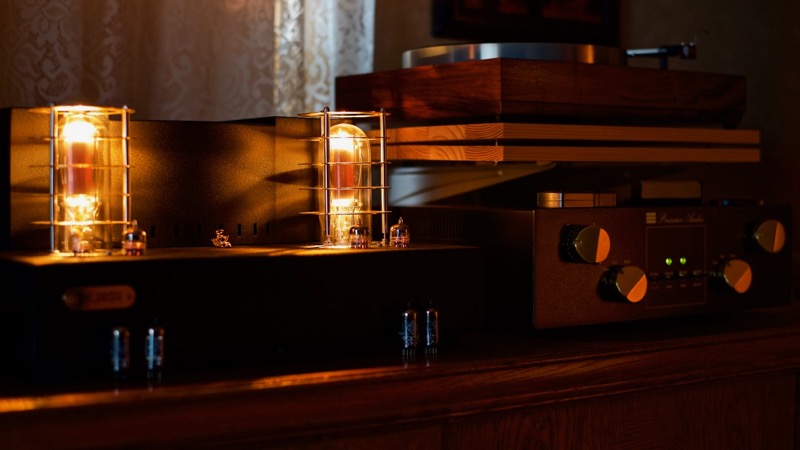
Another one of my passions is recreating musical events in my home through the use of high end audio components. Even though many people may feel that technology has advanced by light years, the most realistic audio reproduction ( to my ears at least ) is accomplished through the use of single ended vacuum tubes that date all the way back to 1931. I use the 845 radio transmitting vacuum tubes in my power amplifier, as well as other triode vacuum tubes in my phono stage, line stage, tuner, etc. Using this "vintage" tubed audio amplication system in conjunction with my turntable playing vinyl records pressed back in the sixties is music to my ears
rjenson wrote:
Great shot! Makes me feel young again. Digital is amazing but there is something about Analog that can not be duplicated.
Bob
Thanks Bob and I agree 100% with you. With analog, the music somehow just seems more full, more harmonic, more 3-dimensional and less sterile than with digital. And that is not to say that digital is bad... cause it's not. I've got over $15,000 invested in my two box digital player and it does sound good, but it just can't compare to my analog rig. I've had a number of people simply stunned by the sound of my tubed and vinyl based audio system. They sit in the listening chair in total disbelief, some of them having to pick their jaws up off the floor It's always great fun sharing my music collection with friends.
As a musician gone bye, tubes produce a sound that digital has not been able to replace. I still have my 60+ year old Ampeg B15 bass amp..all tubes! The sound cannot be duplicated.
Great composition Don!
Dan
Danpbphoto wrote:
As a musician gone bye, tubes produce a sound that digital has not been able to replace. I still have my 60+ year old Ampeg B15 bass amp..all tubes! The sound cannot be duplicated.
Great composition Don!
Dan
Thanks Dan! I also play the cello and can attest that somehow, vacuum tubes really excel at reproducing the harmonics and resonance of the body of stringed instruments. Not only that, but when you hear the quality of the plucked strings or bowed strings... it is so realistic sounding that it will give you goosebumps
And here we are today, striving to get analog quality photos from digital cameras ! It's interesting how the human brain works and what we are capable of distinguishing. I look at 40-year old film slides from my grandpa's photo studio and still shake my head in disbelief--somehow, they just look better. Maybe it's the way our brains are trained. I wonder if my kids would notice the difference? Great shot, BTW!
No Regrets wrote:
Another one of my passions is recreating musical events in my home through the use of high end audio components. Even though many people may feel that technology has advanced by light years, the most realistic audio reproduction ( to my ears at least ) is accomplished through the use of single ended vacuum tubes that date all the way back to 1931. I use the 845 radio transmitting vacuum tubes in my power amplifier, as well as other triode vacuum tubes in my phono stage, line stage, tuner, etc. Using this "vintage" tubed audio amplication system in conjunction with my turntable playing vinyl records pressed back in the sixties is music to my ears
Very cool setup. That looks like a very early Linn Sondek. I often considered building a single ended amp, but couldn't find the right valves. Solid state gear has many hundreds of time the number of elements in the signal path, each providing phase shift with frequency all requiring huge feedback loops to keep it linear.. Small wonder tubes creates a more realistic sound stage with so few elements in the signal path. What are your speakers?
Vancouver47 wrote:
Very cool setup. That looks like a very early Linn Sondek. I often considered building a single ended amp, but couldn't find the right valves. Solid state gear has many hundreds of time the number of elements in the signal path, each providing phase shift with frequency all requiring huge feedback loops to keep it linear.. Small wonder tubes creates a more realistic sound stage with so few elements in the signal path. What are your speakers?
Thank you very much! You certainly understand the differences between solid state and single ended vacuum tube or (valve as you say) amplification. Yes, indeed...that is a Linn Sondek LP12 powered with a custom DC power supply , with the Naim ARO tone arm, and a Benz Zebra Wood Ruby ZH cartridge. My speakers are Dunlavy SCIV Signatures. They stand 6ft tall and weigh 180lbs each. Their sensitivity is 91db with a very flat impedance curve that stays at about 5 ohms throughout the entire frequency range without really fluctuating at all. Tubes love flat impedances
keoniahlo wrote:
And here we are today, striving to get analog quality photos from digital cameras ! It's interesting how the human brain works and what we are capable of distinguishing. I look at 40-year old film slides from my grandpa's photo studio and still shake my head in disbelief--somehow, they just look better. Maybe it's the way our brains are trained. I wonder if my kids would notice the difference? Great shot, BTW!
The kids will actually see not just hear the difference. A good quality well set up tube system and phono end, can produce a sound stage where well recorded orchestral music has depth, width and obvious instrument placement in the sound stage. Just close your eyes and you can point to instruments depth and location just like you can with the stage in a music hall. In a dark sound room few could tell where the speakers were located but all could point to the location of the instruments. I never heard a solid state setup that could come close to the musicality or sound stage rendering.