fredmiranda.com
Login

Moderated by: Fred Miranda
  New fredmiranda.com Mobile Site
  New Feature: SMS Notification alert
  New Feature: Buy & Sell Watchlist
  

FM Forums | Canon Forum | Join Upload & Sell

       2       end
  

Archive 2018 · ISO: How High on APS? PP Techniques?


AmbientMike
Offline
• • • • • •
[X]
p.1 #1 · ISO: How High on APS? PP Techniques?


How high is everyone going on APS? What results are you getting?

I semi-recently got a Canon T6. I've been a little disappointed, because I don't really feel comfortable with 3200 even, and I thought 1600 was good even on the much older 30D.

Although I've used 12800 and been happy with it, considering.

Am I doing something wrong in pp? What iso's are everyone using on APS? And what techniques & software are you using for pp?

I use DPP, but luminanace NR has never been its strength, from what I've seen. So I turn it off. I wind up sharpening before NR, which is probably not ideal. Chrominance NR seems fine, though. I do use masking, at times, with layers in gimp, which is probably a bit harder, but I don't really do volume.

Like to get some inks to good videos, websites, etc on high iso pp etc.


Sep 10, 2018 at 10:18 PM
technic
Offline
• • • •
Upload & Sell: Off
p.1 #2 · ISO: How High on APS? PP Techniques?


On my 80D I use 1600 ISO if I have to, but prefer to stick to 800; 3200 ISO would be for must-have family shots etc. but that's really an emergency setting. High ISO IQ is a step up from the much older 450D, but nothing major IMHO (1/2-1 stop improvement?). Most of the time I use DPP plus some additional noise removal in Nick Denoise if I have to, especially with obtrusive noise in OOF areas of the picture. I usually set luminance NR lower than the standard value but not completely off. I find that chrominance NR in DPP can cause a strong reduction in color/vibrancy of details with High ISO images, so for important images I tone that down as much as possible.

What is acceptable really depends on the subject. I find that 1600 ISO can look great if there is plenty of detail in the subject. Problem is, High ISO is often used with action (fast movement) or low light where detail is compromised, and in such situations the noise and lack of DR can get ugly. There is lots of theory about input and output sharpening but I don't think there is a universal recipe for optimal results. I'm currently experimenting with 1600 ISO for my dragonfly shots because going from 1/4000 to 1/8000s exposure improves sharpness (because of the high speed) and sometimes the result (despite lower DR and more noise / more coarse details) is an improvement over 800 ISO (with a bit more motion blur); but again it really depends.


Sep 11, 2018 at 03:32 AM
charlyw
Offline
• • •
Upload & Sell: Off
p.1 #3 · ISO: How High on APS? PP Techniques?


AmbientMike wrote:
Am I doing something wrong in pp?


Not in PP but in viewing - only you will ever get to see the 1:1 pixel view of any image. Do get the composition right in the camera and you will have no problem when viewing the picture as a picture and not as an assortment of pixels - no matter how high the ISO was.


Sep 11, 2018 at 04:39 AM
lighthound
Offline
• • • • • •
Upload & Sell: Off
p.1 #4 · ISO: How High on APS? PP Techniques?


You should never sharpen noise. Always apply your NR 1st, and then apply your sharpening. Actually sharpening should be the very last thing you do.


Sep 11, 2018 at 05:35 AM
TeamSpeed
Offline
• • • • •
Upload & Sell: Off
p.1 #5 · ISO: How High on APS? PP Techniques?


It is interesting to read replies on threads like this, and commentary on sports. It is a bit obvious who shoots sports casually vs does it pretty extensively.

I have a long history with APS-C high ISO. For each camera that comes out, that I buy, which have been several, I develop 3 levels of NR actions for Photoshop. These are based on ISO noise levels, so I have a medium, high, and aggressive. My findings were such that I would use a combination of raw settings in DPP, coupled with Photoshop filters and Noiseware, on a color by color channel level.

Each model has proven to need a different set of criteria, thus why it is important to pixel peep to really get to know your camera. Process is usually to keep the high ISO NR in camera on APS-C to low or disable, keep sharpening way down, and export to JPEG. In PS, I will treat each color channel to a different set of filters, some require levels of NR, then a final NR on the RGB, and then USM for contract, USM for sharpening, etc. That is a high level of what is in the actionsets I have developed over the years for the 7D, 1D3, 1D4, 5D3, 5D4, and 7D2. I have some tutorial threads on another forum for some of these bodies for others to follow.

I will almost always shoot high ISO inside the house with family, as well as indoor sports ranging from middle school through professional. With the 7D2, I always am at 12800, and periodically higher than that. I run a noise filter in bulk on hundreds of photos, and then tweak from there as I crop for composure, if needed. Exposure is key, like always, even at high ISO.

ISO 6400 on the newer cameras like 80D, 7D2 and SL2 (and other rebel equivs) are perfectly fine, if you watch your camera settings and use DPP.

ISO 6400


All Below are 12800


Colored stage lights are troubling though, without something close to full spectrum, the noise does get a bit tough to manage when I shoot drama and music.


Sep 11, 2018 at 06:50 AM
TeamSpeed
Offline
• • • • •
Upload & Sell: Off
p.1 #6 · ISO: How High on APS? PP Techniques?


The 7D was my first "surgical" approach to noise reduction and I would use that at 6400 often, sometimes moving to 12800, but just not in the same league detail-wise as the newer APS-C. Today's APS-C compete and even beat older cameras like the 1D4 and 1D4 and 5D2.


However the old 7D eeked out some decent images once in a while. At 100% view, the loss of detail is seen to a higher level than today's versions. The 7D2 retains alot of detail at high ISO.


The 7D2 (and even more so with the newer cameras) has decent DR as well.


Sep 11, 2018 at 07:15 AM
dhphoto
Offline
• • • • • •
Upload & Sell: Off
p.1 #7 · ISO: How High on APS? PP Techniques?


I don't use high ISO APS-C that much but when I do I certainly find the newer the sensor the more flexibility with PP. My 80D is a lot better than my 7D

But with my trusty old 7D if I nail the exposure (down to 1/3 of a stop or so) and use my usual PP technique, which is more or less complete noise removal on a PS layer and then carefully painting back areas that require more detail with masks the results are very good.

I think you just have to be prepared to work a little and also DPP isn't the best converter for noise

Checking images out at 100% is rather deceiving too as so much just doesn't show up at repro sizes


Sep 11, 2018 at 07:21 AM
charlyw
Offline
• • •
Upload & Sell: Off
p.1 #8 · ISO: How High on APS? PP Techniques?


dhphoto wrote:
But with my trusty old 7D if I nail the exposure (down to 1/3 of a stop or so)


Nailing the exposure and not having to remedy underexposure always is beneficial to the image quality - at any ISO...


Sep 11, 2018 at 07:55 AM
arbitrage
Offline
• • • • • • •
Upload & Sell: On
p.1 #9 · ISO: How High on APS? PP Techniques?


I always got nervous as my 7D2 got to 1600ISO...I surely shot it above that sometimes but trying to lower SS if possible is the better option. I ideally would like to be at ISO 800. That said, I've got better at NR over the years and I probably can handle 1600-2500 on the 7D2 these days.

With the Canon sensor you have to expose to the right....even if that means pushing ISO up further than you'd like to maintain the SS/Av you need/want, you will be better off than underexposing and trying to protect your ISO value. Canon sensors are not even close to ISO-less and therefore getting the exposure correct (pushed as far as possible without clipping important parts) is going to give you your best image.

On my D500 I shoot at 1600 more comfortably and will shoot that even up to 4000 when I need to...again I have to apply selective NR to get a pleasing result. The D500 sensor is ISO-less so I can shoot whatever I want (screw up) and I don't get penalized...that is a nice safety feature....


Sep 11, 2018 at 08:13 AM
TeamSpeed
Offline
• • • • •
Upload & Sell: Off
p.1 #10 · ISO: How High on APS? PP Techniques?


The 5d4 is actually pretty iso-less for a big part of its range. So Canon had gotten better with at least the latest ff sensors. Not all of canon's sensors can be lumped into the same "bucket".


Sep 11, 2018 at 08:27 AM
gdanmitchell
Offline
• • • • • • •
Upload & Sell: Off
p.1 #11 · ISO: How High on APS? PP Techniques?


lighthound wrote:
You should never sharpen noise. Always apply your NR 1st, and then apply your sharpening. Actually sharpening should be the very last thing you do.


The masking fader is also your friend — use it to keep sharpening away from noise in solid areas and gradients.

A general comment about noise: Many people worry about it too much, I think. Certainly, you typically want to minimize it when you can, but in some kinds of photography noise is inevitable. It has always been with us in photography, and it isn't necessarily a bad thing to have some noise in a photograph. So the issue isn't "preventing" or "eliminating" noise, but rather in controlling it in light of the specific photograph and its usage.

I did a three year project photographing professional classical musicians, mostly in low light environments, such as backstage at rehearsals and concerts. I used a full frame and a cropped sensor camera, often shooting at 1600 ISO to 6400 ISO so that I could shoot handheld without flash or other added light. I shoot exclusively in raw mode, so I was able to deal with high contrasts between direct light and shadows, and I was able to do effective NR in post.

The resulting photographs can be printed at quite large sizes. I have several that I've printed as fine art prints at 18" x 24", and one of the performing groups decided to use photographs from the project as part of their annual marketing campaign — some were printed quite small in mailers and pamphlets (you'll never seen any noise in this sort of thing) but others we enlarged for placement on the exterior of the performing hall in versions that were several feet tall, and they look great.

Edited on Sep 11, 2018 at 11:18 AM · View previous versions


Sep 11, 2018 at 09:00 AM
lighthound
Offline
• • • • • •
Upload & Sell: Off
p.1 #12 · ISO: How High on APS? PP Techniques?


As has been said, the newer camera sensors can achieve things we couldn't have imagined just a few years ago.

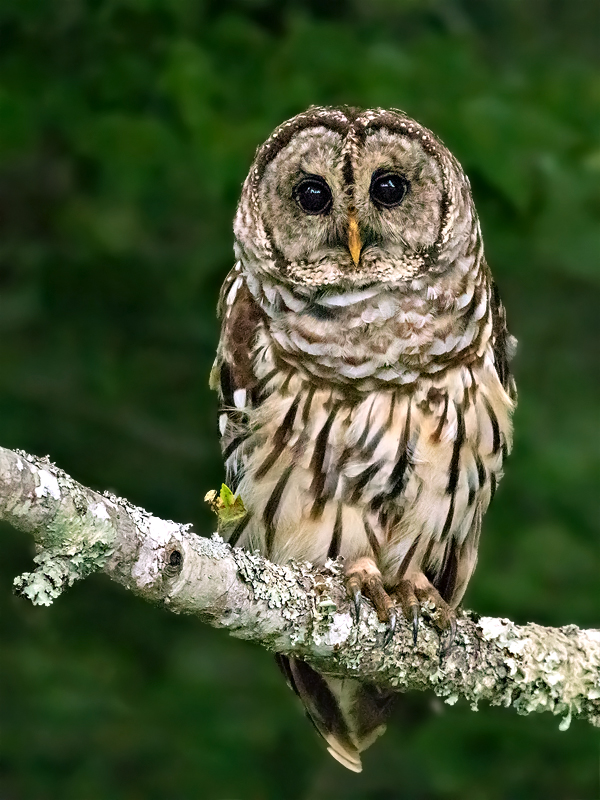
Here is a "safety" shot I had taken one early morning this year with my POS 6DII. It was the first Owl I had ever seen in the wild and I wasn't about to blow my chance to capture at least a grainy shot of him.
I thought he would fly off as soon as I got out of my truck (my normal luck) so I jacked up my SS and let my ISO max out to 40,000.
Yes, that's a 4 with four zeros after it.

My PP NR skills are pretty lacking, but for a "safety" shot at ISO 40,000 I was very impressed with how this one turned out.
It wouldn't win any awards and isn't my best shot I got of this owl but damn, 40,000 is just crazy.

Dave


Sep 11, 2018 at 10:04 AM
TeamSpeed
Offline
• • • • •
Upload & Sell: Off
p.1 #13 · ISO: How High on APS? PP Techniques?


Here is an example too of how the older cameras benefit from using raw all the way to post processing vs the JPG results.

This is a 5D3 at 25600, 100% crop. The before is the JPEG, the after is the raw with the settings I determine to be good for PP, run through DPP then to PS with Noiseware and one of my actions. The noise is mitigated and the detail comes out at the same time, rendering a very clean yet detailed 25600 shot. Not all NR is created equal!

Keep in mind that the only manual step is really to mass update all the raw to the same settings and then export all out to a folder. Then run a PS action in bulk on all JPG in that folder. I will then only edit each to recompose, and maybe some other minor tweaks, but I don't spend alot of time on them.

With the 5D4, I don't even do all of that any longer.


Final 4K view
4K Sample


Sep 11, 2018 at 10:25 AM
AmbientMike
Offline
• • • • • •
[X]
p.1 #14 · ISO: How High on APS? PP Techniques?


TeamSpeed wrote:
Here is an example too of how the older cameras benefit from using raw all the way to post processing vs the JPG results.

This is a 5D3 at 25600, 100% crop. The before is the JPEG, the after is the raw with the settings I determine to be good for PP, run through DPP then to PS with Noiseware and one of my actions. The noise is mitigated and the detail comes out at the same time, rendering a very clean yet detailed 25600 shot. Not all NR is created equal!

Keep in mind that the only manual step is
...Show more

Yeah, I shoot jpegs a lot, but they seem to have similar sharpening and NR to the defaults in DPP. A lot of detail gets,lost, unfortunately. I wish you could adjust sharpening in canera, and turn down/off NR for jpegs.

One image at 1600 just got blown away, for detail, compared to a gh1 image. So I really started trying to figure out what the heck happened. I started turning off luminance NR and adjusting sharpening, after that.

NR definitely is not created equal.

I would be interested in your videos, feel free to post here or pm me. You are getting some nice looking high iso from crop bodies. I haven't done any NR to individual channels.


Sep 11, 2018 at 11:44 AM
AmbientMike
Offline
• • • • • •
[X]
p.1 #15 · ISO: How High on APS? PP Techniques?


dhphoto wrote:
I don't use high ISO APS-C that much but when I do I certainly find the newer the sensor the more flexibility with PP. My 80D is a lot better than my 7D

But with my trusty old 7D if I nail the exposure (down to 1/3 of a stop or so) and use my usual PP technique, which is more or less complete noise removal on a PS layer and then carefully painting back areas that require more detail with masks the results are very good.

I think you just have to be prepared to work a little and also DPP
...Show more

Yeah, DPP is great for details and look, but not for NR. I have done some masking, having one layer where I just blasted the noise, then painted the detail back in. So it sounds like I'm close to getting it right, at the very least.

It sounds like I need to back off a bit to look at the noise. Which sounds good, actually, I may have been overdoing it.
What percentage do you like to zoom in?


Sep 11, 2018 at 11:57 AM
TeamSpeed
Offline
• • • • •
Upload & Sell: Off
p.1 #16 · ISO: How High on APS? PP Techniques?


AmbientMike wrote:
Yeah, I shoot jpegs a lot, but they seem to have similar sharpening and NR to the defaults in DPP. A lot of detail gets,lost, unfortunately. I wish you could adjust sharpening in canera, and turn down/off NR for jpegs.

One image at 1600 just got blown away, for detail, compared to a gh1 image. So I really started trying to figure out what the heck happened. I started turning off luminance NR and adjusting sharpening, after that.

NR definitely is not created equal.

I would be interested in your videos, feel free to post here or pm me. You are getting
...Show more

What do you use for JPEG editing after DPP?

If you would like to share a raw, I can work through the steps I take (plus the Noiseware settings) and then share those back with you. My steps are all automated at this point for the 7D2 processing I do, but I can tear the process apart a bit if that helps.

I have done this with others, and also created a couple of "How to get the most of your XXXXX high ISO shots" threads on the POTN forum.

A word of warning, focus has to be spot on though for this all to work, with a good lens. If focus is off, the detail is then muddied by two factors, slightly OOF and then noise. The results never look very good when those two things come together.


Sep 11, 2018 at 12:24 PM
gdanmitchell
Offline
• • • • • • •
Upload & Sell: Off
p.1 #17 · ISO: How High on APS? PP Techniques?


Quick comment: If maintaining maximum ability to deal with noise (and virtually all other image issues) is critical to you, don't commit to a fixed image format until you absolutely have to do so.

I'm still a Photoshop guy, even in this era of Lightroom. I can do virtually all of my post-processing non-destructively. I do more and more of it in ACR (Adobe Camera RAW), which provides many tools that are parallel to those found in Lightroom. These adjustments can be fine-tuned and changed to your heart's content without affecting the underlying raw image file data.

In addition, I always bring images converted in ACR into Photoshop as smart layers. As a result, if I later need to alter something in ACR I simply double-click the image layer in Photoshop and reopen the raw file in ACR to make changes.

In all cases where it is possible (e.g. sharpening and a few other things) I apply "smart filters" in Photoshop rather than applying "hard" filters. The smart filter adjustments can always be revised and fine-tuned later. I do most NR in ACR before moving to Photoshop, but some advanced methods of handling noise are better done in Photoshop.

Essentially all other image adjustments in Photoshop are done in layers so, even in the worst cases, the adjustment layer can be deleted and I'm back at the imported raw file.

The only downsides to working toward an entirely non-destructive RAW-to-print workflow is that a) you may have to learn some new approaches and b) your Photoshop files will be rather large.

(And, yes, you can do much of this in Lightroom...)

As to NR, the NR adjustments in ACR are very powerful. You can adjust the amount of NR, the radius, how much is focused on image edges and how little is applied to gradients and solid areas. In addition, you can apply NR settings to selections, equivalent to using masks in photoshop. So, for example, you could do a general starting point NR that improves the entire image, and then apply specific additional NR (along with other settings such as positive or negative (!) clarity) to selected areas of the image. ALL of this can be undone or changed later.

Dan


Sep 11, 2018 at 01:04 PM
technic
Offline
• • • •
Upload & Sell: Off
p.1 #18 · ISO: How High on APS? PP Techniques?


TeamSpeed wrote:
A word of warning, focus has to be spot on though for this all to work, with a good lens. If focus is off, the detail is then muddied by two factors, slightly OOF and then noise. The results never look very good when those two things come together.


That was my main point, I guess ... if the subject/conditions will not produce plenty of detail to begin with (e.g. a speeding dragonfly that fills the frame isn't really sharp even at 1/8000s shutter speed), the High ISO noise will quickly turn ugly above 800/1600 ISO. Especially if you cannot use the full image but have to crop from APS-C because you were focal length limited to start with ...

Your workflow sounds great, but only if you have relatively few conditions / settings / PP procedures to handle. If you have to work in vastly different lighting conditions etc. it becomes tedious to find the right settings for each shot. Like AmbientMike I have switched back to in-camera jpegs (with low NR settings and fine/low sharpening) for some type of shots because otherwise the processing would take way too much time. I won't get the maximum IQ this way but I don't want to spend to much time on PP either (that's probably why like arbitrage I consider 1600 ISO the max in practice, while I fully acknowledge that with the right shot conditions and skilled processing a lot more is possible).


Sep 11, 2018 at 01:43 PM
TeamSpeed
Offline
• • • • •
Upload & Sell: Off
p.1 #19 · ISO: How High on APS? PP Techniques?


Actually I do indeed work in different lighting. A large venue for sports RARELY has even lighting anywhere, even on the floor. So I can have over or underexposed shots while shooting action, and since the office requests that I shoot the crowds, even those way up in the club seats, that lighting is dismal. I have 7 years of sports shooting executed through this kind of workflow.

I have developed this methodology over nearly a decade, and it has greatly sped up post processing of hundreds of images for each event shot. It took a while, but once I dug into the color channels and treated them differently depending on the model of camera, it changed everything. Noiseware as well is an OUTSTANDING product. It has so many controls/sliders/tabs and does noise reduction so well, it is the primary tool I use, along with a host of other PS filters.

Also, please remember I have 3 different actions developed by camera model. If I had a mix of ISO from 1600 through 25600, I would group the results of the shoot into 3 folders and then run a different action on each folder. This makes the assumption as well that if you have underexposed or overexposed shots, you have taken care of them first, before sorting the images out by level of noise. You could have a 1600 ISO that needs the aggressive action because you digitally brightened it 2-3 stops and for some bodies, that is a recipe for ugliness.

I also use auto ISO in manual mode with EC+1/3 which really helps even out the shots during an event. The 2015-2016 was primarily shot with a 7D2, so you can dig through all these images to see what you think. There are good results and bad results mixed throughout, but those results were the impetus where I became a paid Pacers shooter.

https://gerberphotos.smugmug.com/Sports-Events/Mad-Ants-20152016
(90% of these went through an automated workflow for cleanup, most post processing individually was to crop the image to what I wanted and perhaps a dab or two of USM or an additional light NR run through Noiseware)

Edited on Sep 11, 2018 at 01:56 PM · View previous versions


Sep 11, 2018 at 01:46 PM
Scott Stoness
Offline
• • • • • •
Upload & Sell: On
p.1 #20 · ISO: How High on APS? PP Techniques?


My experience with usability of high iso is that:
1) Having your light source (sun, moon, ambient light) behind you greatly increases the usability of high iso
2) Having the exposure as close as possible to ETTR also makes a big difference. I use spot exposure and put the subject in the centre and then live with the overexposed behind the subject usually.

But my other experience is that I prefer a grainy blurrless picture mostly over a perfectly exposed blurred picture. And when the sasquatch (or cute baby of some sort) jumps out of the bush for a quick second - damn the perfection, just keep the shutter above 1/125 .

ISO 3200 for pictures that match 1,2 on apsc are usually quite good.


Sep 11, 2018 at 01:56 PM
       2       end


FM Forums | Canon Forum | Join Upload & Sell

       2       end


Welcome back
Log in to your account