Mark Metternich
Offline
• • • • • •
Upload & Sell: On
|
lighthound wrote:
Beautiful shot Mark. I like the simplicity of this one with the vertical water lines and the diagonal of the rock structure.
I could have sworn just a short time ago you had mentioned that you did some RAW sharpening in LR with (Radius =0 / Detail = 100) BEFORE you took it over to PS. Is this a new method you're describing above or did I miss something?
Good stuff as always Mark! 
Dave
Hi Dave.
Thank you very much for the feedback and compliment.
RAW SHARPENING... Robert Park (IMO maybe the most incredible print master on the planet) and I did a 2-day "The Ultimate Mastering Fine Art Printmaking Workshop" in January, and during that time we both merged our knowledge (and both learned from each other - I'm sure myself more than him) and even though I believed I have completely mastered every link in the entire processing chain to make a complete masterful print, actually I learned a hand full critical improvements to workflow that are revolutionary and ingenious, that honestly I believe few on the planet may know. When added up, these new, cutting edge processes/techniques are very potent for another large step forward in complete print mastery! I can not even begin to go into all the details (our extensive/exhaustive class was basically 2-8/10 hour days!) but I will tell you (and whoever reads this) that Raw Sharpening is a powerful, yet double edged sword. Very few people (like under 5-10%) know to use it masterfully, and are instead creating an artifacting in the master image that later (after masterful upsizing) hinders sharpening substantially. I was trusting people to be able to do what honestly, few can. Part of it is monitor issues (it can not be seen on 4K and 5K monitors - so people with new monitors are overdoing it) it needs to be done on a non-laptop, under 4K monitor that views detail well. Even with my Mac Thunderbolt 27 inch (which sees detail for print wonderfully) and my Dell Ultrasharp (Wide Gamut) there is a very big difference in how they view images, especially detail... I actually sent back my brand new super iMac.
Also, one needs to not only be on a good monitor for seeing detail, but at 100% viewing distance they need to be extremely savvy on how they get the Deconvolution Sharpening (radius to the left, detail to the right) into the various types of details in the image. Smooth surfaces can not take any, mid range frequencies can take less than high frequency (super fine detail) and even the radius and detail can be slightly adjusted for mid frequency details, and then of course the really fine details can handle the radius to the left and detail to the right (super fine Deconvolution). Also lens fall off on edges need to be reduced, and things in the far distance of a landscape can handle less (if any) Capture Sharpening (because they are far away, they lack some detail). Then of course manual masking must be done to keep it totally out of smooth surfaces like sky and long exposure water effects, or out of focus areas. Also, how much color noise was removed from the image, and what ISO it was shot at and the overall exposure quality of the image plays into this heavily.
So you can see that this is a comprehensive technique/subject. The HUGE plus is that DECONVOLUTION when working correctly actually reduces lens blur!!! Yes, when working properly. It is actually reducing the transition/feather (blur) of pixels at micro edges! It is nothing like Unsharp Mask in how it treats pixels (in fact almost the opposite). So the HUGE plus is that if done masterfully before sizing an enlargement you will literally get upwards to 10% MORE QUALITY DETAIL in the enlargement than if you never do it! It is an improvement that can not be made up after the upsize! 10% more detail is substantial! That is like comparing an average Canon lens with a uber sharp Leica! And BTW the best upsizing algorithm is not what about 95% of people think it is. And in itself adds (retains) another maybe 5% more detail. So just with two (of many) techniques you are heading toward 15% more detail in an enlargement.
So you might be able to see here that, the techniques are awesome but they take amazing care. What Robert said that he is finding is that the people who buy my Video Tutorials "THE ULTIMATE SHARPENING WORKFLOW FOR FINE ART PRINTING" and "MASTERING FINE ART PRINTING AND COLOR MANAGEMENT" are doing the right techniques, but because of the issues I described above, most times they are overdoing it. Thus do not do it in Raw.
There is also the issue of image size. I know that not a lot of people make 40", 50", 60", 70", 80"... 96"+ images... (a lot of people hire me to process their images for print for them). But here is something I had not seen in my large images: the larger you go the more chance that after the upsize this capture sharpening might cause that grainy artifacting, limiting output sharpening (sharpening the image after resizing it up). I am running some rigorous tests right now and still believe the techniques can not be improved, but how you do your noise reduction and capture sharpening in your master file is critical.
So, what we are now advising is to keep your original master file free of sharpening! Unless you use Raw Smart Objects in Photoshop Layers, and a lot of adjustment layers in Photoshop (after Lightroom Raw processing) and you keep all those layers saved as your master (so you can correct things any time you re open the image) it is better to CAPTURE SHARPEN YOUR TIFF, PSD OR PSB (non compressed file). This means, make a copy of your non sharpened finished master file. Bring it into Photoshop and use the "Camera Raw Filter" and access the same Deconvolution sharpening there as is in Lightroom or Camera Raw, and then apply the effect on the image as a Layer or two and then very carefully go through the image brushing (or masking) in the effect (at 100% viewing distance - on a non 4 or 5K monitor) or out. Essentially and visually you will get the same results as if done in Raw (and I am double testing this now again as Alex Noriega said he has seen a difference, but I have not - even at 12,000% viewing distance.
So in short. Leave your master file completely unsharpened. The depending on how big you make a copy of that file for print, brush the capture sharpening into the image using Photoshop Layers with super care. Then you are never risking hurting your precious master file...
As you might be able to see, this is just one issue of so many awesome huge improvements technology is allowing us as photographers to massively step up our print presentation! And you also might see how the vast majority of people making prints are not getting anywhere near the quality they could be getting out of their images... And THAT is why I am so overwhelmingly happy about partnering up with Robert Park (I believe he EXCEEDS Jeff Schewe and the late-great Bruce Fraser and even Dan Margulis's phenomenal knowledge of everything printmaking, color management and post processing for print) for our workshop. I literally have not believed in anything in my career so much! I have no idea where Roberts life and my own will go in the next year or more, so I am trying to get every photographer I really care about, who wants to make great to incredible prints to this workshop. And honestly it has nothing to do with money. If I was rich, I'd do the exact same thing for free. The people who attended the last one in January (20 people limit) were absolutely overjoyed and blown away by what they learned. Even two total beginners (who I thought might really struggle with all this detailed information) attended and later told me it was the best thing they had ever done. We even had Lab owners / super advanced printers in this class who were in complete awe. I honestly think there is nothing like it anywhere. Everyone gets all the teaching as MP4 video after the class too. The next one is July 21-22.
So all that to say that Robert and I are totally obsessed with everything there is to know or learn about print mastery and we both love to help people shave off years of trial and error, and countless dollars on sub-par printing.
Feel free (anyone) to ask any other questions or message me. I am a super busy person putting in like 14 hours a day working on other peoples prints, mine, Skype lessons and making more Video Tutorials (when I am not traveling doing workshops) and almost never have any time to write lengthy replies like this, or even talk with people. But I always go out of my way in this area because I believe in it so much. I took a walk last night for about an hour (getting in shape for my May NW Tours) and I talked with a person who found me online for the whole hour about how he can master his own unique workflow for quality and sharpening for sports photography. He was a bit shocked I'd give my time away like that, but this is my passion.
BTW, here is that photo again of myself with Robert (it is an iPhone shot) next to his 80" (on the left) and 106" Lumachrome HD prints in the Carnevale Gallery
(Caesars Palace, 3570 Las Vegas Boulevard South, Space# 20 - Appian Way, Las Vegas, NV 89109). These were shot with the D810 and a Tamron lens! You can go up to the print (our entire class did) and with your best glasses, put your nose to the print and still see perfect detail. It is breathtaking!!!! The pride people feel when they have created a masterpiece of one of their favorite images for themselves or others is just wonderful. That expresses just a little of my passion to help others... 
Lastly (and I will say it a million times - so that people can benefit from it - and I get paid NOTHING to do so) Lumachrome HD is by far the best supergloss paper in the world today (and quite affordable). It is a proprietary paper and innovation of Robert Park and ONLY he prints it! It obviously beats Fuji Flex (Chromogenic - Silver Halide - Laser prints) in 3 dementiality, color gamut, detail, contrast ratio and archivalness. For those who may not know, Fujiflex has been the best supergloss in the world for about 20 years or so. Lumachrome is also MUCH better than metal and any other form of super gloss.
Hope it helps someone.
All the best to you and yours!
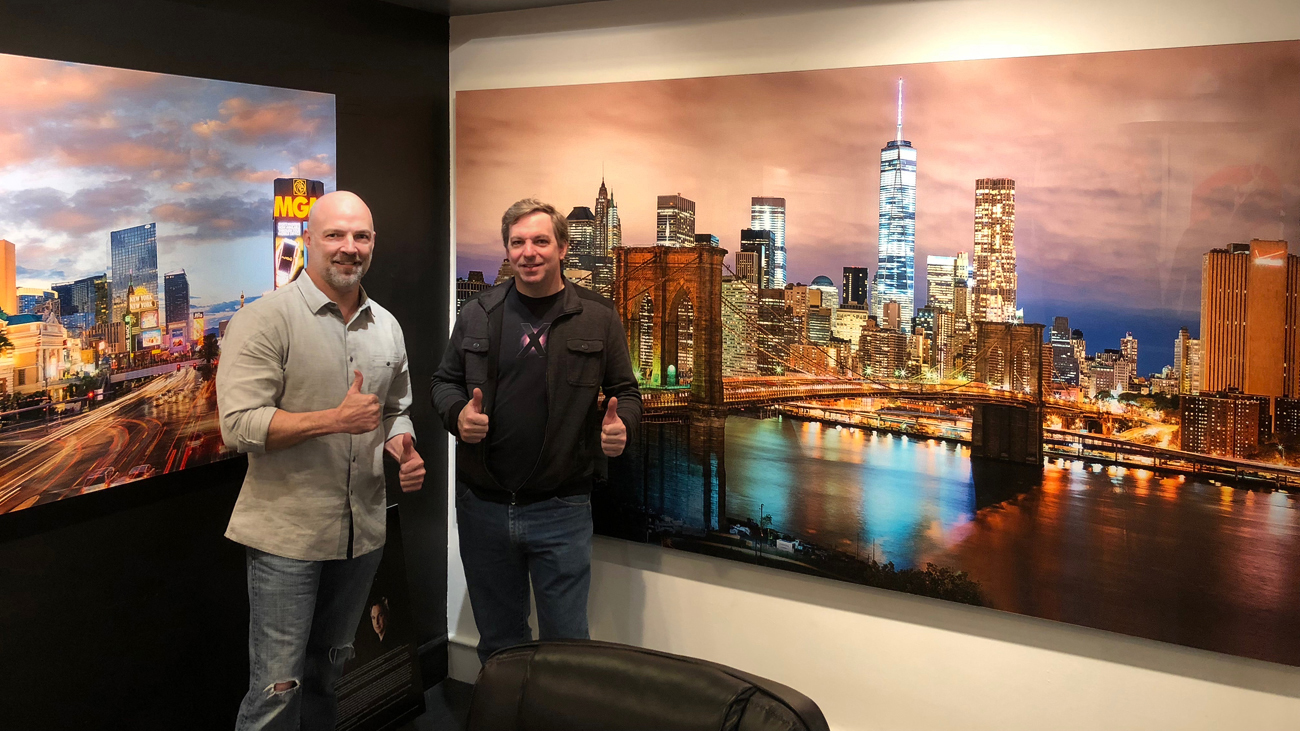
A dumb guy on the left on a guru genius on the right! :)
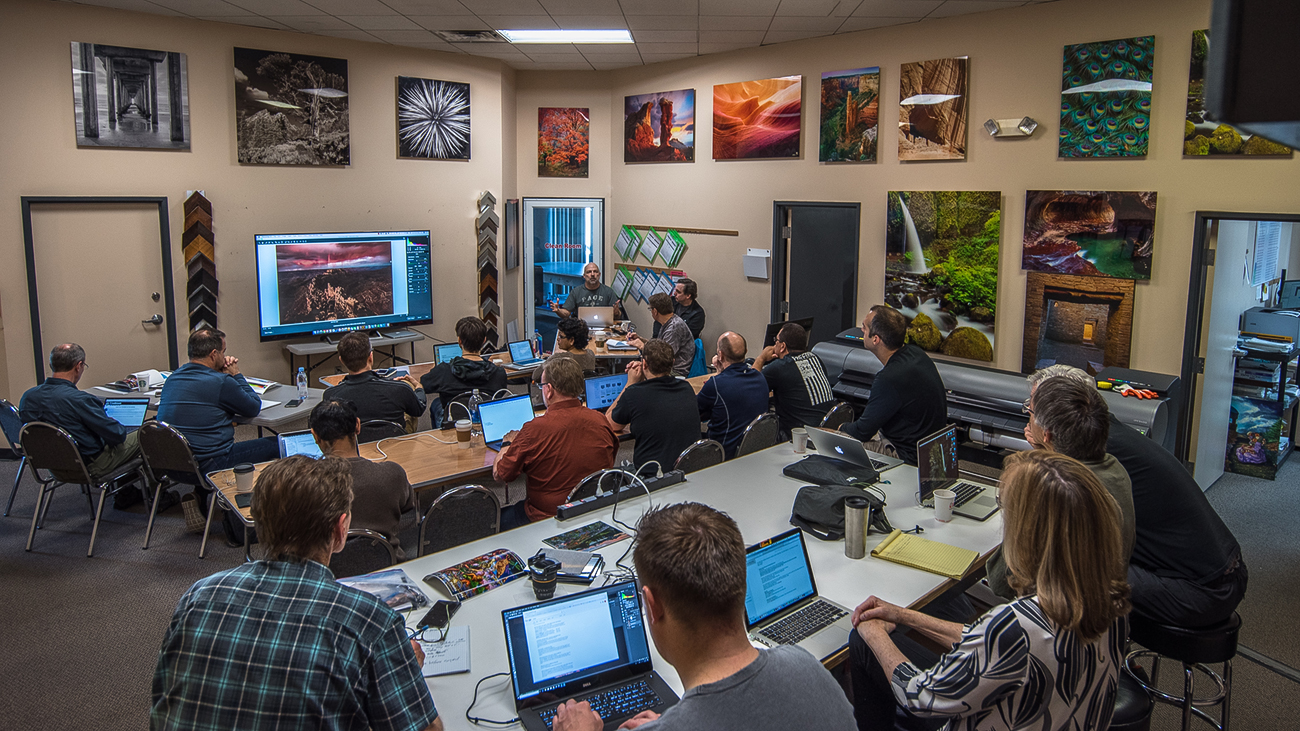
Nerding out on everything masting fine art printing.
Edited on Apr 06, 2018 at 08:13 AM · View previous versions
|


