p.1 #1 · DxOmark: The Sony A7 III has the best low-light score ever tested
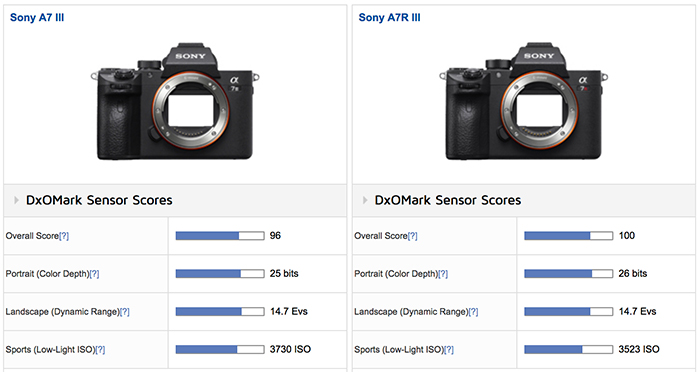
DxOmark just posted the Sony A7 III sensor results. It achieves an overall DxOMark sensor score of 96 points and ranks in the top five best Sony sensors they have tested.
"Sitting between the Sony a S and R models, the sensor in the A7 was always a balance between resolution and sensitivity, but that’s no longer the case. On sensor performance alone, particularly with regard to low light / high ISO sensitivity, the Sony A7 III is ahead of the A7S II and comes very close to the overall image quality potential of the A7 RIII. What was once a showcase model for some interesting camera tech, the A7 III can now add cutting-edge low-light sensor performance to the mix. That may change when Sony releases the A7S III, but in the meantime, priced at around $2,000, it’s not asking for the earth in return."
p.1 #3 · DxOmark: The Sony A7 III has the best low-light score ever tested
Makes me curious whether there is anything in software moving forward that could help mitigate the disparity of DR between the A9 and the A7 line or if this is simply a hardware limitation of the stacked sensor.
p.1 #4 · DxOmark: The Sony A7 III has the best low-light score ever tested
JohnDizzo15 wrote:
Makes me curious whether there is anything in software moving forward that could help mitigate the disparity of DR between the A9 and the A7 line or if this is simply a hardware limitation of the stacked sensor.
Yeap, it does not look good on paper that their "Basic" model full frame is performing noticeably better than their flagship. (sensor-wise)
p.1 #6 · DxOmark: The Sony A7 III has the best low-light score ever tested
ilkka_nissila wrote:
It is normal and to be expected that fast reads (for high fps) add slightly more read noise, limiting dynamic range at base ISO.
Suspected this. However, my curiosity (from the perspective of someone who isn't an expert on the tech) is whether there is anything that could be done to close the gap even a little as it appears to be just shy of a 1.5 stop difference which is huge.
If the stacked sensor is in fact this restrictive for DR at base ISO, I wonder if the ceiling will remain the same moving forward.
p.1 #7 · DxOmark: The Sony A7 III has the best low-light score ever tested
Fred Miranda wrote:
Yeap, it does not look good on paper that their "Basic" model full frame is performing noticeably better than their flagship. (sensor-wise)
If the A7 III is their "Basic" model, where does that leave current products like the A7 and A7 II?
Mar 26, 2018 at 11:45 AM
Steve Spencer Offline • • • • • • • Upload & Sell: On
p.1 #8 · DxOmark: The Sony A7 III has the best low-light score ever tested
Fred Miranda wrote:
Yeap, it does not look good on paper that their "Basic" model full frame is performing noticeably better than their flagship. (sensor-wise)
I don't know that it is such a big deal. The difference at high ISO is truly tiny. Remember this is an ISO units and both cameras are between 3200 and 6400. Keep in mind in ISO units you need 3200 units from 3200 to get another stop of performance. So the 213 units higher performance of the A7 III over the A9 is something like one fifteenth of a stop. Now that is truly tiny and may well be within the ability of the test to measure accurately. Same for color depth 25 and 24.9 is a small difference and who knows how the rounding happened in reporting those two scores. They could be almost identical, but fall on either side of the line for rounding. The big difference is of course base ISO dynamic range, but we know that. The cameras are almost identical from ISO 800 and above and everything, so just don't get the A9 if you are predominantly going to shoot low ISO and you don't need the speed advantages. If you are shooting even moderately high ISO, however, there is no real disadvantage to the A9 sensor and you can use all the other things the A9 provides -- robust silent shutter, no blackout viewfinder, bigger viewfinder, better AF, faster fps. Now if none of those things matter to you and especially is you shoot a lot of low ISO, then you are in the enviable position of getting the cheaper camera and it will be better suited for your use.
Oh, and it isn't the best high ISO camera tested either, both the 44X33 sensors (in the Hassy X1D and Pentax645Z) have high ISO scores that are a quarter of a stop to a third of a stop better than the A7 III.
p.1 #11 · DxOmark: The Sony A7 III has the best low-light score ever tested
Am I mistaken or is the best low light score limited to full frame? I think the X1D's low light score was quite a bit better if I am remembering correctly.
Mar 26, 2018 at 12:28 PM
Steve Spencer Offline • • • • • • • Upload & Sell: On
p.1 #12 · DxOmark: The Sony A7 III has the best low-light score ever tested
Luvwine wrote:
Am I mistaken or is the best low light score limited to full frame? I think the X1D's low light score was quite a bit better if I am remembering correctly.
Yes, Stephen you are correct both the 44X33 sensors they have tested in the Hassy X1D and the Pentax 645Z are about a quarter to a third of a stop better.
p.1 #13 · DxOmark: The Sony A7 III has the best low-light score ever tested
Steve Spencer wrote:
I don't know that it is such a big deal. The difference at high ISO is truly tiny. Remember this is an ISO units and both cameras are between 3200 and 6400. Keep in mind in ISO units you need 3200 units from 3200 to get another stop of performance. So the 213 units higher performance of the A7 III over the A9 is something like one fifteenth of a stop. Now that is truly tiny and may well be within the ability of the test to measure accurately. Same for color depth 25 and 24.9 is a small difference and who knows how the rounding happened in reporting those two scores. They could be almost identical, but fall on either side of the line for rounding. The big difference is of course base ISO dynamic range, but we know that. The cameras are almost identical from ISO 800 and above and everything, so just don't get the A9 if you are predominantly going to shoot low ISO and you don't need the speed advantages. If you are shooting even moderately high ISO, however, there is no real disadvantage to the A9 sensor and you can use all the other things the A9 provides -- robust silent shutter, no blackout viewfinder, bigger viewfinder, better AF, faster fps. Now if none of those things matter to you and especially is you shoot a lot of low ISO, then you are in the enviable position of getting the cheaper camera and it will be better suited for your use.
Oh, and it isn't the best high ISO camera tested either, both the 44X33 sensors (in the Hassy X1D and Pentax645Z) have high ISO scores that are a quarter of a stop to a third of a stop better than the A7 III....Show more →
Except for DR, these numbers are meaningless and I doubt the differences are even perceptible in real images when comparing these Sony full frame sensors. However, many like talking about numbers and comparing charts...and these results are not favorable to the pricey A9 even though it's mainly a sports/action body where base ISO does not matter as much.
p.1 #14 · DxOmark: The Sony A7 III has the best low-light score ever tested
Steve Spencer wrote:
Yes, Stephen you are correct both the 44X33 sensors they have tested in the Hassy X1D and the Pentax 645Z are about a quarter to a third of a stop better.
Thx Steve--sorry, I missed your earlier post with more info on the same subject!
p.1 #15 · DxOmark: The Sony A7 III has the best low-light score ever tested
Fred Miranda wrote:
Yeap, it does not look good on paper that their "Basic" model full frame is performing noticeably better than their flagship. (sensor-wise)
Isn't the DR comparison (with the d850, at least) 'apples and oranges' with respect to megapixel binning? As in, by the time you down-res the d850 to the a73, you pick up DR over the amount shown.
p.1 #16 · DxOmark: The Sony A7 III has the best low-light score ever tested
Fred Miranda wrote:
Sony calls the new A7 III their basic model. Perhaps they want to concentrate their marketing efforts on current models.
So perhaps their marketing approach to the A7 II would be "Less Than Basic" and for the A7 it would be "We Had to Start Somewhere - Wait for the Fire Sale When We Liquidate Remaining Stock"...
p.1 #17 · DxOmark: The Sony A7 III has the best low-light score ever tested
Fred Miranda wrote:
Except for DR, these numbers are meaningless and I doubt the differences are even perceptible in real images when comparing these Sony full frame sensors. However, many love talking about numbers and comparing charts...and these results are not favorable to the pricey A9 even though it's mainly a sports/action body where base ISO does not matter as much.
The overall numbers are usually to be taken with a grain of salt, since being constructed arbitrarily.
What I like when comparing to the D850 and 5div:
The A7iii gives me 1 stop advantage in DR at base over the 5div iso and 2/3 of a stop at higher isos over D850 and 5div.
It gains half a stop in S/N ratio over the D850 and 1/4 ev over the 5div. Not bad for a 2k$ camera.
p.1 #18 · DxOmark: The Sony A7 III has the best low-light score ever tested
Oh, and it isn't the best high ISO camera tested either, both the 44X33 sensors (in the Hassy X1D and Pentax645Z) have high ISO scores that are a quarter of a stop to a third of a stop better than the A7 III.
True, but much faster lenses available for FE mount than any MF camera.
p.1 #19 · DxOmark: The Sony A7 III has the best low-light score ever tested
Fred Miranda wrote:
Except for DR, these numbers are meaningless and I doubt the differences are even perceptible in real images when comparing these Sony full frame sensors. However, many love talking about numbers and comparing charts...and these results are not favorable to the pricey A9 even though it's mainly a sports/action body where base ISO does not matter as much.
Very same thing applies to all pro sports bodies. None of them (A9, D5, 1DXII) have base ISO DR better than best APS-C bodies. That machine gun speed really costs in sensor design. A9 vs. D5 vs. 1DXII vs. A6300
p.1 #20 · DxOmark: The Sony A7 III has the best low-light score ever tested
How long is it going to take to develop sensors capable of capturing more than 15 stops of DR at base ISO?
Anyone wonders what's going to be the limit in 5 or 10 years?