Right now I have the Laowa 15 , Cv 40 and my FE 85. I’ll add back either the Loxia 21 or 25 if that’s real or a Tokina 20 which I always liked. This 24-105 could be my longer lens
alundeb wrote:
The Canon 16-35 F4 L IS does something similar at 35mm. The corners are weaker at f/8 than f/5.6, both far from diffraction limited territory. All test sites have picked up this behavior.
That's interesting and thanks for pointing that out. Did anyone figure out what's causing this behavior on the Canon?
I got a new 24-105 from B&H today for the one that wouldn't focus unless continuous focus was used. This one at the edges doesn't do as well, isn't as sharp. I have one coming from Sony Pro so I will compare. If need be, I will send this one in to Sony for calibration.
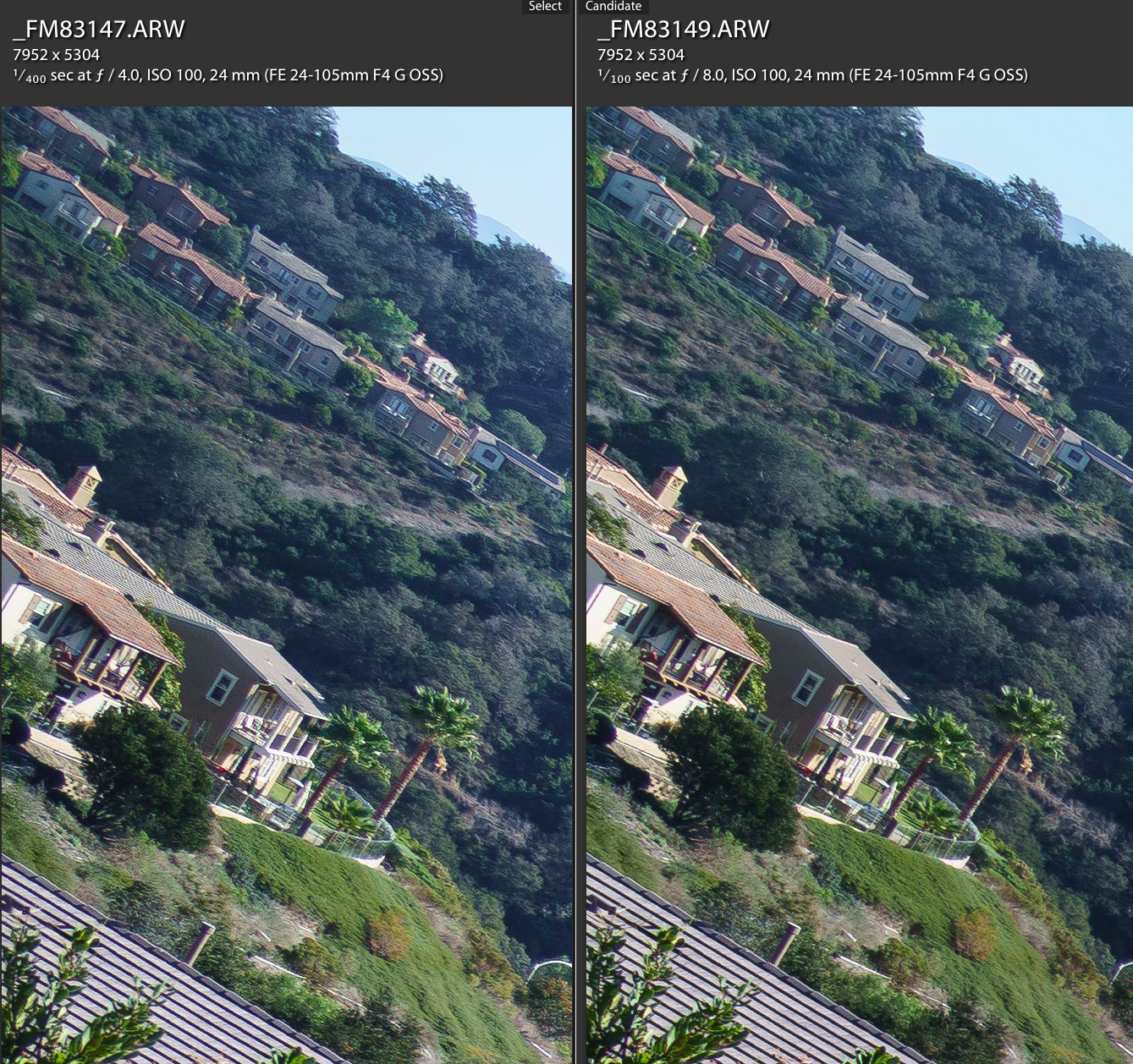
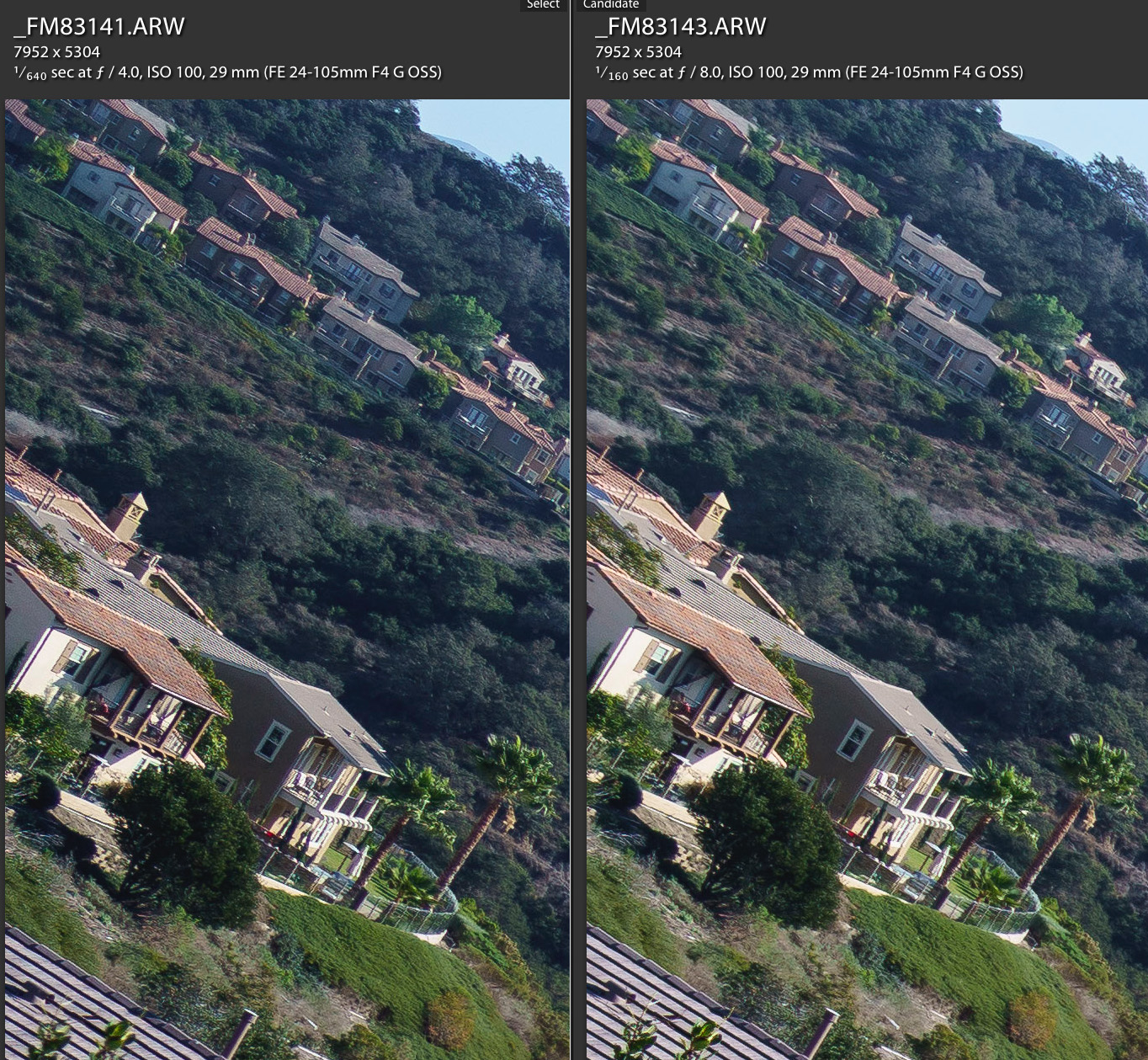
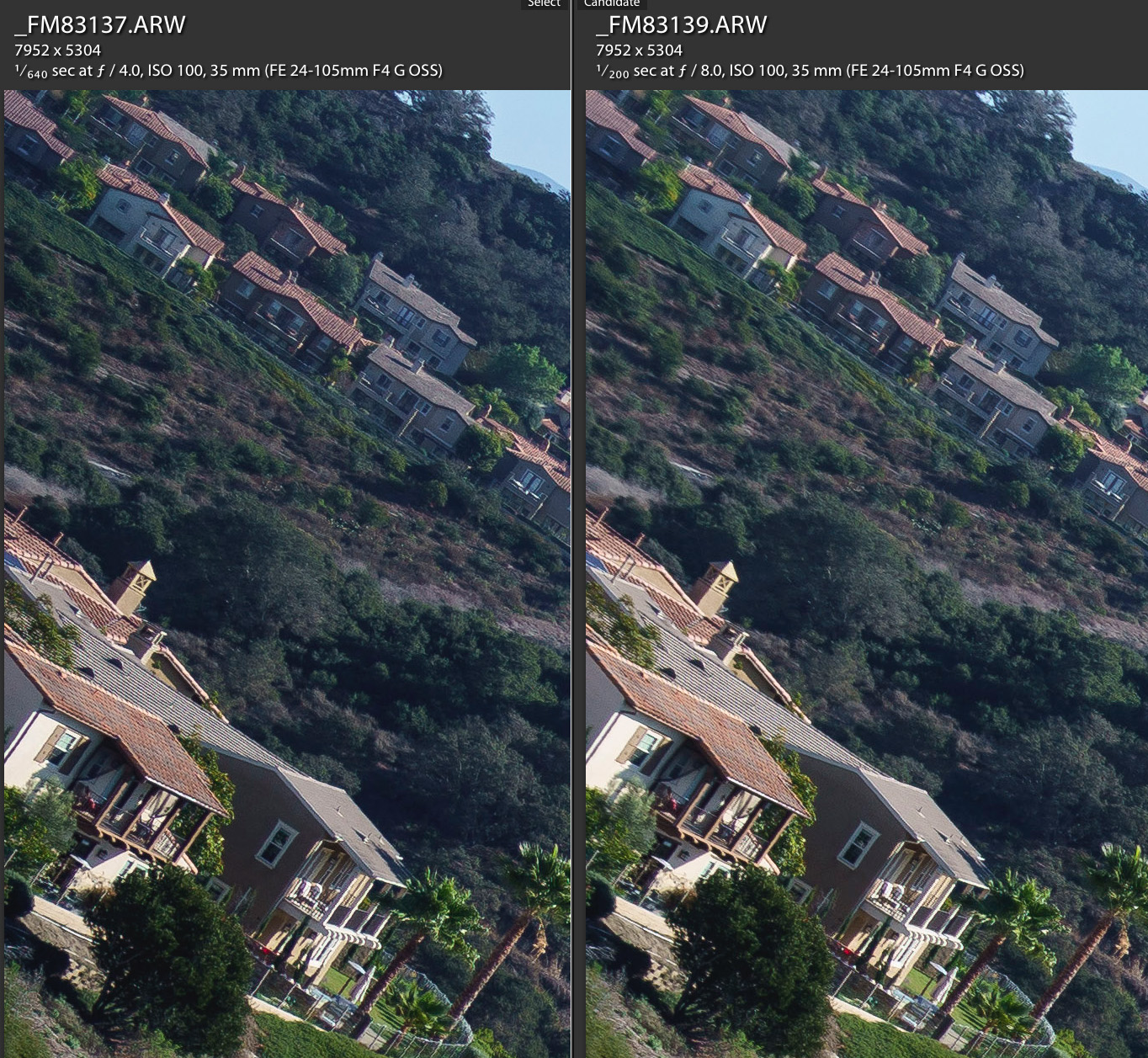
So, I just checked the files and it confirms what I saw on my previous test. Sorry, the lighting is ugly.
From 24mm to 35mm: There is field curvature which is stronger at 24mm and gets progressively lower towards 35mm.
The corner softening I see when stepping the lens down from f/4 until f/8 is probably due to diffraction. This lens performs at a very high level towards the corners from wide-open!
At 24mm, corners looks great from wide open. No improvement when stopping down.
At 28mm, corners looks great from wide open. There is a slight deterioration when stepping down.
At 35mm, corners looks great from wide open. There is a very noticeable deterioration when stepping down.
It looks like the differences between the two at 35mm are all but resolved about 1/3 of the way down into the frames you posted. It looks like there is a triangle of impact in the upper left corner of the crops that covers from about the spot where the closer building roof leaves the frame to possibly the upper right corner of the crop.
Is that how you are seeing it?
That is a bit disturbing that it seems to only show up in a narrow range of focal lengths. I wonder if you may have a subtle element/group spacing issue in the lens, or if this is a problem for all of the lenses due to design.
Does it progressively get wore at apertures smaller than f8?
Lastly... do you have another 35mm lens there that you can do a comparison against so we can see how the lens performs relative to another known lens? While it clearly falls off on performance, it may still beat a bunch of other lenses at that focal length.
It looks like the differences between the two at 35mm are all but resolved about 1/3 of the way down into the frames you posted. It looks like there is a triangle of impact in the upper left corner of the crops that covers from about the spot where the closer building roof leaves the frame to possibly the upper right corner of the crop.
Is that how you are seeing it?
That is a bit disturbing that it seems to only show up in a narrow range of focal lengths. I wonder if you may have a subtle element/group spacing issue in the lens, or if this is a problem for all of the lenses due to design.
Does it progressively get wore at apertures smaller than f8?
Lastly... do you have another 35mm lens there that you can do a comparison against so we can see how the lens performs relative to another known lens? While it clearly falls off on performance, it may still beat a bunch of other lenses at that focal length....Show more →
I only tested it from f/4 until f/8. It does get progressively worse as I stop the lens down but the biggest difference is from f/4 to f/8.
This copy is very well centered at 24mm, 35mm, 50mm and 85mm. It's prime-like regarding centering. It's also sharp to the very corners wide open. This is the first time I encounter this issue where only the extreme corners deteriorate noticeably when stepping the lens down, as usually the opposite happens.
I see two possible explanations:
1) It's caused by diffraction. The corners are already crispy wide open and stopping down the aperture about 2 stops at f/8 causes some softening.
2) This is caused by focus shift. (Update: I don't see any noticeable focus shift with this lens)
Fred Miranda wrote:
I only tested it from f/4 until f/8. It does get progressively worse as I stop the lens down but the biggest difference is from f/4 to f/8.
This copy is very well centered at 24mm, 35mm, 50mm and 85mm. It's prime-like regarding centering. It's also sharp to the very corners wide open. This is the first time I encounter this issue where only the extreme corners deteriorate noticeably when stepping the lens down, as usually the opposite happens.
I see two possible explanations:
1) It's caused by diffraction. The corners are already crispy wide open and stopping down the aperture about 2 stops at f/8 causes some softening.
2) This is caused by focus shift. (Update: I don't see any noticeable focus shift with this lens)...Show more →
Thanks for investigating, Fred. Very weird! Hope you can get an answer to the mystery effect.
I've tested it today for a couple hours. Here are my thoughts:
It's a great zoom. It's impressive how sharp it is throughout the entire focal range. It does not seem to have any weak areas as I see great resolution at center, mid-frame and corners and I was not expecting this level of resolution towards the corners for such zoom range. I've tested many copies of the 24-70/2.8 GM and don't think its performance was this uniform. It's possible that the GM has an slight edge in center resolution at the wider range but the 24-105/4 G performs great across the field...and that's from wide open!
There is some field curvature at the wide range from 24mm until about 35mm which I consider normal for this type of lens. At 35mm field curvature is still there but at a low level. Starting at 50mm until 105mm the lens is pretty much flat field.
Regarding the 35mm corner issue when stopping the lens down. I'm still not 100% sure what's causing it since it could be a combination of things but my best guess is that the main culprit is early signs of diffraction. I've seen this with many of my prime lenses with great corner performance. From 24mm until about 40mm, stopping the lens down does not improve the corners and I actually see a deterioration at f/8. Starting at 50mm, there is a slight improvement in corner resolution by stopping the lens down to f/5.6 and that trend continues until 105mm.
This zoom could replace many primes for travel and landscape photography. I think Sony designed it to complement their 12-24/4 G since it shares the same color rendering (and green bias), aberration correction and flare performance seems similar.
Michael Everet wrote:
My thoughts exactly. I do carry the Canon FDn 50/1.4 just in case I need something fast. I also have the FE 85/1.8 but will probably put it in the bag only when planning on doing portraits. My long lens is the FE 70-300/4, which I like even more than the FE 70-200 that I had. I am trying to keep things light for traveling.
I also have the 16-35 f4, 24-105 f4 and the Sony 70-300 and so far I really like balance between the performance and the size and weight that you get with this combination. The 24-105 was the lens I've been waiting for since I started using Sony and it's better than I expected it to be.
Looks like I'll be getting the 24-105 as soon as it is back in stock. Seems very popular, being backordered at Samys, B&H and Adorama per my calls today.
Like the 12-24, I find this a "must have" focal range and need to purchase new before the time it would take to go down in price in a year or more.
I'll be doing direct comparison against my newly acquired Canon 24-70/2.8L II to see which lens "will rule them all".
I've been taking the 12-24 G and 24-105 G only for a nice light kit with even more coverage. Plus the 77mm ND & CPL filters for the 12-24 G with a set of Breakthrough Photography 10 stop & 6 stop ND's and & CPL for the 24-105 G.
The weight of the two G's is approx. 2.7 lbs. while the weight of the CV 15, Loxia 21 and 24-105 G is approx. 3 lbs. so very comparable in terms of weight.
Yes, these two zooms are light and compact for their range 12-105mm!
These could be just the kind of light, compact & high quality zooms that make the Sony FF mirrorless system more attractive to a larger segment of the market. The GM series zooms are larger and very expensive and the awesome primes while excellent have also mostly been on the pricey side. Could really be a deciding factor for many when whose overall system budget is more fixed.
Especially the prima facie evidence that it's diffraction limited from wide open at the wide end...
Were these tests focussed wide open, or refocussed as you stop down?
It's rare, but I have seen lenses that, rather than having FC wide open which DOF mitigates as you stop down, actually change their underlying FC characteristics as you stop down. (in other words: focus shift that only happens in the corners). Could that be it?
Fred Miranda wrote:
Yes, these two zooms are light and compact for their range 12-105mm!
Especially the prima facie evidence that it's diffraction limited from wide open at the wide end...
Were these tests focussed wide open, or refocussed as you stop down?
It's rare, but I have seen lenses that, rather than having FC wide open which DOF mitigates as you stop down, actually change their underlying FC characteristics as you stop down. (in other words: focus shift that only happens in the corners). Could that be it?
David, I was hoping you would join in...
I contacted Roger and Brandon at LR and they were also puzzled.
Which rare lenses? The 24-105/4 follows your description at the wide range. Designers are getting creative for sure. Remember reviewing the CV 40/1.2! That's a complicated lens.
Fred Miranda wrote:
I've tested it today for a couple hours. Here are my thoughts:
It's a great zoom. It's impressive how sharp it is throughout the entire focal range. It does not seem to have any weak areas as I see great resolution at center, mid-frame and corners and I was not expecting this level of resolution towards the corners for such zoom range. I've tested many copies of the 24-70/2.8 GM and don't think its performance was this uniform. It's possible that the GM has an slight edge in center resolution at the wider range but the 24-105/4 G performs great across the field...and that's from wide open!
There is some field curvature at the wide range from 24mm until about 35mm which I consider normal for this type of lens. At 35mm field curvature is still there but at a low level. Starting at 50mm until 105mm the lens is pretty much flat field.
Regarding the 35mm corner issue when stopping the lens down. I'm still not 100% sure what's causing it since it could be a combination of things but my best guess is that the main culprit is early signs of diffraction. I've seen this with many of my prime lenses with great corner performance. From 24mm until about 40mm, stopping the lens down does not improve the corners and I actually see a deterioration at f/8. Starting at 50mm, there is a slight improvement in corner resolution by stopping the lens down to f/5.6 and that trend continues until 105mm.
This zoom could replace many primes for travel and landscape photography. I think Sony designed it to complement their 12-24/4 G since it shares the same color rendering (and green bias), aberration correction and flare performance seems similar....Show more →
I really appreciate your consistent and thorough testing. These results are great news and not what I was expecting. Now the skeptic in me wonders about copy variation... I'm hoping your's isn't the the unicorn in the bunch.
That was my experience of the ZA 4/24-70: my copy was terrific wide open at about 40mm, but got worse in the corners as I stopped down, unless I focussed on the corners in which case the centre got worse as you stopped down! I recall having seen this before, too, but don't recall on what. Might have been Oly OM 2/90 macro.
Don't have it any more.
I'm trying to resist this lens. If I get it, it would cause heartache on trips about whether to take it or a couple of primes, a decision which would be so hard because really the alternatives do different things well. So easier to make the decision in advance by not owning it, rather than make it for every trip!
I sat out the 12-24 for similar reasons.
But, gotta say, they are shaping up as a killer pair. Especially taking into account that if you do any cropping, cropping in camera with zoom often gives you better resolution than cropping from a wider, better lens.
For the kind of person who enjoys shooting with zooms, and uses primes purely because of perceived better IQ (rather than wanting more separation or just enjoying the haptics and process) these two are looking unmissable.
Fred Miranda wrote:
David, I was hoping you would join in...
I contacted Roger and Brandon at LR and they were also puzzled.
Which rare lenses? The 24-105/4 follows your description at the wide range. Designers are getting creative for sure. Remember reviewing the CV 40/1.2! That's a complicated lens.
DavidBM wrote:
That was my experience of the ZA 4/24-70: my copy was terrific wide open at about 40mm, but got worse in the corners as I stopped down, unless I focussed on the corners in which case the centre got worse as you stopped down! I recall having seen this before, too, but don't recall on what. Might have been Oly OM 2/90 macro.
Don't have it any more.
I'm trying to resist this lens. If I get it, it would cause heartache on trips about whether to take it or a couple of primes, a decision which would be so hard because really the alternatives do different things well. So easier to make the decision in advance by not owning it, rather than make it for every trip!
I sat out the 12-24 for similar reasons.
But, gotta say, they are shaping up as a killer pair. Especially taking into account that if you do any cropping, cropping in camera with zoom often gives you better resolution than cropping from a wider, better lens.
For the kind of person who enjoys shooting with zooms, and uses primes purely because of perceived better IQ (rather than wanting more separation or just enjoying the haptics and process) these two are looking unmissable.
Sony somehow mimicked the 24-70/4 ZA behavior in this aspect but with one important and crucial distinction: The G zoom is sharp to the very corners with minimal astigmatism.
Fred Miranda wrote:
Sony somehow mimicked the 24-70/4 ZA behavior in this aspect but with one important and crucial distinction: The G zoom is sharp to the very corners with minimal astigmatism.
I can see that! 40mm was abut the only place the 24-70 was terrific (well 35-50 was actually pretty good)
The new one seems very impressive.
Fred Miranda wrote:
David, I was hoping you would join in...
I contacted Roger and Brandon at LR and they were also puzzled.
Which rare lenses? The 24-105/4 follows your description at the wide range. Designers are getting creative for sure. Remember reviewing the CV 40/1.2! That's a complicated lens.
One more question...
If it's diffraction, you could expect the centre to soften as much as the corners, at least I think so.
So does it? That would give us some quick insight as to whether it's diffraction or some kind of peripheral focus shift.
(not that it matters much practically, except I suppose if it's peripheral focus shift causing FC, some kind of focussing strategy might help)
I hope no-one reads discussion of this question as evidence of some kind of issue or problem that should put them off, rather than curiosity about unusual behaviour of an outstanding piece of glass..