p.2 #1 · Voigtlander Ultron 28mm f/2 Lens tests with PCX Front Filter
retrofocus wrote:
This was not my conclusion. I don't see any debit with this lens when also mounted on my A7R - if there is a slight corner smearing, it is unrecognizable in the real world photos taken with this combo without pixel peeping. My point was that I don't find any need for this kind of filters not even when combined with the Sony camera. It was one reason why I decided to buy this lens because by not being an ASPH lens, it shows much less - negligible IMO - corner issues with the Sony sensor than other rangefinder-based 28 mm lenses do. ...Show more →
If you don't see any difference, good for you as you can save money and headache from adapting a PCX lens.
p.2 #2 · Voigtlander Ultron 28mm f/2 Lens tests with PCX Front Filter
Fred Miranda wrote:
If you don't see any difference, good for you as you can save money and headache from adapting a PCX lens.
Yes - I am not excluding that there is some little corner smearing with the Sony sensor(s) and this lens, but it is not recognizable in prints and to my eye when not enlarged significantly for pixel peeping purposes. I honestly never cared about it since the photos turn out both well on film as in digital for me. I just can't compare my digital photos taken with the A7R with performance on a Leica M digital sensor since I don't have a digital Leica M camera.
p.2 #3 · Voigtlander Ultron 28mm f/2 Lens tests with PCX Front Filter
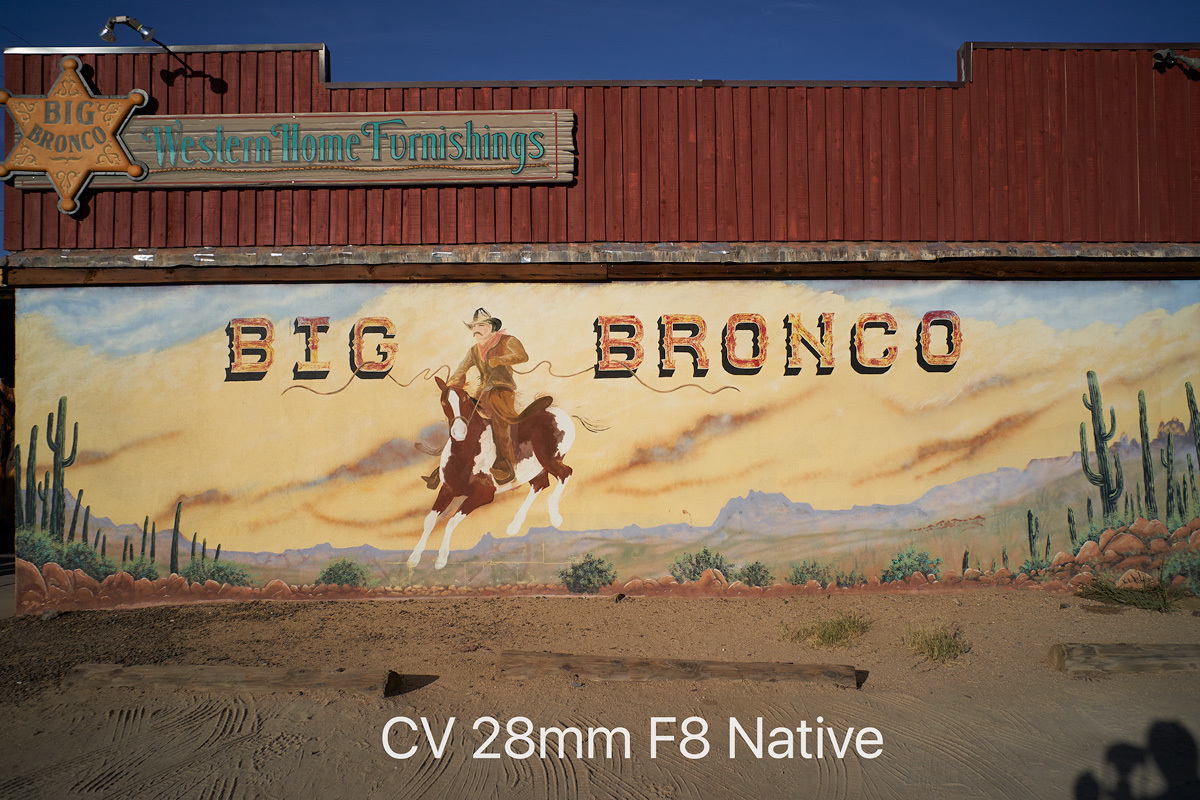
Well even at F8 no filters the corners are still soft but what we are trying to do is get this to F4 with the flat field front filter correction. So two things are going on we are compensating for the Sony filter stack and we are trying to take a native F8/F11 lens quality and push it up 2 stops or more by getting to F4 or f.56. Plus even with the CV 35mm native at F8 with the PCX 5000 at F8 now blows the native F8 away. Its all about improving the IQ across the whole frame sooner than like F8 or F11 native
p.2 #4 · Voigtlander Ultron 28mm f/2 Lens tests with PCX Front Filter
retrofocus wrote:
Yes - I am not excluding that there is some little corner smearing with the Sony sensor(s) and this lens, but it is not recognizable in prints and to my eye when not enlarged significantly for pixel peeping purposes. I honestly never cared about it since the photos turn out both well on film as in digital for me. I just can't compare my digital photos taken with the A7R with performance on a Leica M digital sensor since I don't have a digital Leica M camera.
That's subjective though. It depends on your subject and how you print. Again, I'm not arguing about the merits of correcting lenses not designed for the Sony sensor stack. I'm just glad we have this option.
p.2 #5 · Voigtlander Ultron 28mm f/2 Lens tests with PCX Front Filter
I just read Freds comment and he is right . If your not seeing it than don't sweat it. But between Fred and i we are nit picky pixel peeper crazy.
Bottom line we are trying to draw ever MM of quality we can squeeze out of these lenses. Is it extreme, I honestly don't think it is but more important here is this F stop difference in real world when we are in the wind lets say for instance. If I can squeeze off a image at f4 and keep my shutter speed two stops faster in the wind than without touching my ISO than i just nailed a two stop advantage with the PCX.
p.2 #8 · Voigtlander Ultron 28mm f/2 Lens tests with PCX Front Filter
One thing we should touch on is WHY?
First off we are trying to take these small, light weight and great manual focusing RF lenses and use them on our Sony's because they are reasonable priced as well and on a Leica mount camera are very good. This includes Zeiss ZM lens/Leica Lenses and CV lenses for instance. Maybe more brands as well but our biggest issue is the sensor stack(thicker) of our Sony bodies and we are adjusting to that difference and as a native lens on our Sonys are not taking advantage of these lenses at more wider open F stops. To get corners good we have to stop down a lot. The PCX front filters flatten the field curvature of the lens and we get better quality at almost all F stops, This greatly improves our chances of using these lenses at faster F stops than lets say F8 or F11
p.2 #9 · Voigtlander Ultron 28mm f/2 Lens tests with PCX Front Filter
Phillip Reeve wrote:
Fingers crossed, that you can reach infinity with the 2/2.5m filter!
I have a lot of room myself. Actually kind of weird more room than the 35mm 1.7 so i think Ill be fine. I have two of the K&F adapters and both work so far with the PCX 5000 so I think I have enough for the PCX 2000. Fingers crossed I do or the Dremel is coming out of the closet.
p.2 #10 · Voigtlander Ultron 28mm f/2 Lens tests with PCX Front Filter
GMPhotography wrote:
One thing we should touch on is WHY?
First off we are trying to take these small, light weight and great manual focusing RF lenses and use them on our Sony's because they are reasonable priced as well and on a Leica mount camera are very good. This includes Zeiss ZM lens/Leica Lenses and CV lenses for instance. Maybe more brands as well but our biggest issue is the sensor stack(thicker) of our Sony bodies and we are adjusting to that difference and as a native lens on our Sonys are not taking advantage of these lenses at more wider open F stops. To get corners good we have to stop down a lot. The PCX front filters flatten the field curvature of the lens and we get better quality at almost all F stops, This greatly improves our chances of using these lenses at faster F stops than lets say F8 or F11...Show more →
I'd say the benefit is not only on corners. Mid-field as well and that's important when composing our images (rule of thirds)
It's also subjective. Some would prefer shooting with the native FE 28/2. It's cheaper and designed for the Sony sensor. Basically headache free with AF.
However, for landscapes I found it unpleasant to manual focus, the build is not stellar, distortion is extreme, there is lots of CA and the corners never get very sharp...So, for me, the CV 28/2 + PCX could be a temporary solution until we get a full mechanical manual focus lens that performs better natively (Perhaps Loxia 28 or Firin 28)
p.2 #11 · Voigtlander Ultron 28mm f/2 Lens tests with PCX Front Filter
Im right there with you on this as you know. I simply do not like these fly by wire focusing on the 28, 35, 55. The 85 is better. Seems they have improved this with the newer design Sony AF lenses.
p.2 #12 · Voigtlander Ultron 28mm f/2 Lens tests with PCX Front Filter
Btw there is a lot of community effort on all this front filter correction from a lot of great members here so they should be commended for all there efforts.
p.2 #13 · Voigtlander Ultron 28mm f/2 Lens tests with PCX Front Filter
GMPhotography wrote:
I have a lot of room myself. Actually kind of weird more room than the 35mm 1.7 so i think Ill be fine. I have two of the K&F adapters and both work so far with the PCX 5000 so I think I have enough for the PCX 2000. Fingers crossed I do or the Dremel is coming out of the closet.
Not weird at all. With a shorter focal length the same movement creates a bigger change in focus. That's why a 25mm spacer on a 50mm lens changes that lenses minimal focus distance drastically while it only has a smaller effect on a 200mm lens.
My K&F adapter is 9.55 mm thick which is 0.25mm less than the theoretically perfect value.
A 5m filter on a 35mm lens would need 0.243mm so nearly exactly as much. But a 2m on a 28 would need 0.387mm.
But as has been said: There is variation in the camera mount, in the adapter and in the lens so in practice it might actually work in some combinations.
p.2 #16 · Voigtlander Ultron 28mm f/2 Lens tests with PCX Front Filter
Simple question: what is with the old rule that adding glass always leads to some debit (not going into the UV glass discussion here)? Or in another way: even if this glass improves on the corners somewhat, what is the debit by adding glass on an otherwise already optimized lens?
p.2 #17 · Voigtlander Ultron 28mm f/2 Lens tests with PCX Front Filter
Actually I thought about this but on center where there is no benefit I’m seeing no degradation. I was expecting some since we are adding glass but this is also optical glass so it seems it’s not hurting anything plus they are coated to handle any flare. I guess we are just adding a extra element to the formula. That’s a non scientific answer, I’m sure there is one.
p.2 #18 · Voigtlander Ultron 28mm f/2 Lens tests with PCX Front Filter
retrofocus wrote:
Simple question: what is with the old rule that adding glass always leads to some debit (not going into the UV glass discussion here)? Or in another way: even if this glass improves on the corners somewhat, what is the debit by adding glass on an otherwise already optimized lens?
Much truer back in the days of worse coatings, and worse calculation of non-image forming light.
If the theoretical calculations say that there's no penalty, then the practical penalty will be the same as a clear multicoated filter: maybe a tiny reflection in extreme backlight, but that's about it. Well worth it. Indeed many of us pay that price just for protection from having to be cleaned too often...
p.2 #19 · Voigtlander Ultron 28mm f/2 Lens tests with PCX Front Filter
DavidBM wrote:
Much truer back in the days of worse coatings, and worse calculation of non-image forming light.
If the theoretical calculations say that there's no penalty, then the practical penalty will be the same as a clear multicoated filter: maybe a tiny reflection in extreme backlight, but that's about it. Well worth it. Indeed many of us pay that price just for protection from having to be cleaned too often...
I can't see any different in resolution and flare behavior. As you wrote, there could be a potential penalty in certain conditions just like adding a multi-coated UV filter.
p.2 #20 · Voigtlander Ultron 28mm f/2 Lens tests with PCX Front Filter
Phillip Reeve wrote:
Not weird at all. With a shorter focal length the same movement creates a bigger change in focus. That's why a 25mm spacer on a 50mm lens changes that lenses minimal focus distance drastically while it only has a smaller effect on a 200mm lens.
My K&F adapter is 9.55 mm thick which is 0.25mm less than the theoretically perfect value.
A 5m filter on a 35mm lens would need 0.243mm so nearly exactly as much. But a 2m on a 28 would need 0.387mm.
But as has been said: There is variation in the camera mount, in the adapter and in the lens so in practice it might actually work in some combinations. ...Show more →
Yikes! I hope it will work. I'm actually getting the PCX 2500 tomorrow.