Bird photographers: I don't shoot birds but it seems like your gears (camera and lens) are usually more demanding and expensive than most genre of photography. Do alot of bird photographers make money off their craft or is it more a hobby? Serious question.
I shoot birds. And landscapes. And galaxies. And nebulae. And elephants. And bison. Etc., etc., etc.
Our inside walls have many of my photographs on them. I don't sell photographs. I have some good equipment, because I can, and I find it useful to have good equipment to be the best photographer I can be (e.g., that cheetah a long, long way away looks better with 700mm of focal length on a 50mp sensor than it would at 200mm of focal length, with any sensor).
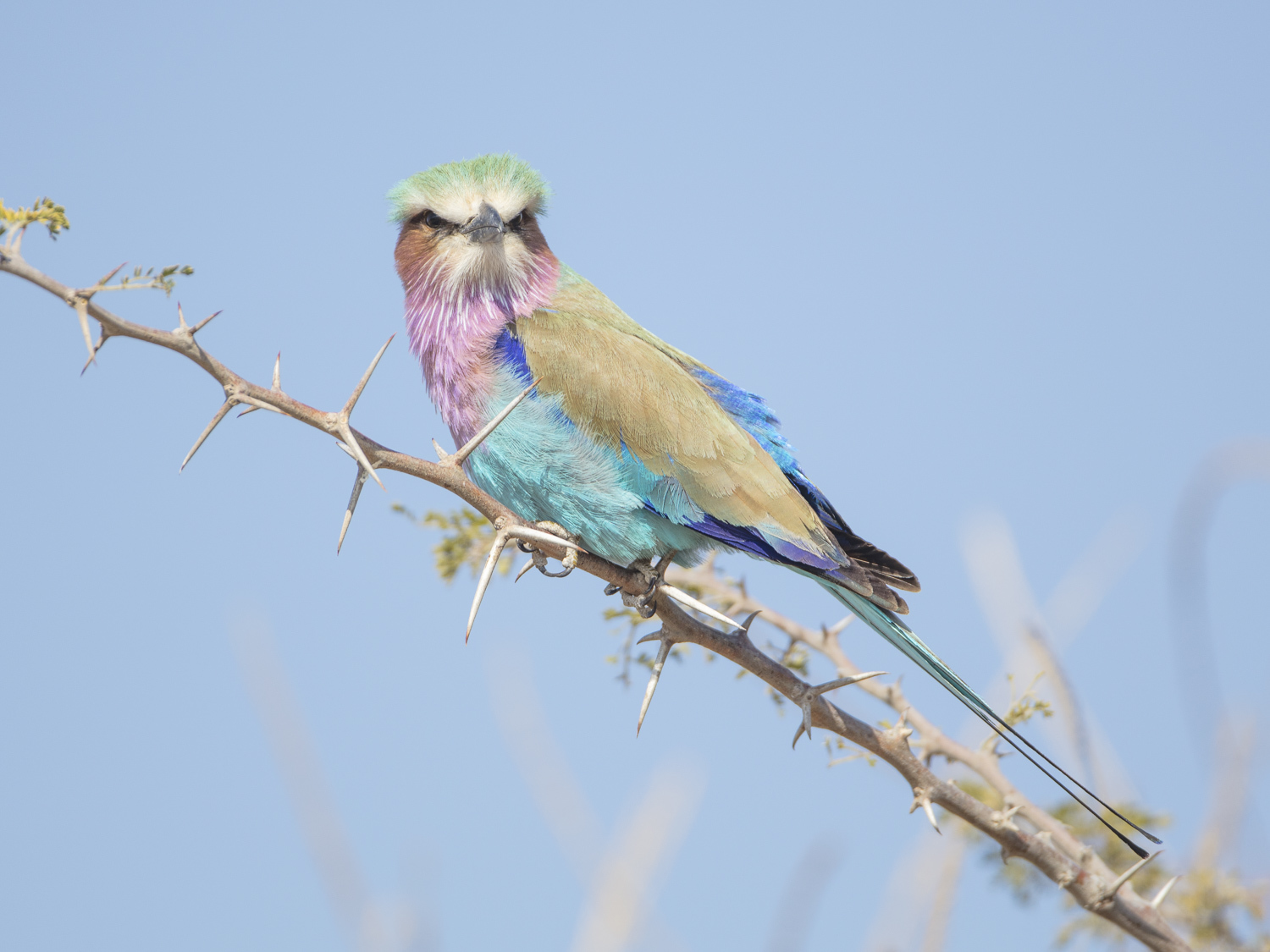
As for shooting birds, who wouldn't want to capture this? It's a tiny crop of the original, about 25% lateral measure (so doesn't show the exquisite detail actually captured); but I think it still shows how much fun it can be to capture these beautiful creatures.
Yes, I am very tempted by the D850. It will complement my 5Ds R and 7D Mark II cameras nicely. This assumes its AF, particularly in low light, really is as good as promised. Otherwise, I will continue to plan to acquire a D5, so it can complement my Canon cameras; the D5 seems to be a suitably justifiable jump from my D3s.
I am already a dual-system shooter. I love individual lenses, made by Canon and Nikon, too much to settle completely upon either system. Not being wealthy, I make no attempt to update camera bodies each generation with each system.
Why do you assume its about the money? There are guys that spend thousands on hotrods,motorcycles, boats and guns. They don't make ANY money from their purchases. But the minute some guy wants a new camera, he has to be making money to justify his/her purchase. Like one of my favorite comedians once said, The only reason your husband is with you is because you're the best he could do. Same thing goes for my Canon 5Dsr. It only gives me one of the four things I wanted: high resolution. I also wanted decent ISO performance (iso 3200), focus peaking and a tilting LCD. Uncropped 4K would have been icing on the cake. All of which Canon is capable of delivering. If it wasn't for their glass they would be doomed. I like others will be saying goodbye to Canon. They don't care, why should we?
Holger wrote:
My opinion, too. Too many get crazy over 0.3ev DR difference. Invest a lot in gear instead of education to improve skills. We earn money from our gear, so it makes sense to upgrade from time to time to ease the workflow. Shooting and having a wedding or two a week is hard on your gear, requires reliability, but it teaches you, too, that post-processing skills, having the ability to trigger emotion in the couple, use light creatively is as or in my opinion far more important.
Personally, I have no interest in birding as a hobby. I wouldn't know what to do with all the images. I can't look at them the whole day, print all of them, sell them (of course very subjective, others have other interests). You need to be very enthusiastic to spend a lot of cash for the large teles and high end bodies. But I am not sure how large a user base serious birders represent for Canikon. I think the fraction to be small.
I think birders and similar nature/wildlife enthusiasts are a significant fraction of Canon sales, because many of them spend lots of money on lenses and there are a lot of them nowadays too (that's including those who are lousy photographers and shoot primarily for 'documentation'). I'm betting as a group they spend more money than all the pros in my country together, even though the big majority don't make any money from their photography.
I primarily shoot dragonflies which is commercially even less interesting than birds (maybe a few people in the whole world are making real money from it?) and I don't have any straight walls in my home to hang picture frames ;-) For some of us it isn't just about the 'end product' but also the fun of experiencing the subject, trying to learn and capture some of the magic of nature in images.
Even though gear isn't the primary factor for getting good pictures (knowing the subject, opportunity/luck, perseverance, knowing your gear etc. are more important), better gear can certainly improve the chances of getting the shot. With better I'm not talking about 0.3 stop of DR or High ISO improvement, but better features both in lenses and cameras. Getting the shot can become very important if you cannot plan most things ahead like with many other types of photography e.g. the average portrait or wedding shot. In nature photography it is obvious that over the last 10-20 years a whole new world has unfolded and 90% of this is thanks to better technology. Look at nature photography books from analog times and even images from famous nature photographers often look boring by current standards because most of today's shots were simply impossible.
Count me in! The D850 will be a great studio camera with files that can be pushed hard in post (like the D810 files). Also the blacks will be very clean, which matters to me when editing low key shots.
Holger wrote:
My opinion, too. Too many get crazy over 0.3ev DR difference. Invest a lot in gear instead of education to improve skills. We earn money from our gear, so it makes sense to upgrade from time to time to ease the workflow. Shooting and having a wedding or two a week is hard on your gear, requires reliability, but it teaches you, too, that post-processing skills, having the ability to trigger emotion in the couple, use light creatively is as or in my opinion far more important.
Personally, I have no interest in birding as a hobby. I wouldn't know what to do with all the images. I can't look at them the whole day, print all of them, sell them (of course very subjective, others have other interests). You need to be very enthusiastic to spend a lot of cash for the large teles and high end bodies. But I am not sure how large a user base serious birders represent for Canikon. I think the fraction to be small.
I'm not into birding, but only into bird photography and then almost exclusively raptors. I don't sell those images. But if I spend whole days standing in the freezing cold, I rather do that with gear that can deliver than waste my time on a fuzzy image.
johnvanr wrote:
I'm not into birding, but only into bird photography and then almost exclusively raptors. I don't sell those images. But if I spend whole days standing in the freezing cold, I rather do that with gear that can deliver than waste my time on a fuzzy image.
Yes, said otherwise: more expensive equipment is easily worth it if it means less time wasted waiting for a shot that is lost in the end due to technical limitations of the gear (or time wasted trying to rescue a so-so shot). Maybe even more so for hobby photographers, because those lost shots cost dearly - if it happens too often the enjoyment of photography can take a big hit.
technic wrote:
In nature photography it is obvious that over the last 10-20 years a whole new world has unfolded and 90% of this is thanks to better technology. Look at nature photography books from analog times and even images from famous nature photographers often look boring by current standards because most of today's shots were simply impossible.
Yes, and the other component of the ubiquity of top-shelf [bird] images now is the demographics of the retiring baby boomers. Lots of spare time and money is resulting in loads of pro-level lenses & bodies being bought & used by hobbyists.
Colin F wrote:
Yes, and the other component of the ubiquity of top-shelf [bird] images now is the demographics of the retiring baby boomers. Lots of spare time and money is resulting in loads of pro-level lenses & bodies being bought & used by hobbyists.
Yes, I noticed the same over here in Europe (not just for wildlife gear, also for very expensive 'retro', 'special edition' etc. gear that probably goes right to the private collection instead of being used for photography). Certainly not that amount of disposable income for hobbies among most of my Generation-X, so one can doubt how long sales to this group will remain a major income source for camera companies.
Colin F wrote:
Yes, and the other component of the ubiquity of top-shelf [bird] images now is the demographics of the retiring baby boomers. Lots of spare time and money is resulting in loads of pro-level lenses & bodies being bought & used by hobbyists.
I always feel young when out doing wildlife photography or on dedicated wildlife photography trips.....
arbitrage wrote:
I always feel young when out doing wildlife photography or on dedicated wildlife photography trips.....
That's because you're not in the northeast of the US. Here it's mostly older people plus a younger generation of Chinese(-Americans?), men and women, who shoot with the high-end gear.
level1photog wrote:
Bird photographers: I don't shoot birds but it seems like your gears (camera and lens) are usually more demanding and expensive than most genre of photography. Do alot of bird photographers make money off their craft or is it more a hobby? Serious question.
Holger wrote:
My opinion, too. Too many get crazy over 0.3ev DR difference. Invest a lot in gear instead of education to improve skills.
It's a hobby at least for me. Maybe I'll sell for fun one day if I get good.
Education & skill is critical. But good equipment is also really valuable, not just GAS, because (generally) your subjects are fast & unpredictable, you're never close enough, and there's never enough light.
TC's that are quite soft and lacking compared to Canon's I would just put a 1.4X III on my 600II and that will give me 59 M pixels of reach on my 5D4 compared to a bare lens, tack sharp with fast AF. I can even quadrople my 1DXII reach to 80 MPixels! compared to a bare lens by...
Can't lie, the specs are drool worthy on the D850 but I see nothing about the camera that would justify switching from my Canon 5dm4 bodies.
Main reasons being:
1) Love my canon glass
2) Prefer Canon color science. Yes you can tweak files to get closer to Canon color, but I personally would rather spend more time shooting and less time in post. Boring sounding things like AWB-W are very useful as well when shooting in mixed lighting
2) My 5dm4 bodies have around 50-60k actuations on them in the past 3-4 months, and have been dropped, banged against doorways, rained on, etc and have been extremely reliable. Nikon's QC issues the last few years make me pretty hesitant to gamble on a wholly new camera.
3) 30mp is a great sweet spot for my shooting/post/storage workflow, having owned 16/21/24/36/42/50 mp cameras. The RAWs have more than enough latitude to push in post. Seriously, if you routinely under or over expose files by more than 1.5-2 stops, then it's the tool behind the camera that's the issue.
4) DPAF is something I use every day, especially for my commercial work where I have to do the typical overhead, tight, low, and over-shoulder perspective shots where it's a little awkward to get that close to talent, and Nikon's implementation of live view AF still apparently lags behind.
One serious option I could see is to make the A7RIII an improved mirrorless version of the A99II. .
I'd been lobbying / watching that prospect for years (and got bashed repeatedly for such a thought) ... all while still holding on to my SLR/C. While many folks "give up" on Canon to do what they wanted to see happen @ certain things. I "gave up" on Sony to bring their A99 SLT, into the mirrorless or E mount realm.


 This assumes its AF, particularly in low light, really is as good as promised. Otherwise, I will continue to plan to acquire a D5, so it can complement my Canon cameras; the D5 seems to be a suitably justifiable jump from my D3s.