CanadaMark wrote:
That's Nikon Japan saying that, not 'people'. There is no reason to doubt them, especially when it also makes sense from a technical standpoint.
The sensor itself is entirely a Nikon design. It features copper wire, dual gain, and is BSI which is starting to look a lot like Sony's fab (or the production lines Sony now owns, like those from Toshiba). We will find out soon enough for sure. In a world where everything is already so optimized that sensor gains are extremely difficult to obtain (when you are already comparing to one of the best like the D810), the fact that they appear to have matched or slightly improved DR, improved ISO performance by a claimed stop, as well as added the electronic shutter, 4K, and increased MP count is really quite an accomplishment. In terms of what people expected from a D810 replacement, I don't see anything so far that suggests this won't be the best sensor available for that. Expecting huge gains is unrealistic because we hit a wall years ago in sensor performance (for Sony/Nikon anyway), and it's all about the small gains now.
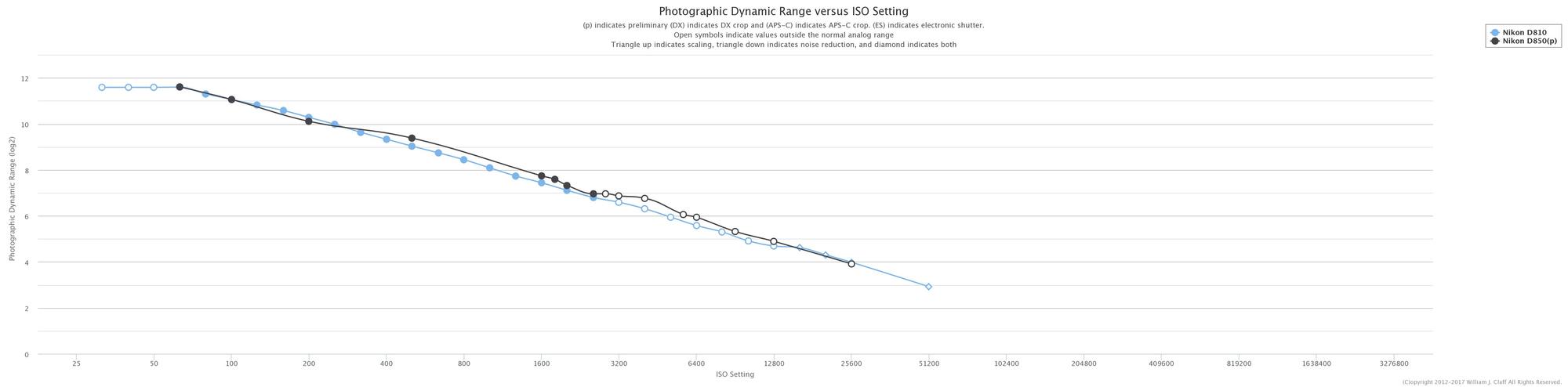
Bill Claff's preliminary numbers show slightly higher overall DR in the measured values (ISO 64 not tested yet), and a very significant bump in ISO performance.
CanadaMark wrote:
Bill Claff's preliminary numbers show slightly higher overall DR in the measured values (ISO 64 not tested yet), and a very significant bump in ISO performance.
If they have improved noise by 1 stop in RAW then I'll be impressed, but some of those sample shots posted last week at ISO 6400-25600 didn't seem too impressive in jpg form at least, looked like large D500 shots.
CanadaMark wrote:
That's Nikon Japan saying that, not 'people'. There is no reason to doubt them, especially when it also makes sense from a technical standpoint.
The sensor itself is entirely a Nikon design. It features copper wire, dual gain, and is BSI which is starting to look a lot like Sony's fab (or the production lines Sony now owns, like those from Toshiba). We will find out soon enough for sure. In a world where everything is already so optimized that sensor gains are extremely difficult to obtain (when you are already comparing to one of the best like the D810), the fact that they appear to have matched or slightly improved DR, improved ISO performance by a claimed stop, as well as added the electronic shutter, 4K, and increased MP count is really quite an accomplishment. In terms of what people expected from a D810 replacement, I don't see anything so far that suggests this won't be the best sensor available for that. Expecting huge gains is unrealistic because we hit a wall years ago in sensor performance (for Sony/Nikon anyway), and it's all about the small gains now.
Bill Claff's preliminary numbers show slightly higher overall DR in the measured values (ISO 64 not tested yet), and a very significant bump in ISO performance.
Agree, with the recent Nikon cameras especially any gains in DR and resolution (for the complete system of lens + camera) will be incremental, at least for most of the users. In the Canon DSLR line there still is significant room for improvement though, especially in low ISO DR.
Other improvements will become more important, like ergonomics and all kinds of new (mostly electronic) features that help with more accurate and faster focusing/tracking, image stabilization and possibly camera shake correction, better metering (better histograms, highlight protection/zebra pattern etc.), focus stacking and other tricks that get around the limitations of a single shot etc. Probably some of that will be delayed until we have mature mirrorless cameras instead of DSLR, because some useful features like a pre-capture buffer are impossible with a DSLR.
For new features that can help the user in getting otherwise difficult shots, IMHO Nikon also does better than Canon at the moment (if you don't need/want any new features, I guess the Canon approach may be better ...)
If there's one thing that's clear to me, is that we are approaching the limits DSLR's can give us. For further improvements in focus / tracking, in-camera shake reduction, and on the fly exposure feedback, we are looking at a different type of camera, i.e. mirrorless.
The 850 seems like a great camera, but to me there's nothing here that's worth switching systems for. I can live with the lower res of the 5D IV, which gives me a good enough 8fps. In fact, this size is a very good balance for events, portraits and most wildlife shots. This sensor is imo also very well balanced, as in: very good dr at low iso (although not best in class), but also good dr at higher iso's and overall high iso performance.
Could use a higher mpix body but that could just as well be a new 5ds (with sensor improvements) or - maybe preferably to take that next step - a ff mirrorless from either Sony or - what the heck, who knows - Canon.
evertdoorn wrote:
If there's one thing that's clear to me, is that we are approaching the limits DSLR's can give us. For further improvements in focus / tracking, in-camera shake reduction, and on the fly exposure feedback, we are looking at a different type of camera, i.e. mirrorless.
Mirrorless is indeed a better platform for much of this but there is the legacy issue. For Canikon it is more attractive to gradually add features to their existing DSLR systems (within the limitations of the DSLR design), instead of introducing them with a completely new 'pro' mirrorless system that upsets the market.
Difficult to say how the market will develop, maybe if Sony (and who knows Olympus/Panasonic) shows real muscle the others will be forced to respond. I considered Sony A7R2 last year but decided against it because of lens limitations (very few suitable native lenses for me, high quality native lenses are very expensive, all kinds of potential issues with AF adapters when using other lenses so far from future-proof). But Sony sure is pushing the limits of new electronic features and they probably will continue with that because that is where mirrorless can have a major advantage over DSLR.
yeah agree, it will absolutely be interesting to see how the market will develop in the next 5 years. I might see a mix of Canon and Sony for me in this period
Until Fuji release a full frame X-T5, or Sony an A7 V with the ruggedness, reliability, battery life, AF and overall performance of a 1DX I'm staying put.
arbitrage wrote:
Bill does have a ISO 64 value now. Identical to the D810.
Good catch - last I looked he didn't have ISO 64 numbers in. Great news that it's the same as the D810 at base ISO given all the other improvements, modifications, and increases. I think that is one thing Nikon knew they couldn't regress from on this particular camera.
Pixel Perfect wrote:
If they have improved noise by 1 stop in RAW then I'll be impressed, but some of those sample shots posted last week at ISO 6400-25600 didn't seem too impressive in jpg form at least, looked like large D500 shots.
That's what the data looks like so far. Every camera looks bad at ISO 25,600 at the pixel level. At least with something like the D850 you can down-sample that quite a lot to hide noise and still have 20+ MP. Bill Claff's ISO ratings show it sandwiched between a D4 and a 1DX for ISO performance. It looks to be about a stop better than the D810 from ISO 400 and beyond, with no loss in DR in the lower ISOs, and improved DR at higher ISOs. That is quite the achievement considering they increased resolution by almost 30% and added an electronic shutter as well.
Sample shots almost always look bad (even from the manufacturers themselves) - if we just went off those, nobody would want to buy anything I wouldn't put any weight at all into preliminary out of camera JPEGs if evaluating IQ. Those few who do shoot JPEG only though should still be happy because since the D5/D500 the JPEG engine has been a huge step above anything previous. You can always do better with a processed RAW.
If I were a rich professional, with enough money to painlessly switch systems every time a shiny new camera came out that I liked better than what I have, and I was convinced that I'd get more commercial-quality images with the D850 than what I have, I'd probably get the new Nikon.
But I'm not any of the above. If I can't take excellent photos with what i have, I have only myself (not my equipment) to blame.
StarNut wrote:
If I were a rich professional, with enough money to painlessly switch systems every time a shiny new camera came out that I liked better than what I have, and I was convinced that I'd get more commercial-quality images with the D850 than what I have, I'd probably get the new Nikon.
Professionals don't typically do that... especially if they want to get rich.
StarNut wrote:
If I were a rich professional, with enough money to painlessly switch systems every time a shiny new camera came out that I liked better than what I have, and I was convinced that I'd get more commercial-quality images with the D850 than what I have, I'd probably get the new Nikon.
But I'm not any of the above. If I can't take excellent photos with what i have, I have only myself (not my equipment) to blame.
So, no, I'm not even slightly tempted.
Mark
Dang, I was really worried you were going to get sucked in.
CanadaMark wrote:
That's what the data looks like so far. Every camera looks bad at ISO 25,600 at the pixel level. At least with something like the D850 you can down-sample that quite a lot to hide noise and still have 20+ MP. Bill Claff's ISO ratings show it sandwiched between a D4 and a 1DX for ISO performance. It looks to be about a stop better than the D810 from ISO 400 and beyond, with no loss in DR in the lower ISOs, and improved DR at higher ISOs. That is quite the achievement considering they increased resolution by almost 30% and added an electronic shutter as well.
Sample shots almost always look bad (even from the manufacturers themselves) - if we just went off those, nobody would want to buy anything I wouldn't put any weight at all into preliminary out of camera JPEGs if evaluating IQ. Those few who do shoot JPEG only though should still be happy because since the D5/D500 the JPEG engine has been a huge step above anything previous. You can always do better with a processed RAW. ...Show more →
I have been able to use out of camera JPG ISO 25600 from the 5D4 for sporting events, enough that clean up and one level of downsizing before printing out as fan posters seem to create very nice results. I rarely go back to the raw any longer with the 5D4 and try to keep ISO down to 12800, but sometimes I end up a stop higher from time to time. I do believe we have plateau'd a bit with high ISO, and instead we are going to see new features and new lower ISO enhancements.
I have been surprised with how many keepers I eek out with the 5D4 this past season though. I am curious what the 7D3 and next 1D series will bring to the table, but after the 6D2, I am preparing to be underwhelmed.
MatthewK wrote:
I'm interested in the D850 from a technical standpoint, but I'm not tempted whatsoever to buy it.
I have an embarrassment of riches when it comes to equipment compared to what I started out with 10 years ago, and now I'm focused on obtaining the equivalent level of knowledge and success actually taking photographs. When I can shoot birds like Peter, Arash, Tony and Romy, or landscapes like Rob, or images comparable to all of the other wonderful photogs on here, then I'll have justified my gear. Until then, no point in switching or buying more, the gear isn't what's holding me back.
My final gear item purchased was this past July, and since then I'm blissfully enjoying this lack of lusting after the next thing. And it's not just camera stuff either, it's the same with my phone, my car, my tv, clothes, everything... Some of the crap I have is 5+ years old, and I see no reason to buy new unless something crumbles into dust from overuse. Sorry, greedy corporations, you've lost me
I'm also a technology enthusiast and found most stuff coming out from manufactures nowadays offered incremental increases and won't be realized by most people (i7 SkyLake vs i7 KalbyLake, cameras, phones, etc). I only upgraded to Canon 5D Mark IV from 6D because I was making money from wedding/portraits. It made it easier with more AF and have features I want such as dual SD/joystick AF, but I don't notice any significant differences in image quality. If I didn't make money off photography, it's really definitely hard for me to justify my upgrade to 5D Mark IV.
It is also a revelation that I owe most of my photography progress from photography education learning from Masters from lighting, post-processing, posing, business education, etc than upgrading to 5D Mark IV. I've seen great photographers shoot with alot of less gears than I have, so it just reaffirms the latest camera isn't everything when you have nice glass and photographic educations.
Bird photographers: I don't shoot birds but it seems like your gears (camera and lens) are usually more demanding and expensive than most genre of photography. Do alot of bird photographers make money off their craft or is it more a hobby? Serious question.
level1photog wrote:
I'm also a technology enthusiast and found most stuff coming out from manufactures nowadays offered incremental increases and won't be realized by most people (i7 SkyLake vs i7 KalbyLake, cameras, phones, etc). I only upgraded to Canon 5D Mark IV from 6D because I was making money from wedding/portraits. It made it easier with more AF and have features I want such as dual SD/joystick AF, but I don't notice any significant differences in image quality. If I didn't make money off photography, it's really definitely hard for me to justify my upgrade to 5D Mark IV.
It is also a revelation that I owe most of my photography progress from photography education learning from Masters from lighting, post-processing, posing, business education, etc than upgrading to 5D Mark IV. I've seen great photographers shoot with alot of less gears than I have, so it just reaffirms the latest camera isn't everything when you have nice glass and photographic educations.
Bird photographers: I don't shoot birds but it seems like your gears (camera and lens) are usually more demanding and expensive than most genre of photography. Do alot of bird photographers make money off their craft or is it more a hobby? Serious question.
...Show more →
My opinion, too. Too many get crazy over 0.3ev DR difference. Invest a lot in gear instead of education to improve skills. We earn money from our gear, so it makes sense to upgrade from time to time to ease the workflow. Shooting and having a wedding or two a week is hard on your gear, requires reliability, but it teaches you, too, that post-processing skills, having the ability to trigger emotion in the couple, use light creatively is as or in my opinion far more important.
Personally, I have no interest in birding as a hobby. I wouldn't know what to do with all the images. I can't look at them the whole day, print all of them, sell them (of course very subjective, others have other interests). You need to be very enthusiastic to spend a lot of cash for the large teles and high end bodies. But I am not sure how large a user base serious birders represent for Canikon. I think the fraction to be small.
I am not "into" birds but I know many, many who are. Most people I know with super telephoto lens are into shooting birds. Almost all of them do it as a hobby. On my photo trips, the majority of people with super tele's that I run across are shooting birds.



 I wouldn't put any weight at all into preliminary out of camera JPEGs if evaluating IQ. Those few who do shoot JPEG only though should still be happy because since the D5/D500 the JPEG engine has been a huge step above anything previous. You can always do better with a processed RAW.

