cgarcia
Offline
• •
Upload & Sell: Off
|
 p.66 #19 · Official: Canon Announces the EOS 6D Mark II p.66 #19 · Official: Canon Announces the EOS 6D Mark II | |
Ralph Conway wrote:
Absolutely wrong. It depends, of what you need and want. Please let me explain after your next sentence, that was:
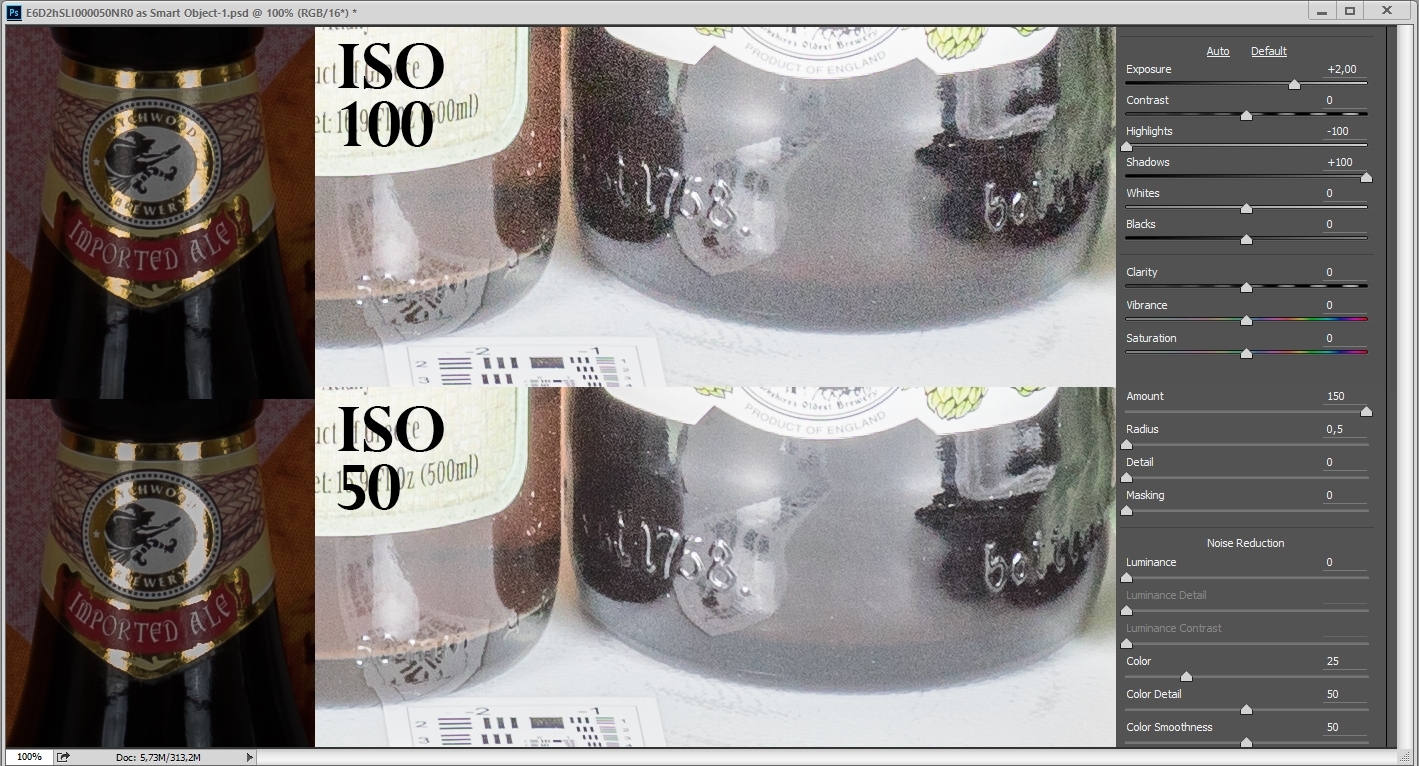
Here we are. At high ISO ALL sensors in reality PERFORM DIFFERENT in case of noise and color rendering. Your statement shows that you never use high ISO.
Compared to two further stops in IQ at High ISO (for example ISO 6.400 to 25K) for those, who need it its a much bigger advantadge than 2 stops higher DR. Painting with light does not mean painting in base ISO, only. Nor does "full sensor potential" mean "highest possible DR. That is the point in this whole discussion that makes me helpless.
Where do you know from that "many people mostly shoot at low ISO" ? You might do, yes.
I still would shoot my excellent 30D if I would shoot at low ISO. DR was excellent enough for my needs. I switched to 5D II because of the better low light performance only. Up to 3600 it worked fine. But I came in permanent troubble at ISO 6400 (because banding started). That was the only cause, why I switched to 6D. Excellent banding free high ISO with acceptable noise up tu ISO 12K. NO other camera offered this 5 years ago. Not Nikon D700, D600/610 not Canons 5D III nor 1DX.
The success of 6D proofed that many photographers indeed shoot mostly at (much) higher ISO than you believe. This is the cause why a camera like 6D was so successfull and could be sold with (still today) top reviews over 5 years now, while top DR bodies have to be exchanged all 2-3 years.
6Ds -3EV center AV made it possible to shoot at ISO 25k using AF and nailing the pic. Absolute impossible with 5D II, III or any earlier body. This is why I am sad, that Canon did not go further their own route and added -4EV to 6D II.
The last testresults seem to show, that 6D IIs ISO 12K and higher catches up with 5D IV and maybee 1DX II.
This is fantastic. And in my opinion much more important for most shooters than a 14 stops DR, that they will never use, need or see. For those who need 14 stops DR there is a great number of cameras "better" than 6D II already available.
Why must 6D II have it, too? And loose the advantadges it has, wich are very important for many (in my opinion most) shooters?
Painting with light does not only mean bright sunlight only. There is moon- and starlight, backlight, sidelight or the low light of a little fireplace, too. Things you can not shoot with or you would destroy by using a flashes. You would destroy it in many cases by pushing the dark areas, too.
Painting with light does not mean, that it is not allowed to paint with hard contrasts, too.
Conny...Show more →
My original point was to defeat the assertion that 1 or 2 EV of additional DR "never" make a difference in the real life, while shooting at low ISO indeed does in many situations. Maybe my example was too dramatic, but lower pushes still benefit from higher DR. And not always it is possible to wait for a proper lighting to take the shot (and cloudy days generate excellent photos with low DR, but a bit on the sad side).
Yes, not cameras perform equally at high ISO, but your example is wrong. You are comparing old with newer sensor tech (5D2 vs 6D). For example, the 1DX2 has at the least as very good high ISO as the 6D despite having much more dynamic range (including about 0.3 EV additional DR at ISO 25600). The same applies to the 5D4 vs 6D. So good high ISO is not incompatible with good DR on modern tech. And the cost of manufacturing a better sensor is the same (otherwise, Canon would have not used them in the 800D at no price increase). But on FF has decided to use the new feature as a market segmentation tool for this generation.
On the other hand, I suspect that good color rendering may be less compatible with "good high ISO" (low noise), due to design tradeoffs trying to increase the sensitivity (the 5D2 was known by being "color blinded" compared to the excelent 1DS3). Measured by DXO (likely at low ISO, though) the D810 still beats to any Canon camera in color depth, despite also beating them at DR.
It is feasible that more sooner than later, the sensors may become almost totally ISO-less. On such a day, high ISO will totally dissapear as we today know it. Cameras will not need ISO amplification, but only digital push instead. By then, shooting at "high ISO" (that is, at ISO 100 pushed 8 stops to reach ISO 25600) will achieve the best results on the sensor with higher DR (more highlights preserved).
Of course, cameras are more than a sensor. There are many other features to take into account. But the sensor is the current "film", and unlike in the past, never it was so important, because now we can not change that "roll" without buying another camera (and Canon is intentionally taking good "profit" from it).
|


 ) of dynamic range isn't a screw it - it's about the scene in front of you and your vision.
 And Canon do have a habit of saying 'the overall market do not consider this important so you can't have it' or even 'we could put it in but it is not up to the standard that we believe people expect so we won't install it'. And that can be frustrating.