If your images are not as good as Robin's you have only yourself to blame and not the gear!
Its been a long time since I visited Robin's site.
Robin Wong does always present his case very well, with nice images.
But in the context of this thread, I'd say that the samples presented in Robin's review does show what is lacking in m4/3 shots.
My impression of it :
1. The portraits are very tight. As the 2x crop factor makes the working distance long with the 85-135mm equivalent is to be used. Shorter FL and the distortion becomes more obvious.
2. There is less of the shallow DOF 'look. Yes, DOF is shallow, but the framing is tight.
If the framing shows off more of the environ, that apparent shallow DOF look is less.
Eg. Indian worker sample just does not have the same 'bite'.
3. The 100% crops shows off the 'pixel fuzz';
Though to be fair, this in wrt FF (often w/o AA filter) and in itself is actually already very good and certainly way above most needs.
4. Tonality does seem 'strained' in some of the shots. Kind of reminds me of sensors a few generations back.
Personally, I don't care too much about this though since I'd tweak it to taste anyway.
I have toyed around with Lightroom and Photoshop and just could not obtain that amazing Olympus skin tone and colors, as well as the amazing fine details.
pinholecam wrote:
Its been a long time since I visited Robin's site.
Robin Wong does always present his case very well, with nice images.
But in the context of this thread, I'd say that the samples presented in Robin's review does show what is lacking in m4/3 shots.
My impression of it :
1. The portraits are very tight. As the 2x crop factor makes the working distance long with the 85-135mm equivalent is to be used. Shorter FL and the distortion becomes more obvious.
I think I know what you're trying to say here, and if that's the case, you're wrong. The focal lengths and crop factor have no impact on the distortion. If a particular lens has some barrel or pincushion, then that's on a particular lens design and not a format issue, but I think you seem to be saying that there is greater perspective distortion from using, say a 45mm lens on m4/3 vs a 90mm lens on full frame, and that's just flat out false. Perspective and perspective distortion is a function of distance and distance only. It has nothing to do with the focal length of the lens.
Jman13 wrote:
I think I know what you're trying to say here, and if that's the case, you're wrong. The focal lengths and crop factor have no impact on the distortion. If a particular lens has some barrel or pincushion, then that's on a particular lens design and not a format issue, but I think you seem to be saying that there is greater perspective distortion from using, say a 45mm lens on m4/3 vs a 90mm lens on full frame, and that's just flat out false. Perspective and perspective distortion is a function of distance and distance only. It has nothing to do with the focal length of the lens. ...Show more →
Yes, I 'm talking about the lenses having more distortion, but I also mentioned that these are prominent in the '50mm equivalent' (ie 20mm, 25mm lenses)
The 45mm and above has much less, but it does mean a working distance of a 90mm to get the same FOV.
When I had m4/3, the Oly 45/1.8 was my go to for portraits (in the more purposed context; as opposed to more causal ones), exactly because the it exhibited the least distortion.
Right...my point is that it's not a format thing. For instance, the Zeiss Batis 85mm f/1.8 for E-mount has a fair bit of pincushion distortion, while the FE 85mm f/1.8 has very low distortion. It's lens dependent. The perspective distortion from a wider angle lens will be the same regardless of format (so, using a 50mm on FF will give the same perspective distortion as a 25mm on m4/3).
Jman13 wrote:
Right...my point is that it's not a format thing. For instance, the Zeiss Batis 85mm f/1.8 for E-mount has a fair bit of pincushion distortion, while the FE 85mm f/1.8 has very low distortion. It's lens dependent. The perspective distortion from a wider angle lens will be the same regardless of format (so, using a 50mm on FF will give the same perspective distortion as a 25mm on m4/3).
Its still format related in the sense that it gets harder to design a lens with less distortion as the focal length gets shorter.
So a m4/3 50mm equivalent would be the 20mm or 25mm and these would be harder to make with less lens distortion than a 50mm focal length lens.
Which is why I ended up using the 45mm more for more formal context portraits.
Apr 06, 2017 at 08:09 AM
Steve Spencer Online • • • • • • • Upload & Sell: On
pinholecam wrote:
Its still format related in the sense that it gets harder to design a lens with less distortion as the focal length gets shorter.
So a m4/3 50mm equivalent would be the 20mm or 25mm and these would be harder to make with less lens distortion than a 50mm focal length lens.
Which is why I ended up using the 45mm more for more formal context portraits.
I'm not so sure it is format dependent, however. It is also easier to design a lens with less distortion if it has a smaller image circle. These two factors (harder to design a lens without distortion at shorter focal lengths) and (easier to design a lens without distortion for a smaller image circle) obviously work in opposing directions when designing lenses for a smaller format. I am not sure which factor has a stronger influence on lens design. My own guess is that some (perhaps even many or most) m4/3rds lenses show more distortion because they are typically made smaller and to a lower price point and one way to meet these other design objectives is to allow distortion to increase. I think you are right that m4/3rds lenses tend to show more distortion, but I don't think this is necessarily a system issue, but rather how the system has evolved so far. Said another way, we could well see wider lenses with less distortion for m4/3rds than we have seen so far. They may be a bit harder to design, but I am not sure of that and just as there are factors making them harder to design, there are factors making them easier to design.
I have not read/compared the reviews of these 4 portrait lenses, but I do believe they are all very good and I don't see distortion to be a major problem with a medium telephoto lens.
Steve Spencer wrote:
I'm not so sure it is format dependent, however. It is also easier to design a lens with less distortion if it has a smaller image circle. These two factors (harder to design a lens without distortion at shorter focal lengths) and (easier to design a lens without distortion for a smaller image circle) obviously work in opposing directions when designing lenses for a smaller format. I am not sure which factor has a stronger influence on lens design. My own guess is that some (perhaps even many or most) m4/3rds lenses show more distortion because they are typically made smaller and to a lower price point and one way to meet these other design objectives is to allow distortion to increase. I think you are right that m4/3rds lenses tend to show more distortion, but I don't think this is necessarily a system issue, but rather how the system has evolved so far. Said another way, we could well see wider lenses with less distortion for m4/3rds than we have seen so far. They may be a bit harder to design, but I am not sure of that and just as there are factors making them harder to design, there are factors making them easier to design....Show more →
I've had two MFT cameras, both Olympus. I loved the system and the great lenses, but abandoned it because of the "weak" colors.
It seems like since the sensors are so relatively small, they made the CFA weak (great overlap between R, G and B). This keeps noise down by letting more light in at each pixel, but it also makes the color depth worse.
First I thought it was the lenses, and I was quite happy after getting the Panaleica 25/1.4 and Olympus 12/2. But still there was something missing compared to larger sensors, and it was not contrast, shallow DOF or acutance.
Funnily, my RX100 III gives as good colors as my a7. In that case I don't at all miss the larger sensor. Which also makes me confident in the belief that it doesn't have with sensor size to do, but optimization for stuff that I don't care for. I much prefer higher noise if the images are more "true". To this date, I still like the files from the bronze age Leica M8 for that same reason.
Steve Spencer wrote:
I'm not so sure it is format dependent, however. It is also easier to design a lens with less distortion if it has a smaller image circle. These two factors (harder to design a lens without distortion at shorter focal lengths) and (easier to design a lens without distortion for a smaller image circle) obviously work in opposing directions when designing lenses for a smaller format. I am not sure which factor has a stronger influence on lens design. My own guess is that some (perhaps even many or most) m4/3rds lenses show more distortion because they are typically made smaller and to a lower price point and one way to meet these other design objectives is to allow distortion to increase. I think you are right that m4/3rds lenses tend to show more distortion, but I don't think this is necessarily a system issue, but rather how the system has evolved so far. Said another way, we could well see wider lenses with less distortion for m4/3rds than we have seen so far. They may be a bit harder to design, but I am not sure of that and just as there are factors making them harder to design, there are factors making them easier to design....Show more →
I think you are partly wrong, partly right here, Steve. It shouldn't be harder to get the same (low) distortion with a smaller format. But since the smaller format needs faster lenses at the same AOV, the lens designers run into trouble. And if you allow for more distortion, you can get better properties in other areas of lens behavior.
In these times of high resolution, allowing high lens distortion is probably a wise move to keep the size of the lenses down, since it can be corrected with software without losing too much resolution.
Makten wrote:
I've had two MFT cameras, both Olympus. I loved the system and the great lenses, but abandoned it because of the "weak" colors.
! I know from your own words that you don't ever print, you don't sell your snaps, but you may want to look at some pictures taken by "photographers". There is nothing weak in Olympus colors. You may prefer Sony colors, but one man's medicine is another one's poison. It doesn't make the Olympus colors weak. And as in most cases, the weak point is the chimp behind the viewfinder.
Apr 06, 2017 at 04:49 PM
Steve Spencer Online • • • • • • • Upload & Sell: On
Makten wrote:
I think you are partly wrong, partly right here, Steve. It shouldn't be harder to get the same (low) distortion with a smaller format. But since the smaller format needs faster lenses at the same AOV, the lens designers run into trouble. And if you allow for more distortion, you can get better properties in other areas of lens behavior.
In these times of high resolution, allowing high lens distortion is probably a wise move to keep the size of the lenses down, since it can be corrected with software without losing too much resolution.
I think we totally agree here. The higher distortion is usually just a design choice to care about other factors more. I think that is often defensible even if it isn't my preference.
Awesome!! You found 1 m4/3 PRO user. I can show you million FF users and what will that prove ? Also, even he is not exclusively using m4/3. His gallery is full of Canon stuff plus he just got X-T20, so who know how long m43 will stay
ajamils wrote:
Awesome!! You found 1 m4/3 PRO user. I can show you million FF users and what will that prove ? Also, even he is not exclusively using m4/3. His gallery is full of Canon stuff plus he just got X-T20, so who know how long m43 will stay
You are fighting an uphill battle, you will not win. And are you being just sarcastic about me finding 1 pro? I hope you are not serious. But if you like, I can take some time to waste and list a lot of Pro photographers using m4/3.
I am really surprised that you would invest $2000 just in a camera body with such anti M4/3 feelings as yours. I'd say sell it and just use your other cameras. I know that If I had your issues with this system I'd have sold the gear a long time ago.
But the truth is, that there are many real pro photographers who have switched from FF/APSC to M4/3 for pro work and are happy with the move.So if you are not getting results, you can only blame yourself. After all I highly doubt that you have a higher standard than those pro photographers.
Just for fun, here is a "PRO" using top of the line Nikon FF gear. Are you now going to say that FF is utter rubbish because of his results? Or is it possible that just like in your case, it is the operator who is the weak link?
Please have a look at what FF is capable of producing in the wrong hands. According to this PRO, he spent 5 years developing his own style for people photography - which is what you are looking at.
Steve Spencer wrote:
I think we totally agree here. The higher distortion is usually just a design choice to care about other factors more. I think that is often defensible even if it isn't my preference.
savingspaces wrote: ! I know from your own words that you don't ever print, you don't sell your snaps, but you may want to look at some pictures taken by "photographers". There is nothing weak in Olympus colors. You may prefer Sony colors, but one man's medicine is another one's poison. It doesn't make the Olympus colors weak. And as in most cases, the weak point is the chimp behind the viewfinder.
ajamils wrote:
And what percentage of photographers ONLY use a camera in controlled environment and with strobes?
Who needs a controlled environment? You can take modern lighting anywhere.
But yes, even in the context of portraits (the genre this thread is about), it's not as large a percentage as it could be. But that their loss--especially if they're dissatisfied with their camera at the same time.
But you are right - for every 1 pro using m43 there is maybe a million others using a DSLR. By the same token, for every 1 pro shooting Sony, there are probably a million pros using a DSLR. Does this mean that Sony cameras are a joke? The figures doesn't really mean much or tell you much. Like Sony, m43 is a relatively new format/system and it has not been widely adopted by pros .... not yet anyway.
Suffice to say, m43 has matured and is definitely good enough for pro use. Is FF better? But of course! Is MF better? Yes, the top commercial photographers would only use MF. I have a pro friend who recently dumped her FF Canon to switch to Hasselblad, as her clientele has changed and FF doesn't cut it for her anymore.
m43 has come a long way even though it hadn't been around for as long as the DSLR. And many professionals have already switched (downgraded if you will) to m43 for variety of reasons.
ajamils wrote:
Awesome!! You found 1 m4/3 PRO user. I can show you million FF users and what will that prove ? Also, even he is not exclusively using m4/3. His gallery is full of Canon stuff plus he just got X-T20, so who know how long m43 will stay
Ultimately, there are positive aspects of either system that cannot be replicated by the other.
Conversely, there are negative aspects of either systems that are not replicated by the other.
More importantly, MOST things can be achieved by either system.
Thankfully, we all get to choose what is most important to ourselves, and save everyone from online pissing matches.
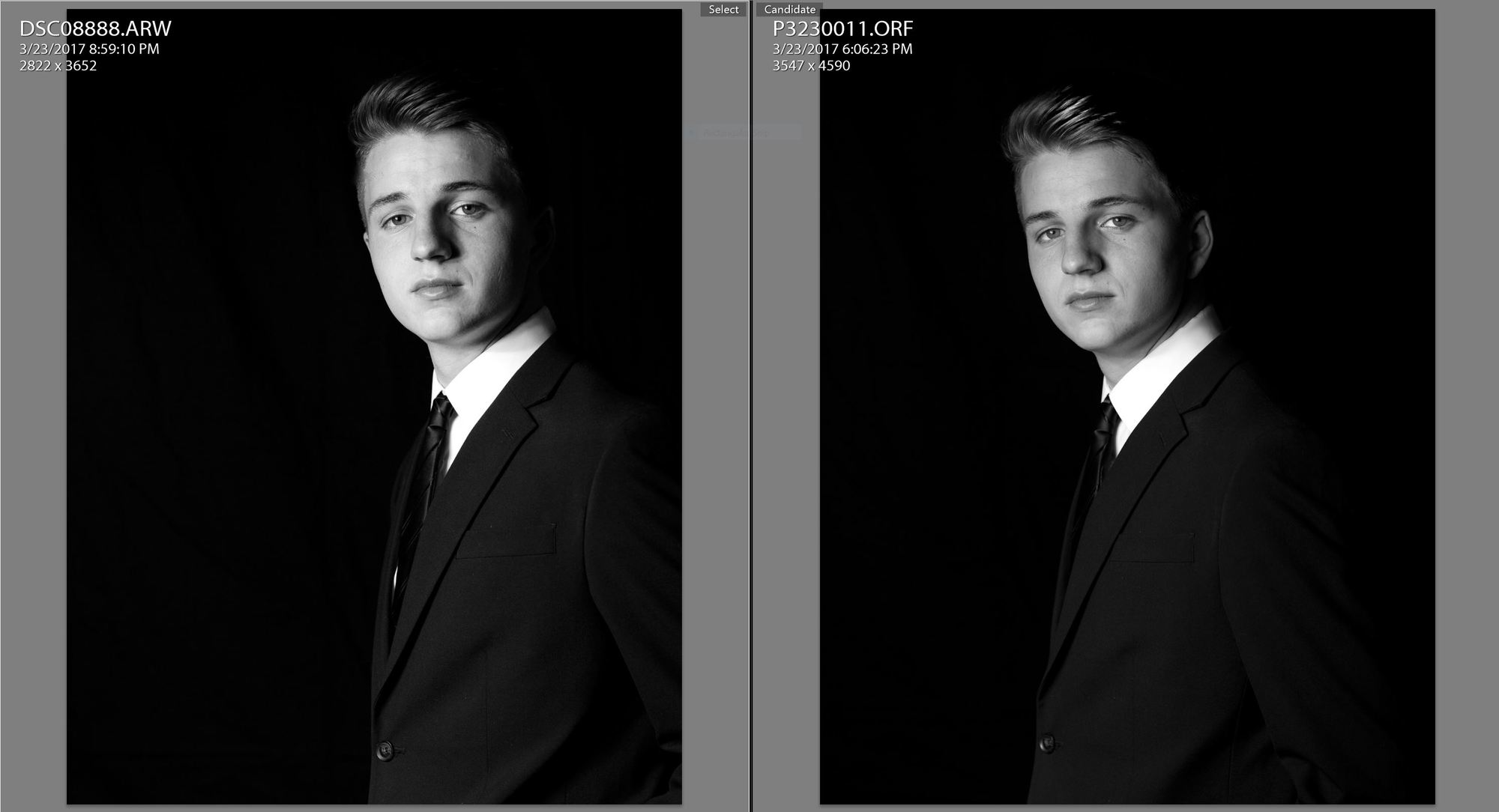
I decided to split the difference - switching the E-M1 II for the A7R II, but keeping my Pen-F and compact primes. Ultimately, the A7R II has superior IQ, but I enjoy the handling and "photographic experience" more with Olympus.
A7 left, Pen-F right. Much more alike than different.


 ! I know from your own words that you don't ever print, you don't sell your snaps, but you may want to look at some pictures taken by "photographers". There is nothing weak in Olympus colors. You may prefer Sony colors, but one man's medicine is another one's poison. It doesn't make the Olympus colors weak. And as in most cases, the weak point is the chimp behind the viewfinder.