p.1 #1 · Dual MicroSD SD Adapter - How does this not exist?
Dual card slots wouldn't be necessary in cameras if we had an SD adapter that could accept two MicroSD cards and simultaneously write to both. Why doesn't this exist? Are they available from some obscure Chinese source? If not, does anyone have the connections to make this happen?
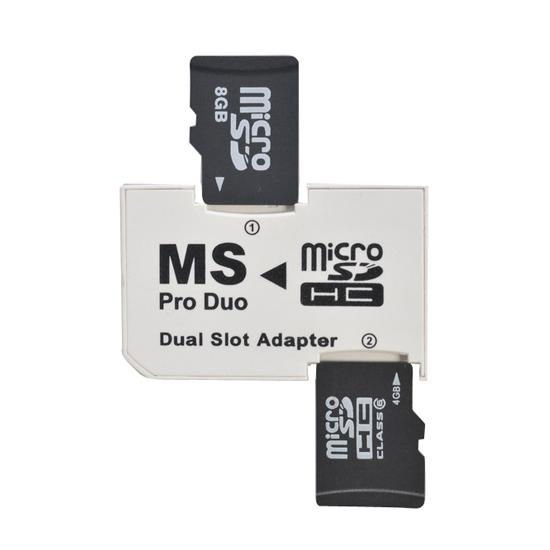
In my searches I did find an MS Pro Duo adapter that is designed to give Sony memory stick devices access to two MicroSD cards. But I'm looking for this is in an SD form factor, and of course, I don't want extra space, but data redundancy.
p.1 #2 · Dual MicroSD SD Adapter - How does this not exist?
I don't know the answer to your question but I got the hunch that it has to do with reliability and/or life expectancy of micro SD cards. I would prefer having two slots in the camera for redundancy but space or shortage of space could be an issue in that configuration.
p.1 #4 · Dual MicroSD SD Adapter - How does this not exist?
I think the issue is likely related to the logic involved: You need a way to instruct the adaptor how it writes to the two cards. And you probably need to envision general-use.
So does it just mirror to the cards? Does it stripe? (RAID-like.) JBOD? Or is it more camera-specific: mirror or distribute evenly? And what if you want to take it a step further, beyond what a simple switch can provide: If you want RAW on one an JPG on the other, how does the camera + adaptor + cards system work to figure that out?
Of course there will also be speed, reliability, compatibility issues too. And who wants to deal with microSD?
All of this is to say that I think it's possible... but it seems nobody serious is willing to get over the hurdles because it just might not be worth the effort in terms of profits/time.
p.1 #5 · Dual MicroSD SD Adapter - How does this not exist?
Parariss wrote:
Wasn't there also a thread on this a month or two ago? Can't remember, but it seems like someone was going to try out some of this tech.
p.1 #8 · Dual MicroSD SD Adapter - How does this not exist?
The Pro Duo adapter can't write to both cards at the same time - it only aggregates the capacity of the two, so it's writing to only one card at a time. Having an SD card write to two Micro SD cards simultaneously would require a bit more logic to facilitate.
p.1 #10 · Dual MicroSD SD Adapter - How does this not exist?
justruss wrote:
I think the issue is likely related to the logic involved: You need a way to instruct the adaptor how it writes to the two cards. And you probably need to envision general-use.
So does it just mirror to the cards? Does it stripe? (RAID-like.) JBOD? Or is it more camera-specific: mirror or distribute evenly? And what if you want to take it a step further, beyond what a simple switch can provide: If you want RAW on one an JPG on the other, how does the camera + adaptor + cards system work to figure that out?
Of course there will also be speed, reliability, compatibility issues too. And who wants to deal with microSD?
All of this is to say that I think it's possible... but it seems nobody serious is willing to get over the hurdles because it just might not be worth the effort in terms of profits/time.
p.1 #11 · Dual MicroSD SD Adapter - How does this not exist?
Hmmmm... Halve a very low (though not zero) probability point of failure (SD card internals) and replace it with new, unproven tech that shares the same camera interface point of failure as the original but adds brand new sources for system failure.
p.1 #12 · Dual MicroSD SD Adapter - How does this not exist?
Parariss wrote:
Hmmmm... Halve a very low (though not zero) probability point of failure (SD card internals) and replace it with new, unproven tech that shares the same camera interface point of failure as the original but adds brand new sources for system failure.
Sign me...down.
The point is to achieve data redundancy. For this adapter to represent a meaningful point of failure, it would have to fail in such a way that it appears to write data to both cards, but fails to write the data to both.
If it were to fail in any other way, the data would be recoverable from at least one card, and a new adapter could be used. Whereas an SD card failure likely results in a total loss of data, and the shoot must be redone (not possible in many cases).
p.1 #13 · Dual MicroSD SD Adapter - How does this not exist?
This is a more complicated problem than most seem to realize.
An adapter like the OP talks about - two micro SD slots in one SD card, with data being written to both cards for the sake of redundancy - is possible, but it requires a small computer to live inside that SD card. That's actually not a far fetched idea - wifi-enabled SD cards like Transcend Wi-Fi and EyeFi already do this. Transcend Wi-Fi cards even run Linux, believe it or not.
However, this adapter would be require more complexity and power than a wifi SD card. The computer in this device would present itself to the camera as an SD card, and it'd need to be fast enough and have enough of a buffer to accept data from the camera. It would write then data to both cards. After error checking, you'd clear that data from the cache. Alternately, it'd proxy data to the first card, and perform duplication from Card 1 to Card 2 in the background. Any way you do it, it's going to add complexity, slow down writes, and sometimes slow down reads.
It would also add another layer of potential failure. The risk of data loss would be quite a bit higher with this device than we see with a stock SD card. I'd wager it's 10x-100x a higher error rate than with a regular SD card. It'd also probably slow down the write time quite a bit, based on the speeds for the kinds of SOCs you could cram into an SD card housing.
As @mjm6 said, power is a potential issue for a device like this. Not only would you need to power both cards, but you'd also need to power the embedded computer inside the SD card. Again, this could be doable but it'd eat into your battery life.
These are digital storage devices, not an analog medium. It's not a matter of simply "streaming" the data to both cards. You could physically make an adapter that just split each data line in two, but it wouldn't work.
p.1 #14 · Dual MicroSD SD Adapter - How does this not exist?
arduluth wrote:
This is a more complicated problem than most seem to realize.
An adapter like the OP talks about - two micro SD slots in one SD card, with data being written to both cards for the sake of redundancy - is possible, but it requires a small computer to live inside that SD card. That's actually not a far fetched idea - wifi-enabled SD cards like Transcend Wi-Fi and EyeFi already do this. Transcend Wi-Fi cards even run Linux, believe it or not.
However, this adapter would be require more complexity and power than a wifi SD card. The computer in this device would present itself to the camera as an SD card, and it'd need to be fast enough and have enough of a buffer to accept data from the camera. It would write then data to both cards. After error checking, you'd clear that data from the cache. Alternately, it'd proxy data to the first card, and perform duplication from Card 1 to Card 2 in the background. Any way you do it, it's going to add complexity, slow down writes, and sometimes slow down reads.
It would also add another layer of potential failure. The risk of data loss would be quite a bit higher with this device than we see with a stock SD card. I'd wager it's 10x-100x a higher error rate than with a regular SD card. It'd also probably slow down the write time quite a bit, based on the speeds for the kinds of SOCs you could cram into an SD card housing.
As @mjm6@ said, power is a potential issue for a device like this. Not only would you need to power both cards, but you'd also need to power the embedded computer inside the SD card. Again, this could be doable but it'd eat into your battery life.
These are digital storage devices, not an analog medium. It's not a matter of simply "streaming" the data to both cards. You could physically make an adapter that just split each data line in two, but it wouldn't work. ...Show more →
Instead of buffering the data the SD card could relay it to both micro SD cards at the same time. To do this it would initiate a write command to the micro SD cards and then hold the incoming data for itself until both micro SD cards were ready to receive the data. Besides removing the need for a buffer this would also eliminate bandwidth issues from having to source two writes from the same internal memory buffer. The downside is that you have to wait until both cards are ready to receive the data, which means some additional latency for cases where one card takes longer than the other.
As for failures, MLC NAND flash is much more likely to fail than the controller electronics which support it, including this theoretical RAID 1 card. And by fail I mean the most likely scenario of individual cells corrupting data, which is more likely than a catastrophic failure of the entire NAND.
p.1 #15 · Dual MicroSD SD Adapter - How does this not exist?
snapsy wrote:
Instead of buffering the data the SD card could relay it to both micro SD cards at the same time. To do this it would initiate a write command to the micro SD cards and then hold the incoming data for itself until both micro SD cards were ready to receive the data. Besides removing the need for a buffer this would also eliminate bandwidth issues from having to source two writes from the same internal memory buffer. The downside is that you have to wait until both cards are ready to receive the data, which means some additional latency for cases where one card takes longer than the other. ...Show more →
To relay the data to both micro SD cards at the same time requires a buffer. The data has to be staged somewhere for it to be written to the cards. As I said above, this isn't a stream being split and sent to two analog recording devices. It's also not fire-and-forget, it's transactional. The data (and SD commands) has to live somewhere until the writes are completed on both cards.
snapsy wrote:
As for failures, MLC NAND flash is much more likely to fail than the controller electronics which support it, including this theoretical RAID 1 card. And by fail I mean the most likely scenario of individual cells corrupting data, which is more likely than a catastrophic failure of the entire NAND.
The risk of failure with the embedded computer isn't the electronics but the programming. The upside is that a failure would likely lead to losing data in the buffer (recent RAW and JPEGs not yet written to the cards) rather than the entire contents of the card. The latter would still be possible, but I think it's less likely.
p.1 #16 · Dual MicroSD SD Adapter - How does this not exist?
arduluth wrote:
To relay the data to both micro SD cards at the same time requires a buffer. The data has to be staged somewhere for it to be written to the cards. As I said above, this isn't a stream being split and sent to two analog recording devices. It's also not fire-and-forget, it's transactional. The data (and SD commands) has to live somewhere until the writes are completed on both cards.
The risk of failure with the embedded computer isn't the electronics but the programming. The upside is that a failure would likely lead to losing data in the buffer (recent RAW and JPEGs not yet written to the cards) rather than the entire contents of the card. The latter would still be possible, but I think it's less likely....Show more →
The data doesn't need to be buffered. Re-read what I posted for details on how it would be implemented. It would bridge the interfaces by latching incoming data from the SD interface/camera and sequence it out to the micro SD cards. This would only require a shallow FIFO to facilitate. I've written embedded firmware for PCIE RAID cards that does exactly what I described.
Your estimate for firmware increasing the risk of failure is overstated. There are lots of interface bridging products on the market. Some have compatibility issues with certain chipsets and such but those typically lead to immediate interoperability issues rather than latent failures.
p.1 #17 · Dual MicroSD SD Adapter - How does this not exist?
snapsy wrote:
The data doesn't need to be buffered. Re-read what I posted for details on how it would be implemented. It would bridge the interfaces by latching incoming data from the SD interface/camera and sequence it out to the micro SD cards. This would only require a shallow FIFO to facilitate. I've written embedded firmware for PCIE RAID cards that does exactly what I described.
Your estimate for firmware increasing the risk of failure is overstated. There are lots of interface bridging products on the market. Some have compatibility issues with certain chipsets and such but those typically lead to immediate interoperability issues rather than latent failures. ...Show more →
Your FIFO would need to be deep enough to make up for the differences in timing between the cards. Either that, or you need to block while waiting for the slowest card to finish writing. A shallow FIFO would end up compounding the increased latency, whereas a buffer would allow you to accept new data from the camera even as you're writing to the cards.
I'm not saying the risk of failure is huge - but IMHO it is significantly bigger than the SD flash on its own. Especially for a small market product like this, which isn't going to be subject to the level of testing that a widely used device does. I guess I think about it like the various AF adapters you can get for E mount, another intelligent device with a small market. I can't help but imagine the threads where the card causes a camera lock up and the solution is to pull and re-insert the card to force a reboot of the embedded computer.
I don't mean to poo-poo the idea, quite the opposite - it's workable. It's just not quite as simple as it might seem if you don't know what's actually required to implement it. As such, it's really not a surprise that no one has developed something like this yet.
p.1 #18 · Dual MicroSD SD Adapter - How does this not exist?
FYI your Sony cameras will work with Memory Stick Duo, so you can stick two micro Sds into that adapter and then into your camera. However the adapter joins the two cards together in a RAID0 style fashion, there's no redundancy, just creates one larger card in a 1+1=2 fashion.
p.1 #19 · Dual MicroSD SD Adapter - How does this not exist?
arduluth wrote:
Your FIFO would need to be deep enough to make up for the differences in timing between the cards. Either that, or you need to block while waiting for the slowest card to finish writing. A shallow FIFO would end up compounding the increased latency, whereas a buffer would allow you to accept new data from the camera even as you're writing to the cards.
I'm not saying the risk of failure is huge - but IMHO it is significantly bigger than the SD flash on its own. Especially for a small market product like this, which isn't going to be subject to the level of testing that a widely used device does. I guess I think about it like the various AF adapters you can get for E mount, another intelligent device with a small market. I can't help but imagine the threads where the card causes a camera lock up and the solution is to pull and re-insert the card to force a reboot of the embedded computer.
I don't mean to poo-poo the idea, quite the opposite - it's workable. It's just not quite as simple as it might seem if you don't know what's actually required to implement it. As such, it's really not a surprise that no one has developed something like this yet....Show more →
Yes, I described the additional latency involved by gating the origin SD write to the synchronous completion of the two micro SD writes. As long as the two micro SD cards are speed matched (preferably of the same model) then the added latency shouldn't be significant for the nominal case. With that the FIFO could be as small as a single sector of data.
p.1 #20 · Dual MicroSD SD Adapter - How does this not exist?
I'd gladly accept some latency for data redundancy. I'm not shooting sports with my A7RII. I assumed it would work like the Wifi SD cards, writing to a master MicroSD initially, then copying to the second MicroSD in the background.
Occasional failures that do not involve loss of data from both cards aren't a concern for me. The idea is to prevent loss of an entire shoot--to avoid the cost of a second production or lawsuit. Having to pull the card out and put it back in once during a shoot is not a serious consideration in light of these risks.
(I could choose a body with two card slots, but there's no other option that allows me to do what I do now. I will snap up the successor to the A7RII when it's available.)