It should be several more weeks before I received the OptoSigma 50mm diameter 5m PCX lens, but my idea of applying the front lens to the ZM 35mm Distagon is to use a generic hood. This fits 49mm filter threads and the inside diameter is about 51mm.
It is also fairly shallow, meaning the front lens position will be as close to the front lens surface as a setup filter solution.
Front lens retention could be from a pressure fit ring of some sort. While this hood will take a 52mm lens cap and filters, the threads do not go all the way down the side. A 52mm retaining ring from a 52mm filter will thread down only so far.
The main gotcha would be if there is any mechanical vignetting, in which case machining would be required.
In the case of the ZM25, no need to cut, grind or mess with step up/down rings. I said it before and ( at the risk of being called a tiresome bore ) I'm telling you again: skip the vintage Proxar 1m and get instead a new 46mm multicoated +1 close-up filter from a reputed manufacturer ( like the Hoya HMC range for instance ).
artur5 wrote:
In the case of the ZM25, no need to cut, grind or mess with step up/down rings. I said it before and ( at the risk of being called a tiresome bore ) I'm telling you again: skip the vintage Proxar 1m and get instead a new 46mm multicoated +1 close-up filter from a reputed manufacturer ( like the Hoya HMC range for instance ).
my understanding is that +1 close up filters are totally different optically from proxar 1m filters. i have a +1 vivitar filter and it isn't even convex on the same side as the proxar 1m.
JimBuchanan wrote:
It should be several more weeks before I received the OptoSigma 50mm diameter 5m PCX lens, but my idea of applying the front lens to the ZM 35mm Distagon is to use a generic hood. This fits 49mm filter threads and the inside diameter is about 51mm. https://c1.staticflickr.com/1/591/32478864612_14219bfdf7_c.jpg
It is also fairly shallow, meaning the front lens position will be as close to the front lens surface as a setup filter solution. https://c1.staticflickr.com/1/359/31789193444_de9cc27552_c.jpg
Front lens retention could be from a pressure fit ring of some sort. While this hood will take a 52mm lens cap and filters, the threads do not go all the way down the side. A 52mm retaining ring from a 52mm filter will thread down only so far.
The main gotcha would be if there is any mechanical vignetting, in which case machining would be required. ...Show more →
There is no vignetting and the 5m front-lens fits in the inside diameter. The problem is that I could not find a way to retain the front-lens in place as there are no inside threads on the hood.
artur5 wrote:
In the case of the ZM25, no need to cut, grind or mess with step up/down rings. I said it before and ( at the risk of being called a tiresome bore ) I'm telling you again: skip the vintage Proxar 1m and get instead a new 46mm multicoated +1 close-up filter from a reputed manufacturer ( like the Hoya HMC range for instance ).
If the Hoya +1 close up filter works as well as the Proxar it would certainly make it much more user friendly. Your response however implies that you have tested the Hoya solution already, is that the case? If so were you able to compare the results to the Proxar results?
DannyBurkPhoto wrote:
I was thinking the same - maybe one initial sticky post with info for each lens, which could be updated as new info becomes available?
I haven't compared Hoya/Heliopan/B+W close-up lenses to he Proxars, because I don't own one of these. I tried a Nikon 1.4m. and a Hoya 1m. close-up on a Contax-G 28 and I saw no degradation whatsoever regarding contrast or additional flare, None of these two are multicoated.
AFAIK most regular close-up filters (including the Proxars ) are meniscus, as opposed to the Optosigmas which are planoconvex elements. Therefore, isn't logical to expect similar performance from all the above mentioned filters?. Agreed, the radii of curvature of a Heliopan and a Proxar may differ and so may their optical performance but who says that the Heliopan mightn’t be equal or better ?.
Besides, if we consider that the all Proxars available everywhere are vintage articles it's also normal to expect that many of them might be in less than optimal condition.(i.e. with the coatings somehow degraded by cleanings, etc..). That doesn't means that the performance, regarding flare/ghosting, must be visibly worse than a new filter but, given the choice, I'd rather buy new specially if it saves me the hassle of cutting the mount, grinding the glass or seeing that the filter isn’t a bit tilted inside the step-up/step-down rings.
Of course, for people already satisfied with their Proxar filters, there's no need to test a different model, which might perform worse (but it might also perform equal or better). But IMHO if one wants to try from scratch the front filter solution with a ZM25, it's more advisable to buy first a 46mm +1 Hoya HMC from a shop which a good return policy; try it and see if the results are comparable to what Guy showed with his ZM25 and the Proxar 1m. If the Hoya is visibly worse, then send it back and fetch a Proxar 1m on Ebay, No money wasted. If the Hoya works fine then you’re sorted without further hassle.
I happen to have a Hoya +1 HMC closeup lens, but nothing to try it on. But I can tell that it's a meniscus lens, not a planoconvex one.
I suppose all closeup lenses of this type are meniscus because they are meant to keep the focal plane as unaffected (flat) as possible. Which is the opposite of what we want here.
----------
Edit: I'm following this thread with interest since the ZM 35/1.4 suddenly seems like and option! I'd love to see some mid distance (~3-6 m) bokeh shots with and without the front lens.
artur5 wrote:
I haven't compared Hoya/Heliopan/B+W close-up lenses to he Proxars, because I don't own one of these. I tried a Nikon 1.4m. and a Hoya 1m. close-up on a Contax-G 28 and I saw no degradation whatsoever regarding contrast or additional flare, None of these two are multicoated.
AFAIK most regular close-up filters (including the Proxars ) are meniscus, as opposed to the Optosigmas which are planoconvex elements. Therefore, isn't logical to expect similar performance from all the above mentioned filters?. Agreed, the radii of curvature of a Heliopan and a Proxar may differ and so may their optical performance but who says that the Heliopan mightn’t be equal or better ?.
Besides, if we consider that the all Proxars available everywhere are vintage articles it's also normal to expect that many of them might be in less than optimal condition.(i.e. with the coatings somehow degraded by cleanings, etc..). That doesn't means that the performance, regarding flare/ghosting, must be visibly worse than a new filter but, given the choice, I'd rather buy new specially if it saves me the hassle of cutting the mount, grinding the glass or seeing that the filter isn’t a bit tilted inside the step-up/step-down rings.
Of course, for people already satisfied with their Proxar filters, there's no need to test a different model, which might perform worse (but it might also perform equal or better). But IMHO if one wants to try from scratch the front filter solution with a ZM25, it's more advisable to buy first a 46mm +1 Hoya HMC from a shop which a good return policy; try it and see if the results are comparable to what Guy showed with his ZM25 and the Proxar 1m. If the Hoya is visibly worse, then send it back and fetch a Proxar 1m on Ebay, No money wasted. If the Hoya works fine then you’re sorted without further hassle. ...Show more →
@GMPhotography has the Proxar 1m and he just ordered the Hoya +1 to compare it to.
I'm sure he will let us know if there is any difference.
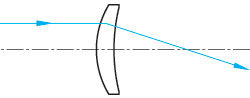
By looking at the Proxar 1m lens, I believe it is a 'positive meniscus' optical design with one convex and one concave surface. (Instead of a convex and a plano found on a PCX lens)
In other words it's a convex meniscus (thicker in the middle than at the edges) and a similar optical design as the one found in glasses for folks whot are long-sighted. Basically these lenses shift the plane of focus from infinity to the distance correspondent to the focal length of the close-up lens.
I'm not sure how the Hoya close-up lens is designed but it probably follows the same mold. Those who have one could check if it is also a positive meniscus. (see image below)
Has anyone looked into finding a resource to grind these and place them in appropriate filter rings so they can be put on a lens without causing problems for the lens hood etc?
I get that this will be a lot more expensive than the Rube Goldberg approach, but it will make them a lot more useful to many people.
I think I've read the whole thread and didn't see a specific mention of this, other than a discussion regarding getting an optometry lab to do the work, but maybe I missed it.
Also, can anyone contribute information on the Voigtlander lenses... lots of possibly great options there, and they are quite inexpensive overall. Yes, they may perform worse than the ZM lenses, but they should be worth considering. Leica, too, of course, but those cover a whole other price level that makes them unlikely for large scale adoption.
Overall, I think that these experiments are most excellent. It's a shame they weren't figured out before many of us sold off our RF lenses.
I ordered the Hoya so I'll will test it out with the Proxar. I get it next week . Worth a try
BTW you guys please just call me Guy. Making me old with the proper naming. Lol
Fred Miranda wrote:
@GMPhotography@@ has the Proxar 1m and he just ordered the Hoya +1 to compare it to.
I'm sure he will let us know if there is any difference.
By looking at the Proxar 1m lens, I believe it is a 'positive meniscus' optical design with one convex and one concave surface. (Instead of a convex and a plano found on a PCX lens)
In other words it's a convex meniscus (thicker in the middle than at the edges) and a similar optical design as the one found in glasses for folks whot are long-sighted. Basically these lenses shift the plane of focus from infinity to the distance correspondent to the focal length of the close-up lens.
I'm not sure how the Hoya close-up lens is designed but it probably follows the same mold. Those who have one could check if it is also a positive meniscus. (see image below)...Show more →
I have seen some improvement using the Hasselblad Proxar 1M on Zeiss ZM 25mm. However, it appeared to not necessarily be perfect and wondering if it's just me. Also wondering if it works differently at different distances.
Been doing some more tests. Best I can do is show examples.
I extracted the glass from the holder and put into step up adapters as described previously in this thread.
Link below is to a 2.8 shot, and after that are f4 and 5.6 if you click to the next images.


 ) I'm telling you again: skip the vintage Proxar 1m and get instead a new 46mm multicoated +1 close-up filter from a reputed manufacturer ( like the Hoya HMC range for instance ).
 .
.