HaruhikoT wrote:
Attach 46-55mm stepup, 55-52mm stepdown, put the 2m lens into the 52mm thread and clamp it with 52-55mm stepup adapter.
Haruhiko, I am going to adapt my Zeiss 35/1.4 ZM with the OptoSigma SLB-50-5000PM. Do you think I could "mount" the PCX lens with a 49mm-52mm step up ring + the disassembled 52mm Amazon UV filter? Or, do I need to get a 49mm-55mm step up, 55mm-52mm step down, plus Amazon filter? Thanks.
Thanks for your advice, £40.00 sounds good.
Curently my 1.4/35 + 5mPCX + PixcoLM/E gets infinity so I'm not hurry to grind my adapter, though interesting to try it.
I've also found there are some local machine shops in Japan.
I would try to ask them when I get TAP or Helicoid adapter.
candreyo wrote:
Hi Haruhiko,
Yes, machine shops do custom/ one off orders also. This service may be upwards of £40.00 in Great Britain, but in other countries the service could be much more affordable depending on labour costs.
I would do a search for a CNC / metalwork shop in your local area, then stop by them and explain you want 0.6mm 'lapped' off the front surface of the bayonet. Tell them it's important that the surface that is being lapped down, remain as flat as possible to ensure there is no light leakage.
Ask them for a quotation first, and it may be best to compare 2-3 different quotations to see who is most affordable.
They may have to remove the bayonet from the adapter to work on it, but this should be doable with screws. ...Show more →
scrappydog wrote:
Haruhiko, I am going to adapt my Zeiss 35/1.4 ZM with the OptoSigma SLB-50-5000PM. Do you think I could "mount" the PCX lens with a 49mm-52mm step up ring + the disassembled 52mm Amazon UV filter? Or, do I need to get a 49mm-55mm step up, 55mm-52mm step down, plus Amazon filter? Thanks.
>> 49mm-52mm step up ring + the disassembled 52mm
This combination won't work because OptoSigma's PCX has 3.1mm thickness. Normal step up ring's thread only have around 3mm thick so we need a kind of spacer. This is why I use the latter case, those two step rings give PCX enough thickness.
HaruhikoT wrote:
>> 49mm-52mm step up ring + the disassembled 52mm
This combination won't work because OptoSigma's PCX has 3.1mm thickness. Normal step up ring's thread only have around 3mm thick so we need a kind of spacer. This is why I use the latter case, those two step rings give PCX enough thickness.
Jim DE wrote:
I own a G21 and have wanted to use it since the original nex5 knowing how well it worked with color positive film on my ContaxG2. I saw results back then that were horrible on the NEX 5. Seemed like ever model someone tried to make that lens work but imo were far from successful compared to the results on the G2.
Now I am seeing this method being used to address corner smears and color shifts with probably the best results so far. My issue is my lens is still uncut but even my 28mmG lens seems to be almost on my sensor when using a kipon adapter on my a7rII. You guys are not worried about lens to sensor contact when stabilization is on? It looks like even cut the lens would be only a fine hair away from making contact if it wasn't already making contact when mounted....Show more →
Compared to NEX5, A7 series have wider space inside mount so I think G21's rear lens guard works without problem. At least mine is OK.
If you worry, using silent mode is much safer.
I saw someone report A7 shutter interferes G16 Hologon's rear lens but in silent mode even G16 works. Also Zeiss documents describe G21 BFD = 12.1mm while G16 BFD = 6.8mm, so even this PCX method make BFD 0.3mm closer to sensor, I believe there is still enough room to the sensor.
Thanks for the reply.... to my eyes with the old original kipon G to E adapter back when the a7r2 was introduced I tried the 28, 35, 45, and 90. Mounting the 28 with kipon really looked like it was going to touch the sensor and if it shook on 5 axis I was sure it would hit so I never even fully mounted that one and put the 28 back in my G2 kit with the 21. For my taste the 35 had smearing issues so it went back as well. The 45 and 90 have been exceptional on every E mount I have owned and were my mainstay until the a7r2. On the a7r2 both displayed a very slight color cast that I never saw when used on any of my other E cameras. It could be easily corrected in post but it annoyed me so I bit the bullet and bought the fe55 and 90 macro to replace my all time favorite g45 and g90. I thought no glass could ever beat these two G lenses but honestly the 55 and 90 Mac imo smoked my old favorites and now my 45 and 90 stay in my nex7 kit.
The 21g was always my favorite G lens on the G2 but I will not cut it if it still has a chance of touching the a7r2 sensor during normal stabilized operation. I see no way it would clear using the kipon adapter without being cut
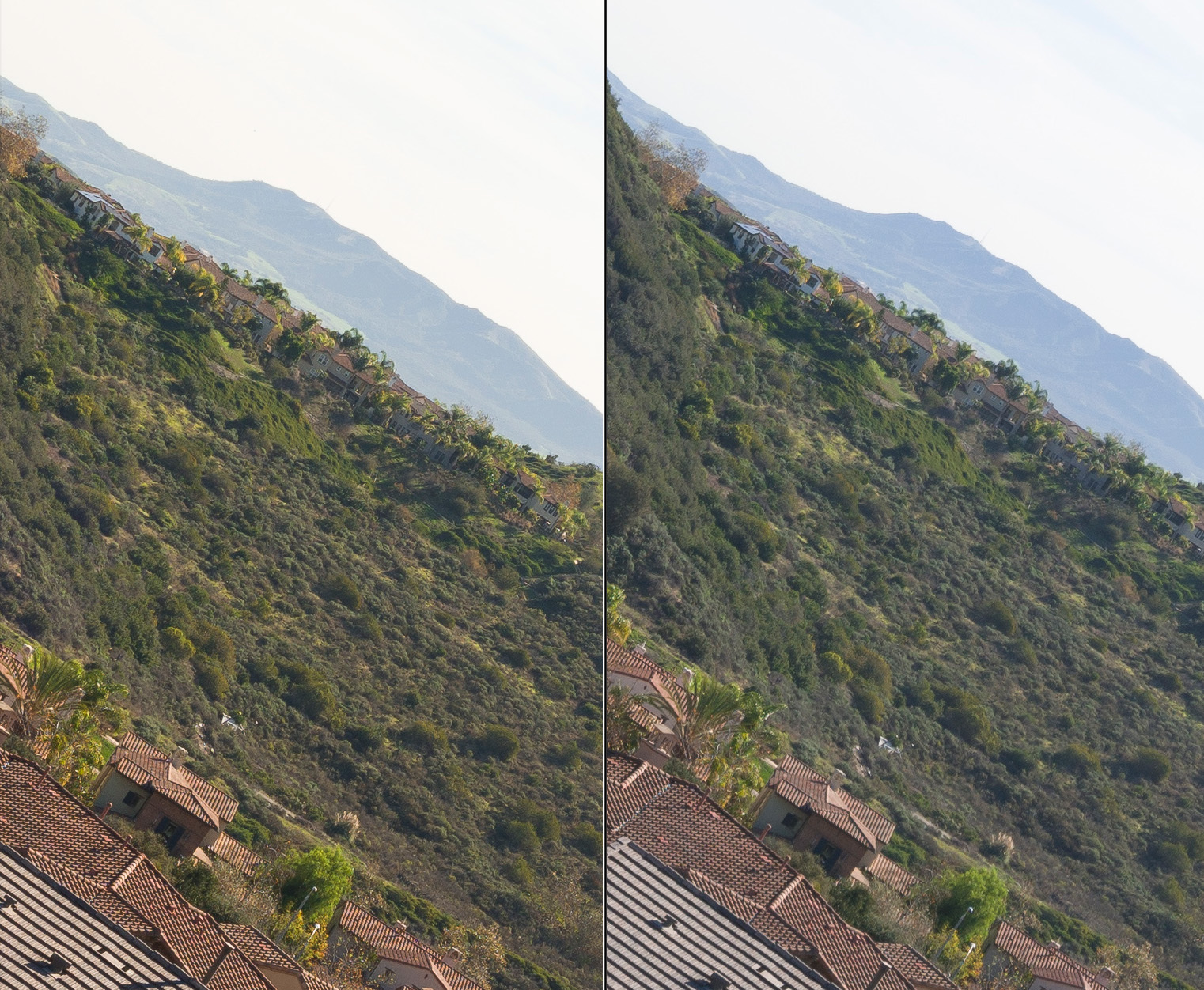
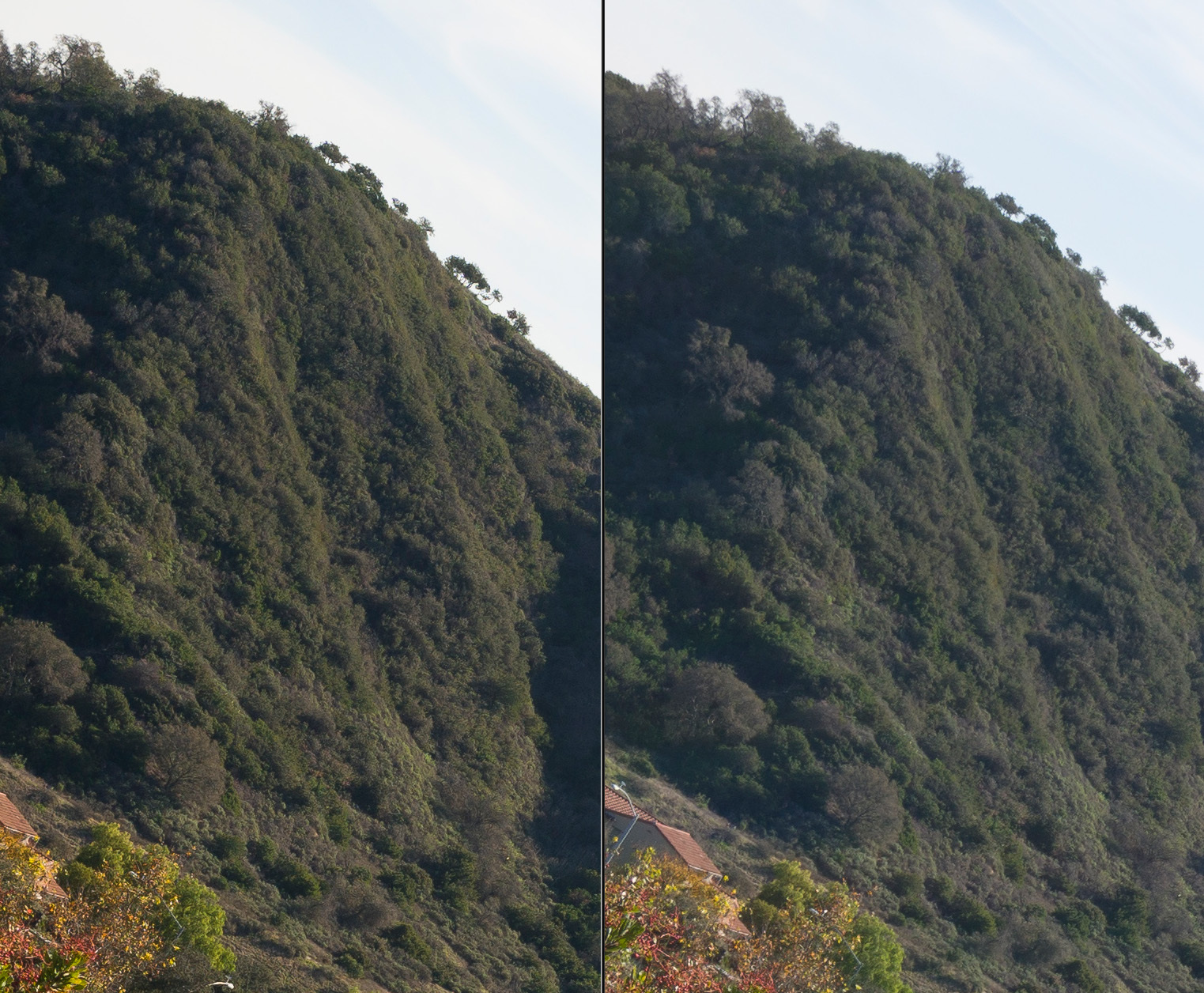
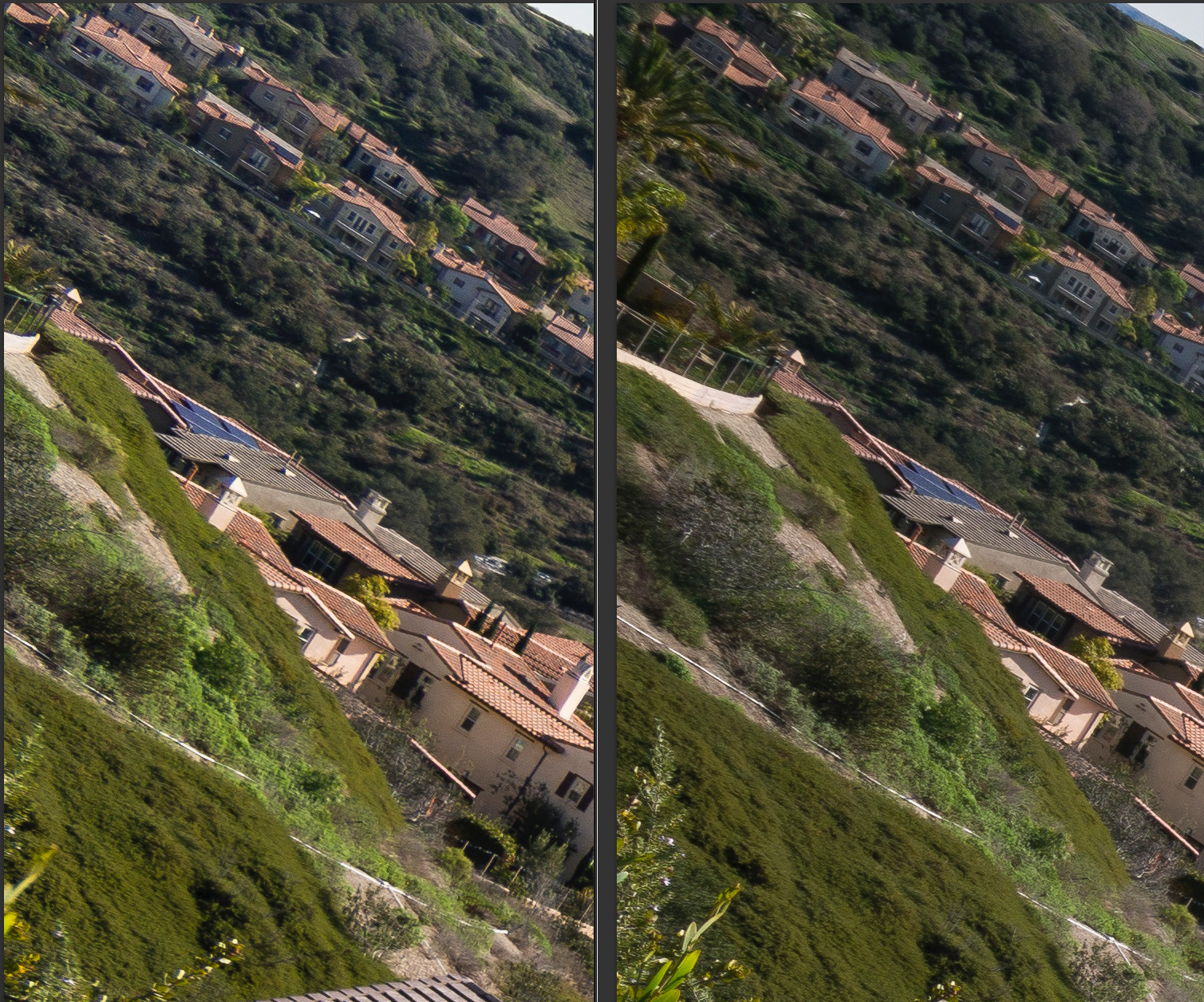
The Eksma Optics 5m filter unfortunately seems not to be as great a match to the Zeiss ZM 35mm 1.4 as the Optosigma 5m filter.
The corner performance is improved to a similar degree, but there is a significant loss in resolution in the midzone.
I have already send Haruhiko the test shots for examination, for you I have also prepared this overview: Sharpness_zeiss_zm_35mm_1.4_center_5m by Bastian Kratzke, auf Flickr
I will probably still be using this Eksma filter until the better one from Optosigma arrives (in February ),
as bokeh is improved enough that it matters to me and I am really not interested in any additional shots like these with whacky bokeh: Zeiss ZM 35mm 1.4 by Bastian Kratzke, auf Flickr
BastianK wrote:
The Eksma Optics 5m filter unfortunately seems not to be as great a match to the Zeiss ZM 35mm 1.4 as the Optosigma 5m filter.
The corner performance is improved to a similar degree, but there is a significant loss in resolution in the midzone.
I have already send Haruhiko the test shots for examination, for you I have also prepared this overview: https://c3.staticflickr.com/1/523/31902459546_0d88435ab8_o.jpg Sharpness_zeiss_zm_35mm_1.4_center_5m by Bastian Kratzke, auf Flickr
Fred Miranda wrote:
It looks like the Eksma Optics 5000mm is about 2mm thicker than the OptoSigma. (5mm vs 3mm).
Could that be what's causing the difference?
According to Haruhiko this should have not made a difference (I was asking him exactly that before ordering the lens).
But I also think this might be the cause, as, together with the coatings, this should be the only difference.
here is quick comparison I did today with the ZM 28/2.8 + 1m Proxar vs Zeiss 16-35/4 @28mm.
Just to keep in mind: According to Chris, a 1.5m PCX (plano-convex) should perform even better than the Proxar 1m (meniscus)
Both lenses were focused at the mid-zone area at infinity distance as carefully as possible. (best of 3 for each)
I would say the ZM is better everywhere in the frame and still a little better than the FE zoom towards the corners. I have a very good copy of the 16-35/4 and think this is the best it can do for 28mm.
WB (Daylight) and LR settings the same for both. (Except that the ZM 28/2.8 got vignetting correction)
BTW: I also tested them against the ZF 28/2 and it performed better than both lenses (Mainly at the corners).
I will wait before posting more comparisons until I get my PCX 1.5m lens.
I just read this after my post . I agree if we can get good 25,28,35 performance than we can keep our zooms home. This technique has changed some thoughts. I love my zoom for it's quality but I'm weird if I'm shooting for money I'm okay with it . For me personally I'd rather have these Zeiss primes
Fred Miranda wrote:
This little 200g lens punches great colors and contrast. I thought my zoom was good enough at 28mm but I'm changing my mind.
GMPhotography wrote:
I'm thinking the 25 ZM since than I can keep my GM 24-70 home for landscape. That would give me 12,18,25,35,85 ZM or Loxia
This stuff really fixes the corners really nicely
Since you don't have the Loxia 21, a Batis 18 and ZM 25/2.8 makes a lot of sense.
I'm going 12, 21, 28, 35, 50, 85 (Mix of CV, Loxia and ZM lenses)
According to reports posted here, the filter set-up I have (Proxar 1m), works best for the ZM 25/2.8.
The best thing about Proxar lenses is that they have T* coating. I'm getting great flare performance as well. (Better than with the zoom)
Fred Miranda wrote:
here is quick comparison I did today with the ZM 28/2.8 + 1m Proxar vs Zeiss 16-35/4 @28mm.
Just to keep in mind: According to Chris, a 1.5m PCX (plano-convex) should perform even better than the Proxar 1m (meniscus)
Both lenses were focused at the mid-zone area at infinity distance as carefully as possible. (best of 3 for each)
I would say the ZM is better everywhere in the frame and still a little better than the FE zoom towards the corners. I have a very good copy of the 16-35/4 and think this is the best it can do for 28mm.
WB (Daylight) and LR settings the same for both. (Except that the ZM 28/2.8 got vignetting correction)
BTW: I also tested them against the ZF 28/2 and it performed better than both lenses (Mainly at the corners).
I will wait before posting more comparisons until I get my PCX 1.5m lens....Show more →
Wow! That's impressive. Especially the mid zone! On the one hand it makes me tempted to get one, on the other it makes me think that a Loxia 28 or other really good modern prime will be truly amazing.
I think the worst thing about the the 16-35 is it's performance against the light. It's not that it performs badly - I don't know a UW zoom that performs better (but I don't know them all of course). It's just that in serious backlight it can produce a slightly murky look that's hard to fix in post, and which is visible at the image level regardless of print size (whereas absolute resolution differences are visible only on close inspection at large sizes).
And with the 28 doing better on that count, even with extra glass, that's impressive.
I wouldn't set too much store on the T* coating. It's just one element - and Optosigma's multicoating is likely fine for just one element (I read in an interview with some Zeiss folk that the flare and contrast performance of modern zeiss lenses, while of course requiring good multicoating of which T* is right up there, depends more on the fact that they spend more CPU time calculating non-image forming rays so as to make designs which inherently have less stray light hitting the sensor)
A little instruction for anyone willing to adjust the Zeiss ZM 35mm 1.4 T* Distagon for infinity (= to be used with a 5m filter).
It is very easy, you don't need a camera spanner only a decent screwdriver.
Two words of caution: First: you will (probably) void your lenses warranty by doing this.
Second: use a decent screwdriver where the tip matches the screws, otherwise you will ruin the screws.
This set worked for me and it is quite cheap: http://amzn.to/2hyXuCl
First: unscrew the four screws holding the bayonet in place (watch out to not accidentally scratch the rear lens) Zeiss_ZM_35mm_1.4 by Bastian Kratzke, auf Flickr
You can already see the shims now. My lens contained four shims:
2 copper, 1 silver, 1 gold (different color equals different thickness). Zeiss_ZM_35mm_1.4 by Bastian Kratzke, auf Flickr
On my lens I had to remove all but the gold shim (it is the thickest) to get infinity hard stop at f/1.4 (was a trial and error approach): Zeiss_ZM_35mm_1.4 by Bastian Kratzke, auf Flickr
That is all you have to do to get the lens properly working at infinity with a 5m filter in front
and a Voigtlander VM-E close focus adapter (should probaly work for TAP as well).
One thing to note, the reason I had to go inside the lens and use the camera spanners, was to adjust it internally so rangefinder focus is correct on Leica M cameras.
This may not be important to everyone, but adjusting it by removing the shims on the other side of the bayonet, causes the rangefinder focus tab to move further inward into the camera.
To maintain rangefinder focus and still adjust the lens for infinity, one would need to remove the retention ring that lays hidden under the bayonet normally. Once the retention ring is removed, the small lens block in the back removes, and there are shims inside.
Those are the shims to remove to adjust infinite focus, without causing the rangefinder focus tab to shift by removing the shims under the bayonet. Removing the shims under the bayonet will unfortunately throw off focusing on rangefinder cameras because the tab is misaligned to the actual focal plane of the lens.
BastianK wrote:
A little instruction for anyone willing to adjust the Zeiss ZM 35mm 1.4 T* Distagon for infinity (= to be used with a 5m filter).
It is very easy, you don't need a camera spanner only a decent screwdriver.
Two words of caution: First: you will (probably) void your lenses warranty by doing this.
Second: use a decent screwdriver where the tip matches the screws, otherwise you will ruin the screws.
This set worked for me and it is quite cheap: http://amzn.to/2hyXuCl
That is all you have to do to get the lens properly working at infinity with a 5m filter in front
and a Voigtlander VM-E close focus adapter (should probaly work for TAP as well)....Show more →


 ),
),