p.3 #1 · Weird Curved Sunstar with Voigtländer 10/5.6 Lens
Good point.
All my photos are in wilderness, so no straight lines to affect. No aspen trees, only pines, not showing any curve with distortion correction.
p.3 #6 · Weird Curved Sunstar with Voigtländer 10/5.6 Lens
So indeed, distortion correction for architectural straight lines seems to follow one set of rules.
However, curved rays of Sunstars seem to follow a different set of rules.
So far, I have never noticed this behavior for any different kind of lens.
Well, we better start looking.
Also, as long as one avoids Sunstars from very intense point light sources, lens distortion corrections required seem fairly benign.
But Sunstars seem to create their own set of problems.
I wonder though if Cosina Voigtländer are aware of this issue?
Next question, how to redesign the lens to avoid this ray curvature problem.
p.3 #7 · Weird Curved Sunstar with Voigtländer 10/5.6 Lens
k-h.a.w wrote: So indeed, distortion correction for architectural straight lines seems to follow one set of rules.
However, curved rays of Sunstars seem to follow a different set of rules.
So far, I have never noticed this behavior for any different kind of lens.
Well, we better start looking.
Also, as long as one avoids Sunstars from very intense point light sources, lens distortion corrections required seem fairly benign.
But Sunstars seem to create their own set of problems.
I wonder though if Cosina Voigtländer are aware of this issue?
Next question, how to redesign the lens to avoid this ray curvature problem.
K-H.
Distortion of lenses does indeed vary with object distance. For some lenses the effect is more pronounced. What is special here, is that even though the sun is at infinity, the sunstar rays are generated from diffraction which happens in the lens iris. The object distance for the the sunstar rays is thus extremely short.
It has nothing to to with the shape of the iris blades. Diffraction stars are always straight. It is only the length and definition of the rays that depend on the blade shapes.
p.3 #8 · Weird Curved Sunstar with Voigtländer 10/5.6 Lens
alundeb wrote:
Distortion of lenses does indeed vary with object distance. For some lenses the effect is more pronounced. What is special here, is that even though the sun is at infinity, the sunstar rays are generated from diffraction which happens in the lens iris. The object distance for the the sunstar rays is thus extremely short.
Thank you. So what in the lens needs to change in which way to correct the problem? TIA.
p.3 #9 · Weird Curved Sunstar with Voigtländer 10/5.6 Lens
k-h.a.w wrote:
Thank you. So what in the lens needs to change to correct the problem? TIA.
K-H.
It would have to be a different lens design altogether. I don't know enough about optics to tell how difficult it is, but I think the lens would have to be much bigger.
p.3 #10 · Weird Curved Sunstar with Voigtländer 10/5.6 Lens
alundeb wrote:
It would have to be a different lens design altogether. I don't know enough about optics to tell how difficult it is, but I think the lens would have to be much bigger.
Thank you. Well, my take away so far is a better appreciation when and how to use this lens to its advantage.
p.3 #11 · Weird Curved Sunstar with Voigtländer 10/5.6 Lens
alundeb wrote:
Distortion of lenses does indeed vary with object distance.
To be absolutely clear, distortion does not vary with object distance, for all objects outside of the lens. If two objects line up but are at different distances there's no way they can project onto different parts of the sensor (light travels in straight lines, more or less ).
This is a very special case where light originates inside the lens. It appears the distortion characteristics differ strongly between the elements in front and behind the aperture stop - I've not seen any other lens exhibit this characteristic. If I were to speculate wildly I'd say one was strongly negative, the other strongly positive and the difference between them gives the residual distortion for the lens. Lets say one lens has distortion of +2 for the front half and +3 for the rear half. The overall distortion is 5, sunstars with this lens have distortion of 3, which is close enough to go unnoticed. Now imagine the Voigtlander has distortion of -12 for the front half and +17 for the rear half. The overall distortion is still 5, yet the sunstars have distortion of 17, which is far more than the rest of the image.
p.3 #12 · Weird Curved Sunstar with Voigtländer 10/5.6 Lens
Matt Grum wrote:
To be absolutely clear, distortion does not vary with object distance, for all objects outside of the lens. If two objects line up but are at different distances there's no way they can project onto different parts of the sensor (light travels in straight lines, more or less ).
Ah, yes, that is of course true. Distortion does however vary with focus distance.
p.3 #15 · Weird Curved Sunstar with Voigtländer 10/5.6 Lens
Matt Grum wrote:
To be absolutely clear, distortion does not vary with object distance, for all objects outside of the lens. If two objects line up but are at different distances there's no way they can project onto different parts of the sensor (light travels in straight lines, more or less ).
This is a very special case where light originates inside the lens. It appears the distortion characteristics differ strongly between the elements in front and behind the aperture stop - I've not seen any other lens exhibit this characteristic. If I were to speculate wildly I'd say one was strongly negative, the other strongly positive and the difference between them gives the residual distortion for the lens. Lets say one lens has distortion of +2 for the front half and +3 for the rear half. The overall distortion is 5, sunstars with this lens have distortion of 3, which is close enough to go unnoticed. Now imagine the Voigtlander has distortion of -12 for the front half and +17 for the rear half. The overall distortion is still 5, yet the sunstars have distortion of 17, which is far more than the rest of the image.
The lens is highly symmetrical; and my understanding is that the low overall distortion of symmetrical wide angles is down the the two halves canceling out the distortion of each other.
That would support your view, as it would suggest that the two halves of the lens would have distortion in different directions.
p.3 #17 · Weird Curved Sunstar with Voigtländer 10/5.6 Lens
I was about to post the likely cause, but I see Matt Grum already did!
Sun stars originate at the aperture stop, the rest of the image forming light from outside the lens of course. So the sun star lines only see half the lens elements and for some designs can have different distortion than the scene.
Curved aperture blades don't make curved diffraction spikes. They just alter the magnitude of the spikes. As typically designed they reduce the spikes.
In the neighborhood of the Sun the rays are bright and nearly linear.
But further out the rays, that are normally barely or not visible at all, are curved as well.
I processed the raw files in such a way to make these faint structures clearly visible.
I also removed some dust spots, as these two images were shot at f/9 for the 10mm and f/11 for the 15mm lens.
p.3 #19 · Weird Curved Sunstar with Voigtländer 10/5.6 Lens
Another image from the Voigtländer HELIAR-HYPER WIDE 10mm F5.6 that likely provides some additional clues about its internal workings.
Here I tried to have the Sun smack in the middle of the frame.


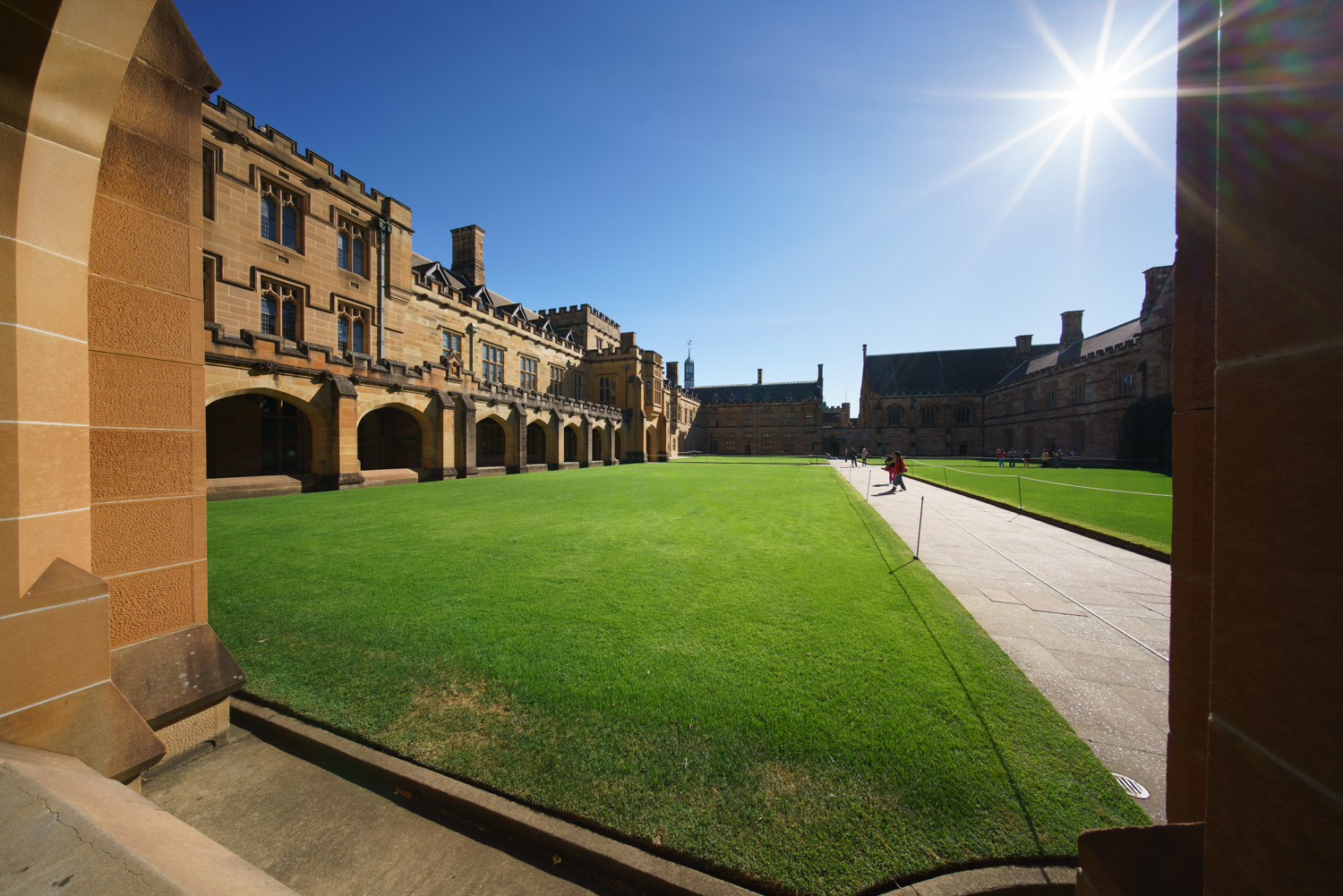


 ).
).