p.33 #1 · Pre-order: Fujifilm GFX 50S Medium Format body ($6,499)
taran wrote:
I have no idea what the Fuji does or does not do. I was merely stating that focus peaking, as a feature, seems to be a low priority for Sony.
Fuji seems to have their act together, so I look forward to what they can achieve with adapted lenses.
@ everyone else, I hope you are right, I was merely stating my concerns as an adapted lens user on the Sony platform, which really doesn't apply here.
In the past, when Fuji combined hardware from Nikon, and their own sensor, via S5pro, the firmware upgrade process was a bipartisan effort, and the process necessitated two engineering teams at two companies collaborating. In this case, Fuji with Sony, I imagine the process to be the same, and that Fuji won't be allowed to offer peaking features that exceed Sony's own cameras. Just as S5 pro never really offered anything better than Nikon's own D200, and cost a hell of a lot more.
Everyone says I am wrong though, in this thread, and other places, so perhaps its not the conspiracy I make it out to be.
Fuji is just buying a sensor from Sony like many other companies do. This is not a combined engineering effort and there is no reason whatsoever to think that Sony has any say or involvement in Fuji firmware. Also focus peaking doesn't depend on any specific support from the sensor. Sony has no role to play in the quality of Fuji's focus peaking algorithms.
p.33 #2 · Pre-order: Fujifilm GFX 50S Medium Format body ($6,499)
adamdewilde wrote:
The 90/2 Summicron-R for sure will cover it.
The APO-Elmarits 100 and 180 have the IC for it, but I haven't looked to see how much resolution falls off outside of the 42mm IC.
The Tely-Elmar 135/4, with the head removed from the RF helicoid and transplanted into an M52 or M58 helicoid will cover will fairly consistent resolution (not high, but consistent). It should make a killer portrait lens.
p.33 #3 · Pre-order: Fujifilm GFX 50S Medium Format body ($6,499)
adamdewilde wrote:
The 90/2 Summicron-R for sure will cover it.
nehemiahphoto wrote:
This is what I was trying to figure out, but it seems it's a trial and error approach...I was going to jump the gun and pick up some glass before it gets inflated.
Is that the APO ASPH version? It's already more costly in R form than M... definitely not a bargain in either mount. The non-ASPH might be a different matter.
p.33 #4 · Pre-order: Fujifilm GFX 50S Medium Format body ($6,499)
taran wrote:
In the past, when Fuji combined hardware from Nikon, and their own sensor, via S5pro, the firmware upgrade process was a bipartisan effort, and the process necessitated two engineering teams at two companies collaborating. In this case, Fuji with Sony, I imagine the process to be the same, and that Fuji won't be allowed to offer peaking features that exceed Sony's own cameras.
Buying just a sensor is very different than taking a complete digital camera and switching out the sensor. That was a total hack job. My personal theory is that it was a proof-of-concept product and their main interest was in building a sensor business. Anyway, Fuji already uses Sony sensors and they're great on firmware updates, so it's safe to say you've got nothing to worry about.
This is the camera i have been looking for if i can mate the tse lenses that i have.
Lots of info on that link. Thank you!
At least we know that currently the prototype does not have EFCS but it's likely to be included in the final production.
I hope it does because it's a crucial feature IMO.
p.33 #8 · Pre-order: Fujifilm GFX 50S Medium Format body ($6,499)
Fred Miranda wrote:
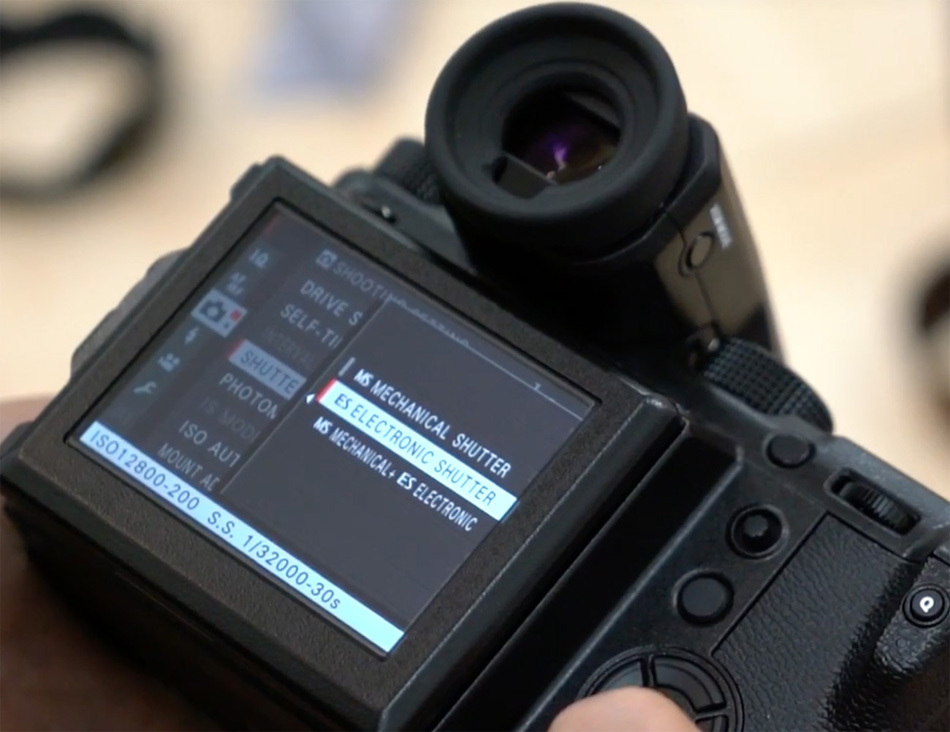
Here is a screenshot showing the shutter options: (captured from the above video)
That looks identical to the similar screen on my XPro2 if I recall it correctly. The electronic shutter mode is useful to me in a number of situations.
p.33 #9 · Pre-order: Fujifilm GFX 50S Medium Format body ($6,499)
rscheffler wrote:
Probably just me, but I much prefer to read interviews... so what did they say was the reason for the Bayer CFA?
To reduce the complexity of the signal processing.
p.33 #11 · Pre-order: Fujifilm GFX 50S Medium Format body ($6,499)
alundeb wrote:
To reduce the complexity of the signal processing.
I know it's contentious (and I'll not pollute this thread with my opinion) but my real curiosity is if Fuji continues the x-trans in future ASP-C bodies. I could see it going either way. Fuji could go bayer by establishing some consistency between lines. Obviously, with the XA-1 and now GFX 50S, Fuji has established that IQ with a Bayer is entirely possible (and I think necessary) for many.
But they could also leave it as it serves a lower end of the market, it's an emblem of that line (however debatable). It would be wonderful if they offered both, but I doubt this.
p.33 #12 · Pre-order: Fujifilm GFX 50S Medium Format body ($6,499)
alundeb wrote:
That ISO 200 minimum stuff makes me pause. It should be 50 like it is on the larger Sony sensors.
It's been a while, but as I understand it, the Sony ISO 50 option isn't native like the D810's ISO 64 in that you are penalized for using ISO 50 with less DR. Can't check DXO or other site now. I also don't like a native ISO 200...
p.33 #13 · Pre-order: Fujifilm GFX 50S Medium Format body ($6,499)
rscheffler wrote:
Probably just me, but I much prefer to read interviews... so what did they say was the reason for the Bayer CFA?
I basically did read it. His accent was just too strong for me so I just turned on subtitles and cranked up the playback speed.
He claims these pixels are large enough that they didn't feel whatever performance boosts they get from X-Trans on the little sensors were not needed and so they opted to simplify the camera's processing pipeline. I'm not sure that makes a whole ton of sense to me.
Perhaps more interesting is that he basically says they tweaked the microlens design compared to the stock version of this sensor to better deal with a short flange depth and related steeper ray angles. He also seemed open to the idea of third party adapters. Much more encouraging than Sony's "we'll just build giant lenses and legacy rangefinder users can screw themselves" approach with the A7x series.
p.33 #18 · Pre-order: Fujifilm GFX 50S Medium Format body ($6,499)
Lee Saxon wrote:
Well,
(a) at 36x24 crop this is still a 30.6 megapixel sensor, that's nothing to sneeze at
(b) Fuji has listened to many of the desires of the potential market for this camera, so there's every reason to hope it has a quality imaging pipeline and uncooked raw at least on par with pro DSLRs (which would make it the only mirrorless option [with a focal plane shutter] which does)
(c) As Fred mentioned, the Tilt/Shifts would *actually* cover 44x33 (and still have room for some movements). A Canon 13mm f/3.3 with some movements? That's pretty frakking cool.
Now, I don't think this camera is a good investment if that's all you're going to use it for. But if you'd also use it "right" (buy native lenses or adapt other MF ones), the above are some neat "bonus" possibilities.
Myself, I think Sony is going to realize that designing cameras to up-sell NEX customers (A7 series) isn't going to get them everywhere they want to go and finally design one to convert pro DSLR users (A9). And by then (or immediately thereafter), Canon and Nikon are finally going to get with the 21st century. I'm leaning toward waiting for that....Show more →
Note: I'm not dissing the camera, just trying to get an objective idea of which hopes and claims are correct and also of which may be somewhat less realistic or useful.
For example, regarding the use of FF-oriented TS lenses, while they might give coverage of the larger (by nearly twice as much) 33 x 44 frame, they would not likely be usable across the full range of their movements. I have no doubt that there might be some photographers interested in such an arrangement (and more power to them!) but I am pretty sure that the number would be a lot less than, say, those who would be interested in TS lenses that do provide full movement range — and that this especially likely to be true among the kinds of photographers who would spend nearly $10k for such a camera.
Again, I'm impressed with the camera, but I just think some of the (plausible) ideas for adapting lenses are not going to be all that appealing to many users. On the other hand, I'm confident that adapters that allow the use of non-Fujifilm MF lenses on the camera will be more popular.
p.33 #19 · Pre-order: Fujifilm GFX 50S Medium Format body ($6,499)
I think most folks would know that as that does exist today very much using a MF tech cam as a lot of lenses will not get past the image circle with shifts and rise and fall. Case in point a Rodie 23mm on a Full frame back is about 17mm from memory that lens you can shift very little like 5mm forget the exact number but I do remember only 3mm of rise or fall before you get into a hard vignetting . This will certainly happen with say Canons T/S as you will hit a wall in the same fashion . Where that is we have to really test for it because color shift will happen before you hit the vignetting or hard wall limit. Now there is a trick in MF where we use a LLC card where we take a diffused milk white like plexiglass card put that over the lens open up about a stop take a shot than in software it analyzes the white image corrects the color shift than it gets that data and applies it to the real image and cleans it up. It's a little complicated in a way but every tech cam shooter has to do this for every shift amount. Panos like 3 shots well you have to take 3 LCC shots for each pano frame too. Than correct each 3 images than stitch it. I'm simplifying it here but it is a process to remove color shift. Sticking a Canon T/S will involve the same process. Now sometimes you can get away with a 5mm or even 10mm shift without any problems but in general the more you shift the more color issues your going to hit so this is when LCC come into play. Learning curve here but there is not going to be a free picnic if your getting close to the image circle and going back to a limited one with a 35mm lens this can be a real issue to deal with.
This stuff really needs to be tested as Fuji also from what I read put micro lenses on the sensor and that can have a negative effect for shifting. I know it all sounds like fun and it is adapting lenses but our limitations will be image circle really big enough to avoid color shift in the first place than using LCC techniques. MF shift lenses will be less if a issue because a much bigger image circle. We just won't know any of this until we actually try it and find the limits.
p.33 #20 · Pre-order: Fujifilm GFX 50S Medium Format body ($6,499)
Anyone know the exit pupil distances of the Rodenstock or Schneider tech lenses? I checked both sites and didn't find any info about this. According to Lensrentals The TS-E 17 is ~90mm and the 24 is 86mm.
I don't doubt there is potential for color shifts and that the micro lens optimization may or may not play along...