p.5 #1 · Canon 5D4 dynamic range analyzed from RAWs
Given that the HW has capability of reading both A and B separately and AB combined, the optimal readout sheme regarding read noise and DR in the main raw data would be:
main = (A/2+B/2) at low ISO
main = (AB)/2 at high ISO.
Combining (AB)/2 and and A in FW into a high DR simple raw file is not a trivial computation.
The reason we cannot get (A/2+B/2) could be that the sensor only has HW capability of A and AB. This scheme is probably also used for DPAF.
There is probably also a limitation that the same gain in the ISO amplifier has to be used for both A and AB.
p.5 #2 · Canon 5D4 dynamic range analyzed from RAWs
And of course the highlight recovery from A would not give anything at the lowest ISO where A would be clipped at (AB)/2 anyway. Both A and B reaches FWC and absolute saturation at the level where the readout of AB touches the clipping level and A gives an unclipped reading, given that they use the same HW amplification.
The peak DR will actually be acheived by combining AB and A at ISO 200 I think, where A would give a saturated unclipped readout at FWC, and the read noise of AB is still low.
p.5 #4 · Canon 5D4 dynamic range analyzed from RAWs
Schlotkins wrote:
So basically, if you could combine both shots then DR would equal the best Sony/Nikon sensors? is that right?
Yes, about so. The highlights would have a bit more noise, but that is not a problem in reality.
You would have to shoot differently to get the same result though. Shoot at one ISO stop higher and overexpose one stop, then pull back and combine. ETTR would get yet another meaning
But seriously, yes, it seems that DP RAW can squeeze another stop of DR and it can be done as it is with post -processing.
p.5 #5 · Canon 5D4 dynamic range analyzed from RAWs
skibum5 wrote:
It also seems like their sensor+new ADC on chip system actually can deliver as much DR as Nikon can manage at ISO100 or in that range but by going with DualPixel design for AF for video and using 14bit HW they are losing a stop and it seems like perhaps all dualpixel bodies could have had one more stop of DR had they been traditional AF cameras only? Or if they simply decide to care more about DR than this minor focus shift, bokeh shift stuff.... honestly I sort of think it would've been far more worth it to just deliver the extra stop without compromise than this bokeh, flare, focus micro shift stuff which I'm not sure will end up being used all that much once the novelty wear off. I mean I'm sure it could be useful at times but.... ...Show more →
We need to consider Canon's longer term outlook about the cameras these new sensors will go in.... All so far include fairly robust video capability and they're seemingly only a step away from full-fledged mirrorless (strip the OVF in favor of an EVF). Once that happens, DPAF capability, and hence the split-pixel design, will be a critical component of mirrorless AF performance.
This continues the trend since the 5DII of increasingly stills/video hybridization. The tradeoff of course is pure stills (and pure video) capability. Maybe the stills side could be addressed with a custom sensor for the 5DS Mark II? That's likely the niche of the market where the end user will value the greatest possible DR with the greatest possible resolution.
From my point of view, I'm happy with Canon's direction. General sensor performance is once again competitive and the DPAF implementation appears to be extremely good. This offers some reassurance that whenever Canon finally releases a 'pro' FF mirrorless camera, that it should be a fairly smooth transition from DSLRs. I.e. not the many compromises found in the Sony a7 series.
This particular shot allows to perceive the potential effect of using the extra subimage to recover the lost highlights.
Fortunately this picture is taken at f/2.2; and despite being a 35mm lens, the focus is relatively near (from the exif information focus upper/lower, the focus seems placed at about 5 metres, matching the visual guess).
If you use a image viewer allowing to switch back and forth at 100% between both images while keeping the position (I use geeqie in Linux), the parallax effect it clearly visible, specially in the subjects placed behind the persons in focus at the image centre. Still, only a tiny amount of pixels. The out of focus areas are also more blurred in the combined image. On the other hand, the extra subimage shows apparently more chromatic aberration in the bokeh (maybe the burning in the main image, combined with dcraw processing, is contributing to mask it out).
So, shooting landscapes seems to be a perfect candidate for recovering highlights from the secondary extra image. Or even more radical: to directly use it as a backup of the main when overexposed: this may still get a natural photo (maybe not the most real, but something equivalent occurs when the lack of AA filter adds subtle amounts of real plus invented detail). The subimage in this example is less blurred in the OOF areas (I assume that the other separate subframe -the one not provided by Canon- would also have more apparent depth of field). Anyway, for landscapes common focus distances and apertures that could be not noticeable, and I suspect that DOF if the same, only the blurring changes.
The algorithm to recover the highlights in shallow DOF photos could be far more demanding, because the parallax effect will be strong. It would be interesting to see an f/1.4 example at longer focal lengths.
p.5 #7 · Canon 5D4 dynamic range analyzed from RAWs
don't think the parallax is real or makes sense, I think the lighting shift tricks the brain into thinking pixels shift over a touch? it would be good if I am correct since if parallax entered into the mix it might make it not so usable in the end
it does seem like the the single channel has more DOF than the combined, which sort of makes sense, perhaps it could lead to a bit harsh bokeh when combined for low DOF shots, for f/8 landscape stuff I think it might be OK though (assuming the lighting can be uniformly compensated for otherwise highlights might look like they are lit in opposition to the rest of the image), hopefully for low DOF wildlife it still wouldn't look too bad it might make the lense blur and bokeh a bit worse quality
p.5 #8 · Canon 5D4 dynamic range analyzed from RAWs
These are the final DR graphs, using the RAW samples from Imaging Resource. When there are several RAW for a given ISO level (e.g. 4 files for ISO 100) the file with the higher DR has been selected (but the differences are tiny).
Note how the 5D4 has different values for each color channel, specially at low ISO levels. This is a very rare feature:
The comparison uses the two greens channels combined on each camera. Had we used the combination of the 4 channels (RGGB) the result would almost 100% match that of the combined greens alone:
p.5 #10 · Canon 5D4 dynamic range analyzed from RAWs
Would my observation be correct if I deduced that the 1Dx2 and 5D4 are quite even, but that the 1Dx2 has a roughly 1/3 stop advantage in S/N in the 800 to 12800 ISO range?
p.5 #12 · Canon 5D4 dynamic range analyzed from RAWs
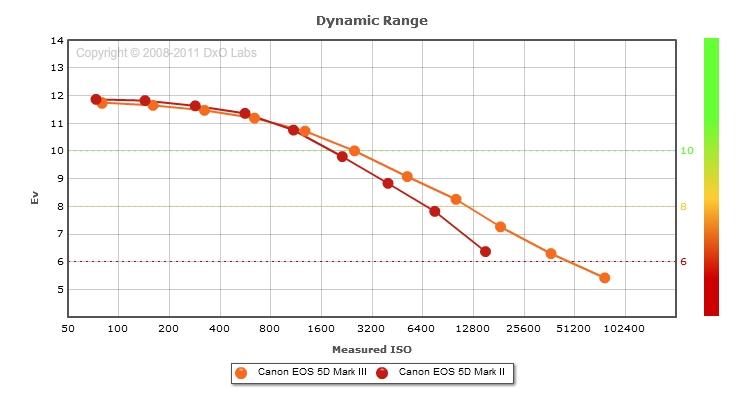
nevermind... I found this chart.
WAIT so the 5D III had slightly worse/same-ish dynamic range than the II unless you were going over 1600 ISO?
and I'll be seeing about 2 stops of DR improvement moving up to the 5D IV.
I'm really curious to see how this will effect my photos. I'm a little cautious as my first digital, the 350D, has pretty much the same DR measurement as my second DSLR the 5D.
I really didn't like the 350D. Just was not happy coming from film and going to that image quality. The 5D converted me to digital.
p.5 #13 · Canon 5D4 dynamic range analyzed from RAWs
The big difference in terms of noise between the 5D2 and 5D3 was the higher ISO noise. The 2 had a lot of pattern noise (banding) that was drastically reduced with the 3. Much easier to clean up an ISO 6400 or 12800 image on the 3 than on the 2.
p.5 #16 · Canon 5D4 dynamic range analyzed from RAWs
Tom_W wrote:
The big difference in terms of noise between the 5D2 and 5D3 was the higher ISO noise. The 2 had a lot of pattern noise (banding) that was drastically reduced with the 3. Much easier to clean up an ISO 6400 or 12800 image on the 3 than on the 2.
The 3 has that nasty banding issue that is a pain to clean up at times. Hoping the 4 resolves that. It wasn't an everyday problem, but it definitely made more work for me at times.
p.5 #17 · Canon 5D4 dynamic range analyzed from RAWs
Interesting - I found the 5D3 to be considerably cleaner in the mid-high ISO range than the 2, and I really didn't notice the banding much. But I generally stayed at 6400 and below. Sure, if you pushed it hard, you could see the banding in the shadows, but it was much better than the 2 in that respect.
I shouldn't be saying "was" - it sounds like an obituary.
Still have mine, until the Mk 4 proves itself.
p.5 #18 · Canon 5D4 dynamic range analyzed from RAWs
Tom_W wrote:
The big difference in terms of noise between the 5D2 and 5D3 was the higher ISO noise. The 2 had a lot of pattern noise (banding) that was drastically reduced with the 3. Much easier to clean up an ISO 6400 or 12800 image on the 3 than on the 2.
5D2 had a fixed pattern noise that was both horizontal and vertical and impossible to clean up, the 5D3 had a vertical fixed pattern noise, but could be cleaned up, but both had poor shadow DR, although 3 was better. 5DsR is a lot better again as it has no fpn in shadows and effective shadow DR is probably 2EV better.
This particular shot allows to perceive the potential effect of using the extra subimage to recover the lost highlights.
Fortunately this picture is taken at f/2.2; and despite being a 35mm lens, the focus is relatively near (from the exif information focus upper/lower, the focus seems placed at about 5 metres, matching the visual guess).
If you use a image viewer allowing to switch back and forth at 100% between both images while keeping the position (I use geeqie in Linux), the parallax effect it clearly visible, specially in the subjects placed behind the persons in focus at the image centre. Still, only a tiny amount of pixels. The out of focus areas are also more blurred in the combined image. On the other hand, the extra subimage shows apparently more chromatic aberration in the bokeh (maybe the burning in the main image, combined with dcraw processing, is contributing to mask it out).
So, shooting landscapes seems to be a perfect candidate for recovering highlights from the secondary extra image. Or even more radical: to directly use it as a backup of the main when overexposed: this may still get a natural photo (maybe not the most real, but something equivalent occurs when the lack of AA filter adds subtle amounts of real plus invented detail). The subimage in this example is less blurred in the OOF areas (I assume that the other separate subframe -the one not provided by Canon- would also have more apparent depth of field). Anyway, for landscapes common focus distances and apertures that could be not noticeable, and I suspect that DOF if the same, only the blurring changes.
The algorithm to recover the highlights in shallow DOF photos could be far more demanding, because the parallax effect will be strong. It would be interesting to see an f/1.4 example at longer focal lengths. ...Show more →
The perspective change from the different images is very subtle and this is due to the very limited baseline afforded by the size of the lens aperture. Human eye separation is of order 60-65mm, but even @ f/2.2 the 35mm lens has an effective aperture (entrance pupil) of 16mm.
p.5 #20 · Canon 5D4 dynamic range analyzed from RAWs
Pixel Perfect wrote:
5D2 had a fixed pattern noise that was both horizontal and vertical and impossible to clean up, the 5D3 had a vertical fixed pattern noise, but could be cleaned up, but both had poor shadow DR, although 3 was better.
Sigh.
But 13.5 stops of DR? I'm expecting all of the folks who felt that DR was the be all and end all to come rushing back to Canon.


 ? Or if they simply decide to care more about DR than this minor focus shift, bokeh shift stuff.... honestly I sort of think it would've been far more worth it to just