This topic is in the 2016 archive. You can read it and like its posts here. It is read only.
Archive 2016LensRentals: Planar T* FE 50/1.4 ZA is absolutely superb!
p.5 #1LensRentals: Planar T* FE 50/1.4 ZA is absolutely superb!
Fred, I'm looking forward to what you find. One of the really cool things about this forum is we've got skilled people who can run the gamut from lab testing to field correlation. It's an awesome feedback loop.
I can get the sensor assembly, the trick for me is two fold. First getting the entire glass assembly including the last piece off of the sensor intact. But even then it leaves us glass that is a bit smaller than we'd like. We already have issues at 20mm because of the baffle. I fear edge reflections (because the glass has to be further in front of the microscope of the MTF bench than it would the camera) would further complicate things. What I really need is a 6 or 8 cm diameter window of the same thickness.
One thing that I think Fred mentioned earlier - why would the difference matter now when it didn't seem to with other lenses. We would expect f/1.4 lenses to be much more sensitive than f/1.8 or 2.8 lenses. One of the things that has me suspicious is the 85 f/1.4 GM has a bit of a similar appearance. The 35mm f/1.4 didn't but that lens had so much sample variation that I suspect it masked the finding.
Jul 18, 2016 at 06:20 PM
p.5 #2LensRentals: Planar T* FE 50/1.4 ZA is absolutely superb!
realVivek wrote:
Physical thickness (what everyone refers to, in general)
The optical thickness is an obfuscating term introduced when ridiculous numbers from unreliable collections were employed in a discussion. Also note that the optical thickness has some assumptions to calculate and arrive at the numbers.The optical thickness is not so complicated and is what matters in terms of the effect of the coverglass on the performance of the lens. It is simply the physical thickness multiplied by the refractive index. The coverglass is typically made of a material very similar to N-K5 glass or its equivalents from Ohara or Hoya. Regardless, you can safely multiply the physical thickness by about 1.47 to arrive at the optical thickness.You basically expanded on the assumptions I referred to. The cover glass material is different than that of the stack which is an epoxied stack of two different materials. So, there are 4 materials involved (including the epoxy).
From the optical transmission of the cover glass, I would conclude that it is not N-K5 or its equivalent.
As i mentioned earlier, the A7 sensor is only $250. It is easy to verify everything.
I'll replace "made" with "modeled by in optical design software," the Compact Zoom and other cinema lenses from Zeiss use N-K5 as the coverglass material. That is likely a carryover from microscope slides, but if they consider it good enough for the master anamorphic lenses, I would consider it an adequate model.
Brandon Dube wrote
realVivek wrote
Matt Grum wrote
Is that the physical thickness or the optical thickness?The optical thickness is an obfuscating term introduced when ridiculous numbers from unreliable collections were employed in a discussion. Also note that the optical thickness has some assumptions to calculate and arrive at the numbers.
From the optical transmission of the cover glass, I would conclude that it is not N-K5 or its equivalent.
As i mentioned earlier, the A7 sensor is only $250. It is easy to verify everything.
I'll replace "made" with "modeled by in optical design software," the Compact Zoom and other cinema lenses from Zeiss use N-K5 as the coverglass material. That is likely a carryover from microscope slides, but if they consider it good enough for the master anamorphic lenses, I would consider it an adequate model.
Jul 18, 2016 at 06:39 PM

p.5 #3LensRentals: Planar T* FE 50/1.4 ZA is absolutely superb!
Fred Miranda wrote:
Now what does the mid zone dip mean? My guess is you will have to very closely pixel peep to see it at f/1.4 and you won't even be able to see it with such peeping at f/2. IMO, not a serious issue at all. So, if we keep the strengths in perspective, then we should note that it is not sharper than all other 50s in all ways, but if we keep the weaknesses in perspective then we should note that even the mid zone dip is unlikely to create any serious problems. That's how I see it anyway.
Now, when people actually get the lens in their hands (thank you Fred for offering to do tests, you do a fantastic job) we will learn a lot more about what I see as the more important stuff. How does the lens perform at infinity, at medium distances, and close up? How is the bokeh at middle distances, close up, at large distances? How about wide open and stopped down a fair bit? How is the coma performance, wide open and how does it clear up stopped down? How about the bokeh fringing, how bad is it wide open and how far does the lens need to be stopped down for it to clear up? How is the contrast wide open; are there still some spherical aberrations? What about astigmatism in the corners; how it is wide open and then stopped down? All these things matter to me at least as much as sharpness and it will take more than just one review to address them (even as good as Fred's reviews are he doesn't try to address all these issues). So, it is early and the lens looks great, but let's try to keep both the positives (there is a good chance the Otus will beat it in at least some ways) and the negatives (that mid zone dip probably is a small issue at most) in perspective.Rogers article says the mid zone dip may be an artifact of their testing rig having not quite the right stack thickness...
EDIT. Oops I see many others have pointed out this possibility, still I won't delete as reading above I can see I wasn't the only one not to have got to those posts so it bears saying again...I think Roger is testing with a 2mm glass cover and it seems to be working great so far. Perhaps the magic number is 2.5mm (or 2.3mm) but we don't know for sure if that would improve things noticeably. He was able to test with 1mm and 3mm glass covers and the MTF looked worse at these thicknesses.
Sony's own 'computerized' MTF shows the same tangential line dip at mid-field (look at the blue lines showing 40 line pairs/mm).
It's not as deep when compared to LensRentals but it's there at f/1.4. As someone wrote, this may not even show up...Show more →
I think these graphs show the mid zone dip is likely to be part of how the lens performs, but I think they are also consistent with Roger using glass that is a bit too thin. The mid zone dip is a bit more exaggerated in the Roger's data (compared to the Sony charts) and more telling the tang lines do not rebound over the sag lines like they do in the Sony chart. All that is consistent with a bit too thin glass in the path.
Said another way the Sag lines from Roger's data match almost exactly the Sony chart, but the tang lines are lower. A selective lowering of the tang lines is consistent with what happens when the cover glass is too thin.
DavidBM wrote
Steve Spencer wrote
I think I was the one who brought up the mid zone dip. I wish now I would not have done so, some seem to have given it way too much weight. Yes, it is there in the MTFs, but it is less extreme than some awfully good lenses (i.e., the Leica M 50 f/1.4) for which it is hardly noticeably in practice. I don't think it is going to be a serious issue for this lens at all. IMO, it is really only an issue when comparing this lens to the Otus. The FE 50 f/1.4 has about as much of a sharpness advantage over the Otus as the Otus has over the FE 50 f/1.4 in the mid zone. Their sharpness patterns are about equal, but different. That was all I was trying to say. My comment was really meant to note that as exciting as this lens is, there are still some ways that the Otus will outperform it (e.g., corrections for aberrations and mid zone sharpness).Now what does the mid zone dip mean? My guess is you will have to very closely pixel peep to see it at f/1.4 and you won't even be able to see it with such peeping at f/2. IMO, not a serious issue at all. So, if we keep the strengths in perspective, then we should note that it is not sharper than all other 50s in all ways, but if we keep the weaknesses in perspective then we should note that even the mid zone dip is unlikely to create any serious problems. That's how I see it anyway.
Now, when people actually get the lens in their hands (thank you Fred for offering to do tests, you do a fantastic job) we will learn a lot more about what I see as the more important stuff. How does the lens perform at infinity, at medium distances, and close up? How is the bokeh at middle distances, close up, at large distances? How about wide open and stopped down a fair bit? How is the coma performance, wide open and how does it clear up stopped down? How about the bokeh fringing, how bad is it wide open and how far does the lens need to be stopped down for it to clear up? How is the contrast wide open; are there still some spherical aberrations? What about astigmatism in the corners; how it is wide open and then stopped down? All these things matter to me at least as much as sharpness and it will take more than just one review to address them (even as good as Fred's reviews are he doesn't try to address all these issues). So, it is early and the lens looks great, but let's try to keep both the positives (there is a good chance the Otus will beat it in at least some ways) and the negatives (that mid zone dip probably is a small issue at most) in perspective.
EDIT. Oops I see many others have pointed out this possibility, still I won't delete as reading above I can see I wasn't the only one not to have got to those posts so it bears saying again...
Sony's own 'computerized' MTF shows the same tangential line dip at mid-field (look at the blue lines showing 40 line pairs/mm).
It's not as deep when compared to LensRentals but it's there at f/1.4. As someone wrote, this may not even show up...Show more →
I think these graphs show the mid zone dip is likely to be part of how the lens performs, but I think they are also consistent with Roger using glass that is a bit too thin. The mid zone dip is a bit more exaggerated in the Roger's data (compared to the Sony charts) and more telling the tang lines do not rebound over the sag lines like they do in the Sony chart. All that is consistent with a bit too thin glass in the path.
Said another way the Sag lines from Roger's data match almost exactly the Sony chart, but the tang lines are lower. A selective lowering of the tang lines is consistent with what happens when the cover glass is too thin.
Jul 18, 2016 at 06:40 PM
p.5 #4LensRentals: Planar T* FE 50/1.4 ZA is absolutely superb!
Wide difference in the midzone between sag and tang lines could indicate harsh bokeh. Midzone dip reminds me of some of the fast Leica M lenses which have field curvature. Wonder if this lens has much FC?
Jul 18, 2016 at 06:47 PM
p.5 #5LensRentals: Planar T* FE 50/1.4 ZA is absolutely superb!
wayne seltzer wrote:
Wide difference in the midzone between sag and tang lines could indicate harsh bokeh. Midzone dip reminds me of some of the fast Leica M lenses which have field curvature. Wonder if this lens has much FC?
No. If you read the review, he has tested FC and it has astonishingly little. The mid dip (as Roger notes and as others have pointed out) may be an artefact of the sensor cover glass in the test.
Jul 18, 2016 at 06:51 PM
p.5 #6LensRentals: Planar T* FE 50/1.4 ZA is absolutely superb!
I'll test it against my GM 85 when I get it
Jul 18, 2016 at 07:03 PM
p.5 #7LensRentals: Planar T* FE 50/1.4 ZA is absolutely superb!
For my uses - unless it has auto focus it is of no use.
What good is all the superb image quality when the focus is missed by even an inch when at f/1.4 ?
I don't know what's keeping them from adding auto focus, but I do know for sure they would sell more of them even if the price went up quite a bit.
What good is all the superb image quality when the focus is missed by even an inch when at f/1.4 ?
I don't know what's keeping them from adding auto focus, but I do know for sure they would sell more of them even if the price went up quite a bit.
Jul 18, 2016 at 07:08 PM
p.5 #8LensRentals: Planar T* FE 50/1.4 ZA is absolutely superb!
I wonder why the Otus MTF looked so much different than the one on brochure. Zeiss stated the Otus reached 70% contrast on 40 lp/mm at the center (Erwin Puts confirmed this), but it's not the case from Roger's measurement. What would be the possible cause?
Jul 18, 2016 at 07:10 PM
p.5 #9LensRentals: Planar T* FE 50/1.4 ZA is absolutely superb!
DavidBM wrote:
No. If you read the review, he has tested FC and it has astonishingly little. The mid dip (as Roger notes and as others have pointed out) may be an artefact of the sensor cover glass in the test.
Ok, thanks i missed that in the review. Well, usually something has to be sacrificed to raise the bar much in fast 50's so i am wondering what that is? With Otus its size, weight and price.
The fact it is sharper at 50mm rather than 55mm is harder to do too.
wayne seltzer wrote
Wide difference in the midzone between sag and tang lines could indicate harsh bokeh. Midzone dip reminds me of some of the fast Leica M lenses which have field curvature. Wonder if this lens has much FC?Ok, thanks i missed that in the review. Well, usually something has to be sacrificed to raise the bar much in fast 50's so i am wondering what that is? With Otus its size, weight and price.
The fact it is sharper at 50mm rather than 55mm is harder to do too.
Jul 18, 2016 at 07:29 PM
p.5 #10LensRentals: Planar T* FE 50/1.4 ZA is absolutely superb!
phuang3 wrote:
I wonder why the Otus MTF looked so much different than the one on brochure. Zeiss stated the Otus reached 70% contrast on 40 lp/mm at the center (Erwin Puts confirmed this), but it's not the case from Roger's measurement. What would be the possible cause?
There are a lot of different ways to do an MTF test, related to the coverglass and color content choices. Zeiss does do their MTF measurements differently to those done at Olaf/LensRentals. There are, however, a number of Otus lenses in the Olaf/LensRentals measurement pool that would look like that. They generally look like one of these two scenarios:
http://i.imgur.com/SsOkMMi.png
or
http://i.imgur.com/sPqpmxt.png
Jul 18, 2016 at 07:34 PM
p.5 #11LensRentals: Planar T* FE 50/1.4 ZA is absolutely superb!
It's likely - very likely - to be a lens aimed at GM users; a fast-heavy-large lens designed for professional usage wide open with the bokeh-centric image built around a strong center.
With MTF, you really have to compare within (not across) certain methodologies and procedures. Sony's own data make it very clear the FE55 is stronger at f8, where that lens has ultra high (calculated) results, with none of the astigmatism of the FE 50/1.4.
Informed users of the FE55 use it stopped down a little where possible - as it is an all rounder, not a specialized lens. Here for reference below, are Sony's own data, therefore same methodology, for these two lenses. Note levels of each line pair and pattern across the frame.
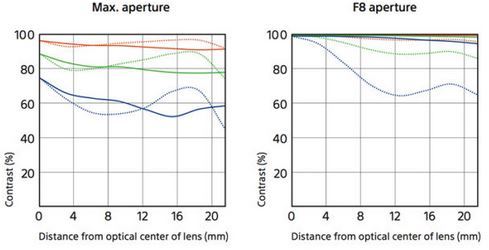
FE 50/1.4 (max aperture - f1.4 - and f8)
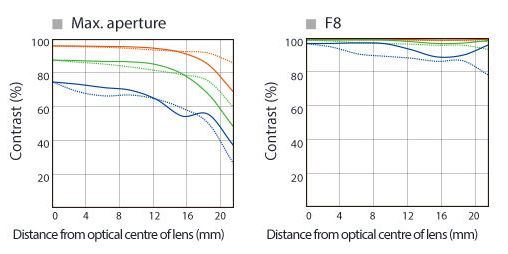
FE 55/1.8 (max aperture - f1.8 - and f8)
With MTF, you really have to compare within (not across) certain methodologies and procedures. Sony's own data make it very clear the FE55 is stronger at f8, where that lens has ultra high (calculated) results, with none of the astigmatism of the FE 50/1.4.
Informed users of the FE55 use it stopped down a little where possible - as it is an all rounder, not a specialized lens. Here for reference below, are Sony's own data, therefore same methodology, for these two lenses. Note levels of each line pair and pattern across the frame.
FE 50/1.4 (max aperture - f1.4 - and f8)
FE 55/1.8 (max aperture - f1.8 - and f8)
Jul 18, 2016 at 09:41 PM
p.5 #12LensRentals: Planar T* FE 50/1.4 ZA is absolutely superb!
philip_pj wrote:
It's likely - very likely - to be a lens aimed at GM users; a fast-heavy-large lens designed for professional usage wide open with the bokeh-centric image built around a strong center.
With MTF, you really have to compare within (not across) certain methodologies and procedures. Sony's own data make it very clear the FE55 is stronger at f8, where that lens has ultra high (calculated) results, with none of the astigmatism of the FE 50/1.4.
Informed users of the FE55 use it stopped down a little where possible - as it is an all rounder, not a specialized lens. Here...Show more →
Interesting. Not, then, a lens for Fred to use for landscapes, as he sort of guessed (at least in comparison to FE55 or the Loxia)
On a similar note Fred says that he likes Roger's test because, like his own, they are at infinity. That's what you need for landscapes. But he was wondering if this lens should replace the FE55 for portraiture and so on. But for that 2 or 3 metre testing is what you want, surely, not infinity...
Jul 18, 2016 at 09:45 PM
p.5 #13LensRentals: Planar T* FE 50/1.4 ZA is absolutely superb!
DavidBM wrote:
With MTF, you really have to compare within (not across) certain methodologies and procedures. Sony's own data make it very clear the FE55 is stronger at f8, where that lens has ultra high (calculated) results, with none of the astigmatism of the FE 50/1.4.
Informed users of the FE55 use it stopped down a little where possible - as it is an all rounder, not a specialized lens. Here for reference below, are Sony's own data, therefore same methodology, for these two lenses. Note levels of each line pair and pattern across the frame.Interesting. Not, then, a lens for Fred to use for landscapes, as he sort of guessed (at least in comparison to FE55 or the Loxia)
On a similar note Fred says that he likes Roger's test because, like his own, they are at infinity. That's what you need for landscapes. But he was wondering if this lens should replace the FE55 for portraiture and so on. But for that 2 or 3 metre testing is what you want, surely, not infinity...
I wrote previously on this thread that I don't think the new FE 50/1.4 was built for landscapes being a big and bulky f/1.4 lens and all. The same can be said about the 85 GM. However, the lack of field curvature, high resolution and contrast at infinity does not hurt anyone having lenses capable of doing it all. At this point, we are not sure how this lens performs at closer distances but it could possibly be its strength since it's suitable for events, portraits and general low light photography.
For me personally compacts like the Loxia 50/2 and CY 100/3.5 are my preference covering this range for landscapes.
philip_pj wrote
It's likely - very likely - to be a lens aimed at GM users; a fast-heavy-large lens designed for professional usage wide open with the bokeh-centric image built around a strong center.With MTF, you really have to compare within (not across) certain methodologies and procedures. Sony's own data make it very clear the FE55 is stronger at f8, where that lens has ultra high (calculated) results, with none of the astigmatism of the FE 50/1.4.
Informed users of the FE55 use it stopped down a little where possible - as it is an all rounder, not a specialized lens. Here for reference below, are Sony's own data, therefore same methodology, for these two lenses. Note levels of each line pair and pattern across the frame.
On a similar note Fred says that he likes Roger's test because, like his own, they are at infinity. That's what you need for landscapes. But he was wondering if this lens should replace the FE55 for portraiture and so on. But for that 2 or 3 metre testing is what you want, surely, not infinity...
I wrote previously on this thread that I don't think the new FE 50/1.4 was built for landscapes being a big and bulky f/1.4 lens and all. The same can be said about the 85 GM. However, the lack of field curvature, high resolution and contrast at infinity does not hurt anyone having lenses capable of doing it all. At this point, we are not sure how this lens performs at closer distances but it could possibly be its strength since it's suitable for events, portraits and general low light photography.
For me personally compacts like the Loxia 50/2 and CY 100/3.5 are my preference covering this range for landscapes.
Jul 18, 2016 at 11:30 PM
p.5 #14LensRentals: Planar T* FE 50/1.4 ZA is absolutely superb!
If this lens is what it's made out to be so far, it's almost a pity that it's designed for the short register and small-ish diameter of the NEX-cum-FE mount.
As un-adaptable as it gets
As un-adaptable as it gets
Jul 19, 2016 at 02:00 AM
p.5 #15LensRentals: Planar T* FE 50/1.4 ZA is absolutely superb!
xrayvision wrote:
For my uses - unless it has auto focus it is of no use.
What good is all the superb image quality when the focus is missed by even an inch when at f/1.4 ?
I don't know what's keeping them from adding auto focus, but I do know for sure they would sell more of them even if the price went up quite a bit.
Having to reverse engineer the AF protocol for several different systems. A very different proposition to making AF lenses for one company which you already have a close working relationship with. They could outsource the electronic communications to another company, like Metabones did with Conurus, however they still haven't worked out all the bugs in their adapter.
It's taken Sigma with significantly more resources a long time to get reliable autofocus across mounts, and I guess Zeiss didn't want the stellar optical performance of the lens marred in any way by AF issues ("I paid $4,000 for this lens and it wont even focus correctly").
Jul 19, 2016 at 02:39 AM
p.5 #16LensRentals: Planar T* FE 50/1.4 ZA is absolutely superb!
charles.K wrote:
The FE 50/1.4 looks to be a superb lens. Sharper than the Otus ... quite amazing!
The rendering, look and smoothness from the RAW files I have played with is all there and more. Look wise it appears to be that of the M50 Lux Asph cross with the M 50 Cron Pre Asph. If this means having the FE 50/1.4 that is about the same size/weight as the 50L with MB IV adapter, I am thrilled.
If this the FE 50/1.4 truly specs out as we expect, kudos to Sony for producing a great 50mm.
If you're telling me that the rendering is similar to the 50Lux, then I'm intrigued Charles.
Will keep on eye on this one. Might be forced to use Sony after all :P
Jul 19, 2016 at 03:19 AM
p.5 #17LensRentals: Planar T* FE 50/1.4 ZA is absolutely superb!
Fred Miranda wrote:
I wrote previously on this thread that I don't think the new FE 50/1.4 was built for landscapes being a big and bulky f/1.4 lens and all. The same can be said about the 85 GM. However, the lack of field curvature, high resolution and contrast at infinity does not hurt anyone having lenses capable of doing it all. At this point, we are not sure how this lens performs at closer distances but it could possibly be its strength since it's suitable for events, portraits and general low light photography.
For me personally compacts like the Loxia 50/2 and...Show more →
I'm always surprised to hear this; people wanting light lenses for landscape while using a 200/2 or something for portraits. I'm the opposite. I will set up a big honkin' tripod to shoot a landscape but I want to be mobile shooting people. Is the problem that if the gear is too heavy you can't get to the landscape site? I can see that.
Jul 19, 2016 at 03:44 AM
p.5 #18LensRentals: Planar T* FE 50/1.4 ZA is absolutely superb!
In regards to the mid zone with the GM 85 my mid range tests equaled exactly to Freds infinity test which I'm thinking this lens will do the same. Now I would not rule this lens out for landscape because of the flat field is perfect for it but obviously the other issue comes into play of weight, size
Now I would not hesitate to take the GM 85 to do landscapes because it is really nice at infinity but I bought a ZM 85 f4 only because of weight and size. Otherwise these two lenses are going to be killer good stopped down to landscape aperture like f5.6 and F8.
DavidBM wrote:
With MTF, you really have to compare within (not across) certain methodologies and procedures. Sony's own data make it very clear the FE55 is stronger at f8, where that lens has ultra high (calculated) results, with none of the astigmatism of the FE 50/1.4.
Informed users of the FE55 use it stopped down a little where possible - as it is an all rounder, not a specialized lens. Here for reference below, are Sony's own data, therefore same methodology, for these two lenses. Note levels of each line pair and pattern across the frame.Interesting. Not, then, a lens for Fred to use for landscapes, as he sort of guessed (at least in comparison to FE55 or the Loxia)
On a similar note Fred says that he likes Roger's test because, like his own, they are at infinity. That's what you need for landscapes. But he was wondering if this lens should replace the FE55 for portraiture and so on. But for that 2 or 3 metre testing is what you want, surely, not infinity...
Now I would not hesitate to take the GM 85 to do landscapes because it is really nice at infinity but I bought a ZM 85 f4 only because of weight and size. Otherwise these two lenses are going to be killer good stopped down to landscape aperture like f5.6 and F8.
DavidBM wrote:
philip_pj wrote
It's likely - very likely - to be a lens aimed at GM users; a fast-heavy-large lens designed for professional usage wide open with the bokeh-centric image built around a strong center.With MTF, you really have to compare within (not across) certain methodologies and procedures. Sony's own data make it very clear the FE55 is stronger at f8, where that lens has ultra high (calculated) results, with none of the astigmatism of the FE 50/1.4.
Informed users of the FE55 use it stopped down a little where possible - as it is an all rounder, not a specialized lens. Here for reference below, are Sony's own data, therefore same methodology, for these two lenses. Note levels of each line pair and pattern across the frame.
On a similar note Fred says that he likes Roger's test because, like his own, they are at infinity. That's what you need for landscapes. But he was wondering if this lens should replace the FE55 for portraiture and so on. But for that 2 or 3 metre testing is what you want, surely, not infinity...
Jul 19, 2016 at 03:45 AM
p.5 #19LensRentals: Planar T* FE 50/1.4 ZA is absolutely superb!
Yea it's the hiking scenario but if your working pretty much out of the car not such a big deal. As I get older I'm a little less likly to really go hike a 5 mile trail.
For me I like a light weight kit for more urban landscapes like walking around NY or something like that. For me if I'm carrying the big stuff it feels more like work. I went the other night on top of the rock here in NY. I took the RXr1 II and the 21 converter and it was such a joy to carry barely nothing get a couple great shots than head out to dinner. I took a little table top tripod and got some nice images. So for me the lighter a system is it does not feel like I'm out doing a gig for pay.
Lee Saxon wrote:
For me personally compacts like the Loxia 50/2 and CY 100/3.5 are my preference covering this range for landscapes.I'm always surprised to hear this; people wanting light lenses for landscape while using a 200/2 or something for portraits. I'm the opposite. I will set up a big honkin' tripod to shoot a landscape but I want to be mobile shooting people. Is the problem that if the gear is too heavy you can't get to the landscape site? I can see that.
For me I like a light weight kit for more urban landscapes like walking around NY or something like that. For me if I'm carrying the big stuff it feels more like work. I went the other night on top of the rock here in NY. I took the RXr1 II and the 21 converter and it was such a joy to carry barely nothing get a couple great shots than head out to dinner. I took a little table top tripod and got some nice images. So for me the lighter a system is it does not feel like I'm out doing a gig for pay.
Lee Saxon wrote:
Fred Miranda wrote
I wrote previously on this thread that I don't think the new FE 50/1.4 was built for landscapes being a big and bulky f/1.4 lens and all. The same can be said about the 85 GM. However, the lack of field curvature, high resolution and contrast at infinity does not hurt anyone having lenses capable of doing it all. At this point, we are not sure how this lens performs at closer distances but it could possibly be its strength since it's suitable for events, portraits and general low light photography.For me personally compacts like the Loxia 50/2 and CY 100/3.5 are my preference covering this range for landscapes.
Jul 19, 2016 at 03:54 AM
p.5 #20LensRentals: Planar T* FE 50/1.4 ZA is absolutely superb!
GMPhotography wrote:
In regards to the mid zone with the GM 85 my mid range tests equaled exactly to Freds infinity test which I'm thinking this lens will do the same. Now I would not rule this lens out for landscape because of the flat field is perfect for it but obviously the other issue comes into play of weight, size
Now I would not hesitate to take the GM 85 to do landscapes because it is really nice at infinity but I bought a ZM 85 f4 only because of weight and size. Otherwise these two lenses are going to be killer...Show more →
With MTF, you really have to compare within (not across) certain methodologies and procedures. Sony's own data make it very clear the FE55 is stronger at f8, where that lens has ultra high (calculated) ...
Guy I'm sure they will be very good at landscape apertures, but it is worth noting that Sony's calculated MTF shows the new 50 as better than the 55 1.8 wide open (agreeing with Roger) but also shows the 55 1.8 significantly better than the new 50 1.4 at f8. So the older lens (or indeed the Loxia) might be an even better choice for landscape.
In regards to the mid zone with the GM 85 my mid range tests equaled exactly to Freds infinity test which I'm thinking this lens will do the same. Now I would not rule this lens out for landscape because of the flat field is perfect for it but obviously the other issue comes into play of weight, size
Now I would not hesitate to take the GM 85 to do landscapes because it is really nice at infinity but I bought a ZM 85 f4 only because of weight and size. Otherwise these two lenses are going to be killer...Show more →
DavidBM wrote
philip_pj wrote
It's likely - very likely - to be a lens aimed at GM users; a fast-heavy-large lens designed for professional usage wide open with the bokeh-centric image built around a strong center.With MTF, you really have to compare within (not across) certain methodologies and procedures. Sony's own data make it very clear the FE55 is stronger at f8, where that lens has ultra high (calculated) ...
Guy I'm sure they will be very good at landscape apertures, but it is worth noting that Sony's calculated MTF shows the new 50 as better than the 55 1.8 wide open (agreeing with Roger) but also shows the 55 1.8 significantly better than the new 50 1.4 at f8. So the older lens (or indeed the Loxia) might be an even better choice for landscape.
Jul 19, 2016 at 04:22 AM