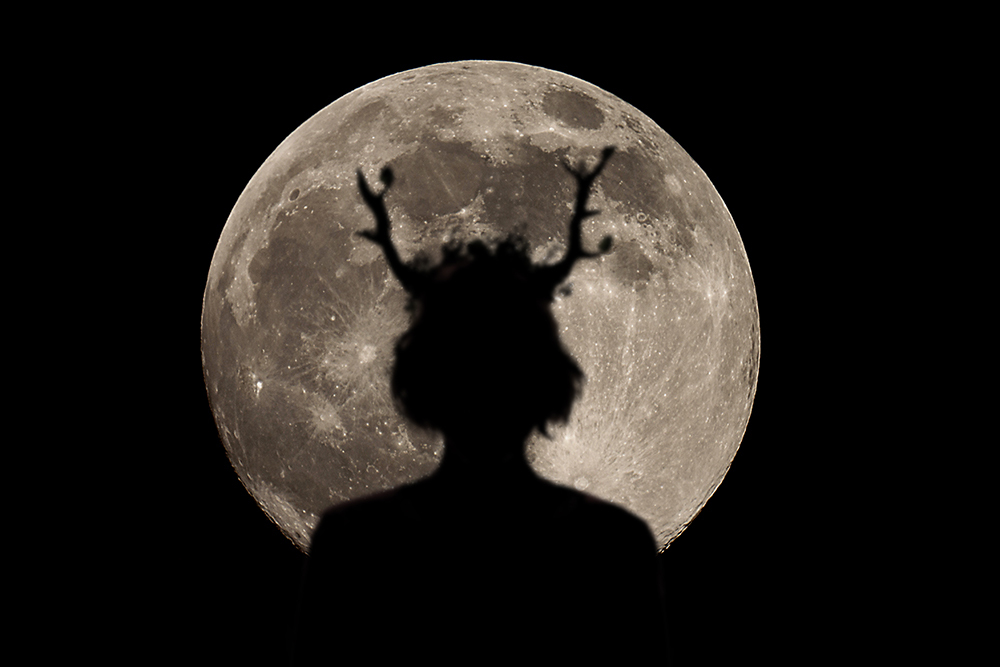
(1) The moon needs to be brighter. It makes no visual sense to me that the source of the light in the image is far darker and yellower than the very bright reflected light on your model (which in this case appears as a rim light around her chin, neck, and the "antlers." Also, the craters and seas on the moon are the same value or darker than the halo around the moon... again, that makes no visual sense.
(2) The light values on the model cannot equal the light values of the moon itself... at least not if you want to convincingly depict the lighting situation. Barring the addition of another obvious source of foreground light (e.g., underlit by warm campfire light), having your model appear as anything but a virtual silhouette is not particularly believable.
(3) The moon should be smaller. For it to be that big in the frame, you would've needed to have shot your model through a 600mm or longer.
(4) There needs to be something else in the sky, and it shouldn't be pitch black. Right now it is completely black and starless but for the strange yellow light from the moon... which doesn't make sense to me visually. It might help to try and take a picture of the moon properly exposed and seeing how the camera would render it. Then use the lessons learned from that rendition to inform your composite.
(5) Your initial lighting setup does not approximate how the moon would really light a person in this situation. Like the sun or any dominant celestial object, the moon is a very small (relative to the subject) yet bright point light source. So rather than a huge light source like the one you have there, a use bare bulb or conical reflector from slightly above and behind the model might've been a better choice (and also easier to composite, since you can use a green screen.
Arka wrote:
A few notes that I hope will be helpful.
(1) The moon needs to be brighter. It makes no visual sense to me that the source of the light in the image is far darker and yellower than the very bright reflected light on your model (which in this case appears as a rim light around her chin, neck, and the "antlers." Also, the craters and seas on the moon are the same value or darker than the halo around the moon... again, that makes no visual sense.
(2) The light values on the model cannot equal the light values of the moon itself... at least not if you want to convincingly depict the lighting situation. Barring the addition of another obvious source of foreground light (e.g., underlit by warm campfire light), having your model appear as anything but a virtual silhouette is not particularly believable.
(3) The moon should be smaller. For it to be that big in the frame, you would've needed to have shot your model through a 600mm or longer.
(4) There needs to be something else in the sky, and it shouldn't be pitch black. Right now it is completely black and starless but for the strange yellow light from the moon... which doesn't make sense to me visually. It might help to try and take a picture of the moon properly exposed and seeing how the camera would render it. Then use the lessons learned from that rendition to inform your composite.
(5) Your initial lighting setup does not approximate how the moon would really light a person in this situation. Like the sun or any dominant celestial object, the moon is a very small (relative to the subject) yet bright point light source. So rather than a huge light source like the one you have there, a use bare bulb or conical reflector from slightly above and behind the model might've been a better choice (and also easier to composite, since you can use a green screen. ...Show more →
Thank you Arka, for taking the time to provide such a nicely detailed response. It is much appreciated. I stated in my original post that it was a fantasy-based portrait. the definition of fantasy is "the faculty or activity of imagining things, especially things that are impossible or improbable." I did not set out to create a believable portrait, I set out to make a pretty portrait. I understand that this image could never happen. I was going for a heavily-backlit shot that would add to the drama of the final composite.
The moon in my composite was a photo I took on May 20th of this year. It was taken at 1250mm, F12, 1/30sec & 100 ISO, with a Canon T1i. The moon is very bright and the only time I have captured stars in a full-moon shot are during an eclipse.(or a much wider shot with the moon over-exposed) I actually had to make it smaller in my original composite.
You are absolutely correct when you say that a realistic attempt would result in a silhouette. Although not horrible, it wasn't what I was going for.
gregfixit wrote:
Thank you Arka, for taking the time to provide such a nicely detailed response. It is much appreciated. I stated in my original post that it was a fantasy-based portrait. the definition of fantasy is "the faculty or activity of imagining things, especially things that are impossible or improbable." I did not set out to create a believable portrait, I set out to make a pretty portrait. I understand that this image could never happen. I was going for a heavily-backlit shot that would add to the drama of the final composite.
I appreciate that fantasy is what you are going for. However, I wonder if the effort can ultimately be effective (either as believable or pretty) if the lighting physics doesn't make sense to the ordinary observer? I'm a big fan of the fantasy genre, but even the most effective paintings in those genres (e.g., Whelan, Frazetta, Dos Santos, Orbik, Vallejo/Bell) are anchored to believably realist elements (particularly issues like anatomy, lighting, and material rendering). I think a ties to visually credible lighting physics would certainly improve your effort here. This has a lot of potential, but letting one of several possible dictionary definitions of "fantasy" be your guide to processing the composite may not be serving you well. Even impossibility has aesthetic limits.
Of course, the ultimate direction you choose to take the piece is entirely up to you.
The moon in my composite was a photo I took on May 20th of this year. It was taken at 1250mm, F12, 1/30sec & 100 ISO, with a Canon T1i. The moon is very bright and the only time I have captured stars in a full-moon shot are during an eclipse.(or a much wider shot with the moon over-exposed) I actually had to make it smaller in my original composite.
You are absolutely correct when you say that a realistic attempt would result in a silhouette. Although not horrible, it wasn't what I was going for.
Thanks again for the feedback.
You needn't be stuck with a silhouette. But if you want the face to be believably visible, it would be helpful to have some other light source as a fill.