This topic is in the 2016 archive. You can read it and like its posts here. It is read only.
Archive 2016Odd corners/Edge sharpening up with A7RII + Leica 50mm Summilux-ASPH
p.1 #1Odd corners/Edge sharpening up with A7RII + Leica 50mm Summilux-ASPH
My A7Rii has a weird behavior with Rangefinder lenses (specifically Leica) in the corners and edges. If I focus on my subject at 10 feet (wide open at f/1.4) and there are trees at infinity in the corners, the trees would appear more in focus than an object 20 feet behind my subject.
It’s almost as if my focus plane is not linear but rather curved. And at the very extreme corners of my images, I get unwanted sharpening.
I’ve also noticed that all my Leica lenses do no behave like they do on my Leica M9-P. Both my 35mm Summilux FLE and my 50mm summilux have a nasty swirly bokeh if a busy background such as foliage is present.
I have not tried any native lenses to see if this is a defect of the sensor. It is very annoying and not pleasing.
I’ve read that A7RII+rangefinder= smeared corner, but in my case, my corners sharpens up instead.
I’ve attached a few images to show what I mean. They're not high quality, but I hope you see what I mean.
http://i.imgur.com/Lx7JmsU.jpg
http://i.imgur.com/etCQMZm.jpg
And
http://i.imgur.com/wGZJGLe.jpg
http://i.imgur.com/9QvG9Mz.jpg
May 16, 2016 at 11:26 AM
p.1 #2Odd corners/Edge sharpening up with A7RII + Leica 50mm Summilux-ASPH
Its curvature of field exacerbated by the thick sensor stack.
If you focus on a flat plane the edges and corners are unsharp, or 'smeared'
Several long threads over the last couple of years about this 'feature' of the A7 series.
Gerry
If you focus on a flat plane the edges and corners are unsharp, or 'smeared'
Several long threads over the last couple of years about this 'feature' of the A7 series.
Gerry
May 16, 2016 at 12:20 PM
p.1 #3Odd corners/Edge sharpening up with A7RII + Leica 50mm Summilux-ASPH
Pease, have a look here. https://www.fredmiranda.com/forum/topic/1392833/0
May 16, 2016 at 12:39 PM
p.1 #4Odd corners/Edge sharpening up with A7RII + Leica 50mm Summilux-ASPH
How does this explain the swirly bokeh that I suddenly have?
Its almost like these lenses are an entirely different lens altogether. Their character are totally not the same.
Its almost like these lenses are an entirely different lens altogether. Their character are totally not the same.
May 16, 2016 at 01:51 PM
p.1 #5Odd corners/Edge sharpening up with A7RII + Leica 50mm Summilux-ASPH
dumplinknet wrote:
How does this explain the swirly bokeh that I suddenly have?
Its almost like these lenses are an entirely different lens altogether. Their character are totally not the same.
It's basically putting astigmatism into the optics by adding in an element that wasn't designed into the path.
When the FP curves out it increases the apparent swirlyness of the bokeh because the tangential and sattigal focus are impacted differently.
Look here:
http://toothwalker.org/optics/astigmatism.html
You will see a good description of the optics involved, but it doesn't specifically address this.
However, it's possible to imagine that as the FP curves out, so do the plane of comparable bokeh appearance. As this happens, the impact (radially) becomes foreshortened somewhat, causing the swirly effect.
---Michael
May 16, 2016 at 03:08 PM
p.1 #6Odd corners/Edge sharpening up with A7RII + Leica 50mm Summilux-ASPH
The rangefinder lenses you mentioned are ones that are problematic on the A7rx. 7ou will be much happier with rangefinder lenses that are more telecentric in design and are therefore not affected much, if at all, by the thickness of the Sony sensor stack. There are topics that discuss what lenses are good, but I can vouch for the Leica WATE, CV 35/1.2, Leica 75/1.4, 75/2 apo, 90/2 apo, 135/3.4 apo. Most, if not all Leica R lenses will work and pretty much any rangefinder lens longer than 50mm will work.
May 16, 2016 at 04:50 PM
p.1 #7Odd corners/Edge sharpening up with A7RII + Leica 50mm Summilux-ASPH
Is that CV 35/1.2 version 1 or 2?
May 16, 2016 at 08:01 PM
p.1 #8Odd corners/Edge sharpening up with A7RII + Leica 50mm Summilux-ASPH
dumplinknet wrote:
Is that CV 35/1.2 version 1 or 2?
I have version 2. Not sure there is much to choose between them, however. Some will claim one version or the other is better, but I have never seen anything definitive. I suspect they are optically about the same. My experience is that it works very well from wide open at subjects close by--like for portraiture, but it is poor at infinity until stopped down and the corners at infinity don't get good until F 5.6 or, best, at F8. At F8, it is very good at infinity-- as good as the native FE 35/2.8. Biggest downside is weight. It is small but dense.
Edited on May 17, 2016 at 07:57 AM · View previous versions
May 16, 2016 at 10:10 PM
p.1 #9Odd corners/Edge sharpening up with A7RII + Leica 50mm Summilux-ASPH
'..almost as if my focus plane is not linear but rather curved'
Indeed your focal plane is strongly curved - caused by field curvature, it's a characteristic of this lens. This makes it really tricky to use on high resolution sensors, which will accentuate lens behavior. Put another way, high resolution 'rewards good design while punishing poor design'. It's surprising to see it show so clearly at f1.4, because in the FLE it really degenerates at f2.8-f4 before recovering its composure (somewhat) by f5.6.
It applies to many M lenses made by both Zeiss and Leica, that the corners show how good image content can appear when BOTH curvature and astigmatism are absent, even at low contrast - the f1.4 chart shows both lower lines parallel and close together (low astigmatism) and steady declines (normal outer frame behavior). You also see fine detail in the corners with poor acutance (astigmatism in 10 lpmm).
'Its curvature of field exacerbated by the thick sensor stack.
If you focus on a flat plane the edges and corners are unsharp, or 'smeared'
Several long threads over the last couple of years about this 'feature' of the A7 series.'
Here we can find evidence to the contrary. Firstly the MTF makes it clear that the curvature impacts the midfield, not the corners. And we see these images have pretty good corners, in fact this is the complaint lodged by the OP.
It's hard to see in three dimensional images at wide apertures because DOF is so thin, but if you were to shoot a perpendicular image of a wall you would see a dramatic loss of sharpness on the focal plane of the wall.
What is interesting here is the loss of quality of bokeh in the part of the image worst affected by curvature. Imagine a circle that just touches the short edges - that is 12mm from the center, and it's the low point for the FC, after it begins at image height of ~7mm. My notion is that curvature impacts bokeh quality, because data that is close together in the image looks very different as the field shapes near or away from it, hence 'swirly bokeh'. It's never seen in flat field lenses (or at least not mine - RX1, CY 100/3.5, 35-70, FE55) because focus fade is consistent going outwards from the focal plane in both directions - front and back.
35mm is at the threshold of ray angle problems for symmetric lenses on regular sensor stacks like the Sonys have, so effects should be less than for many other M lenses. Anyway, visit Tim Ashley's site for a great demonstration of the FC pattern of the 35 FLE and RX1 (top two images, and please note: the FLE was mounted on a Leica M240, not a Sony a7x, both images are f4):
http://tashley1.zenfolio.com/blog/2013/4/leica-m-240-with-35mm-f1-4-fle---some-observations
Now see the MTF charts for the FLE below, each with its aperture identified:
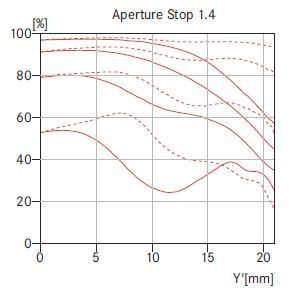
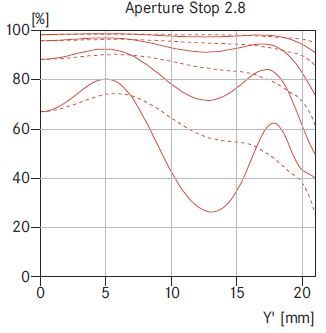
Indeed your focal plane is strongly curved - caused by field curvature, it's a characteristic of this lens. This makes it really tricky to use on high resolution sensors, which will accentuate lens behavior. Put another way, high resolution 'rewards good design while punishing poor design'. It's surprising to see it show so clearly at f1.4, because in the FLE it really degenerates at f2.8-f4 before recovering its composure (somewhat) by f5.6.
It applies to many M lenses made by both Zeiss and Leica, that the corners show how good image content can appear when BOTH curvature and astigmatism are absent, even at low contrast - the f1.4 chart shows both lower lines parallel and close together (low astigmatism) and steady declines (normal outer frame behavior). You also see fine detail in the corners with poor acutance (astigmatism in 10 lpmm).
'Its curvature of field exacerbated by the thick sensor stack.
If you focus on a flat plane the edges and corners are unsharp, or 'smeared'
Several long threads over the last couple of years about this 'feature' of the A7 series.'
Here we can find evidence to the contrary. Firstly the MTF makes it clear that the curvature impacts the midfield, not the corners. And we see these images have pretty good corners, in fact this is the complaint lodged by the OP.
It's hard to see in three dimensional images at wide apertures because DOF is so thin, but if you were to shoot a perpendicular image of a wall you would see a dramatic loss of sharpness on the focal plane of the wall.
What is interesting here is the loss of quality of bokeh in the part of the image worst affected by curvature. Imagine a circle that just touches the short edges - that is 12mm from the center, and it's the low point for the FC, after it begins at image height of ~7mm. My notion is that curvature impacts bokeh quality, because data that is close together in the image looks very different as the field shapes near or away from it, hence 'swirly bokeh'. It's never seen in flat field lenses (or at least not mine - RX1, CY 100/3.5, 35-70, FE55) because focus fade is consistent going outwards from the focal plane in both directions - front and back.
35mm is at the threshold of ray angle problems for symmetric lenses on regular sensor stacks like the Sonys have, so effects should be less than for many other M lenses. Anyway, visit Tim Ashley's site for a great demonstration of the FC pattern of the 35 FLE and RX1 (top two images, and please note: the FLE was mounted on a Leica M240, not a Sony a7x, both images are f4):
http://tashley1.zenfolio.com/blog/2013/4/leica-m-240-with-35mm-f1-4-fle---some-observations
Now see the MTF charts for the FLE below, each with its aperture identified:
May 16, 2016 at 11:50 PM
p.1 #10Odd corners/Edge sharpening up with A7RII + Leica 50mm Summilux-ASPH
I got rid of all my Leica M lenses when I got the a7r because they didn't work too well...
I kept one lens; a 35mm Summilux (pre-ASPH). It has that great Mandler glow wide open, and sharpens up nicely when it is stopped down. It still doesn't work well on the a7r, but I just can't quite part with it. I guess I keep hoping that I will be able to use it to better effect on a camera in the future.
---Michael
May 17, 2016 at 11:31 AM

p.1 #11Odd corners/Edge sharpening up with A7RII + Leica 50mm Summilux-ASPH
It helps if the lenses are designed for a digital Leica instead of for film. The M8 had a .5mm cover glass, and cameras since then have had about a 1mm cover glass. This thickness is still a lot thinner than the Sony cameras, but lenses designed for the 1mm cover glass are more likely to work well with the Sony camera. Lenses with longer exit pupils work better and all lenses work better at narrower apertures. This means you see less problems with lenses with a narrower smallest aperture. Here are some that work at least pretty well. The WATE (16-21mm f/4), the 24 summilux (f/1.4), the new 28 elmarit ASPH (f/2.8), the new 35 summicron ASPH (f/2), the 35 summilux ASPH FLE (f/1.4), the 50 summicron-M (Pre-AA version), the 50 summicron ASPH APO, and everything longer than 50mm. At 28mm Fred did a test with the new 28mm f/2.8 ASPH and it does show some issues wide open and at f/4, but it is quite good at f/5.6 and excellent by f/8. I haven't seen test of the new 28 cron or of the 28 lux. I'm not sure how they do. More testing of the new 35 cron ASPH would also be good. From what I have seen it looks pretty good and much much better than the older version.
Most of these are quite expensive, but if you go non-Leica the Consina/Voigtlander lenses offer some additional choices. In particular he CV 21 f/1.8 is pretty good, as is the CV 35 f/1.2 vII is quite good as well.
Most of these are quite expensive, but if you go non-Leica the Consina/Voigtlander lenses offer some additional choices. In particular he CV 21 f/1.8 is pretty good, as is the CV 35 f/1.2 vII is quite good as well.
May 17, 2016 at 01:16 PM
p.1 #12Odd corners/Edge sharpening up with A7RII + Leica 50mm Summilux-ASPH
I have to disagree with the 35mm summilix FLE. It does not work well on the A7RII. If your ead my original post I mention that both my 35 and 50 lux does this same behavior.
May 17, 2016 at 02:18 PM
p.1 #13Odd corners/Edge sharpening up with A7RII + Leica 50mm Summilux-ASPH
dumplinknet wrote:
I have to disagree with the 35mm summilix FLE. It does not work well on the A7RII. If your ead my original post I mention that both my 35 and 50 lux does this same behavior.
Yeah, I did catch that in your original post, but these shots are with the 50 lux ASPH right? I would love to see the shots you think are problematic with the 35 lux ASPH FLE. A number of people have reported that this lens does pretty well. What is really needed is side by side shots with a Leica digital camera (like the M240) and a Sony camera (ideally the A7 or A7 II to keep resolution the same). Then you can see just how performance is affected by the thicker cover glass. I believe I have seen one such test by Jim Klasson awhile back and although the 35 lux ASPH FLE does a bit better on the M240, it had not too much different performance on the Sony camera. I haven't bothered to look up the test again, however, and my memory might very well be faulty. I also know that, IMO, the 35 lux ASPH FLE has pretty bad bokeh on a Leica camera, so when you say it has swirly bokeh on the Sony camera, I am not sure it is worse. In contrast, IMO, the 50 lux ASPH has beautiful bokeh on a Leica and it is significantly worse on a Sony camera. In addition, a number of people (I would say about 10) have commented with pictures here about how the 50 lux ASPH is worse on a Sony camera. So, your report is quite consistent with others that the 50 lux ASPH loses quite a bit of its charm on the Sony cameras, but your report that the 35 lux ASPH FLE does a lot worse on the Sony seems at least a bit discrepant with what others have reported. You may very well be right in your assessment. I just haven't yet written off the lens based on your report, but I would love to see other shots with that lens and I very well may be convinced. Your report has given me a bit of a pause but the evidence on balance still seems to me to be that the 35 lux ASPH FLE is not terribly affected by the Sony cover glass. It isn't really much of an issue for me personally as I don't much care for the rendering of the 35 lux ASPH FLE.
May 17, 2016 at 03:44 PM
p.1 #14Odd corners/Edge sharpening up with A7RII + Leica 50mm Summilux-ASPH
philip_pj wrote:
'..almost as if my focus plane is not linear but rather curved'
Indeed your focal plane is strongly curved - caused by field curvature, it's a characteristic of this lens. This makes it really tricky to use on high resolution sensors, which will accentuate lens behavior. Put another way, high resolution 'rewards good design while punishing poor design'. It's surprising to see it show so clearly at f1.4, because in the FLE it really degenerates at f2.8-f4 before recovering its composure (somewhat) by f5.6.
It applies to many M lenses made by both Zeiss and Leica, that the corners show how...Show more →
I would be extremely careful analyzing MTF charts one does not know the measurement or computation conditions of for things like field curvature. They could be taking best focus at any point in the field, at each measurement point in the field, etc. Really one does not know.
May 17, 2016 at 04:20 PM
p.1 #15Odd corners/Edge sharpening up with A7RII + Leica 50mm Summilux-ASPH
philip_pj wrote:
'..almost as if my focus plane is not linear but rather curved'
Indeed your focal plane is strongly curved - caused by field curvature, it's a characteristic of this lens. This makes it really tricky to use on high resolution sensors, which will accentuate lens behavior. Put another way, high resolution 'rewards good design while punishing poor design'. It's surprising to see it show so clearly at f1.4, because in the FLE it really degenerates at f2.8-f4 before recovering its composure (somewhat) by f5.6.
Disagree with your wording. You're making it sound like all the fault for the poor image quality is due to 'poorly designed' lenses, when it's not. One could twist it the other way and say it's a consequence of a poorly designed sensor package. But that too is out of context because the two were never made to be compatible with each other.
The image characteristics illustrated by the OP do not appear when these lenses are used on compatible Leica digital cameras. As already noted by others, this is specifically a consequence of sensor incompatibility.
Leica RF lenses were never designed for ~2mm sensor cover thickness, as found on Sony's sensors. As a result, most Leica RF lenses 50mm and wider generate inferior image quality on Sony cameras compared to Leica cameras. Even if at times the images may appear to be acceptable, they're usually still sub-optimal compared to similar images from a compatible sensor.
The Summilux lenses are a design compromise, just like any lens, but have specific quirks. Rather than aiming for optical perfection at any size, Leica aims for certain high standards of performance in a small lens design, relevant to the system for which they are made, with all the inherent consequences of such a design. Consider that the Summilux are high speed lenses and will typically be used for available light work where f/1.4 is required. It makes sense that priority is placed on wide open (or near wide open) performance compared to 2-3 stops down. My experience working with these lenses is that yes, there is strange mid zone field curvature behavior in the f/2.8-4 range. I know that and therefore work wide open or one stop down where they're better behaved, or in the area of f/8 when I need depth of field and best across-frame performance. However, never do the Luxes render images in the manner illustrated by the OP, when used on a compatible Leica digital camera. To reiterate, these images are specifically due to the Sony sensor.
IMO, if the OP wishes to use these lenses on a mirrorless camera, the available options are:
1) Leica SL
2) Sony with Kolari Vision thin-glass sensor modification
There are few RF lenses wider than 50mm that play well on stock Sony sensors. If you're interested in leveraging an existing RF lens collection, or using some of the best available RF glass on a Sony camera, then it's necessary to get the Kolari sensor modification.
Edited on May 17, 2016 at 06:44 PM · View previous versions
May 17, 2016 at 06:32 PM
p.1 #16Odd corners/Edge sharpening up with A7RII + Leica 50mm Summilux-ASPH
Could the choice of adapter impact the results as well?
May 17, 2016 at 06:34 PM
p.1 #17Odd corners/Edge sharpening up with A7RII + Leica 50mm Summilux-ASPH
That could also affect things because the 50 Lux ASPH and 35 Lux FLE are floating lens designs. If the lens does not focus accurately at infinity on the adapter, it will mean the floating element is not in optimum position.
But this is only additional to the much more severe image degradation caused by exaggerated and differential field curvature of the sagittal and tangential planes as a result of sub-optimal stock Sony sensor stack thickness.
But this is only additional to the much more severe image degradation caused by exaggerated and differential field curvature of the sagittal and tangential planes as a result of sub-optimal stock Sony sensor stack thickness.
May 17, 2016 at 06:40 PM
p.1 #18Odd corners/Edge sharpening up with A7RII + Leica 50mm Summilux-ASPH
I feel compelled to say that I would find that field curvature quite interesting for environmental portraits. It isolates the subject but provides enhanced detail of surroundings in parts of the frame (edges, corners) where the main subject is unlikely to be. I know that wasn't the OP's intent, so it doesn't meet those needs and this comment doesn't do any good there, but I'd rather talk about this as "not behaving as designed" rather than "sub-optimal." I'm biased, though, as I rather have a crush on the character contributed by my 35 FLE's field curvature.
As an aside, I totally love how much this community geeks out over this kind of nuance.
Cheers,
Jon
As an aside, I totally love how much this community geeks out over this kind of nuance.
Cheers,
Jon
May 17, 2016 at 09:06 PM
p.1 #19Odd corners/Edge sharpening up with A7RII + Leica 50mm Summilux-ASPH
Dumplinknet, I am trying to find similarly composed images taken with Summilux-M 50 asph on modded and stock Sony A7R cameras, but none of my shots show that extreme issue.
Normally I wouldn’t use unmodified A7R with Lux 50 for infinity shots, but when shooting wide open filed curvature and corners on stock Sony A7x are not that bad nor important (too me).
Please see examples below and follow sharpness in horizontal plane where the backgrounds are more less at even distance.
Modded A7R @ f/1.4
http://www.kozera.ca/photos/images/20160410_0128_640.jpg
http://www.kozera.ca/photos/images/20160413_0139_640.jpg
Modded A7R @ f/2
http://www.kozera.ca/photos/images/20160408_0088_640.jpg
Stock A7RM2; wide open
http://www.kozera.ca/photos/images/20151121_0076_640.jpg
PS.
Is it possible that the M to FE adapter is at fault?
May 17, 2016 at 10:08 PM
p.1 #20Odd corners/Edge sharpening up with A7RII + Leica 50mm Summilux-ASPH
I am using the CV close focus adapter. I'm not sure if its the adapter at fault since its the only one I have.
However, if you look at the gentleman with the chair, you'll notice that the upper right corner of the white wall starts sharpening up. The wringle details on that part of the wall is are more apparent than the part just to the right of his left hand. This example isn't as severe but its still apparent. In fact, the whole right side of that wall starts to gain focus as it looses bokeh. The same can be said about the left side of this image. The window slats become more in focus- although not entirely.
However, if you look at the gentleman with the chair, you'll notice that the upper right corner of the white wall starts sharpening up. The wringle details on that part of the wall is are more apparent than the part just to the right of his left hand. This example isn't as severe but its still apparent. In fact, the whole right side of that wall starts to gain focus as it looses bokeh. The same can be said about the left side of this image. The window slats become more in focus- although not entirely.
May 18, 2016 at 04:20 PM