p.2 #1 · What do you use for weighting down your tripod?
Charles Loy wrote:
I use a heavy tripod, never needed extra weight.
Me too. Mine weighs 9.5lbs.
The key to using hanging weights is to have the weight touching the ground. Prior to getting the heavy tripod I've hung my camera bag but with the strap taut hanging from a wide-gate carabiner and the bag lightly resting on the ground as stated above by 1bwana1. A weight that swings in the wind is useless.
Aztatlan wrote:
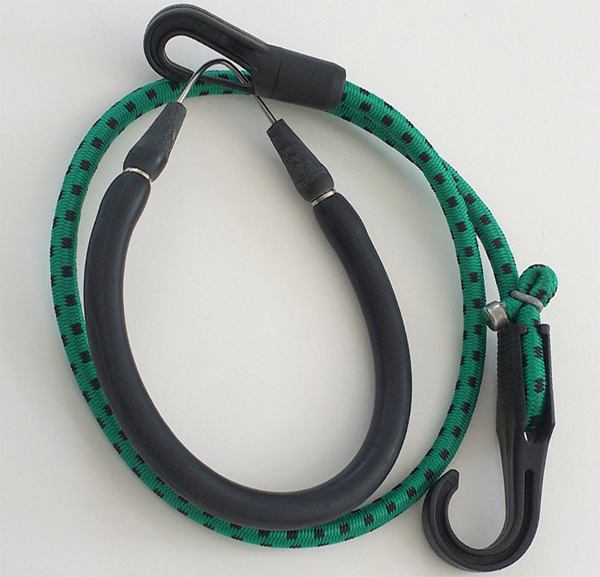
A piece of long, stretchy cord purchased from a boating store.
This is my solution for my travel tripod. A couple of years ago I cobbled together bits and pieces from a marine store (picture below). The bungee cord is of a length that's taut when the tripod is at full extension, and the hook allows for the cord to be shortened when the tripod is shorter.
p.2 #2 · What do you use for weighting down your tripod?
Mark_L wrote:
Has anyone got a link to a test that shows a hanging weight actually reduces the amplitude of vibration from a camera shutter and/or wind?
p.2 #3 · What do you use for weighting down your tripod?
peter_n wrote:
Me too. Mine weighs 9.5lbs.
The key to using hanging weights is to have the weight touching the ground. Prior to getting the heavy tripod I've hung my camera bag but with the strap taut hanging from a wide-gate carabiner and the bag lightly resting on the ground as stated above by 1bwana1. A weight that swings in the wind is useless.
This is my solution for my travel tripod. A couple of years ago I cobbled together bits and pieces from a marine store (picture below). The bungee cord is of a length that's taut when the tripod is at full extension, and the hook allows for the cord to be shortened when the tripod is shorter....Show more →
This makes total sense. I gotta use your idea now, thanks for sharing!
p.2 #6 · What do you use for weighting down your tripod?
Mark_L, you have been handed the task of setting up a full spectrum protocol of testing. I wish you all the luck with infinite variables that you will discover along the way.
you first cast a wide net and then work your way down to the ones that make you particular product/idea look the best.
really the so called testing by individuals and companies on products are almost comedic if not borderline criminal in their "directed" results. no standards and again way too many variables.
there is no one answer that works in all environments.
like Molson said, go take a picture. we all should.
p.2 #7 · What do you use for weighting down your tripod?
I don't use anything to weigh my tripod down. Never have. If I know it's going to be windy I take my HEAVY ass 3011 bogen legs. I'm usually using my Induro or vanguard 99% of the time with nothing weighing it down
p.2 #8 · What do you use for weighting down your tripod?
I think some folks are making this harder than necessary. Take some small black trash bags or baggies or empty socks with you. After setting up and determining the need for weight, use whatever Mother Nature provides -- dirt, mud, gravel, sand, bear scat, moose chips -- to fill the dampeners. Drape same over lens and body. When finished, empty containers and go home.
My other obsessive hobby is concert recording (aka taping) bands which allow it. We typically have a set of microphones 10-15' off the ground, and the standard stand is a big light stand, Bogen, etc. We stake it down to the ground with tent stakes when it's windy. Our concern isn't so much a little movement as we are worried about the whole thing falling over and crashing.
p.2 #11 · What do you use for weighting down your tripod?
Mark_L wrote:
Seriously, go and work on your craft or leave those who strive for the best results alone to do our work.
Don't forget to book some time in a wind tunnel to measure the vibrational amplitude of round tripod legs at high wind velocities; a suspended mass won't fully dampen this effect (but I you're more interested in the striving than in the actual results anyway... )
p.2 #12 · What do you use for weighting down your tripod?
molson wrote:
Don't forget to book some time in a wind tunnel to measure the vibrational amplitude of round tripod legs at high wind velocities; a suspended mass won't fully dampen this effect (but I you're more interested in the striving than in the actual results anyway... )
By all means go on posting opinions on a technical question in a gear forum based purely on conjecture and no evidence but take your rridiculous hyperbole elsewhere.
p.2 #13 · What do you use for weighting down your tripod?
actually molson's comment is correct - and I have often used wind tunnels - but you will need more than that: a vibrometer or laser interferometry would work, plus a fast datalogger and some FFT software
that is something that a tripod manf. firm would do - or a scientist or similar firms in other fields - for example B&W has used laser interferometry to study cone breakup in their hifi speakers
p.2 #17 · What do you use for weighting down your tripod?
Mark_L wrote:
By all means go on posting opinions on a technical question in a gear forum based purely on conjecture and no evidence but take your rridiculous hyperbole elsewhere.
If you have ever photographed in really windy locations, like Patagonia - or southern Alberta - you would know what I'm talking about...
But I guess if you're one of those armchair photographers that sits in front of their computer all day, fantasizing about "perfecting their technique" I realize how all this all must sound like "rridicluous (sic) hyperbole" to you... so I'll stop confusing you with facts and real-world observations.
p.2 #18 · What do you use for weighting down your tripod?
Weight, stake and the loop methods only help to hold the tripod down in high wind and stabilize the platform (so the wind doesn't slightly pick it up). But overall, they don't help to dampen the vibration (a different idea) when vibration occurs. As such, it solely depends on the tripod's characteristics (and the head) to dampen the vibration: material, shape, construction, etc. It's critical for when the wind settles down a bit so you can take the pictures. If you expect by adding 10-20lbs of weighs would eliminate vibration in high wind, that is just not realistic.
To assess the vibration dampening of your tripod, a tap test with a laser pointer or vibration recording app on your phone can be used to see how long it would settle if you induce vibration. Definitely not a rigorous scientific test in any way, but at least you know.
p.2 #20 · What do you use for weighting down your tripod?
rw11 wrote:
actually molson's comment is correct - and I have often used wind tunnels - but you will need more than that: a vibrometer or laser interferometry would work, plus a fast datalogger and some FFT software
that is something that a tripod manf. firm would do - or a scientist or similar firms in other fields - for example B&W has used laser interferometry to study cone breakup in their hifi speakers
it's called vortex shedding induced vibration... but photographers call it a pain in the butt.




 )
)