p.1 #1 · Advice for starting pet portraits...lighting especially
Ok...looking to start shooting pets, mostly dogs and donating to get dogs adopted from local shelter. My wife is a groomer so after grooms would be perfect time I'm guessing. I'm ready to spring for light setup. I own a Nikon D610 with 2.8 70-200 Nikon, 2.8 24-70 Tamron, and 2.8 15-30 Tamron, Thinking I'm good for lenses, advice welcome though. I have not bought my flash, strobes, nothing. I could start with flash'(s) and umbrellas or . Maybe a strobe and SB. I'd like some and all opinions. And also why you'd advise what you think. Thanks for your help with these choices. BTW, i shouldn't say money is no object, it is. But, I also firmly believe in getting what you pay for. I'd rather spend once, and be happy then get junk. So....use that as a guide if you like. Thanks everybody!!!
p.1 #2 · Advice for starting pet portraits...lighting especially
My wife and I did volunteer work for the local SPCA last year doing dog photography of the adoption ready pups to post on their website and of some of their special events. It was a lot of fun, rewarding and a great experience. I had to resist taking some home with me. I highly recommend doing it.
You'll typically get better results with properly setup artificial lighting but I don't think you'll need for all your shots, particularly if you're shooting outdoors. Here are some things I learned about doing dog photography regarding lighting and in general.
1. An assistant will be your most valuable asset. It's difficult to try and handle various dogs AND do photography at the same time but it can be done. Budget more time than you think you'll need. Some dogs can take a while before they settle down enough to get decent shots not to mention all the other things you'll have going on.
2. Get your equipment setup first and then exercise the dog before taking photos. By giving the dog a chance to get their excitement out of their system they will be more relaxed and therefore more likely to be cooperative. The biggest challenge was getting them to sit in one spot long enough for a decent pose. But every single dog is different.
3. Of course use squeaky toys or treats to get them to perk up their ears, look at you and to get their attention. But use them sparingly and don't show them or squeak the toy until your are ready to press the shutter. It only works a few times and after that they become accustomed to it and less likely to respond. There are many similarities to photographing toddlers if you can imagine what that is like.
4. With some dogs you may only get a few shots with the lights since it can scare them away when it flashes, pops and beeps. Lights can make some strange noises. Sometimes it works in your favor. Also, they can be intimidated by a large umbrella or softbox so be aware of that.
5. Bring some props with you such as scarfs, bandanas, tennis balls, background, blanket, towel to clean off drool etc.
6. If you have access to a room or otherwise secure area you can then remove the leash and collar. They always look better without restraining devices but you also don't want to have to chase a run away dog.
7. Watch where you place your gear. Dogs will do what dogs do (especially pups). As I'm sure you know, some dogs will try to claim your expensive new photo gear as their own, so be aware of that fact. This is another reason to walk or run them before the shoot. If you have a table or shelf, put your gear on that. Anything on the ground is fair game. If you have to lay it on the ground be sure to cover it with a trash bag or something.
8. Speedlights are fine for dog photography but I find mono-lights easier to use, setup, reliable, recycle faster, and offer a much broader selection of light modifiers. Personally, I'll take a mono-light over a speedlight any day but speed lights are obviously more compact and portable. I prefer Profoto lights myself since they are rugged, constant, easy to use, and very reliable but you'll pay for those qualities. The Paul C. Buff make some pretty decent lights at decent prices but I have seen some other brands come out with very capable monolights in the last couple of years as well as some more powerful third party speedlights.
9. Umbrellas are very versatile and I would start there. You can add a softbox later as you develop your skills at this and you'll get a better idea of what will work best for you. Take the amount of space you'll have available into consideration. One downside of umbrellas is that they can take up a lot of room or become airborne on a windy day. Get a lightstand that is strong enough for the type of light you'll use and weight it down. An excitable large dog can easily knock it over.
10. A reflector will come in handy. It helps to have an assistant to hold it for you but I've also leaned one against the wall to bounce light from my strobe. You can also use a second lightstand for that. Also a reflector is less likely to scare a dog.
11. A background is nice to have to improve your photos but is not essential. I used a blue randomly patterned cloth background for some of my shots. Blue worked well for me since there are not many blue colored dogs around (although I do have an eleven year old three legged blue pitbull. it's true!). You don't really want the background to be close to the same color as the dog. You need some contrast. Although, black dogs look great when they are well lit against a black background it's not good for an adoption photo. They need to be able to see the dog clearly.
12. My goal was to end up with three good shots. A. A tight portrait so you could get a good look at the face, B. One of the whole dog to see the body from head to tail. C. One of the dog in action or playing.
13. Have your assistant stand behind and above you to get their attention. Most of the shots you are going to want the dog looking into the camera.
14. I like to setup the lights so they are down low at the dogs level (but not so low it's aiming up). A C-stand with a boom arm is excellent for this and is very sturdy. Don't use a cheap wimpy stand for an expensive mono or strobe light.
15. Don't use a wide-angle lens and take a close up of their face unless you want them to look like they have a clown's nose. Use an aperture that gives you a depth-of-field long enough to have their whole head nose-to-ear in focus as a minimum. That's my preference anyways. You're 24-70mm will be the most used. The telephoto will be great for action shots and will give you the stand-off distance and zoom capability you'll need to let them run around and play.
16. Be careful! Some of these dogs will steal your heart. But most importantly, have fun with the dog. They all appreciate the human contact and each has their own story. Who knows what these pups have been through?
p.1 #4 · Advice for starting pet portraits...lighting especially
Yes, you are in good shape with your lens setup for what you are planning to do but if I should recommend addition to your lens setup then I would recommend 105mm or 150mm macro lens for closups of eyes, fur, claws etc. but that is not important for adoption photos.
I'm using three speedlights (nikon sb-600 and yongnuo 560 iii) for my pet work, I have mostly used shoot-through umbrellas for the two front lights (both sides of the camera and little bit higher up than the dog height sitting) and then I have used one flash in the back for separation when needed. That's my safe lighting setup if you like.
I just recently bought two softboxes so I'm playing with setups with that right now.
In my experience I would keep the setup really simple in the beginning and you want to try to create rather large area relative to the dog size in light because most dogs like to move around but with assistant and leash on the dog (use these thin show leases and ask the assistant to keep it as straight up as possible without choking the poor dog ) you can make the lighting area smaller. You get rid of the leash in post-processing.
Use table to put the dog on to elevate him to your level, makes things much more comfortable specially with these smaller dogs.
Most importantly enjoy your time with the dogs, play with them and get to know them a little before you start shooting.
p.1 #5 · Advice for starting pet portraits...lighting especially
Nice write up, Konablue.
Rabbit, Buff monos are highly regarded by many entry-level enthusiasts (and pros). They aren't high end gear but they are inexpensive and dependable, and Buff's well known for very inexpensive repairs if they do go down.
The Profoto system Konablue uses is high end and high dollar, as he mentions. If you want to look into something in between, here's a thread on the topic with several references to Elinchrom.
And there are a couple of Elinchrom mono's on the Buy/Sell board right now at attractive prices - the $300 range and they're probably about twice that new. I have no affiliation with the seller but he/she has good reviews. Naturally there's always a bit of an unknown buying used but many of us do it all the time. I wish I could justify them - I'd pick them up in a heartbeat as they don't come around on B/S very often but I already have about six of them.
One advantage of the mono's he's selling is they have built in radio receivers so all you'd have to get is the Skyport transmitter to go on your camera's hotshoe - about $150 I think, new. I have a lightly damaged one I'll send you as a donation to the cause if you go with the Eli's. I haven't looked into repair cost but it shouldn't be too much - it's just a 10 cent piece of plastic that enables mounting. I bonked it against another camera and snapped it. Everything else about the transmitter is perfect.
You seem to be very new to studio lighting so in case you're unaware, $25 umbrellas are fine to get started with. They spill light everywhere but for your immediate purposes it's no big deal.
If you start digging the more serious portraiture thing, you'll want to begin experimenting with softboxes. They generally provide a more buttery, softer light and the light is somewhat easier to control.
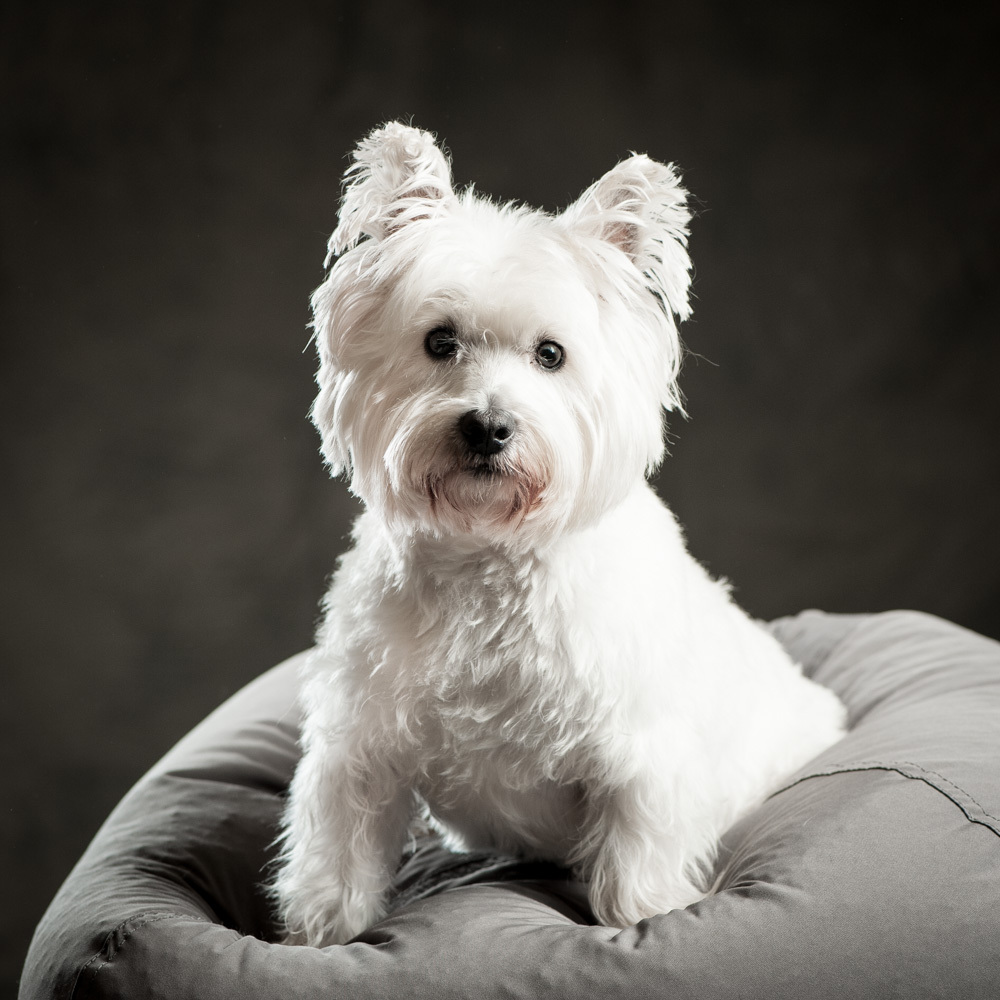
I've done very little pet portraiture - all of it outdoors except the image below. I was dog sitting for a friend and tried to grab a quick shot of her two Westies. They obey me well but I really wasn't sure how I was going to get them to sit still at a distance. What I attempted was putting them up high enough (dog on top of a bean bag on top of a short table) that they'd hopefully be reluctant to jump down and come play with me.
I cushioned the floor around the platform in case they did jump, which the female did, but the male hung in there for about three snaps. Not a good photo but it illustrates the idea.
p.1 #7 · Advice for starting pet portraits...lighting especially
Patience. Most times it'll be a wrangle. They don't want to sit still, unless they are trained.
And be wary of poop.
I don't shoot dogs. I did some stuff for my parents one year taking pictures of their pups for a gift.
10 minutes into the studio visit and Roscoe pooped all over my floor. Have a poop handler. Or be ready t handle it yourself.
I used a three-light setup on this; three AB units - two for rim, one up-and-over for main light. Roscoe was a bit freaked out by the strobes going off at first, so we had a period of time where he wandered around the studio while I popped them off so he'd get used to them and simmer down.
Monolights or a pack system will give you more power if you need it. I shot Roscoe at f/8.
If you are looking to do this on the cheap, get some used speedlights, like some Vivitars of those Youngyeo (I don't know how the hell to pronounce or spell them).
Keep it simple. You are going to spend most of your time wrangling and getting their attention.
p.1 #8 · Advice for starting pet portraits...lighting especially
My good friend Wendi Boden shoots all the dogs and cats at the NKLA (Best Friends) shelter in West Los Angeles. She shoots on white with two or three Buff Einsteins, either with umbrellas or softboxes. Actually, I think she's using two bare heads on the white seamless background and a single umbrella or softbox with a reflector on the animals. Has to shoot a bit loosy goosy in framing because they're moving around so much and she needs to conform to the shelter's developed style - which she developed. She's been shooting Canon 5DS and 70-200 tethered to a MBP into Capture One and doing up to twenty animals per day. It's a crazy schedule but she loves it and does a fantastic job and has only taken one home for keeps.
p.1 #9 · Advice for starting pet portraits...lighting especially
Can you shoot outside?
I like to take environmental portraits using a single key light and letting ambient provide fill. For the key I use a PCB Einstein with a soft silver PLM, I like the big one, 64" I think. Gotta have sandbags or a helper to hold it. I shoot at ~24-35 mm on FF, put the critter in front of cool landscape/cityscape background, light it from above and to the side, adjust shutter speed to control fill light. You could do speedlight and 43" Westcott umbrella for easier/cheaper alternative. From there I might switch to longer focal length for closeups, put sun behind critter as rim light, then fill with the PLM.
For run-and-gun speedlite stuff, I like to use a Lumiquest SB III softbox on a pigtail ttl chord, I use a wide-ish lens and hold the light out with my hand. Lots of missed shots but I like this as a flexible setup for a moving target and I like the fast light falloff you get with the mini-softbox held close to the subject.
p.1 #10 · Advice for starting pet portraits...lighting especially
My wife, Wendi Boden, is the photographer that Peter mentioned who photographs animals for NKLA. Her professional name is Wendi Marafino, and her website is www.wendimarafino.com.
She's been shooting for NKLA for a little over two years now. They originally projected around 100 animal adoptions a month, yet the number has now grown to over 300. This is an intense amount of work for her between shooting and post-processing.
Her setup is three Paul C Buff Enstein's with animals shot on white vinyl seamless. There are two lights for the background, bare head with grids. The key light is another with a large umbrella-shaped soft box. There are no reflectors. She originally wanted to use studio strobes, but her shooting space at NKLA is very small. Therefore, she attempted to shoot the animals with Speedlights, but quickly learned they didn't provide enough power and had slow recycle times. When shooting animals, she needed the light to be available immediately. Otherwise, the shot would be missed.
As Peter stated, she shoots with a Canon 5DS tethered to a MBP into Capture One. The only lens she uses for these images is a 70-200mm. She's not a fan of wide angle on the animals with shallow depth of field. That's not her style and not what NKLA wants. If I recall, she shoots at f/11, ISO 200.
She has an assistant who helps by handling the animals while shooting, and volunteers assist by exercising the dogs beforehand. Large animals are shot on the ground, and smaller animals are shot on a table. In either case, she gets down to eye level when photographing, which really helps to draw the viewer in. For each animal, she averages about 15 minutes of shooting time.
She also has a large selection of toys, squeakers, and iPhone apps to hold the animals attention. And this is in conjunction with her enthusiasm. Her goal is to capture the personality of the animals with a head shot and three additional poses of each animal.
After photographing, she spends hours in post processing to retouch, color correct, and knock the background to white. The retouching is minor, but she does clean up the dander and fly-aways. The idea is to achieve a clean, crisp image.
Here's a few of her recent shots. I'm biased, but I believe she does a fantastic job! I'm so very proud of her that I couldn't help but post a message and show off some of her photos.
p.1 #11 · Advice for starting pet portraits...lighting especially
Thanks for the detailed explanation Mike. I couldn't remember exactly what she did, even though I remember telling her what to buy but it's been a couple of years. And I think Wendi's experience with the shortcomings of the speed lights is important to note for anyone who might be serious, especially the recycle times, which are critical for animals moving around and being generally uncooperative and impatient.
p.1 #12 · Advice for starting pet portraits...lighting especially
Mike
Wow...beautiful shots of the animals. Love the info you provided and helped me tons. I think your wife does a super job and does these animals justice to find them a permanent home. Does she leave all the lights and background at the shelter? I'd like to also shoot grandkids at my house so didn't know if transporting was a hassle. Other than that, does she use the biggest Einsteins? Thanks for your help....Tom
p.1 #13 · Advice for starting pet portraits...lighting especially
rabbit59 wrote:
Does she leave all the lights and background at the shelter? I'd like to also shoot grandkids at my house so didn't know if transporting was a hassle. Other than that, does she use the biggest Einsteins?
She leaves the lights at the shelter along with the seamless, c-stands, and sand bags. Unfortunately, she's unable to leave everything setup, because the shooting space is shared for many other activities. If you want to transport them, you can use various different cases. We actually have another set of Einsteins at home that we store in a Pelican case.


 . Maybe a strobe and SB. I'd like some and all opinions. And also why you'd advise what you think. Thanks for your help with these choices. BTW, i shouldn't say money is no object, it is. But, I also firmly believe in getting what you pay for. I'd rather spend once, and be happy then get junk. So....use that as a guide if you like. Thanks everybody!!!