This topic is in the 2015 archive. You can read it and like its posts here. It is read only.
Archive 2015(updated) Lens colour difference test
p.1 #1(updated) Lens colour difference test
Update: the first set of colour slices shown below is modified, as suggested by many replies to the original posting. The mid-grey panel above the "TM" mark in the ColorChecker was used to balance colour and exposure across all eight original RAW files, to RGB(127,127,127). There is slight variation in illumination vertically. The centre areas of all mid-grey panels are within +/-1 of 127 for all lenses.
The second set of colour slices is the original set, which are as-shot, and not adjusted for colour balance and exposure.
The order of lenses is the same in both sets of slices and different from the order used to list the lenses, below.
[back to the original, with slight edits]
The current thread on "how lenses affect colour" got me thinking. In particular, the following comment from that thread...
redisred wrote:
... Actual color differences between lenses are pretty slight when you neutralize everything.
https://www.fredmiranda.com/forum/topic/1385639/1#13189682
Hmmm... Let's see.
Here's the results from a simple test that I just performed with the following lenses (in alphabetical order):
Canon EF 50/1.2L USM
Canon EF 50/1.4 USM
Canon EF 24-105/4 L IS USM
Carl Zeiss Makro-Planar T* 50/2 ZE
Leica Summicron-R 50/2 E55
Mamiya Mamiya-Sekor C 55/2.8 N
Pentacon MC 50/1.8 electric
Pentax SMC Pentax-FA 50/2.8 Macro
An example of the full test scene is shown in the first image posted below, taken with the CZ 50/2 ZE.
The second attached image shows a set of stacked "slices", from across the centre of the third row of the Greytag Macbeth Color Checker chart, which is in the centre of the test scene. The order of lenses in the slices is different from the alphabetical list shown above.
For these tests, the scene was illuminated by a pair of Elinchrom Dlite-4 strobes in 60 x 80cm softboxes, triggered by a 600EX-RT flash (at 1/64 power and pointing at the ceiling) on the 6D camera. The camera White Balance is set to 5200 deg K. All images were taken at t = 1/5 sec, f/8, and ISO 100, and focused at f/8 in LiveView (using DOF preview when necessary). A tungsten ceiling light was used to assist in the focusing, but turned off for the test photos. Two photos were taken for each lens, and there were no apparent differences between the first and second shots.
The 6D RAW images were opened in PS CS6 via ACR 9.1.1 with no import processing (e.g. tint, exposure, sharpening). The images were then adjusted for colour balance and exposure, as described at the top of the thread.
Cheers,
Jim
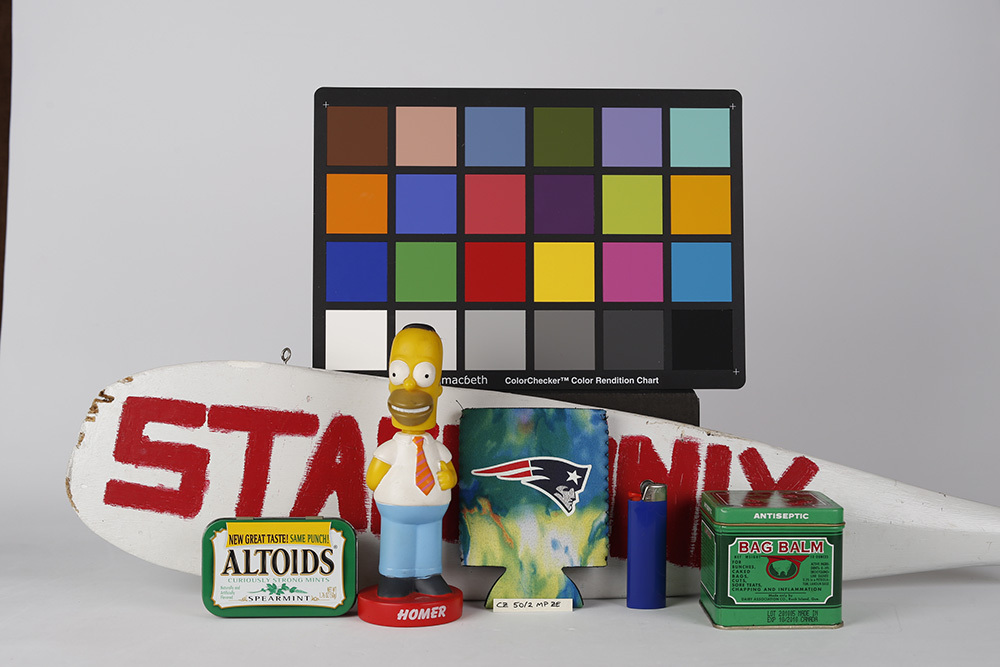
Sample image of full test scene
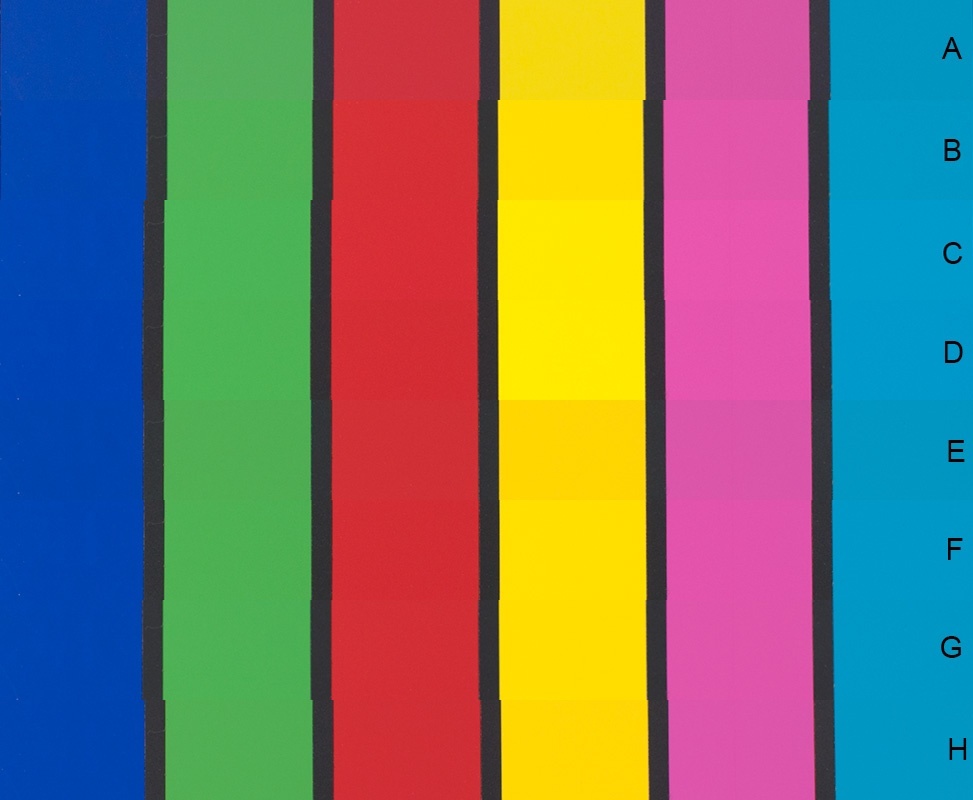
Colour slices, processed for colour balance and exposure, using mid-grey panel
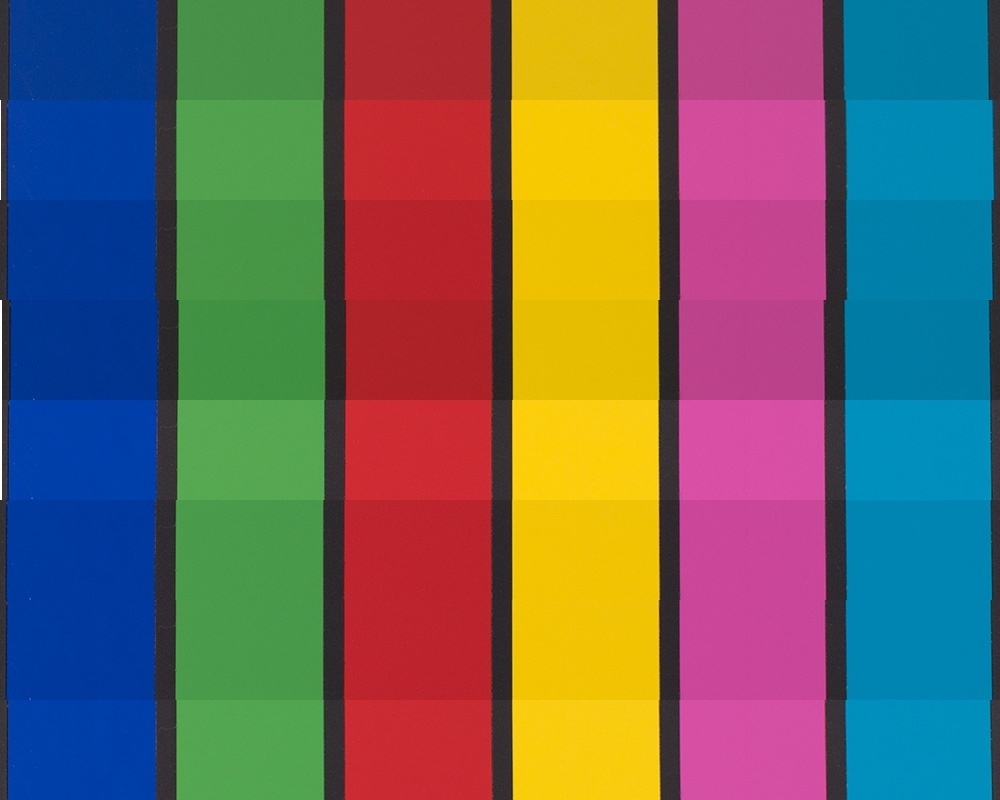
Original colour slices, "as shot"
Edited on Sep 10, 2015 at 05:12 AM · View previous versions
The second set of colour slices is the original set, which are as-shot, and not adjusted for colour balance and exposure.
The order of lenses is the same in both sets of slices and different from the order used to list the lenses, below.
[back to the original, with slight edits]
The current thread on "how lenses affect colour" got me thinking. In particular, the following comment from that thread...
redisred wrote:
... Actual color differences between lenses are pretty slight when you neutralize everything.
https://www.fredmiranda.com/forum/topic/1385639/1#13189682
Hmmm... Let's see.
Here's the results from a simple test that I just performed with the following lenses (in alphabetical order):
Canon EF 50/1.2L USM
Canon EF 50/1.4 USM
Canon EF 24-105/4 L IS USM
Carl Zeiss Makro-Planar T* 50/2 ZE
Leica Summicron-R 50/2 E55
Mamiya Mamiya-Sekor C 55/2.8 N
Pentacon MC 50/1.8 electric
Pentax SMC Pentax-FA 50/2.8 Macro
An example of the full test scene is shown in the first image posted below, taken with the CZ 50/2 ZE.
The second attached image shows a set of stacked "slices", from across the centre of the third row of the Greytag Macbeth Color Checker chart, which is in the centre of the test scene. The order of lenses in the slices is different from the alphabetical list shown above.
For these tests, the scene was illuminated by a pair of Elinchrom Dlite-4 strobes in 60 x 80cm softboxes, triggered by a 600EX-RT flash (at 1/64 power and pointing at the ceiling) on the 6D camera. The camera White Balance is set to 5200 deg K. All images were taken at t = 1/5 sec, f/8, and ISO 100, and focused at f/8 in LiveView (using DOF preview when necessary). A tungsten ceiling light was used to assist in the focusing, but turned off for the test photos. Two photos were taken for each lens, and there were no apparent differences between the first and second shots.
The 6D RAW images were opened in PS CS6 via ACR 9.1.1 with no import processing (e.g. tint, exposure, sharpening). The images were then adjusted for colour balance and exposure, as described at the top of the thread.
Cheers,
Jim
© jcolwell 2015
Sample image of full test scene
Colour slices, processed for colour balance and exposure, using mid-grey panel
Original colour slices, "as shot"
Edited on Sep 10, 2015 at 05:12 AM · View previous versions
Sep 08, 2015 at 04:01 PM
p.1 #2(updated) Lens colour difference test
I think what you'd need to to do really see any differences is
1. normalize them all by the intensity of blue, and stack the results
1a. repeat for each other color
2. potentially do the above and also normalize by the hue of each color
EG, it is clear that some lenses are letting more light through at the same f-stop than others. But is it uniform by color?
And the differences in intensity make it hard to see any (likely subtle) differences in hue or saturation that may be there.
Sep 08, 2015 at 04:12 PM
p.1 #3(updated) Lens colour difference test
The only possible flaw I see right off in your methodology is that it appears that you did not make sure your gray level was equalized with regard to exposure between all of the lenses - say making sure all of them were at 127 across lenses for that same gray patch. Lenses will have different light transmission (even though your exposure is set the same) so that value must be equalized as a starting point I think. I suspect that's one of the reasons we are seeing the different brightness levels/ color intensity. If you equalize the exposure, I wonder how different the color intensities/ brightness would look?
Edit: Taylor was a second quicker than me! I would normalize (exposure wise) based on the neutral though as a start.
Edit: Taylor was a second quicker than me!
I would normalize (exposure wise) based on the neutral though as a start.Sep 08, 2015 at 04:13 PM
p.1 #4(updated) Lens colour difference test
Tariq Gibran wrote:
... you did not make sure your gray level was equalized with regard to exposure between all of the lenses - say making sure all of them were at 127 across lenses for that same gray patch. Lenses will have different light transmission ...
Yes, that was intentional.
I was shooting the lenses using their marked f-stops, not testing their relative t-stops. Most alt shooters use f-stops. N'est ce pas? As I said, if you shoot them like I did, that's what you'll get. I think that's how most alt shooters do it. Take photos, that is.
Sep 08, 2015 at 04:18 PM
p.1 #5(updated) Lens colour difference test
jcolwell wrote:
Yes, that was intentional.
I was shooting the lenses using their marked f-stops, not testing their relative t-stops. Most alt shooters use f-stops. N'est ce pas? As I said, if you shoot them like I did, that's what you'll get. I think that's how most alt shooters do it. Take photos, that is.
But you are specifically testing the lenses, not just "taking photos". Any test I do such as this, I eliminate any variables I can thus hopefully leaving only the variable you are testing for left (in this case, lens color). That's what I do anyway with a controlled test... I don't even know if it's so that in the field I would be going by exact F-stops when switching lenses either. I usually go by the histogram and put exposures around the same spot, regardless of F-stop on the lens. But carry on...
Tariq Gibran wrote
... you did not make sure your gray level was equalized with regard to exposure between all of the lenses - say making sure all of them were at 127 across lenses for that same gray patch. Lenses will have different light transmission ...I was shooting the lenses using their marked f-stops, not testing their relative t-stops. Most alt shooters use f-stops. N'est ce pas? As I said, if you shoot them like I did, that's what you'll get. I think that's how most alt shooters do it. Take photos, that is.
But you are specifically testing the lenses, not just "taking photos". Any test I do such as this, I eliminate any variables I can thus hopefully leaving only the variable you are testing for left (in this case, lens color). That's what I do anyway with a controlled test... I don't even know if it's so that in the field I would be going by exact F-stops when switching lenses either. I usually go by the histogram and put exposures around the same spot, regardless of F-stop on the lens. But carry on...
Sep 08, 2015 at 04:23 PM
p.1 #6(updated) Lens colour difference test
These tests are representative of how these lenses would normally be used.
The parameters varied for this test are those used by the photographer, when taking the photo. Do you think that a comparison of colour behaviour when 'normalized' for t-stop would have less variance than this test, based on f-stop?
Just askin. I don't know the answer... yet.
The parameters varied for this test are those used by the photographer, when taking the photo. Do you think that a comparison of colour behaviour when 'normalized' for t-stop would have less variance than this test, based on f-stop?
Just askin. I don't know the answer... yet.
Sep 08, 2015 at 04:30 PM
p.1 #7(updated) Lens colour difference test
jcolwell wrote:
Yes, that was intentional.
I was shooting the lenses using their marked f-stops, not testing their relative t-stops. Most alt shooters use f-stops. N'est ce pas? As I said, if you shoot them like I did, that's what you'll get. I think that's how most alt shooters do it. Take photos, that is.
I'm sorry, that sounds like non-sense. You claim most alt shooters don't meter through their lens What you've done here is meter through one lens to set a specific exposure - F/8 at 1/5 and then not let the camera meter normalize for light transmission differences between lenses. I don't know of a single alt shooter in the world that would meter through one lens, lock the exposure, switch lenses and then shoot. They would meter through the lens mounted on their camera and if that lens had 1/3 a stop less transmission than another then the camera meter would make up for it.
Secondly, I am also unaware of any competent photographer who doesn't make slight adjustments to exposure in post. So again, any alt shooter I know would in the end make adjustments equivalent to normalizing the greys.
And last, as to another comment you made, of course changes in brightness affect color. You shot the most saturated slice of the color checker and peak saturation of an RGB space is only in the middle tones, as you increase or decrease brightness from there you lose saturation. Depending on the colormetric settings of your RAW converter you can easily alter output saturation (and thus color) just by moving the exposure or brightness controls.
So in my opinion, if you want your test to have any relevance at all you really should equalize exposure on the grays. At the moment you've got large enough exposure/brightness variations that the actual color differences due to spectral transmission and veiling glare are being totally obscured by trivial exposure differences. I'm not suggesting you re-shoot the scene, but just in the RAW converter adjust the exposures so they all have the same middle grey value in the output.
Please do follow up, I know taking test shots is time consuming and you've got some great test data here if you present it in a meaningful way. Thanks for taking the time to share your results so far!
Tariq Gibran wrote
... you did not make sure your gray level was equalized with regard to exposure between all of the lenses - say making sure all of them were at 127 across lenses for that same gray patch. Lenses will have different light transmission ...I was shooting the lenses using their marked f-stops, not testing their relative t-stops. Most alt shooters use f-stops. N'est ce pas? As I said, if you shoot them like I did, that's what you'll get. I think that's how most alt shooters do it. Take photos, that is.
I'm sorry, that sounds like non-sense. You claim most alt shooters don't meter through their lens
What you've done here is meter through one lens to set a specific exposure - F/8 at 1/5 and then not let the camera meter normalize for light transmission differences between lenses. I don't know of a single alt shooter in the world that would meter through one lens, lock the exposure, switch lenses and then shoot. They would meter through the lens mounted on their camera and if that lens had 1/3 a stop less transmission than another then the camera meter would make up for it.Secondly, I am also unaware of any competent photographer who doesn't make slight adjustments to exposure in post. So again, any alt shooter I know would in the end make adjustments equivalent to normalizing the greys.
And last, as to another comment you made, of course changes in brightness affect color. You shot the most saturated slice of the color checker and peak saturation of an RGB space is only in the middle tones, as you increase or decrease brightness from there you lose saturation. Depending on the colormetric settings of your RAW converter you can easily alter output saturation (and thus color) just by moving the exposure or brightness controls.
So in my opinion, if you want your test to have any relevance at all you really should equalize exposure on the grays. At the moment you've got large enough exposure/brightness variations that the actual color differences due to spectral transmission and veiling glare are being totally obscured by trivial exposure differences. I'm not suggesting you re-shoot the scene, but just in the RAW converter adjust the exposures so they all have the same middle grey value in the output.
Please do follow up, I know taking test shots is time consuming and you've got some great test data here if you present it in a meaningful way. Thanks for taking the time to share your results so far!
Sep 08, 2015 at 10:33 PM
p.1 #8(updated) Lens colour difference test
The differences seen by directly looking though lenses at a white sheet of paper do not reproduce as noticeably when taken all the way through the digital photo process, ending on an internet forum.
This shouldn't surprise anyone.
Bright, saturated colors on a chart are probably the worst possible indicators of the subtle differences in color transmission between lenses.
Pale, barely discernible, almost-white colors will show it better.
Also, this test involves reproduction and display, the parameters of which, unless they are printed or viewed directly on a known monitor, are not under control.
Sep 08, 2015 at 11:23 PM
p.1 #9(updated) Lens colour difference test
I think I kinda agree with Keith. In a studio the light source and environment don't correspond well with what one would encounter say, outdoors - given all the various times of day, locations, seasons, and elevations - just a few of the things that alter light quality. I kinda think one comes to an understanding of a particular len's "chromatic transmission" and all the other aspects of light transmission (flares, clarity, CA, etc.) by using the lens in allot of different situations. Comparing in-studio is for sure one part of all that though. I wanna see more.
Sep 09, 2015 at 12:17 AM
p.1 #10(updated) Lens colour difference test
Tough crowd. 
kwalsh wrote:
You claim most alt shooters don't meter through their lens ...Secondly, I am also unaware of any competent photographer who doesn't make slight adjustments to exposure in post. ...
I'll pass on the opportunity to respond with biting sarcasm. I make no claims. I provided a detailed description of how this simple test was performed. One of the main decisions I made for this test was to do no post-processing. There are many other ways to compare these lenses. I didn't do them.
kwalsh wrote:
You claim most alt shooters don't meter through their lens
...Secondly, I am also unaware of any competent photographer who doesn't make slight adjustments to exposure in post. ...I'll pass on the opportunity to respond with biting sarcasm. I make no claims. I provided a detailed description of how this simple test was performed. One of the main decisions I made for this test was to do no post-processing. There are many other ways to compare these lenses. I didn't do them.
Sep 09, 2015 at 08:07 AM
p.1 #11(updated) Lens colour difference test
I don't see any differences in color here. The upper lenses seemed to be a little warmer / more saturated than the lower ones, but that turned out to be only the difference in viewing angle on my monitor.
Am I color blind?
Am I color blind?
Sep 09, 2015 at 08:30 AM
p.1 #12(updated) Lens colour difference test
alundeb wrote:
I don't see any differences in color here. The upper lenses seemed to be a little warmer / more saturated than the lower ones, but that turned out to be only the difference in viewing angle on my monitor.
Am I color blind?
I don't know. Do you remember the online colour perception test that was popular a few years ago?
Sep 09, 2015 at 08:32 AM
p.1 #13(updated) Lens colour difference test
jcolwell wrote:
Am I color blind?I don't know. Do you remember the online colour perception test that was popular a few years ago?
Yes, I scored a little above average.
alundeb wrote
I don't see any differences in color here. The upper lenses seemed to be a little warmer / more saturated than the lower ones, but that turned out to be only the difference in viewing angle on my monitor.Am I color blind?
Yes, I scored a little above average.
Sep 09, 2015 at 08:34 AM
p.1 #14(updated) Lens colour difference test
If the chart is in the same order as the lens list, then there is minimal difference in Mamiya Mamiya-Sekor C 55/2.8 N and the Pentacon MC 50/1.8 electric, almost as if they used the same lens coatings and glass specs.
Very interesting and thank you for testing and posting.
jcolwell wrote:
The current thread on "how lenses affect colour" got me thinking. In particular, the following comment from that thread...
https://www.fredmiranda.com/forum/topic/1385639/1#13189682
Hmmm... Let's see.
Here's the results from a simple test that I just performed with the following lenses (in alphabetical order):
Canon EF 50/1.2L USM
Canon EF 50/1.4 USM
Canon EF 24-105/4 L IS USM
Carl Zeiss Makro-Planar T* 50/2 ZE
Leica Summicron-R 50/2 E55
Mamiya Mamiya-Sekor C 55/2.8 N
Pentacon MC 50/1.8 electric
Pentax SMC Pentax-FA 50/2.8 Macro
An example of the full test scene is shown in the first image posted below, taken with the CZ 50/2 ZE.
The...Show more →
Very interesting and thank you for testing and posting.
jcolwell wrote:
The current thread on "how lenses affect colour" got me thinking. In particular, the following comment from that thread...
redisred wrote
... Actual color differences between lenses are pretty slight when you neutralize everything.Hmmm... Let's see.
Here's the results from a simple test that I just performed with the following lenses (in alphabetical order):
Canon EF 50/1.2L USM
Canon EF 50/1.4 USM
Canon EF 24-105/4 L IS USM
Carl Zeiss Makro-Planar T* 50/2 ZE
Leica Summicron-R 50/2 E55
Mamiya Mamiya-Sekor C 55/2.8 N
Pentacon MC 50/1.8 electric
Pentax SMC Pentax-FA 50/2.8 Macro
An example of the full test scene is shown in the first image posted below, taken with the CZ 50/2 ZE.
The...Show more →
 ). Also, a few of the slice images were slightly stretched horizontally to normalize actual angle of view (esp. for the M645 55mm image), to make the image swatches more or less line up. Anyway, these adjustments are trivial, and should not influence colour rendition, at all. Other than these few size and attitude adjustments (and whatever PS CS6 does when saving to jpeg), no PP was used on these images.

Sep 09, 2015 at 09:23 AM

p.1 #15(updated) Lens colour difference test
Jim, thanks for the lens test. I know it takes time and effort. As suggested above (and not so politely by some), I would like to see the exposure variable held constant so that I could actually learn something about the color differences. As it stands now there are potentially 2 things happening here (light transmission differences and color differences) and it difficult to know what it is that I am seeing. I think you have a great start, please don't be dissuaded by some of the comments above. 
Edited on Sep 09, 2015 at 09:56 AM · View previous versions
Edited on Sep 09, 2015 at 09:56 AM · View previous versions
Sep 09, 2015 at 09:49 AM
p.1 #16(updated) Lens colour difference test
jcolwell wrote:
Tough crowd.
...Secondly, I am also unaware of any competent photographer who doesn't make slight adjustments to exposure in post. ...I'll pass on the opportunity to respond with biting sarcasm. I make no claims. I provided a detailed description of how this simple test was performed. One of the main decisions I made for this test was to do no post-processing. There are many other ways to compare these lenses. I didn't do them.
Apologies if my post read as harsh, re-reading it now I see it has a much sharper tone than I intended. Bad writing/editing on my part.
Again, thanks for taking the time and of course feel free to do what ever you want for your test methodology, I was only trying to address why many users wouldn't find the data as presented relevant and how it to make it more relevant if you have the time and inclination to do so. I completely understand not having the desire or time to do so and being annoyed by nitpicking posts.
Cheers!
Tough crowd.
kwalsh wrote
You claim most alt shooters don't meter through their lens ...Secondly, I am also unaware of any competent photographer who doesn't make slight adjustments to exposure in post. ...Apologies if my post read as harsh, re-reading it now I see it has a much sharper tone than I intended. Bad writing/editing on my part.
Again, thanks for taking the time and of course feel free to do what ever you want for your test methodology, I was only trying to address why many users wouldn't find the data as presented relevant and how it to make it more relevant if you have the time and inclination to do so. I completely understand not having the desire or time to do so and being annoyed by nitpicking posts.
Cheers!
Sep 09, 2015 at 09:54 AM
p.1 #17(updated) Lens colour difference test
No worries, there's more than one way to process a digital image.
Of course, this has affected the schedule for my soft lens tests and gear head review.
Of course, this has affected the schedule for my soft lens tests and gear head review.
Sep 09, 2015 at 02:45 PM
p.1 #18(updated) Lens colour difference test
Though I rarely post photos with the colors as captured, I would like to thank you, Jim, to share your test here. Interesting to see a lens that is so wildly off from others, and not in a way that I like.
Sep 09, 2015 at 05:54 PM
p.1 #19(updated) Lens colour difference test
Now that is interesting! (the normalized comparison).
Sep 09, 2015 at 06:58 PM
p.1 #20(updated) Lens colour difference test
Next - create LR color profiles for each, and inverse profiles, so you can "remove" the color differences from the lens you used and "apply" a different one!
Sep 09, 2015 at 07:00 PM