davewolfs wrote:
They are fixing the compression issue via firmware. No ETA.
Seems like they could have it ready by August upon release if they are really serious. In any case, what I read via IR with regard to Sony's response is: "He said that they could provide this via a firmware update (I wasn't sure to what extent their image processor was optimized somehow for the compressed format), but he couldn't promise any ETA..". emphasis added by me. That seems a little different then a guarantee that they are/ will fix the compression issue.
r.gil wrote:
We need a little romance in this discussion
Here's a shot with a few flowers for everybody that I just shot on my kitchen window with my RX1r
hmm... what's that artifact on the top line of the image?
theSuede wrote:
This does look like the camera to get, for the holiday season. Very early announcement for an Aug/Sept release though?
As some suggested, it may be timed to coincide with Canon shipping the 5DS now, which will certainly cause some cancelled preorders.
That said, other brands are no different at times. Some I'm familiar with: Canon announced the 5DS in early February. They announced the 1DX in October 2011, then put it through more field trials, including EURO 2012 and the London Olympics before finally releasing the camera to us mortals in August 2012. Never mind their 200-400 development announcement in Feb. 2011, over TWO years before production lenses shipped in May 2013 (the earthquake in Japan was partly to blame). Then there is Leica and M cameras... the M240 was announced in Sept. 2012 and generally only became available in very limited quantities six months later.
I agree with your comment about AF tracking capability... at some point mirrorless will match and eclipse DSLRs. Probably not quite there yet.
second shot is an amazing DR sample, at least 15stops (plus) to get it done this way. No way, any DSLR can meter this good in action. I wished we have their raw to check the noise.
Steve Spencer wrote:
there is a huge difference in the ability to lift shadows with Canon and Sony. With Canon I never go above 10/100 (I have a 5D MKII). When I do the banding in the shadows
The Canon 7DII has eliminated the fixed pattern noise/ banding. You can pull up the shadows by 5 stops with no banding/ pattern noise.
Dr. Roger Clark is an astrophotographer who does image processing for the Cassini Saturn mission. He has a pretty interesting web site. This is on the 7DII:
This camera is a stellar performer in low light situations, especially in the lowest light situations commonly found in astrophotography. A major improvement for long exposures is that the 7D Mark II camera has thermal dark current approximately 10 times lower than the nearest Canon camera I have measured as of this writing.
This makes the 7DII a game changing camera for night photography especially when one needs the reach that small pixels provide. The camera also has a new low price point for an action camera, with an impressive autofocus system previously found only on higher priced cameras. This too makes the camera a game changer as it enables more people to get into action photography and produce pro-level images (of course with proper experience).....
(Example D): bring up the low end with levels (right slider moved from 255 down to 64). Note that in (D) there is no visible banding patterns in the dark areas.
He also notes that the sensor itself is capable of 14.5 stops of DR, but it is limited by the read out circuity (read out noise) to 11.7 using the DxO 8 MP average.
***
I have been shooting Nikon and Sony for 7+ years. I sold my Nikon D7100 to buy the 7DII, which is an absolutely great wildlife & event camera at higher ISO. I still have my Nikon D5300, Sony A6000, and Sony A7II that I shoot more at base ISO.
GMPhotography wrote:
Thanks Matt and Steve. Steve you made a point that explained about going over 40 in recovery of the shadows which why I have not seen it as I never get that high.
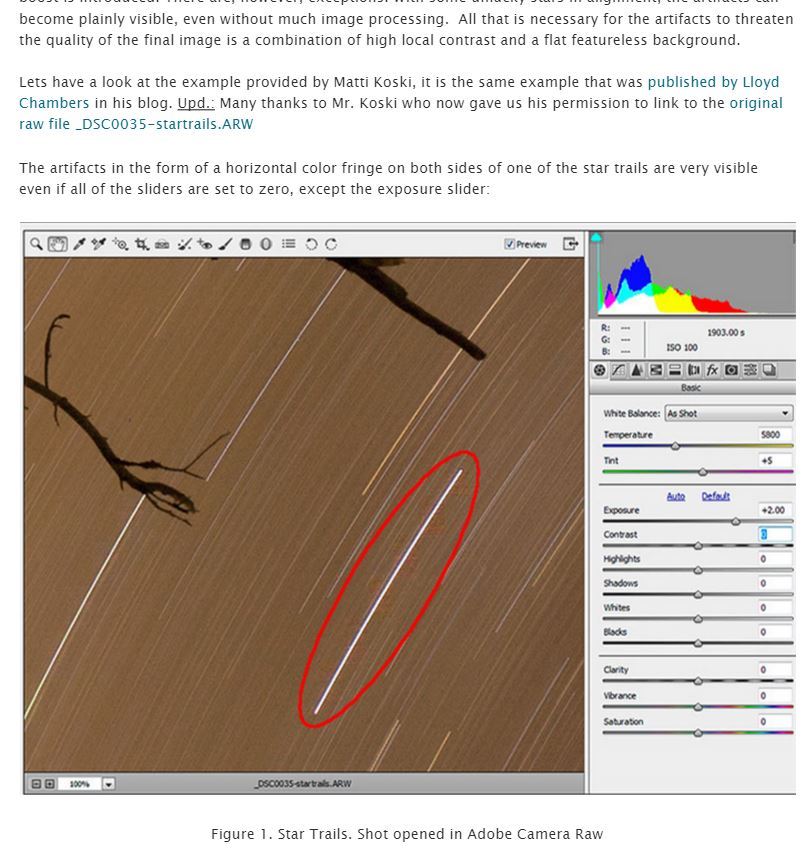
Here is a post at Raw Digger about the artifacts in the case of an astrophotograpy shot:
I've never done astrophotography, and my brain is not up to doing it in the future. Those folks have some pretty sophisticated tools that they use for image capture and processing, I've learned quite a bit through reading about their image capture techniques (layering 30+ images) and processing tools,
rscheffler wrote:
As some suggested, it may be timed to coincide with Canon shipping the 5DS now, which will certainly cause some cancelled preorders.
That said, other brands are no different at times. Some I'm familiar with: Canon announced the 5DS in early February. They announced the 1DX in October 2011, then put it through more field trials, including EURO 2012 and the London Olympics before finally releasing the camera to us mortals in August 2012. Never mind their 200-400 development announcement in Feb. 2011, over TWO years before production lenses shipped in May 2013 (the earthquake in Japan was partly to blame). Then there is Leica and M cameras... the M240 was announced in Sept. 2012 and generally only became available in very limited quantities six months later.
I agree with your comment about AF tracking capability... at some point mirrorless will match and eclipse DSLRs. Probably not quite there yet....Show more →
Hm... Might actually be true for more up-market stuff... Normally you get impatient nowadays when an announced product isn't available the week after
AF: Still, it seems to at least have some inherent promise. It's not like I shoot lacrosse, hockey or small birds in flight all the time... If it's a bit better than the A7II and the latest Panas/Olys, and I'll be happy enough for 99% of everyday usage.
Good to see it's still about other cameras, other brands, esoteric forms of photography, ever more out there 'faults'. Reassuring in a very odd kind of way - Sony will always be unworthy, no matter how great their cameras become, no matter how successful.
Tariq asked why there were two week old threads on the Sony forum front page a week or two back. It's pretty obvious..why come here to be inundated with increasingly out of place, off brand commentary rather than information and discussion on the new models?
Fred might consider removing the forum, it seems the best way 'backward' at this stage. Bye for now - and good light to all.
Tariq Gibran wrote:
Seems like they could have it ready by August upon release if they are really serious. In any case, what I read via IR with regard to Sony's response is: "He said that they could provide this via a firmware update (I wasn't sure to what extent their image processor was optimized somehow for the compressed format), but he couldn't promise any ETA..". emphasis added by me. That seems a little different then a guarantee that they are/ will fix the compression issue.
mmurph wrote:
The Canon 7DII has eliminated the fixed pattern noise/ banding. You can pull up the shadows by 5 stops with no banding/ pattern noise.
Dr. Roger Clark is an astrophotographer who does image processing for the Cassini Saturn mission. He has a pretty interesting web site. This is on the 7DII:
This camera is a stellar performer in low light situations, especially in the lowest light situations commonly found in astrophotography. A major improvement for long exposures is that the 7D Mark II camera has thermal dark current approximately 10 times lower than the nearest Canon camera I have measured as of this writing.
This makes the 7DII a game changing camera for night photography especially when one needs the reach that small pixels provide. The camera also has a new low price point for an action camera, with an impressive autofocus system previously found only on higher priced cameras. This too makes the camera a game changer as it enables more people to get into action photography and produce pro-level images (of course with proper experience).....
(Example D): bring up the low end with levels (right slider moved from 255 down to 64). Note that in (D) there is no visible banding patterns in the dark areas.
He also notes that the sensor itself is capable of 14.5 stops of DR, but it is limited by the read out circuity (read out noise) to 11.7 using the DxO 8 MP average.
***
I have been shooting Nikon and Sony for 7+ years. I sold my Nikon D7100 to buy the 7DII, which is an absolutely great wildlife & event camera at higher ISO. I still have my Nikon D5300, Sony A6000, and Sony A7II that I shoot more at base ISO.
mmurph wrote:
The Canon 7DII has eliminated the fixed pattern noise/ banding. You can pull up the shadows by 5 stops with no banding/ pattern noise.
Canon have made improvements to banding and pattern noise but the absolute level of noise in the shadows is still far higher than with Sony's Exmor, the latest Samsung sensors and several others.
mmurph wrote:
Dr. Roger Clark is an astrophotographer who does image processing for the Cassini Saturn mission. He has a pretty interesting web site.
Aside from a clear appeal to authority I'm not sure why that's relevant, yes the 7D II is good in low light. This thread is about the α7ʀ II announcement.
Too many are pushing Sony by putting down other systems, and ignoring current issues. For instance, there been some talk about how bad Canon pattern noise is in the shadows. You could only expect someone to respond to that type of post, to clarify what is actually possible with the latest Canon gear.
Then there's the "14bit Sony RAW files" that are actually 11+bit lossy compressed RAW files. You get Sony users saying it doesn't matter. Again, someone is going to respond - and that response might include personal experiece working another camera maker who is using lossless 14bit RAW files (since no Sony camera do!).
matthewsaville wrote:
I'm assuming you're being sarcastic and light-hearted, which I'm fine with. I've posted here a few times before; the whole reason I'm a fan of lightweight / compact cameras is not because I need to start working out more, but because I'd love to be able to carry 2-3 cameras into the wilderness if I can. Here's an expansion of my opinion on the subject: https://youtu.be/wGkBKDEaLEU
As I've said before, I'd love to own an A7R II. But it would not be a camera that I could own two or three of, for both budget and weight / size reasons.
For that, I'll probably have to wait and see if a weather-sealed A6000 mk2 arrives in time to go on sale for $500-600 on Black Friday / Cyber Monday this year. ;-)...Show more →
Matt Grum wrote:
It's absolutely, 100%, most definitely the lossy compression doing that. You'll get the same results regardless of the RAW converter. I see the same thing with ACR/Lightroom as with dcraw, in fact you can run dcraw through a debugger and see exactly what's causing the artifacts, first hand.
Just got home and caught up on this thread.
I don't hangout on photo forums much (this is the only place I post and have an account), so it was nice to see other members who have been looking into and researching this issue as well.
Matt - I caught up on your other posts regarding this and it is actually nice (and a relief) to see others confirm what I have been seeing. Your knowledge on how RAWs operate with the current cameras (not just Sony) is refreshing, and lines up with what I have been seeing with my own shots. I personally shoot with a 1-DX, a D800E and a Sony A7r and A7s.
davewolfs wrote:
They are fixing the compression issue via firmware. No ETA.
As I wrote before, my understanding is that this can't be true. The compression is part of the sensor readout hardware before the CPU in the camera ever sees the raw data,
The compression doesn't bother me in the least. But people who are bothered by it shouldn't buy this camera expecting it to change with a firmware update.
ebrandon wrote:
As I wrote before, my understanding is that this can't be true. The compression is part of the sensor readout hardware before the CPU in the camera ever sees the raw data,
The compression doesn't bother me in the least. But people who are bothered by it shouldn't buy this camera expecting it to change with a firmware update.
Your understanding may be right, or it may be wrong. We don't know enough for sure how it works.
howard wrote:
Your understanding may be right, or it may be wrong. We don't know enough for sure how it works.
Well we know a bit actually. On Luminous Landscape I've read that the "brain" of the A7 series is a 12 bit ASIC which wouldn't even be able to handle 14 bit data from the sensor. Also that some of benefits of compressing the data before ever writing an image to the card includes less lag and faster refresh for the EVF.
Keep in mind that the A7 series are the only full frame mirrorless cameras in the world capable of (1) more than 24mpx, (2) outputting high quality 4K video. Without the compression, consumer-grade hardware may not even exist yet for a fast enough EVF experience or fast enough readout for 4K video.