This topic is in the 2015 archive. You can read it and like its posts here. It is read only.
Archive 2015Canon 5DS dynamic range: zero improvement (RAWs analyzed)
p.20 #1Canon 5DS dynamic range: zero improvement (RAWs analyzed)
Monito wrote:
+1
3. I'm not sure mttran understands what he is posting with the charts or why. He certainly doesn't try to explain them or interpret them. I'm not sure he could do so clearly even if he took the time he would need to do so.
Making such assumptions can make you look foolish in the end.
Gunzorro wrote
mmtran -- I can't understand this either. You can't just regurgitate someone else's study results without a full explanation of the terms and the conditions of the study. You have a habit of doing this to supposedly support your position in technical debates. If you can't or won't provide complete explanation, please don't use these examples.3. I'm not sure mttran understands what he is posting with the charts or why. He certainly doesn't try to explain them or interpret them. I'm not sure he could do so clearly even if he took the time he would need to do so.
Making such assumptions can make you look foolish in the end.
Mar 29, 2015 at 07:14 PM
p.20 #2Canon 5DS dynamic range: zero improvement (RAWs analyzed)
EB-1 wrote:
In landscape images there are occasions when higher DR would be useful, but it's not the deal breaker very often and HDR offers a much higher increase in DR than a sensor bump does. I do also like dark shadows sometimes. In the old days we called that contrast - to delineate certain details.
EBH
Drama. Many of the masters of landscape have blocked shadows or lost detail in the highlights in their images. I think the ability to present detail in every part of the image is often overused. I'm not saying having a more DR capable sensor wouldn't be good, it's just that it can also become case of because I can doesn't mean I should. It can be a fine line to walk, especially when the general public tend to go gaga over crazy HDR type images. I'm not on that bandwagon.
Mar 29, 2015 at 07:15 PM
p.20 #3Canon 5DS dynamic range: zero improvement (RAWs analyzed)
chez wrote:
Making such assumptions can make you look foolish in the end.
Of course. If they were assumptions and not based on the evidence, in this thread for example. He's had plenty of opportunity to disprove the hypothesis. Note further that I stated it as a hypothesis I was not sure about, not as something I assumed to be fact.
Mar 29, 2015 at 07:18 PM
p.20 #4Canon 5DS dynamic range: zero improvement (RAWs analyzed)
Monito wrote:
+1
1. However, there are a lot of technical articles on the site but little or no explanation there, that I can find, of the codes for the charts that mttran posted. If someone can find it and post it or a link, I would be grateful.
2. mttran did not post the source, which is a definite failure: https://home.comcast.net/~NikonD70/ I think you have to have cookies enabled because the charts there are blank for me. Or maybe it is crappy microvirussoft SilverLight.
3. I'm not sure mttran understands what he is posting with the charts or why. He certainly doesn't try to...Show more →
The charts are blank until you populate them with data from cameras that interest you - the list on the right will let you do that (toggle a camera on/off in the charts). The explanation of the significance of the various parameters is not easy to get to - clicking "home" on the link lists articles where some can be found. A bit like Clarkvision but with less explanation
Gunzorro wrote
mmtran -- I can't understand this either. You can't just regurgitate someone else's study results without a full explanation of the terms and the conditions of the study. You have a habit of doing this to supposedly support your position in technical debates. If you can't or won't provide complete explanation, please don't use these examples.1. However, there are a lot of technical articles on the site but little or no explanation there, that I can find, of the codes for the charts that mttran posted. If someone can find it and post it or a link, I would be grateful.
2. mttran did not post the source, which is a definite failure: https://home.comcast.net/~NikonD70/ I think you have to have cookies enabled because the charts there are blank for me. Or maybe it is crappy microvirussoft SilverLight.
3. I'm not sure mttran understands what he is posting with the charts or why. He certainly doesn't try to...Show more →
The charts are blank until you populate them with data from cameras that interest you - the list on the right will let you do that (toggle a camera on/off in the charts). The explanation of the significance of the various parameters is not easy to get to - clicking "home" on the link lists articles where some can be found. A bit like Clarkvision but with less explanation
Mar 29, 2015 at 07:38 PM
p.20 #5Canon 5DS dynamic range: zero improvement (RAWs analyzed)
Thanks AJS. I previously tried the index and reading some articles, but I can't seem to find the terms used in the charts explained. If you have found explanations for each term I'd love to read them.
Also, there are no lists on the right and no toggles for me to use. But it would be a blessing if we could understand the charts mttrans prepared and dumped on us without explanation.
Also, there are no lists on the right and no toggles for me to use. But it would be a blessing if we could understand the charts mttrans prepared and dumped on us without explanation.
Mar 29, 2015 at 07:44 PM
p.20 #6Canon 5DS dynamic range: zero improvement (RAWs analyzed)
NCAndy wrote:
EBHDrama. Many of the masters of landscape have blocked shadows or lost detail in the highlights in their images. I think the ability to present detail in every part of the image is often overused. I'm not saying having a more DR capable sensor wouldn't be good, it's just that it can also become case of because I can doesn't mean I should. It can be a fine line to walk, especially when the general public tend to go gaga over crazy HDR type images. I'm not on that bandwagon.
Again..that is fine if YOU are not on the bandwagon...but can you at least understand some other people value more DR in their images. Historically, and in fact most landscape photographers still use techniques to manage the dynamic range in an image from GND filters to exposing multiple images of a scene to later combine these. Many of your so called MASTERS have been using these techniques for years. We now have cameras which reduce the reliance ( note I said reduce not eliminate ) on techniques to work around DR scenes which like I said is only a good thing. It allows more flexibility and choice...very much like the flexibility of to use high ISO or a flash when taking shots of dim scenes.
Don't forget the MASTERS used flash in the old days to illuminate dim scenes...now we have the option of use high ISO. Aren't options great?
EB-1 wrote
In landscape images there are occasions when higher DR would be useful, but it's not the deal breaker very often and HDR offers a much higher increase in DR than a sensor bump does. I do also like dark shadows sometimes. In the old days we called that contrast - to delineate certain details.EBH
Again..that is fine if YOU are not on the bandwagon...but can you at least understand some other people value more DR in their images. Historically, and in fact most landscape photographers still use techniques to manage the dynamic range in an image from GND filters to exposing multiple images of a scene to later combine these. Many of your so called MASTERS have been using these techniques for years. We now have cameras which reduce the reliance ( note I said reduce not eliminate ) on techniques to work around DR scenes which like I said is only a good thing. It allows more flexibility and choice...very much like the flexibility of to use high ISO or a flash when taking shots of dim scenes.
Don't forget the MASTERS used flash in the old days to illuminate dim scenes...now we have the option of use high ISO. Aren't options great?
Mar 29, 2015 at 07:50 PM
p.20 #7Canon 5DS dynamic range: zero improvement (RAWs analyzed)
chez wrote:
EBHDrama. Many of the masters of landscape have blocked shadows or lost detail in the highlights in their images. I think the ability to present detail in every part of the image is often overused. I'm not saying having a more DR capable sensor wouldn't be good, it's just that it can also become case of because I can doesn't mean I should. It can be a fine line to walk, especially when the general public tend to go gaga over crazy HDR type images. I'm not on that bandwagon.Again..that is fine if YOU are not on the bandwagon...but can you at least understand some other people value more DR in their images. Historically, and in fact most landscape photographers still use techniques to manage the dynamic range in an image from GND filters to exposing multiple images of a scene to later combine these. Many of your so called MASTERS have been using these techniques for years. We now have cameras which reduce the reliance ( note I said reduce not eliminate ) on techniques to work around DR scenes which like I said is only a good...Show more →
I thought I did acknowledge that extra DR would be a good thing. But I also think it is often overused because it's there. I think we're on the same page, more tools, more options.
NCAndy wrote
EB-1 wrote
In landscape images there are occasions when higher DR would be useful, but it's not the deal breaker very often and HDR offers a much higher increase in DR than a sensor bump does. I do also like dark shadows sometimes. In the old days we called that contrast - to delineate certain details.EBH
I thought I did acknowledge that extra DR would be a good thing. But I also think it is often overused because it's there. I think we're on the same page, more tools, more options.
Mar 29, 2015 at 07:56 PM
p.20 #8Canon 5DS dynamic range: zero improvement (RAWs analyzed)
EB-1 wrote:
It's easy to photograph a mountain with a slow camera, but not so when handholding a 500/4 and tracking a subject at 10-12 FPS. Last time all the people that had the EVFs were cursing and missing the animal action shots or had to shoot wide and guess what the capture would be. Almost all of the good images were from the 1D IV, 1D X or D4, all with big teles.
If I had to prioritize the limitations that prevent me from capturing a good image they would be in order of importance:
1. AF/general camera speed
2. High ISO noise
3....Show more →
chez wrote:
The beauty with expanded DR is that you can still have those deep dark shadows if you want...and if you don't, you can raise them...hopefully without ugly banding. More options is always better than less.
Using your list of importance, DR would the the highest on my list with the other 3 not even making my list. Maybe since we shoot such different images is leading to our views of the importance of DR. That is what really bothers me. If someone shoots images which don't challenge DR...why can't they just be happy with their current gear, but in doing so,...Show more →
I'm fine with the Nikon 36 MP, but the speed is not there and there are some lacking lenses.
I'd like a 36MP Canon (rather than 50) with better high ISO and 7 FPS instead of what is offered in the 5DsR, but it doesn't seem to be happening yet.
It's one thing to not be happy about the 5Ds/R, but trolling in the Canon Forum for that Sony system that is useful for Ansel Adams types and crappy for most else, does nothing for the Canon users.
EBH
Mar 29, 2015 at 08:04 PM
p.20 #9Canon 5DS dynamic range: zero improvement (RAWs analyzed)
EB-1 wrote:
If I had to prioritize the limitations that prevent me from capturing a good image they would be in order of importance:
1. AF/general camera speed
2. High ISO noise
3. Not enough reach
4. Lack of DR
In landscape images there are occasions when higher DR would be useful, but it's not the deal breaker very often and HDR offers a much higher increase in DR than a sensor bump does. I do also like dark shadows sometimes. In the old days we called that contrast - to delineate certain details.
EBH
Using your list of importance, DR would the the highest on my list with the other 3 not even making my list. Maybe since we shoot such different images is leading to our views of the importance of DR. That is what really bothers me. If someone shoots images which don't challenge DR...why can't they just be happy with their current gear, but in doing so, also realize some people shoot different subjects which put priority on different aspects of the camera.
Many landscape photographers don't care about FPS, high ISO, AF tracking or in fact AF in general...you don't see them going into a bird in flight discussion putting down the need for better AF tracking.
EB, if you are happy with existing DR in your cameras, then you should be all set in that aspect. Can you not at least understand others just might not be as satisfied as you?I'm fine with the Nikon 36 MP, but the speed is not there and there are some lacking lenses.
I'd like a 36MP Canon (rather than 50) with better high ISO and 7 FPS instead of what is offered in the 5DsR, but it doesn't seem to be happening yet.
It's one thing to not be happy about the 5Ds/R, but trolling in the Canon Forum for that Sony system that is useful for Ansel Adams types and crappy for most else, does nothing for the Canon users.
EBH
Not so. I'm a Canon user. Most of my gear is Canon. All but one of my lenses work on my 2 Canon cameras. What is really nice with the Sony system and specifically the A7R for Canon landscape photographers is that you can still use all your existing Canon lenses. For landscape photos, I've been using the A7R camera with my Canon lenses. For sports, wildlife, portraits etc....I still use my 5D2 and 7D with my Canon lenses.
Don't know why we need to delineate ourselves into one camp or another. In fact we talk about SIgma, Tamron, Tokina and Zeiss lenses here...all that fit onto Canon cameras. Now we have a camera that fits onto Canon lenses. I don't see any difference.
EB-1 wrote
It's easy to photograph a mountain with a slow camera, but not so when handholding a 500/4 and tracking a subject at 10-12 FPS. Last time all the people that had the EVFs were cursing and missing the animal action shots or had to shoot wide and guess what the capture would be. Almost all of the good images were from the 1D IV, 1D X or D4, all with big teles.If I had to prioritize the limitations that prevent me from capturing a good image they would be in order of importance:
1. AF/general camera speed
2. High ISO noise
3. Not enough reach
4. Lack of DR
In landscape images there are occasions when higher DR would be useful, but it's not the deal breaker very often and HDR offers a much higher increase in DR than a sensor bump does. I do also like dark shadows sometimes. In the old days we called that contrast - to delineate certain details.
EBH
chez wrote
The beauty with expanded DR is that you can still have those deep dark shadows if you want...and if you don't, you can raise them...hopefully without ugly banding. More options is always better than less.Using your list of importance, DR would the the highest on my list with the other 3 not even making my list. Maybe since we shoot such different images is leading to our views of the importance of DR. That is what really bothers me. If someone shoots images which don't challenge DR...why can't they just be happy with their current gear, but in doing so, also realize some people shoot different subjects which put priority on different aspects of the camera.
Many landscape photographers don't care about FPS, high ISO, AF tracking or in fact AF in general...you don't see them going into a bird in flight discussion putting down the need for better AF tracking.
EB, if you are happy with existing DR in your cameras, then you should be all set in that aspect. Can you not at least understand others just might not be as satisfied as you?
I'd like a 36MP Canon (rather than 50) with better high ISO and 7 FPS instead of what is offered in the 5DsR, but it doesn't seem to be happening yet.
It's one thing to not be happy about the 5Ds/R, but trolling in the Canon Forum for that Sony system that is useful for Ansel Adams types and crappy for most else, does nothing for the Canon users.
EBH
Not so. I'm a Canon user. Most of my gear is Canon. All but one of my lenses work on my 2 Canon cameras. What is really nice with the Sony system and specifically the A7R for Canon landscape photographers is that you can still use all your existing Canon lenses. For landscape photos, I've been using the A7R camera with my Canon lenses. For sports, wildlife, portraits etc....I still use my 5D2 and 7D with my Canon lenses.
Don't know why we need to delineate ourselves into one camp or another. In fact we talk about SIgma, Tamron, Tokina and Zeiss lenses here...all that fit onto Canon cameras. Now we have a camera that fits onto Canon lenses. I don't see any difference.
Mar 29, 2015 at 08:26 PM
p.20 #10Canon 5DS dynamic range: zero improvement (RAWs analyzed)
The difference is the incessant proselytizing.
Mar 29, 2015 at 08:31 PM
p.20 #11Canon 5DS dynamic range: zero improvement (RAWs analyzed)
Monito wrote:
The difference is the incessant proselytizing.
I'm not trying to convert anyone. I really don't care what others shoot. I just voice my opinion...very much like you voice yours. I believe we are still entitled to do so...right?
Obviously, when a thread is about dynamic range, there will be comparisons with the Sony sensor. If you walked into this thread thinking otherwise, you are somewhat naïve.
Mar 29, 2015 at 08:37 PM
p.20 #12Canon 5DS dynamic range: zero improvement (RAWs analyzed)
I expected a reiteration of the comparisons with the Sony sensor, comparisons that we have read before in numerous other threads. There was sure to be at least one reiteration, which would be fair enough.
I did not expect (or at least I hoped for a break from) the incessant proselytizing.
I did not expect (or at least I hoped for a break from) the incessant proselytizing.
Mar 29, 2015 at 08:42 PM
p.20 #13Canon 5DS dynamic range: zero improvement (RAWs analyzed)
Monito wrote:
I expected a reiteration of the comparisons with the Sony sensor, comparisons that we have read before in numerous other threads. There was sure to be at least one reiteration, which would be fair enough.
I did not expect (or at least I hoped for a break from) the incessant proselytizing.
Like I already said, I am not trying to convince anyone. I really don't care what you shoot. I just lay out my own experiences for others to read. You can take it for whatever you like...but frankly I care very little what you shoot. I care lots what I shoot.
Mar 29, 2015 at 09:11 PM
p.20 #14Canon 5DS dynamic range: zero improvement (RAWs analyzed)
chez wrote:
I did not expect (or at least I hoped for a break from) the incessant proselytizing.Like I already said, I am not trying to convince anyone. I really don't care what you shoot. I just lay out my own experiences for others to read. You can take it for whatever you like...but frankly I care very little what you shoot. I care lots what I shoot.
For someone who doesn't care, you seem to care a great deal about others. Maybe time to let it go...
Monito wrote
I expected a reiteration of the comparisons with the Sony sensor, comparisons that we have read before in numerous other threads. There was sure to be at least one reiteration, which would be fair enough.I did not expect (or at least I hoped for a break from) the incessant proselytizing.
For someone who doesn't care, you seem to care a great deal about others. Maybe time to let it go...
Mar 29, 2015 at 09:12 PM
p.20 #15Canon 5DS dynamic range: zero improvement (RAWs analyzed)
chez wrote:
Many landscape photographers don't care about FPS, high ISO, AF tracking or in fact AF in general...you don't see them going into a bird in flight discussion putting down the need for better AF tracking.
No they don't. They go into BIF threads and continue to whine about low ISO DR. It's a mantra. Some posters do it often enough so that it resembles a macro that kicks off every so many hours.
Nothing is going to change until Canon thinks it's worth the investment. So far they just don't see enough gain in it.
Mar 29, 2015 at 09:43 PM

p.20 #16Canon 5DS dynamic range: zero improvement (RAWs analyzed)
Much of this dialogue has been about the ability to pull up shadows from the abyss and in the name of cleaner files, less noise, etc.
Given credence to the fact that there is no single strategy that serves all applications, no need beat the dead horse @ horses for courses. But, I have a question from a technical standpoint.
My perspective has been that if I bracket a second shot, rather than make a 5 EV pull (for instance), that I'll have more data to work with for that portion of the scene. First question ... is that an accurate assessment? Second question ... how much more information would that represent?
Does a 5 EV exposure diff, render 2^5 times diff amount of data being captured (for the same given portion of an image)?
Edited on Mar 29, 2015 at 09:54 PM · View previous versions
Mar 29, 2015 at 09:50 PM
p.20 #17Canon 5DS dynamic range: zero improvement (RAWs analyzed)
NCAndy wrote:
Many of the masters of landscape have blocked shadows or lost detail in the highlights in their images.
There are a few landscape photographers with recognized names whose photographs regularly exhibit such problems. That is kind of sad, but most good landscape (and other photographers) avoid such things. :-)
RustyBug wrote:
Much of this dialogue has been about the ability to pull up shadows from the abyss and in the name of cleaner files, less noise, etc.
Given credence to the fact that there is no single strategy that serves all applications, no need beat the dead horse @ horses for courses. But, I have a question from a technical standpoint.
My perspective has been that if I bracket a second shot, rather than make a 5 EV pull (for instance), that I'll have more data to work with for that portion of the scene. First question ... is that an accurate assessment?...Show more →
You would have greater potential bit depth — the full bit depth from one exposure plus whatever additional you have from the second. So, yes, in this case blending may not give you greater dynamic range, but it can give combined scene data with greater bit depth.
Whether that matters much or not is a different question I think. Any time you bring up very dark portions of the image (from whatever camera you use) you potentially flatten the dynamic range of the affected area. If you bring up an entire area by the same amount, not so much. We often diminish this problem by using masked curves, since the curve can maintain or even increase the dynamic range of the affected area, though transitions between the adjusted area and surrounding areas could be an issue. (And blends are not entirely immune to this issue either.)
In a lot of ways, rather than relying on too much theory — a lot of that in this thread! — it is often better to just acquire the techniques used to adjust these things and try them and see what the result is. (Relevant to this thread, I read a lot in here about horrible effects on dark areas when they are recovered in post — noise, funny colors, banding, etc. — but I almost never encounter them in any way that negatively affects prints, and when I do there are almost always ways to adjust and compensate.)
One other thing to keep in mind. I know that many of you get this, but I wonder if everyone does? There seems to be an idea that if you have greater DR you won't have to adjust in post. That's not it. In fact, if you capture an image (either with a larger DR sensor or a blend) that has a huge dynamic range you are most certainly going to have to do some work in post to diminish that DR in your print, since prints cannot produce the same DR that any of the cameras mentioned here can capture.
Dan
Mar 29, 2015 at 09:52 PM
p.20 #18Canon 5DS dynamic range: zero improvement (RAWs analyzed)
Here is a primer on the ISOless ISO
http://home.comcast.net/~NikonD70/GeneralTopics/Sensors_&_Raw/Sensor_Analysis_Primer/Photographic_Dynamic_Range_Shadow_Improvement.htm
For those shooting raw it can be useful to know when raising ISO in the camera has little or no advantage over applying digital gain in post processing.
(Some people call this property “ISOless”. I think that is a very poorly chosen term.)
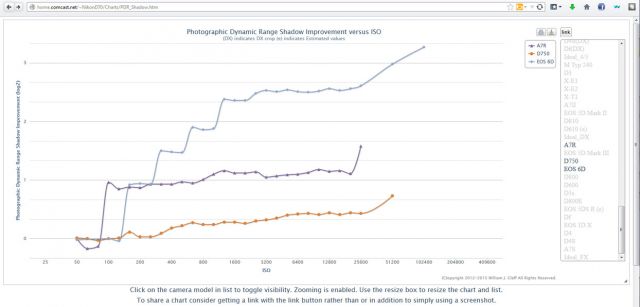
Here is an interactive chart for comps of this concept.
http://home.comcast.net/~NikonD70/Charts/PDR_Shadow.htm
A quick comparison of the 6D, D750, A7R is provided for reference.
My .02 so far is that this ISOless ISO is suggesting that in some camera's raising the ISO has little value regarding your shadow dynamic range beyond pulling it up in post, whereas other cameras continue to benefit from raising ISO. It would appear that this is an inherent design approach variation.
Feel free to correct my limited understanding of this ISOless ISO concept. But, my gut is telling me that this becomes a case of more than one way to skin the cat, as long as you know how to do the skinning in each approach.
My read on the chart is that it is of little value to raise the ISO in the D750, you can just pull it up in post.
Conversely, there is value in continuing to use higher ISO's in the 6D ... you won't need to pull your shadows up in post.
Looks like two different approaches by design that can get you to essentially the same place in the end, just via different mechanisms of approach ... one @ ISO, one @ PP
Since I didn't author these, the author is certainly welcome to provide further clarification ... and my presentation of this, does NOT infer that I'm asserting correctness in my assessment of its interpretation (although, it is an honest effort to be so). Just an honest effort to understand what's really going on ... to facilitate better understanding of how to optimize our various tool options (regardless of tool of choice).
Edited on Mar 30, 2015 at 08:01 AM · View previous versions
http://home.comcast.net/~NikonD70/GeneralTopics/Sensors_&_Raw/Sensor_Analysis_Primer/Photographic_Dynamic_Range_Shadow_Improvement.htm
For those shooting raw it can be useful to know when raising ISO in the camera has little or no advantage over applying digital gain in post processing.
(Some people call this property “ISOless”. I think that is a very poorly chosen term.)
Here is an interactive chart for comps of this concept.
http://home.comcast.net/~NikonD70/Charts/PDR_Shadow.htm
A quick comparison of the 6D, D750, A7R is provided for reference.
My .02 so far is that this ISOless ISO is suggesting that in some camera's raising the ISO has little value regarding your shadow dynamic range beyond pulling it up in post, whereas other cameras continue to benefit from raising ISO. It would appear that this is an inherent design approach variation.
Feel free to correct my limited understanding of this ISOless ISO concept. But, my gut is telling me that this becomes a case of more than one way to skin the cat, as long as you know how to do the skinning in each approach.
My read on the chart is that it is of little value to raise the ISO in the D750, you can just pull it up in post.
Conversely, there is value in continuing to use higher ISO's in the 6D ... you won't need to pull your shadows up in post.
Looks like two different approaches by design that can get you to essentially the same place in the end, just via different mechanisms of approach ... one @ ISO, one @ PP
Since I didn't author these, the author is certainly welcome to provide further clarification ... and my presentation of this, does NOT infer that I'm asserting correctness in my assessment of its interpretation (although, it is an honest effort to be so). Just an honest effort to understand what's really going on ... to facilitate better understanding of how to optimize our various tool options (regardless of tool of choice).
Edited on Mar 30, 2015 at 08:01 AM · View previous versions
Mar 30, 2015 at 06:54 AM
p.20 #19Canon 5DS dynamic range: zero improvement (RAWs analyzed)
Further exploration from the author ...
http://home.comcast.net/~NikonD70/GeneralTopics/Sensors_&_Raw/Sensor_Analysis_Primer/Read_Noise_-_Optical_Black.htm
Excerpted from above:
Read Noise is a key factor in determining the shadow performance of a digital sensor.
An analysis of Read Noise helps us separate the contribution of the preamplifier from that of the Analog to Digital Converter (ADC).
Measuring Read Noise can be quite troublesome, especially for Nikon cameras.
The chief problem is that Nikon “zero” corrects the raw data so it is difficult to compute standard deviation for black (lens cap) frames.
Again, clarification is welcome.
Mar 30, 2015 at 07:27 AM
p.20 #20Canon 5DS dynamic range: zero improvement (RAWs analyzed)
AJSJones wrote:
http://home.comcast.net/~NikonD70/index.htm is the source of the various plots
Thanks AJSJones, for the source of the graph (I trust you that it is in that long list!).
I'm not a researcher, so a comprehensive list of tables, graphs, and article web links is not something I'm much inclined to follow up on in support of someone else's point on a debate. This the sort of maneuver that mmtran makes continually: producing a "fact" and leaving in it to his reader to validate what he is saying through their own research (which he is now directing).
I would prefer him to do his own comparisons or tests, then provide those results with explanation of all the important aspects.
Gunzorro wrote
mmtran -- I can't understand this either. You can't just regurgitate someone else's study results without a full explanation of the terms and the conditions of the study. You have a habit of doing this to supposedly support your position in technical debates. If you can't or won't provide complete explanation, please don't use these examples.Thanks AJSJones, for the source of the graph (I trust you that it is in that long list!).
I'm not a researcher, so a comprehensive list of tables, graphs, and article web links is not something I'm much inclined to follow up on in support of someone else's point on a debate. This the sort of maneuver that mmtran makes continually: producing a "fact" and leaving in it to his reader to validate what he is saying through their own research (which he is now directing).
I would prefer him to do his own comparisons or tests, then provide those results with explanation of all the important aspects.
Mar 30, 2015 at 07:43 AM