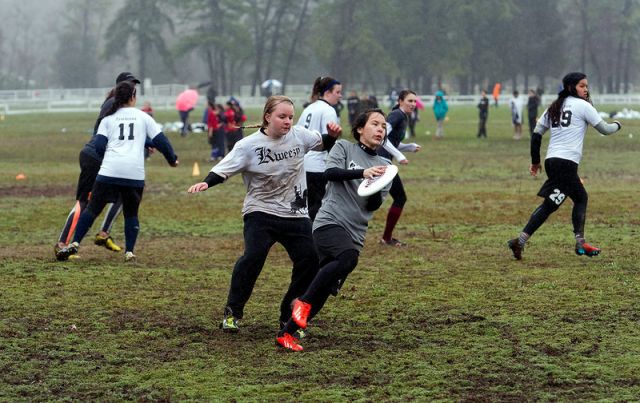
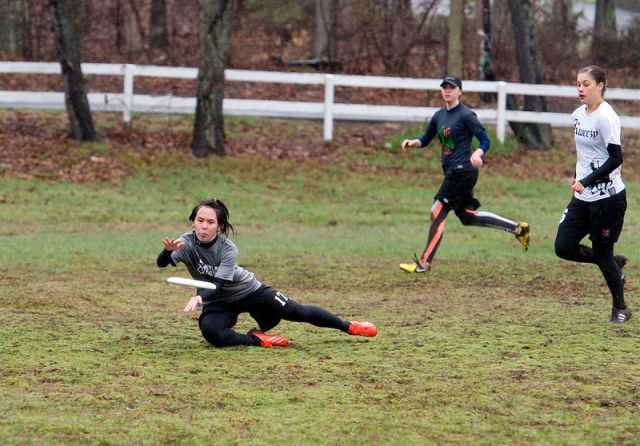
Just curious what filters, if any, people might use for sports photography. I had never used filters until recently I bought a Neutral Density filter for ski photography to cut down on overexposure and I love it. However, I mainly shoot Ultimate Frisbee (daytime, outside, varying weather conditions) and was wondering if I should be using a filter.
I was having the issue where if I dropped the exposure compensation, my camera would not be able to shoot at a high enough shutter speed to expose the photo properly. Shooting ISO100 and my shutter speed 1/4000 (max), the highest f stop I could get was f/8-9 and that wasn't enough to get good blur in the background. I always had more than enough light so the ND filter let me increase my aperture
kirkrsnyder wrote:
I was having the issue where if I dropped the exposure compensation, my camera would not be able to shoot at a high enough shutter speed to expose the photo properly. Shooting ISO100 and my shutter speed 1/4000 (max), the highest f stop I could get was f/8-9 and that wasn't enough to get good blur in the background. I always had more than enough light so the ND filter let me increase my aperture
Filters are going to cut your light by some amount (same as dropping EC). A CPL for example can reduce it from approx 1-2 stops. Only you can judge if adding one will still allow for sufficient shutter speed to stop to action. In your example a 1 stop reduction in light would allow you to compensate by opening up the ap by a stop say from 8 to 5.6 while shooting at 1/4000. If your body's max ss is 1/4000 then filtering becomes more relevant.
Not picking a fight either ... if the op is shooting 1/4000 @ f8 (assuming that is the correct exposure), dropping the ss to 1/2000 means you have to bump the f-stop to f11, right? Opening to f5.6 would overexpose the photo by 2-stop, right?
In a way, I understand why the op needs a filter, if there are abundant lights. With a 2-stop filter, he can shoot at 1/4000s @ f4. Shallower DOF if that is what the op is looking for.
kirkrsnyder wrote:
Just curious what filters, if any, people might use for sports photography. I had never used filters until recently I bought a Neutral Density filter for ski photography to cut down on overexposure and I love it. However, I mainly shoot Ultimate Frisbee (daytime, outside, varying weather conditions) and was wondering if I should be using a filter.
pretty much only a clear one to keep the field crap off the front end and the rain along with the occasional snow early or late in the season
some really good venues coming up: www.usaultimate.com
I use a 2 stop ND when I'm workin' daylight rodeo. Allows me the liberty to shoot
@f2 or f2.8 to destroy often shitty BG's....even then, a 1/4000th limit wouldn't cut it.
The OP's settings of ISO 100, f/8, and 1/4000 sec correspond to a 1 EV overexposure for ambinent light of 17 EV, which corresponds to bright sun at high altitude. This makes good sense to me.
I would usually overexpose a stop or more when shooting in snow, in order to make the snow look white. I would do this because the camera's light meter assumes the average image content 'brightness' corresponds to middle grey, and so a relatively small subject on a mostly-snowy background will have grey snow with the camera set to 0 EV adjustment. Setting it to +1EV decreases shutter speed by 1 stop, and gives brighter brights.
Note that this is the opposite to what Alan Yuen recommends. I typically dial EC down (i.e. -EV) to increase shutter speed when the image is mostly dark, in order to get the "average exposure" darker than middle grey. This difference is probably based on a difference of inierpretation in what "dial EC down" means.
At lower altitudes, where you'll probably find most Ultimate Frisbee games are being played, a sunny day corresponds to EV 14 or 15, and so you'll have a two- or three-stop 'advantage' compared to high altitude with a snowy background. So, for example, at ISO 100 and 1/4000 sec, you can get "0 EV adjusted" images at apertures of f/2 or f/2.8, which is plenty wide for most action applications. In practice, you'll probably stop down to f/4 or so. In low light, you'll increase ISO and eventually wish you had a 200mm f/1.8 lens.
IOW, no, you shouldn't need any ND filters for 'normal' outdoor sports and activities.
P.S. the 'monkey lives in New Mexico, where the sun is a lot closer to the ground than most other "moderate altitude" places in the world, except maybe the Saraha.
jcolwell wrote:
The OP's settings of ISO 100, f/8, and 1/4000 sec correspond to a 1 EV overexposure for ambinent light of 17 EV, which corresponds to bright sun at high altitude. This makes good sense to me.
I would usually overexpose a stop or more when shooting in snow, in order to make the snow look white. I would do this because the camera's light meter assumes the average image content 'brightness' corresponds to middle grey, and so a relatively small subject on a mostly-snowy background will have grey snow with the camera set to 0 EV adjustment. Setting it to +1EV decreases shutter speed by 1 stop, and gives brighter brights.
Note that this is the opposite to what Alan Yuen recommends. I typically dial EC down (i.e. -EV) to increase shutter speed when the image is mostly dark, in order to get the "average exposure" darker than middle grey. This difference is probably based on a difference of inierpretation in what "dial EC down" means.
At lower altitudes, where you'll probably find most Ultimate Frisbee games are being played, a sunny day corresponds to EV 14 or 15, and so you'll have a two- or three-stop 'advantage' compared to high altitude with a snowy background. So, for example, at ISO 100 and 1/4000 sec, you can get "0 EV adjusted" images at apertures of f/2 or f/2.8, which is plenty wide for most action applications. In practice, you'll probably stop down to f/4 or so. In low light, you'll increase ISO and eventually wish you had a 200mm f/1.8 lens.
IOW, no, you shouldn't need any ND filters for 'normal' outdoor sports and activities.
P.S. the 'monkey lives in New Mexico, where the sun is a lot closer to the ground than most other "moderate altitude" places in the world, except maybe the Saraha.
h317 wrote:
Not picking a fight either ... if the op is shooting 1/4000 @ f8 (assuming that is the correct exposure), dropping the ss to 1/2000 means you have to bump the f-stop to f11, right? Opening to f5.6 would overexpose the photo by 2-stop, right?
In a way, I understand why the op needs a filter, if there are abundant lights. With a 2-stop filter, he can shoot at 1/4000s @ f4. Shallower DOF if that is what the op is looking for.
Hope I did not screw up my calculation
Yup you got it right, I must have been drinking some really weak coffee this morning and reversed f stop logic which invalidates my point. I've edited my response. Sorry for the confusion.