I browsed the first few pages of the Alt forum, but didn't find a general wideangle lens thread for the Sony A7s. Since is is probably the hardest problem to solve at the moment, I think it might be good to have one.
I own the Zeiss ZF.2 21/2.8 Distagon, but this is rather bulky and not so flexible. I am wondering if anyone has any experience with the Nikon 18-35/3.5-4.5G, which is fairly new, compact and apparently very sharp. It might make a really nice travel and landscape wideangle zoom.
I own the Nikon 18-35 G and it is a truly outstanding lens on the D800E, and very light weight. The only downside is a pronounced moustache distortion. Much like the Distagon 21/2.8
Haven't tried it on the A7r yet, but expect it to deliver.
How is it to use the new G lenses on the available adapters? The 18-35G initially got poopooed as a consumer wideangle, but I've only seen great things from it when stopped down. I haven't handled one myself, but it may be a nice option for people who shoot both Nikon and Sony bodies.
uscmatt99 wrote:
How is it to use the new G lenses on the available adapters?
The aperture has to be adjusted using the ring on the adapter (given, it must have one), very rudimentary, without any scale. I have tried to use the mtereing to estimate the aperture, and it works OK.
Roger Cicala posted over on the Canon forum in the Sony thread the following
"What theSuede and others said earlier I've talked to two well-known lens designers, an adapter manufacturer, and someone who does sensor glass modifications about. All 3 agreed the off-axis issues are about cover glass thickness and composition.
For lenses with exit pupils near the rear (most wide angles and M mount, many others) off-axis performance isn't going to be as good as center performance. The good news is almost all tilt-shifts have exit pupils way up in the lens, so that should do better"
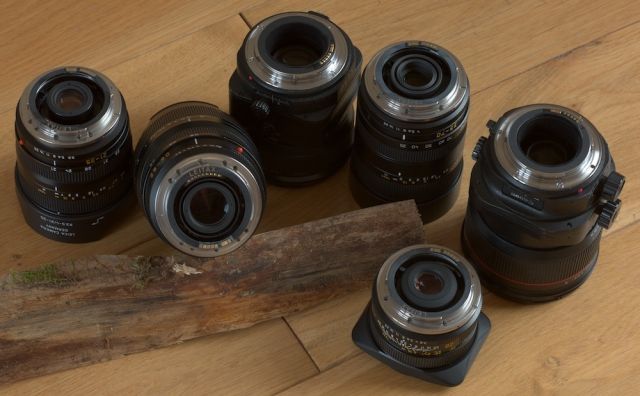
I checked out the two TS's and the exit pupil even at infinity setting is indeed 'way up in' the lens body. The WA leica R's I've got are flush fairly close to the lens bayonet. Image of the Canon 24+45 TS and the 28, 21-35, 35-70 and 28-90 all at the widest focal length and set to infinity.
If you care about size, I don't see this lens and buying you much. It is 95mm long from the flange on a Nikon camera, and 83mm in diameter. The Zeiss 21 is 87mm in diameter but this is only at the front end to accommodate the large front element, It is also 110mm, but that includes the caps. So the Nikon is only going to be a few mm narrower, and only at the front, and it is only a few mm shorter. IMO, they are basically the same size.
If you care about weight, however, the Nikon is a lot lighter because it is made of plastic instead of the metal in the Zeiss.
In my view this would be a non-starter as the very small gain in size isn't worth giving up the easier operation and better performance from the Zeiss.
The hood of the 21 is also kinda large, and the general shape is just awkward in a photo bag. The zoom would also give more flexibility. This is why I mentioned it as a travel lens possibility. I am not much of a wide shooter, so the range rom 18-35 would be covered, and I could add a few primes, maybe the 55/1.8 and the ZF.2 85/1.4 for a complete but compact kit. 18 is also quite a bit wider than 21. The 16-35/4 VR would be even better in that sense, but it is much larger.
It's a crazy cheap lens and will probably break and infinity seems to be dead in the middle of the focus throw on my lens but the 14mm Roki is a good value - but more awkward than the 21mm in the bag. And for the most part there is the possibility of 'too wide'
But here's the thing - try stuffing the Otus and the 135 Apo into your bag and the 21mm will seem like a rounding error from then on.
I think waiting for that Zeiss 24/2 that should come mid next year might be the best idea. Now, if one can not wait please let me know what the solution to the problem is, other than L28/2.8 II.
carstenw wrote:
The hood of the 21 is also kinda large, and the general shape is just awkward in a photo bag. The zoom would also give more flexibility. This is why I mentioned it as a travel lens possibility. I am not much of a wide shooter, so the range rom 18-35 would be covered, and I could add a few primes, maybe the 55/1.8 and the ZF.2 85/1.4 for a complete but compact kit. 18 is also quite a bit wider than 21. The 16-35/4 VR would be even better in that sense, but it is much larger.
Interesting. I don't find the hood on the Zeiss large at all and I think it reverses nicely for storage, but I hear people complaining about the hood all the time, so I guess I am the one who is out of step. Have you considered the Olympus OM 18 f/3.5 and 21 f/3.5? Together they would be smaller than either the Zeiss 21 or the Nikon zoom, and would obviously be a lot smaller on the camera.
For what it's worth I'm kind of interested in the 18-35mm now. I haven't really been paying attention to Nikon so I kinda missed this lens. It's cheaper, flexible (zoom) and light. The Nikon G-adapters are a bit of a pain but not as bad as the Contax-G adapters so for a wide-angle stopped-down tripod lens that's not a problem. This maybe something that'll hold me over for a while for landscape and hiking with the A7r. Anyone have both and want to test them?
carstenw wrote:
The hood of the 21 is also kinda large, and the general shape is just awkward in a photo bag. The zoom would also give more flexibility. This is why I mentioned it as a travel lens possibility. I am not much of a wide shooter, so the range rom 18-35 would be covered, and I could add a few primes, maybe the 55/1.8 and the ZF.2 85/1.4 for a complete but compact kit. 18 is also quite a bit wider than 21. The 16-35/4 VR would be even better in that sense, but it is much larger.
I am very happy with my ZA24/2. It's super sharp across the frame on A7R, and has the same great rendering properties as my other favourite lens, the Contax Zeiss 28/2 Holywood. Those include superb microcontrast (3D pop), great colors, nice bokeh and almost macro like close focusing abilities.
The ZA24/2 is a bit bulky of course, with the LA-EA4, but until there is a native Zeiss 24/2, and maybe even after, the ZA24/2 is more than enough for all my wideangle needs on A7R. Rapid SSM AF is a bonus.
Jon Tainton wrote:
Roger Cicala posted over on the Canon forum in the Sony thread the following
"What theSuede and others said earlier I've talked to two well-known lens designers, an adapter manufacturer, and someone who does sensor glass modifications about. All 3 agreed the off-axis issues are about cover glass thickness and composition.
For lenses with exit pupils near the rear (most wide angles and M mount, many others) off-axis performance isn't going to be as good as center performance. The good news is almost all tilt-shifts have exit pupils way up in the lens, so that should do better"
I checked out the two TS's and the exit pupil even at infinity setting is indeed 'way up in' the lens body. The WA leica R's I've got are flush fairly close to the lens bayonet. Image of the Canon 24+45 TS and the 28, 21-35, 35-70 and 28-90 all at the widest focal length and set to infinity. ...Show more →
Keep in mind that the rear element of a lens is NOT the exit pupil. The exit pupil is the virtual image of the aperture when viewing it through the rear of the lens. Granted, having the rear element "way up" in the lens body is probably a good indication that the exit pupil is far from the sensor, too. However, you can have a lens where the rear element is relatively close to the sensor, but the exit pupil is further away. That's why you can't simply look at the rear lens element and judge light ray angle incidence. The newer mirrorless lens designs often have rear elements near the mount, but the exit pupil is closer to the front of the lens.
douglasf13 wrote: Jon Tainton wroteRoger Cicala posted over on the Canon forum in the Sony thread the following
"What theSuede and others said earlier I've talked to two well-known lens designers, an adapter manufacturer, and someone who does sensor glass modifications about. All 3 agreed the off-axis issues are about cover glass thickness and composition.
For lenses with exit pupils near the rear (most wide angles and M mount, many others) off-axis performance isn't going to be as good as center performance. The good news is almost all tilt-shifts have exit pupils way up in the lens, so that should do better"
I checked out the two TS's and the exit pupil even at infinity setting is indeed 'way up in' the lens body. The WA leica R's I've got are flush fairly close to the lens bayonet. Image of the Canon 24+45 TS and the 28, 21-35, 35-70 and 28-90 all at the widest focal length and set to infinity.Keep in mind that the rear element of a lens is NOT the exit pupil. The exit pupil is the virtual image of the aperture when viewing it through the rear of the lens. Granted, having the rear element "way up" in the lens body is probably a good indication that the exit pupil is far from the sensor, too. However, you can have a lens where the rear element is relatively close to the sensor, but the exit pupil is further away. That's why you can't simply look at the rear lens element and judge light ray angle incidence. The newer mirrorless lens designs often have rear elements near the mount, but the exit pupil is closer to the front of the lens. ...Show more →
Ah, mea culpa. Thanks Douglas for taking the time to explain, much appreciated.
Note to self - read up on lens basics before posting b@*!@^ks ....
 Login