Thanks for comment, my buddy has a pair 5D3 with one filter removed and the other not that he uses for weddings
He tends to use the one with filter installed esp for people, and hates the filterless one due to the moire, red cast esp on the tuxes, his opinion it was not worth it for weddings, esp. when he is doing post to correct the reds
It is however just the same in sharpness between the 2, but the filterless one carries my detail in it when I viewed both at 100% under same lighting, camera settings
But I think for landscapes, architecture, city, and street it might be worth it, which I do 80% of the time
The low pass filter reflects IR so removing it will certainly make blacks look red. I opened up my 20D and converted it to IR, and my NEX 3 and converted it into full spectrum. They both shoot primarily the IR spectrum unless you put a filter on the lens to control the wavelength.
The difference between the two is that I replaced the LP filter with an IR on the 20D, and left the Sony sensor uncovered.
Biggest issue is that all colours focus on the same plane, except the reds -so depending on content they may be soft.
I was interested some years ago but never did it due to moire, red casting, ir and aliased edges. Don't think you should bother, better have good sharpening technic. D800 and a7r are other stories, designed like this, and more pixel density also quite avoid moire.
dasrocket wrote:
The low pass filter reflects IR so removing it will certainly make blacks look red. I opened up my 20D and converted it to IR, and my NEX 3 and converted it into full spectrum. They both shoot primarily the IR spectrum unless you put a filter on the lens to control the wavelength.
The difference between the two is that I replaced the LP filter with an IR on the 20D, and left the Sony sensor uncovered.
Biggest issue is that all colours focus on the same plane, except the reds -so depending on content they may be soft.
Both the 20D and NEX3 are B&W cameras for me....Show more →
The low pass filter (or also called AA, anti alias filter) is not responsible for blocking the IR light. The AA filter is a clear lithium niobate crystal which displaces incoming light into two beams of light with different polarizations. This reduces the so-called moire effect. Having such AA filter like in most digital cameras comes with a price - loss of resolution and sharpness. The camera manufacturers normally are not willing to state this in the technical specs of the sensor, but the reduction of resolution by the AA filter is between 20-30% depending on brand and sensor type
This filter array on top of the digital sensor also contains another filter element which is responsible for blocking IR light coming to the sensor. It is called internal cutoff filter (ICF).
dhphoto above said that it is not worth to bother to remove this filter array. This is not true. In fact it makes quite a difference, also on any Canon DSLR. I know this for sure since I converted one of my 5D MkIIs into an IR camera. For this the AA (and ICF) filter array are removed and replaced by an IR filter which blocks regular light with a cutoff at 715 nm (also I lost the ultrasonic cleaner array which is glued to the AA filter). Even IR photos normally are not as sharp as regular light photos, I am still amazed about the sharpness and the detail in my IR photos taken with this camera. I can definitely see that my regular 5D MkII body loses quite a bit of resolution due to the AA filter.
This means that the OP might get value from having such AA filter removed in one of his Canon cameras. Especially in architecture and landscape photography this would be very useful. You will then use the sensor to its maximum resolution. I never found moire patterns disturbing which sometimes appear in some of my IR photos with narrow lines present. I consider it a minor issue for having the huge benefit of great resolution and sharpness.
Nevertheless I have no experience by removing the AA filter from a sensor used in a camera for regular light photography. It is possible that some color changes happen, not sure to which extent. Reason for blocking IR light with the ICF array is simply to improve the visible color saturation. By removing the AA/ICF filters, you might see a difference in color saturation. I would discuss this with the company where you intend to have your camera body modfied. They are normally experienced and know about those effects more in detail.
retrofocus wrote:
...the reduction of resolution by the AA filter is between 20-30% depending on brand and sensor type
A "20-30%" "reduction in resolution" sounds quite awful, doesn't it. But what does that actually mean? What are the values you are comparing here?
...the OP might get value from having such AA filter removed in one of his Canon cameras. Especially in architecture and landscape photography this would be very useful. You will then use the sensor to its maximum resolution. I never found moire patterns disturbing which sometimes appear in some of my IR photos with narrow lines present. I consider it a minor issue for having the huge benefit of great resolution and sharpness.
I think it is good that you used the work "might" in that first sentence. I have never removed an AA filter, though one of my cameras has no AA filter. Comparisons are complicated, in that my Canon body is full frame and the other (Fujifilm X-E1) is 1.5x cropped sensor and 16MP rather than 22MP. I can offer a few observations that might be useful to anyone thinking about this issue - though, to repeat, I have not done a direct comparison between two otherwise identical cameras where one has the filter removed.
The image quality from the X-E1 is surprisingly good - though what portion of this is due to the fine lenses and what to the lack of the AA filter is very hard to say. I do notice that I use less aggressive sharpening in post to get similar results. I have also not noticed any particular issue with moire - you can get that even with a camera with an AA filter with certain subjects. (Though note that the Fujifilm camera uses a non-Bayer photo site array that is said to be more resistant to moire effects.)
So, that sounds like good news: no major moire issues (albeit with a different photo site array pattern), fine sharpness.
However, I remain unconvinced that the real world advantages of removing the AA filter will play out quite the way we imagine. For example, while a 20%-30% improvement in sharpness (to use your estimate) sounds quite wonderful - but what does that actually mean? I'm not sure from your descriptions. But that aside, by applying normal sharpening techniques (for detail, for local area contrast, and for dot-gain compensation in prints) one can produce truly wonderful and very sharp results in quite large prints from a 22MP full frame sensor. And, when it comes to making very large prints from a "small" format such as full frame ("small" by comparison to MF) it is rarely the case that sensor sharpness is the limiting factor. Even for a very careful photographer, other things probably limit potential enlargement size as much as or more than that.
But let's say that there is a "20% to 30%" improvement in "resolution." Let's assume that this is equivalent to increasing the number of photo sites by 20% to 30%. (I don't know what it means since you didn't say - 20-30% higher lp/mm? something else.) It turns out that this is a barely visible increase in print size at the comparable resolution.
I have little doubt that a camera without an AA filter can be very good and can produce very sharp images. However, when all else is equal (as it would be when comparing the pre and post AA removal camera) and when appropriately different sharpening settings are used, it seems that the objectively visible difference would be extremely small - and probably only arguably somewhat significant in a narrow band right around the upper limit for print size.
There's an alternative viewpoint to consider before doing surgery on a camera. ;-)
gdanmitchell wrote:
A "20-30%" "reduction in resolution" sounds quite awful, doesn't it. But what does that actually mean? What are the values you are comparing here?
I think it is good that you used the work "might" in that first sentence. I have never removed an AA filter, though one of my cameras has no AA filter. Comparisons are complicated, in that my Canon body is full frame and the other (Fujifilm X-E1) is 1.5x cropped sensor and 16MP rather than 22MP. I can offer a few observations that might be useful to anyone thinking about this issue - though, to repeat, I have not done a direct comparison between two otherwise identical cameras where one has the filter removed.
The image quality from the X-E1 is surprisingly good - though what portion of this is due to the fine lenses and what to the lack of the AA filter is very hard to say. I do notice that I use less aggressive sharpening in post to get similar results. I have also not noticed any particular issue with moire - you can get that even with a camera with an AA filter with certain subjects. (Though note that the Fujifilm camera uses a non-Bayer photo site array that is said to be more resistant to moire effects.)
So, that sounds like good news: no major moire issues (albeit with a different photo site array pattern), fine sharpness.
However, I remain unconvinced that the real world advantages of removing the AA filter will play out quite the way we imagine. For example, while a 20%-30% improvement in sharpness (to use your estimate) sounds quite wonderful - but what does that actually mean? I'm not sure from your descriptions. But that aside, by applying normal sharpening techniques (for detail, for local area contrast, and for dot-gain compensation in prints) one can produce truly wonderful and very sharp results in quite large prints from a 22MP full frame sensor. And, when it comes to making very large prints from a "small" format such as full frame ("small" by comparison to MF) it is rarely the case that sensor sharpness is the limiting factor. Even for a very careful photographer, other things probably limit potential enlargement size as much as or more than that.
But let's say that there is a "20% to 30%" improvement in "resolution." Let's assume that this is equivalent to increasing the number of photo sites by 20% to 30%. (I don't know what it means since you didn't say - 20-30% higher lp/mm? something else.) It turns out that this is a barely visible increase in print size at the comparable resolution.
I have little doubt that a camera without an AA filter can be very good and can produce very sharp images. However, when all else is equal (as it would be when comparing the pre and post AA removal camera) and when appropriately different sharpening settings are used, it seems that the objectively visible difference would be extremely small - and probably only arguably somewhat significant in a narrow band right around the upper limit for print size.
There's an alternative viewpoint to consider before doing surgery on a camera. ;-)
20-30% relates to the MP number (I didn't clearly stated it above). I know that the micro four/third cameras have one of the strongest AA filters put in which leads to the highest loss of resolution here. I am not sure what exactly is the number for our Canon cameras - I was never able to find a detailed info about this (maybe somebody else here can jump in who has an idea). If we assume that our 5D MkII loses 20% to the AA filter it would make it more like a 17 MP sensor instead of the full 21 MP sensor. This is just an example the loss might be more or less.
Hard to tell from my IR camera how much better resolution I get since I have an orange/apple comparison here because one camera is shooting in IR while the other body is using regular light. I only know that I can get details often better with my IR camera than with my regular one (using the same lens of course on both). But it is difficult to exactly quantify how much better it is.
retrofocus wrote:
20-30% relates to the MP number (I didn't clearly stated it above). I know that the micro four/third cameras have one of the strongest AA filters put in which leads to the highest loss of resolution here. I am not sure what exactly is the number for our Canon cameras - I was never able to find a detailed info about this (maybe somebody else here can jump in who has an idea). If we assume that our 5D MkII loses 20% to the AA filter it would make it more like a 17 MP sensor instead of the full 21 MP sensor. This is just an example the loss might be more or less.
Hard to tell from my IR camera how much better resolution I get since I have an orange/apple comparison here because one camera is shooting in IR while the other body is using regular light. I only know that I can get details often better with my IR camera than with my regular one (using the same lens of course on both). But it is difficult to exactly quantify how much better it is. ...Show more →
Yes, the IR issue makes it complicated, especially if you photograph subjects where the IR effect increases contrast and results in an improvement of "subjective sharpness." (That can be a good thing!)
Yep - that was I referring to! When my 5D MkII was converted to IR, I asked to have the AA/ICF filter array being sent back to me. Depending on the angle to a light source, I can clearly see the mirror effect of the top IR-reflecting layer of this array.
retrofocus wrote:
dhphoto above said that it is not worth to bother to remove this filter array.
And I did say I was speaking personally, I'm not going to tell someone not to modify their own gear!
But then I can't see the point of modifying a perfectly good camera to shoot IR when it's such a niche thing to want to shoot and I would never consider using Magic Lantern either.
I'm sure Canon put the filter there for a reason, I personally am not going to mess with it, as I said YMMV
The maxmax mad hot Rod verion looks great. The blacks look much better. I bet the B&W converted file looks superb also. I would do it on my 1DS3 which serves mainly as my backup to try it out. I remember a few years ago I talked to an aerial photographer and he used modified (aa filter removed) 1DS's for his work. He said that there is a noticeable increase in sharpness.
I have a PhaseOne digital back and of course it does not have an AA filter on the ccd. It is superbly sharp at the pixel level. I am sure the lack of an aa filter has something to do with it.
dhphoto wrote:
And I did say I was speaking personally, I'm not going to tell someone not to modify their own gear!
But then I can't see the point of modifying a perfectly good camera to shoot IR when it's such a niche thing to want to shoot and I would never consider using Magic Lantern either.
I'm sure Canon put the filter there for a reason, I personally am not going to mess with it, as I said YMMV
I can see your point - I also thought twice about modifying a second MkII body just for IR. But I should maybe mention that IR has developed to my main passion in photography - as you said, it is a niche, but I really enjoy it. I am never getting bored finding new things to shoot and to experience in IR. Having two same camera bodies enable me also to merge IR and regular color photos with great success. I am sure at some point I will upgrade my regular light camera body, but I will hold on to my IR converted camera body for a very long time for sure.
I agree with your remark regarding Magic Lantern. I am also not messing around with it because I find most advantages offered by Magic Lantern software are focusing on video applications which are currently of no interest to me.
As stated above, in regular light the so called "hot rod" modification can potentially cause some issues in regard to color saturation, but I don't have any experience here with this conversion specifically. It might depend on the main application for which you will use such converted camera for if this is worth it or not.
Sneakyracer wrote:
The maxmax mad hot Rod verion looks great. The blacks look much better. I bet the B&W converted file looks superb also. I would do it on my 1DS3 which serves mainly as my backup to try it out. I remember a few years ago I talked to an aerial photographer and he used modified (aa filter removed) 1DS's for his work. He said that there is a noticeable increase in sharpness.
I have a PhaseOne digital back and of course it does not have an AA filter on the ccd. It is superbly sharp at the pixel level. I am sure the lack of an aa filter has something to do with it. ...Show more →
I used MaxMax for my IR camera conversion and made very good experience with them. Very good response to my inquiries/questions which I had, fast service. I found them very helpful. They also offered to re-glue the ultrasonic cleaner to the new added IR filter replacing the AA/ICF filter array, but I decided not to go for it since the surcharge wasn't cheap for this. I just mention it here because it could be considered depending how the camera will be used later.
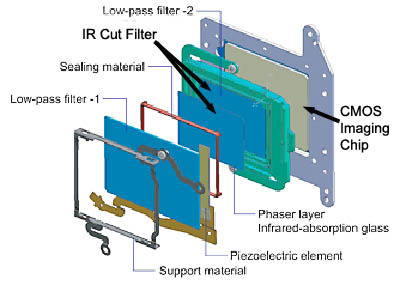
Removing the filters from DSLRs has a tremendous impact in Astronomy, where I'm mostly involved. As far as Canon cameras go, they have an LPF-1 and LPF-2 filter. The LPF-2 is removed when we want to get more of the deep-red Hydrogen alpha data (like in the Orion Nebula, for instance.) To get the anti alias filtration out, you need to remove LPF-1 and LPF-2.
As mentioned, this leaves you vulnerable to IR. It also messes up the white balance. The best way to combat this is to use Astronomik EOS Clip-In filters. There's all sorts of them, but the one you want is the OWB-CCD Type 3. It reverts the white balance and IR rejection back to factory specs. It clips in the camera, between the lens bayonet and the body. Be warned though, it will not work with EF-S lenses, and I think they only have them for crop-sensors.
Here's the main problem: Getting the sensor properly positioned so that autofocus functions correctly. Some people replace the LPF-2 with clear Edmunds optical glass, and it helps get the AF back close. For what it's worth, as far as AF goes, I've never seen a camera perform as well after a mod as it did before. Getting the sensor orthogonal again is virtually impossible, as is getting the AF precisely tuned like it was before.
It's fun to mod them, fun to shoot with them, but I wouldn't do it with any camera that I used primarily for terrestrial (daytime) photography. Here's a shot of the filters, courtesy of Gary Honis:
austin.grant wrote:
Removing the filters from DSLRs has a tremendous impact in Astronomy, where I'm mostly involved. As far as Canon cameras go, they have an LPF-1 and LPF-2 filter. The LPF-2 is removed when we want to get more of the deep-red Hydrogen alpha data (like in the Orion Nebula, for instance.) To get the anti alias filtration out, you need to remove LPF-1 and LPF-2.
As mentioned, this leaves you vulnerable to IR. It also messes up the white balance. The best way to combat this is to use Astronomik EOS Clip-In filters. There's all sorts of them, but the one you want is the OWB-CCD Type 3. It reverts the white balance and IR rejection back to factory specs. It clips in the camera, between the lens bayonet and the body. Be warned though, it will not work with EF-S lenses, and I think they only have them for crop-sensors.
Here's the main problem: Getting the sensor properly positioned so that autofocus functions correctly. Some people replace the LPF-2 with clear Edmunds optical glass, and it helps get the AF back close. For what it's worth, as far as AF goes, I've never seen a camera perform as well after a mod as it did before. Getting the sensor orthogonal again is virtually impossible, as is getting the AF precisely tuned like it was before.
It's fun to mod them, fun to shoot with them, but I wouldn't do it with any camera that I used primarily for terrestrial (daytime) photography. Here's a shot of the filters, courtesy of Gary Honis: ...Show more →
IR cutoff for the alpha hydrogen channel is at 656 nm, right? My regular IR (cutoff 715 nm) camera works perfectly fine with the re-calibrated AF, both in LiveView as well as with regular AF. The conversion company did a very good job calibrating it to the IR light sensitivity. Then I used Focal Pro to calibrate my EF lenses with my IR-converted camera to adjust MFA correctly. Works excellent!