tsdevine wrote:
A good portion of the corners and edges are getting cropped off on the NEX 7.....an even tougher nut to crack on FF.
Geez!?!?!
The M's have profiles for each lens to correct for this. Sony won't do this and it may be quite some time before the correction are available, I guess in Lightroom or some such raw processor.
j.liam wrote:
The M's have profiles for each lens to correct for this. Sony won't do this and it may be quite some time before the correction are available, I guess in Lightroom or some such raw processor.
VERY disheartening. May cancel my pre-order.
actually it sounds like sony has an app you can install on the cameras to do this if you want it in jpeg. you'll have to find the right settings yourself though – it's not like sony is going to make correction files for a bunch of leica lenses themselves.
LR (and capture 1) already has a plugin for it, can be done at in batches at import if you like, only issue is that files have to converted to DNG first.
edwardkaraa wrote:
Nope that's pretty standard. You should note that 1000:1 contrast ratio is impossible to achieve with any lens. It only can be done when you expose the film as a contact sheet. However, as far as I understand, 80 lines per millimeter actually means line pairs, so you can safely double that number. That would be equal to the theoretical resolution of a 24mp sensor, except that the real resolution is about 1/3 lower due to the bayer array.
The "chart contrast" is the light projected on to the film surface to create the exposure. This is typically an idealized square wave original, limited by either the lithography lens used to project it, or the diffraction resulting from the distance between the contact sheet (usually lithography etched aluminum coated PET film) and the line width. Another method is to use laser sweeps, you can focus lasers down to about 1/1000mm beamwidths, giving a 500lp/mm resolution with very high contrast.
The "limiting resolution" is the absolute extinction point. Zero remaining contrast on the film.
If you look at the last page of the Fuji datasheet, you see the "real" MTF values. "Real" with some unsharp mask applied that is, note that the contrast transfer is OVER 100% from 0lp/mm to 25lp/mm.... - so they're slightly optimistic, just like an oversharpened image from an AA-less sensor.
Normally in lens tests like in Imatest or with DxO or any other software based package, you use 50% contrast as the cutoff point. Velvia 50 reaches MTF50 at ~45lp/mm, so definitely not brilliant. That's 90^2*24*36 = 7.0MP.
Tristan Campbell has a pretty meticulously set up comparison here: Ektar100 vs 5Dmk2
Shot with a Canon 200F2.8L @ F5.6, where the lens outresolves the 5Dmk2 sensor by a factor of at least 2:1.
According to many sources (I don't know...) Ektar100 has better resolution than Velvia50. Ektar100 datasheet from Kodak
"The M-E is larger than the Sony and an RF, no live view, etc. Different camera. The Sony..IQ wise..can beat any Leica camera, period. BUT it can not match them for build, feel, use, wide angle M mount use, etc. Nothing can."
"The A7 and A7r seem to be made for M lenses The size and feel is perfect and the camera is easy to focus (at least for me) when using them. Small, solid and manual."
yo says:
November 18, 2013 at 10:31 am
I’m really interested also…because for now there isn’t any UWA lens in RF range that can be used on A7/A7R without any default (vignetting, colors smears etc.) …
That’s a problem for landscape and architecture…as for achitecture I would like to know if lack of AA filter on A7R will cause moiré artefacts, could you test that on repetitive paterns please ..?
Reply
Steve Huff says:
November 18, 2013 at 10:51 am
Sure there is..the WATE works well and that gives you 16-18-21 focal lengths. There are also other UWA lenses that work. Not all, but some do.
"Already tested and shown the 15 here a few weeks ago. The 21 1.8 from Voigtlander is great the 21 2.8 from Zeiss is good on the A7. The Zeiss Biogon f/2 I have shown MANY samples from and it is amazingly good. Just look at past write ups here…"
p.100 #11 · A7/A7r - performance with WA RF lenses
uhoh7 wrote:
well Huff is absolutely raving about A7s and M glass in his comments here:
The Zeiss Biogon f/2 I have shown MANY samples from and it is amazingly good. Just look at past write ups here…"
When Huff says stuff like that you know he is shooting from the hip, leaning on *old* reviews, certainly not talking specifically about the Biogons on the A7r, certainly not for all shooting conditions. Enthusiasm is great but qualification is necessary and often that is missing in his pieces.
Its not that every lens has to be superlative for documentary purposes while also being stellar for infinity landscape purposes.
I've no problem with using certain lenses for certain purposes. I'll part with a couple hundred for a nice old SLR lens and an adapter to provide an UWA field of view for close in work or a specific look and the odd scenic, but I'm not likely myself to spend thou$ands on lenses that I can't use for crisp distance shots edge to edge because I tend tend to like multi-purpose lenses not merely due to cost but also space in the bag while travelling. I want a good 20 or 25mm and just one when going light. Maybe just one period.
Put another way, many of us hated seeing nice RF glass limited by the field of view afforded by using full frame optics on crop cameras. Now we find some of this same glass being limited by fundamental physical incompatibilities with full frame high-res sensors. It's the APS-C problem with a different twist.
Very confusing: the article states that the Contax G 28 is OK. I have seen pictures to the contrary, yet this photographer seems to know what he is doing. Could it be all down to the specific adapter?
p.100 #14 · A7/A7r - performance with WA RF lenses
To me the most interesting and the one thing I chose to take away from the article was the comment on adapters when he tested the ZM25/2.8, indicating that, in his sampling, the Metabones was the adapter of choice. Ok, maybe that's worth something... But I'm still not convinced that adapters are playing a big role in reducing or eliminating smearing found with lenses on this camera where it doesn't routinely occur on say the M9.
The sample shot he provided for that lens doesn't convince me the ZM25 is free from smearing though. He seems to have it stopped down enough to create DoF encompassing a number of feet (deep inside shop on shelves look acceptably sharp) yet outside as you move away from the crisp centre fairly quickly towards the edges of the frame the rendering looks smeared, not out of focus, in areas that probably should also be acceptably sharp.
I'd love to feel differently as I'd buy a ZM25 again in a heartbeat if I thought it was solid on this camera but the text and sample don't convince me.
Apparently we've entered the realm of determining the meaning of two character words in a Clintonesque fashion where we need to know what the meaning of what "is", is. No political comment intended! Only in our case, "ok" actually can have greatly varying meaning in context. Ugh!
p.100 #16 · A7/A7r - performance with WA RF lenses
Actually the 15's not too bad. I've just got round to taking a couple of shots with it and the red edge looks about the same or less than the M9. Hard to tell if it's smearing in the corners or out of focus objects. I've got a big brick wall around the corner, I'll try and take some pics when I walk the dog!
I might even do a comparison with the M9 if it's of any interest?
p.100 #17 · A7/A7r - performance with WA RF lenses
philber wrote:
Very confusing: the article states that the Contax G 28 is OK. I have seen pictures to the contrary, yet this photographer seems to know what he is doing. Could it be all down to the specific adapter?
I usually just look at the images first rather than read what someone says. Have a look at his Contax G 28 image outside of the central area (taken at F8 no less).
p.100 #18 · A7/A7r - performance with WA RF lenses
Ra7erSharp wrote:
Actually the 15's not too bad. I've just got round to taking a couple of shots with it and the red edge looks about the same or less than the M9. Hard to tell if it's smearing in the corners or out of focus objects. I've got a big brick wall around the corner, I'll try and take some pics when I walk the dog!
I might even do a comparison with the M9 if it's of any interest? https://dl.dropboxusercontent.com/u/4999128/DSC00156.arw
That's a link to a CV15/4.5 raw. Give it a minute to upload though.
Thanks !.
In my experience with the CV15 /4.5 on APS-C cameras, this lens has quite a lot of field curvature. I expect than in a FF sensor this will be even more noticeable. To assess corner smearing whit the Heliar 15 i'd fine tune the focus ( with image magnification) on the corner of the frame, not the centre, specially at wider apertures.
That CV 15 sample, if far from perfect, looks better than I feared for such UWA.
To those who think that the A7r is even worse than the NEX-7 with RF wides, please take the picture above and crop it to APS-C size. You'll have a 16Mp, photo with a FOV of a 23mm lens on FF and virtually no color shift or smearing, Compare it to the behavior of the NEX-7 with this lens and judge by yourselves.
p.100 #19 · A7/A7r - performance with WA RF lenses
michaelwatkins wrote:
Now we find some of this same glass being limited by fundamental physical incompatibilities with full frame high-res sensors. It's the APS-C problem with a different twist.
+1 physical properties of the projected image.
Different designs for different approach to covering the same 24x36 > different results. While the digital Bayer array microlens sensor has its limitations ... design of the projection to deliver the light to sensor is part of the issue as well.
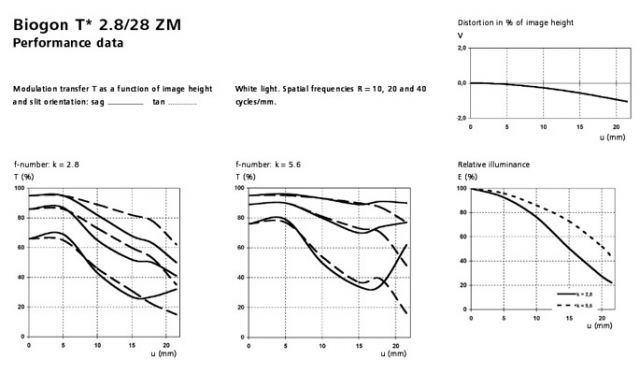
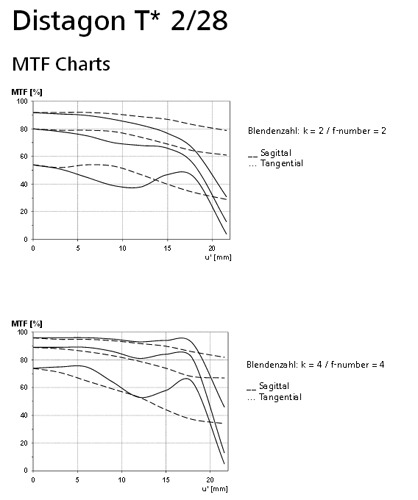
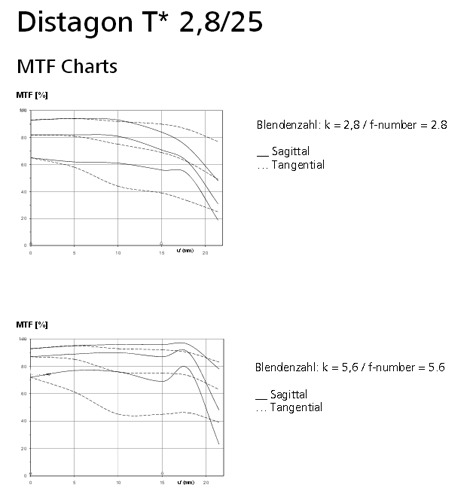
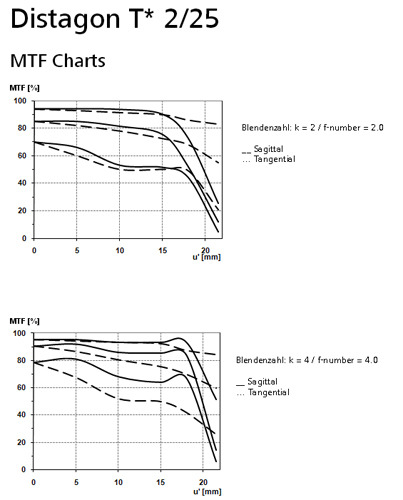
Looking at 15mm (note where in the image the Biogon drops down below the 30% mark) on we can see a rather stark difference in what is reaching the sensor. Putting the Biogon on a crop and we get a nice benefit of not seeing how it really performs in the edges/corners. Putting the Biogon on FF and suddenly we get what we asked for.
Even the wider 25mm fares differently from the different design in the outer areas.
p.100 #20 · A7/A7r - performance with WA RF lenses
Tariq Gibran wrote:
I usually just look at the images first rather than read what someone says. Have a look at his Contax G 28 image outside of the central area (taken at F8 no less).
He talks about the G28 and the ZM21 above, but the photo below is labeled ZM25?


 - so they're slightly optimistic, just like an oversharpened image from an AA-less sensor.