so the material used and how its layered up and its binding have little to do with it? don't composites become quite anisotropic depending on directionality? young's modulus will change with the vector or grain of the material
Young's modulus is not always the same in all orientations of a material. this is what makes composites so much fun to play with.
sjms wrote:
so the material used and how its layered up and its binding have little to do with it? don't composites become quite anisotropic depending on directionality? young's modulus will change with the vector or grain of the material
Young's modulus is not always the same in all orientations of a material. this is what makes composites so much fun to play with.
Young's modulus, the elastic modulus, and the modulus of elasticity are various terms for the same property.
Yes, the material used affects the stiffness - but it's Young's modulus not the density that matters. One of the most dense metals we know of is lead - very high density (exceeded by Mercury), but it's not a very stiff material, and Mercury is even less stiff.
Aluminum is far less dense than lead, but is a lot stiffer.
The value for structural steel (missing in the table) is usually taken as 29 (x 10^6), or 29,000,000 psi. (I'll quote Imperial values because the majority of users here are from the US, although I use both systems in structural engineering - I'm bi-metric).
At 29.0, steel is almost three times as stiff as Aluminum, but Al has the advantage of being much lighter (hence its use in aircraft and tripods).
You are right about how Young's mod varies with direction - another example is wood.
In any event, I don't look at load rating tables for tripods because tripods seldom break in proper use - some of them just vibrate too much. When it comes to stability (vibration), there's no magic solution that defies physics - for a given material, the larger thicker legs perform better than the smaller, lighter ones - but they're also heavier.
that's why there are different weaves and layups. we don't break the rules just "bend" them a little. it just makes the original equation a wee bit more complex.
life is full of compromise and then there is the occasional surprise.
Just my two cents but the only reason I opted for the Gitzo 3542LS over the 3532LS or the RRS TVC-33 is that I can fit the 3542LS in my carry-on. I honestly don't ever see myself using something bigger or heavier than about a 300mm f/2.8 so really any of them should theoretically deal with pretty much anything I have to throw at them.
sjms wrote:
that's why there are different weaves and layups. we don't break the rules just "bend" them a little. it just makes the original equation a wee bit more complex.
life is full of compromise and then there is the occasional surprise.
True, but the value for the modulus of elasticity includes these factors, so the equation is the same.
Glenn
Jul 10, 2013 at 11:06 AM
Lars Johnsson Offline • • • • • • • Upload & Sell: Off
kendalltristan wrote:
Just my two cents but the only reason I opted for the Gitzo 3542LS over the 3532LS or the RRS TVC-33 is that I can fit the 3542LS in my carry-on. I honestly don't ever see myself using something bigger or heavier than about a 300mm f/2.8 so really any of them should theoretically deal with pretty much anything I have to throw at them.
When a strong Systematic style small size tripod for carry-on is important, the Gitzo series 4 (GT 4552 TS) is outstanding.
I looked at it when I was shopping but I couldn't justify spending that much money on a tripod that is essentially too short for me to use without either hunching over or using a center column. I'm 5' 11" so the 3542LS with a BH-55 on top is at the lower limit of what I consider acceptable. I've been seriously considering adding a spacer or leveling base to push the total height up another inch or so. There would be no way for me to get the 4552TS tall enough without a center column.
Jul 10, 2013 at 05:24 PM
Lars Johnsson Offline • • • • • • • Upload & Sell: Off
kendalltristan wrote:
I looked at it when I was shopping but I couldn't justify spending that much money on a tripod that is essentially too short for me to use without either hunching over or using a center column. I'm 5' 11" so the 3542LS with a BH-55 on top is at the lower limit of what I consider acceptable. I've been seriously considering adding a spacer or leveling base to push the total height up another inch or so. There would be no way for me to get the 4552TS tall enough without a center column.
But it will fit inside a carry-on bag for international airlines. Your tripod doesn't do that. At least not for most airlines. That was the point and strength of it.
Lars Johnsson wrote:
But it will fit inside a carry-on bag for international airlines. Your tripod doesn't do that. At least not for most airlines.
It does, it just has to be inserted diagonally in the bag rather than straight. I can pull one leg up a little bit and hardly lose any space to it as most of my clothes and other items will fit between the legs. Naturally I have to remove the head for travel, but that's hardly an issue.
kendalltristan wrote:
It does, it just has to be inserted diagonally in the bag rather than straight. I can pull one leg up a little bit and hardly lose any space to it as most of my clothes and other items will fit between the legs. Naturally I have to remove the head for travel, but that's hardly an issue.
Very timely - I spent the afternoon today looking for an easily carried bag that would take my GT2540EX (four sections). With the head removed, it will fit diagonally into a 24" or 25" bag. Oddly, one brand had a 21" bag, and it worked. So much for size standards (almost as useful as weight capacities for tripods).
Darn lucky I didn't get a three section model (they were on sale and selection was limited).
In the end I have ordered Gitzo 3532 LS, as I do not see a benefit convincing enough for switching to another brand, i.e., RRS. Moreover, in their latest generation of the Systematic tripod line, Gitzo have implemented a number of noteworthy evolutionary design improvements. One of them is a modified hub shape which probably addresses the high stress concentration points in the older design.
Again, thank you all for your valuable inputs.
kendalltristan wrote:
It does, it just has to be inserted diagonally in the bag rather than straight. I can pull one leg up a little bit and hardly lose any space to it as most of my clothes and other items will fit between the legs. Naturally I have to remove the head for travel, but that's hardly an issue.
I do exactly the same thing with my 3541LS which at 21.7" folded is just a wee bit smaller than the 3542LS. Gitzo has a bewildering array of systematic tripods and other models to choose from, their big sellers are the 3-series systematics and in the current range they have 5 of them.
I'm 5' 8" and when buying a "big" tripod almost two and a half years ago I looked very carefully at the Gitzo and RRS models. Once you get your head around the multiplicity of Gitzo offerings there does seem to be something there for you in terms of size and weight.
OTOH I find the RRS tripods to be a bit awkward in size and a bit heavier too. For my height their 33 is perfect with a max height of 58.0" but it only folds to 26.0" and weighs 4.3 lbs. Now they have the 34L but that only folds to 24.5" and it weighs 4.7 lbs. So the RRS 34L is 24% heavier and 13% longer than my 3-series Gitzo. Not worth swapping for sure.
The folded size is what's important for travel and while I have a travel tripod I do take my systematic on trips if I have a car at the other end. The weight OTOH you can't do anything about. I assume the weight differential is due to the solid milled aluminum RRS uses for the metal parts. In contrast Gitzo uses cast magnesium alloy for those parts. Much is made of the reliability and durability of milled aluminum but in all honesty I haven't seen or heard of reports of Gitzo systematics fracturing at the base. Regular Gitzo tripods yes, but not the systematics. Someone please correct me if I'm wrong.
Both Gitzo and RRS tripods are clearly great products, but for my height and how I use my tripod of the current ranges from the two companies I'd get another Gitzo if my current one broke, almost certainly the 3542LS. This despite the fact that Gitzo customer service (at least the parts side) is appalling in the US. I know RRS has great customer service as I'm a RRS customer but great CS doesn't make up for something that doesn't work for me in one way or another.
nobody expects you to be perfect I mean me, being 5'7", made all the difference in the world with my RRS tripods
and yes there have been issues with the Gitzo spiders but mostly at the step areas for setting leg angles. corrosion can start under the painted surface and won't show up for awhile. their methods have not really changed. the ocean series is a more robust and substantially higher in price.
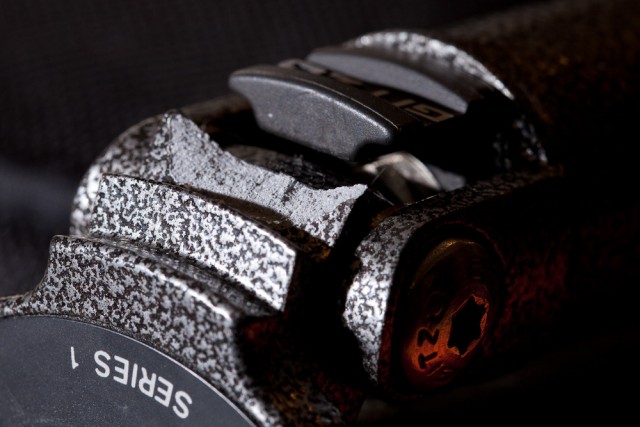
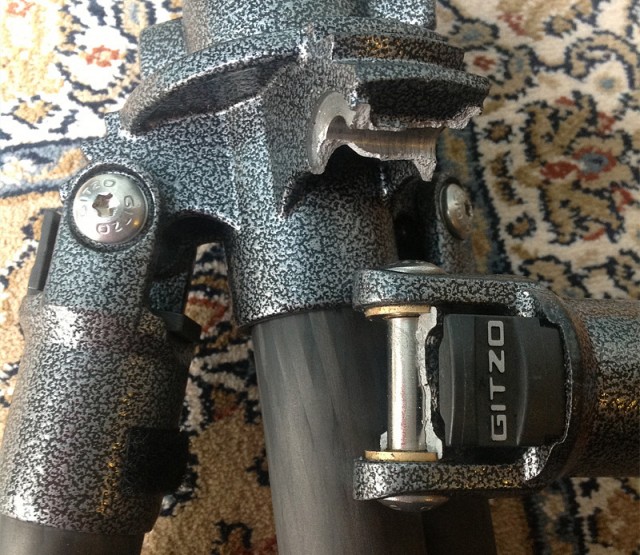
A similar mishap (second photo in sjms' post) afflicted my Gitzo in the winter time snow. I don't think the magnesium castings are as strong as they should be. The breakage was my fault, but it taught me how that tripod is not as robust as I thought it was. Light weight materials have their limitations when it comes to bearing certain forces.
Although I am still a Gitzo user I am giving serious thought to my next tripod being one from RRS.
sjms wrote:
nobody expects you to be perfect I mean me, being 5'7", made all the difference in the world with my RRS tripods
and yes there have been issues with the Gitzo spiders but mostly at the step areas for setting leg angles. corrosion can start under the painted surface and won't show up for awhile. their methods have not really changed. the ocean series is a more robust and substantially higher in price.
I had an old Manfrotto 190 aluminum tripod break in exactly the same place from a fairly minor knock. I showed it to my father, a machinist specializing in aircraft, and he said that was some of the cheapest "pot metal" he has seen. I'm not very mechanically inclined but even I noticed the cast aluminum used was very low density and almost porous compared to the aluminum he machined for light planes.
point of reference: Manfrotto (the people who originally bought and owned Gitzo previous to Vitec which now owns them both) has always used Mg (magnesium) alloy and some Al in their castings as does Gitzo (except for the mondo priced Stainless Steel Ocean line). the alloying may be different though and possible methodology. the legs themselves are aluminum. but I do have a 25+ year old Bogen nomenclatured Manfrotto 3021 that has managed to survive the ravages of time.
the use of Billet Aluminum is quite a bit different from straight Al casting (though itself was originally cast). it is in fact the same product used by your father for machining aircraft parts (as it is today in all sized aircraft) is the same product used in the RRS product line pretty much in its entirety. you anodize this instead of painting it too. it will outlast anything short off SS under use.
the standard for RRS and just about the rest of the following pack is 6061-T6 for component material.
bare Mg alloy blocks are attached to metal boat hulls and other areas as sacrificial anodes for corrosion.
B Landau wrote:
A similar mishap (second photo in sjms' post) afflicted my Gitzo in the winter time snow. I don't think the magnesium castings are as strong as they should be. The breakage was my fault, but it taught me how that tripod is not as robust as I thought it was. Light weight materials have their limitations when it comes to bearing certain forces.
Although I am still a Gitzo user I am giving serious thought to my next tripod being one from RRS.
Yes I have seen the pictures sjms posted and others too, there are plenty of instances of fractures like them. A lot have occurred in extreme cold however Gitzo does specify a temperature range for use with their warranty material but not many people read the fine print.
All of these breakages I've seen have been with tripods that have a center column, and I've never seen or even heard of a fracture like in the pix sjms posted happening with a Gitzo systematic.
I too have thought about RRS, but as I said earlier their sizes are awkward for me. Maybe they will expand their range in the future.
RRS does not specify an operating ranges. might have something to do with better design and materials to work better in a somewhat more hostile environments.
as to weights and measures Gitzo plays the tech game well putting up a barrage of somewhat useful info and mixing it with PR persiflage. they have changed/upgraded their product so many times in the past few years its hard to keep up. but then again does one need too? some don't need to bother playing "chase the rabbit".