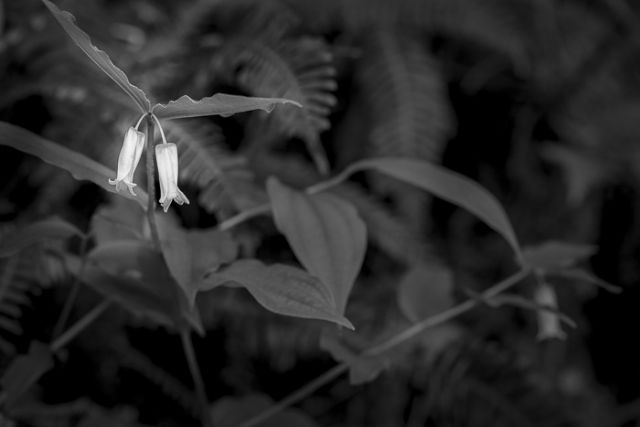
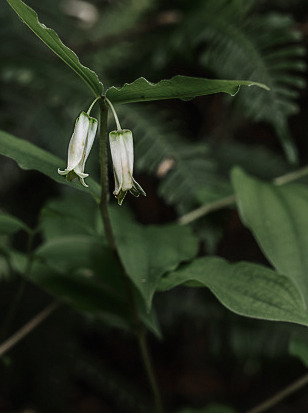
I think I would darken the foliage immediately behind the flowers so the flowers stand out even better.
The flowers are such a very small part of this image that it is clear you are trying to build the image to be more than just flowers. Unfortunately, to me, the background seems to be lots of clutter and not very interesting. Perhaps we could be more helpful if you would explain what you are trying to show with this image.
+1 @ Jim, although I think I see where you're going with your tonal values to draw our eye. I'm always diggin' "command & control" @ "draw the eye". The technique, though looks like you used a gradient or feathered brush and have some "spill" onto the foliage that Jim first refers to.
I see this one as a "skill builder" exercise that could use two things ... one, less spill/better control/mask/etc. and two, they look just a tad hot (not blown) that might pull back on, particularly if you are able to decrease the foliage behind them.
When a photo has a single strong focal point which contrasts strongly with the background it's a sure bet the viewer's instinctive perception process will skip to it and fixate on it. Recognizing that the photographer should think about how long they are likely to dwell on it, where their attention will be drawn next, what of interest they will find when they get to the end of that leading line, and finally whether or not they will find their way back to the more important main focal point for a second look before leaving the photo.
When I evaluate the photo along those lines I see a strong focal point, rendered less interestingly in B&W than it would have been in color. Bright colors is one of the more compelling aspects of flowers. Take away the color and they are less interesting. The B&W conversion creates strong contrast, but a color version would also have strong COLOR contrast between the flowers and foliage.
I suspect that second flower in the background would be a more compelling secondary focal point in a color version of the same shot, but that raises the question of whether or not to tempt the viewer off the main focal point with another flower. As when telling a joke sometimes it's better to just deliver the "punchline" then end the story. In a photo that's done with cropping decisions.
When there is a strong foreground focal point the question to ask yourself is how much background context is needed for the viewer to understand the story. For example if the flower was growing out of a crack in the sidewalk in Times Square or near the rim of the Grand Canyon including that background context would ad a new level of interest to the visual narrative and story that the viewer's mind creates from the clues in the photo. Here the background, which is given many more pixels than the focal point, really doesn't add anything to the story. Instead it distracts from the focal point by tempting a curious eye to explore the 'negative' space in the hope of finding some other visual reward hidden there.
When critiquing photos of others I'll crop in tight on what is the obvious main focal point then expand the frame outwards slowly adding context and moving the focal point around in the frame to play any lines me away off the corners of the frame, so when my eye does follow a stem or leaf from the flower it hits a corner of the frame and "bounces back" like a billiard ball on a pool table.
For this one I'd crop out the second flower and curved leaf above it. There a nice leading line in the leaves connecting the two flowers, but the second smaller out-of-focus one isn't as interesting as the one in the foreground so I view it as a distraction diluting the impact of the first.
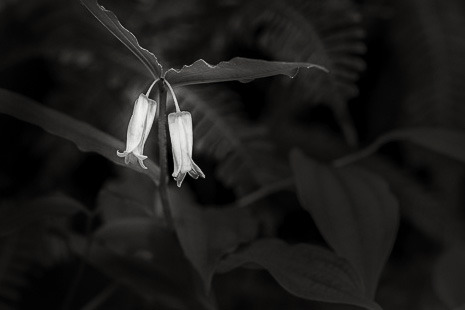
Whenever you use a horizontal crop and put the main focal point near one side it sends a subliminal message to the viewer to go explore the space. Cropping in from the right and making it a vertical crop will make the main focal point larger and more compelling and keep the viewer's attention locked on it longer because there's nothing else to catch the eye. I think that works better for this shot because the second flower in the background isn't interesting or needed for context to tell the story here, which is simply "Come look at this interesting flower I found".
I will echo the welcome of others - glad you decided to post the image here.
Couple of thoughts: the tonal values on the leaves look gray and muddy to me, perhaps just me.
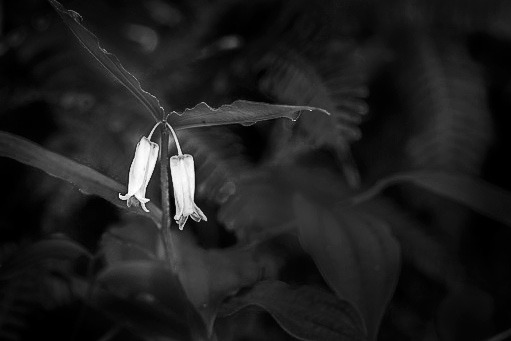
I took the liberty of cropping a re-work to place the blossoms at an intersection of vertical and horizontal 1/3 lines - not that it is a concrete rule, just looked better to me. That also removes the central leaves which compete for attention of the eye; also removes the diagonal branch lower right that, to me is another distraction.
Just my thoughts, others may and will disagree but we all get along
Re-works are typical as I mentioned on BWV - if you object, let me know and I will pull the image. Also, it is often helpful to include the Exif, as you have done - my thought there is I could never hold 0.8 sec and get anything sharp - tripod? Cable release?
Lastly, it would help to have the original color version for others to pursue re-works, if you are inclined to do that.
Again welcome, look forward to having you share more images with us!
Jglaser757 wrote:
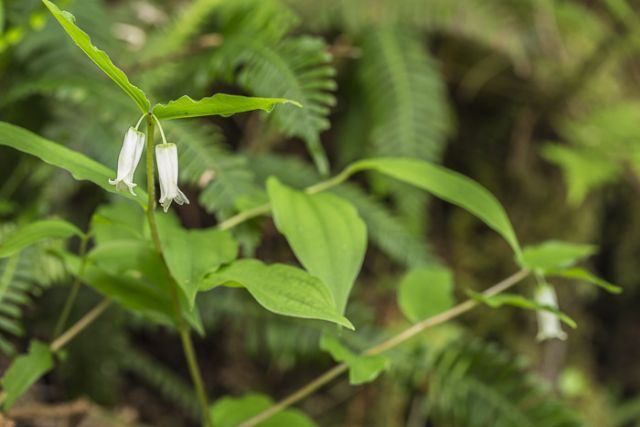
excellent comments by all!! I am including the color version,,I thought it was sort of blah,,,
I also thought about cropping, and I have a version of it with a darker background, but I thought it was lacking in detail.
Below is the image I started with,,kinda blah and uninteresting to me.
Oh Thanks for the great feedback and suggestions
As @RustyBug notes, an excellent learning experience - fun image to work with. Where the original took me...I used ACR but all of the tools, well most of them, are available in LR4.4.
Thanks for posting the color. My tastes run mostly toward B&W, hopefully someone will take the color path.
I'm torn between your cropped image and mine, before crop. I did rework my original more towards your version with deeper blacks also. I was trying to achieve a less busy background by darkening in my original, but the new cropped version simplifies it more! I'm hoping it is totally resolved now.
Jglaser757 wrote:
I'm torn between your cropped image and mine, before crop. I did rework my original more towards your version with deeper blacks also. I was trying to achieve a less busy background by darkening in my original, but the new cropped version simplifies it more! I'm hoping it is totally resolved now.
Couple of things - (1) remember it is your vision for the image, and you decide what is preferred. There is no correct answer, merely a variety of perhaps better, and not so better, alternatives; and (2) speaking for myself, I find my preferences vary from day-to-day. And, a completely new re-work at a later time might be better yet. Nothing is absolute or static.
All that said, we are all here to learn. Looking forward to your sharing more images with us and hearing you thoughts regarding others' images.
Interesting that you changed to a deeper green than the original! I hate that stupid brown spot on the back leaf. It's distracting to me. I do like it vertical though
I do like the original version posted and off-centre framing but, and imho it's a big but, if I chopped off the attached leaf above and left of the main flower heads I would reshoot it with more room around the flowers and main leaves. It looks like the flower could also be pulled forward to increase the separation between the main flower heads and background. This increase might of allowed you to get a touch of backlight onto the flower increasing the contrast between foreground and background.
It's a good image to practice post processing as shown by the various alternatives being offered up but again imo 90% of the effort needs to be put into the subject environment and lighting before pressing the shutter and the post processing becomes relatively minor to deliver a good image
photosbykev wrote:
It's a good image to practice post processing as shown by the various alternatives being offered up but again imo 90% of the effort needs to be put into the subject environment and lighting before pressing the shutter and the post processing becomes relatively minor to deliver a good image
I think @photosbykev raises a point we often forget - and I am a frequent offender. Sometimes digital and the computer makes things just too easy. I cannot imagine making the changes to images I often make using a wet darkroom - no way!