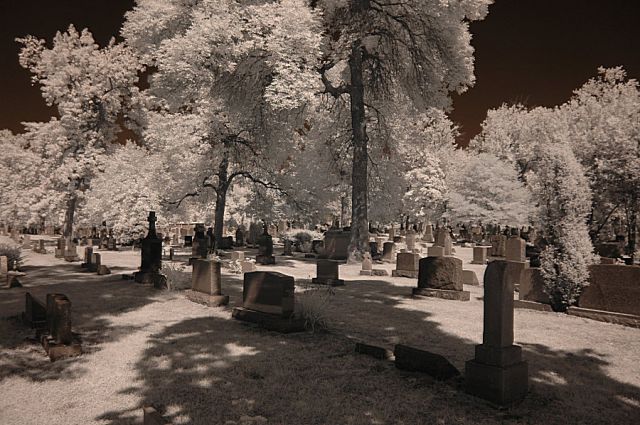
Nikon D300(s) is the best option in my opinion, strong body will last a lifetime and IQ is good for IR. Don't know any companies in the US, so can't help with that.
D70 work just fabulous, I highly recommend Life Pixel for conversion, they will help you with camera choice, there are some that work real good and others that do not like I think when I had mine converted the D70 was perfect but D70s was no good, I would contact life pixel for information
I've only had it a couple of months, so I can't speak too much about it. I don't shoot much IR in the winter. But, the camera and filter work well. The only issue is that you can't do a manual WB. Nikons only go down to 2500, which is where I set the Kelvin. The actual WB of this filter is around 1800, according to the eyedropper WB tool in Capture One. That's not a big deal. If you want to shoot false color, simply shoot RAW and then use NX2 or Capture One or similar converter to do the WB during the RAW conversion.
Previously, I had a conversion done to a Sony digicam by MaxMax. http://www.maxmax.com/
I was very happy with the conversion that they did. The camera worked for years as an IR camera and may still do so. Dunno, it's been a while (2005) since I've last used it.
As for the "best" camera to convert, I dunno. Lifepixel claims that the latest Nikons are the best to convert, for Nikon users. I'd suggest browsing some of Lifepixel's articles about that. They have a lot of good info.
You'll also want to make sure that you use lenses that don't produce IR hotspots. There are several Nikon mount lenses that will supposedly work well with IR.
I suggest a D200 matched to a 18-70mm. Because of hotspots and focus issues. You can also just use ACR and Photoshop to for processing. D90 and D300 and newer bodies, it's best you use Capture for white balance and such. I suggest you call Lifepixel and talk to them about this before you do anything.
BTW, are G lenses OK or are the "IR hotspots" specific to FLs?
I don't understand all that I know about IR hotspots in lenses. What I know is that some will produce them and others will not. It doesn't seem to matter whether it's new or old, G or not. Last year, when I started looking to do this conversion, I found 3 or 4 places that give listings of lenses with good/bad IR performance. Here is the thread that I started then. https://www.fredmiranda.com/forum/topic/1151459/0?keyword=hotspot#10987563
Here's that first post, verbatim, in case the link doesn't work.
In an earlier discussion of IR, the problem of lenses having "hotspots" with IR came up and several small listings were discussed. Today, I found what seems to be the mother of all lists of lens hotspot performance, at this link.
One problem with these lists is that lenses will apparently perform differently on a converted camera than they do when a filter is attached to the front of the lens. There are also reports of lenses differing at different f/stops and zoom positions. It isn't always clear how the lenses were tested.
I'm partial to full-frame bodies for IR conversions because IR-converted sensors lose a significant amount of light gathering ability, so having a full-frame sensor helps keep shutter speeds within reason. I have a Life Pixel-converted Canon 5D that I love. I use a Samyang 14mm with mine, which eliminates any focusing issues since the DOF is huge and I just keep the lens dialed to hyperfocal or infinity. Here's a few samples:
many IRs in that portfolio starting with the D70; D200,,,and now the 5D2. As much as I love Nikon, I think the Canon 5D2 and Canon lenses (no hot spots!) is (are) the best for IR.
I don't like Lifepixel..they have made several "mistakes when converting my camera...the folks in NJ do a better job of it...
I have a full spectrum D200 I can sell you for a very good price if you are interested...
All lenses have to be looked at on an individual basis. NO blanket statement about one company's lenses being better oir worse will make it. Even different verwsions of the same lens can have differing IR capabilities. Nikon's 18-70 works well for me.
Most of us start with a Hoya RM72 IR filter. It's a 720 nanometer filter, and a great starting point. www.2filter.com usually has very good prices on filters.
If you have the choice, get a camera converted to IR use...so much more convenient to use than one where you use filters on the front of the lens...A converted camera will allow you to handhold images easily (well at good shutter speeds - above 1/60th of a second); and you will be able to use the histogram as well.
Again, as much as I liked Nikon for IR photography - Canon (surprisingly), specifically the 5D2, has been the best camera I have used for IR photography. You can use Nikon lenses (AIS lenses are best for this; well some AIS lenses) on a Canon body...so if you are invested in Nikon, you can just get a Canon body...but for me the 24-105 F4 Canon lens is a great IR lens...no hot spots for me at any Fstop or mm.
I've been tinkering with converting nikons for almost 8 years now. I also converted a couple olympus pen bodies, and a couple sony NEX's. Mirrorless or live view bodies are IMO, the better choices due to focus. My recent conversion was a nikon D5000, love the results:
I created a custom camera raw profile where the WB starts out at the negative end of the kelvin scale, so ACR gives me a more accurate WB setting in ACR.