I'm trying to create a lighting setup to shoot Persian Rugs. Some of the rugs measure up to 15'x20'. The camera will be set directly above and will shoot straight down on the rugs which will lay flat on the floor. The lens will be square to the plane of the rug and will need to get good quality even lighting across the entire surface.
I hope someone has experience with this or at least something similar I'm guessing at least two strobes firing from opposite ends but not sure so I'm looking for some ideas or some actual experience with a similar setup.
Thanks and I hope to hear from fellow fredmiranda members.
If you HAVE TO shoot from above. 2 umbrellas 40"> will be fine, mid-line, about 10 FT up off the floor on each end at a 45 pointing down. You're mileage may vary here, but you can chimp through any rough spots. A light meter would be a real help here.
There are rugs you can shoot with a typical "reproduction type" lighting as you describe. Two or four sources from sufficient distance, evenly lighting the area. But: (a big but) there are types of shiny silk rugs which need a single source lighting, otherwise they show unevenness, due to the highly reflective surface.
I remember a situation where the single source was set at about 30' distance for evenness. An assistant, directed from above, moved the source around the carpet to find out the ideal spot. Side note: a polarizer didn't help.
Since the camera is above the rugs, if feasible in the space bounce your lights off the ceiling above the rugs for even omni-directional lighting. The net effect is similar to outdoor light in open shade or overcast. Use a gray card and set Custom WB.
A simple trick I use for gauging if exposure is even over a large area is to place white objects (I use shop towels) at the four corners and the middle. Adjust lighting / exposure in test shots so all start to clip in the camera playback warning at the same time, then close lens 1/3 stop and you'll have ideal, even lighting.
All hand knotted rugs have "grain" due to the way the knots are tied which affects appearence when viewed obliquely from opposite ends when on the floor. That shouldn't be a problem shooting from above, but you might want brush them to either get the grain to lay down or stand up and compare how that affects appearance in the reproduction, if at all.
John Skinner wrote:
If you HAVE TO shoot from above. 2 umbrellas 40"> will be fine, mid-line, about 10 FT up off the floor on each end at a 45 pointing down. You're mileage may vary here, but you can chimp through any rough spots. A light meter would be a real help here.
I don't have any other option to get the full rug in frame as some are too heavy to hang on a wall and shoot straight at them. I'll use a light meter too after it's set up. Thanks!
cgardner wrote:
Since the camera is above the rugs, if feasible in the space bounce your lights off the ceiling above the rugs for even omni-directional lighting. The net effect is similar to outdoor light in open shade or overcast. Use a gray card and set Custom WB.
A simple trick I use for gauging if exposure is even over a large area is to place white objects (I use shop towels) at the four corners and the middle. Adjust lighting / exposure in test shots so all start to clip in the camera playback warning at the same time, then close lens 1/3 stop and you'll have ideal, even lighting.
All hand knotted rugs have "grain" due to the way the knots are tied which affects appearence when viewed obliquely from opposite ends when on the floor. That shouldn't be a problem shooting from above, but you might want brush them to either get the grain to lay down or stand up and compare how that affects appearance in the reproduction, if at all....Show more →
I wish I could bounce from the ceiling but I'm working with very high ceilings so need to rely on direct lighting. I like the idea of the white objects at the corners and middle. I'll be shooting all manner of Persian rugs and will shoot a perspective shot as well as overhead to show-off texture of pile. One of the issues is I have a contraption for attaching my camera to a quick release that I can hoist as high as needed to get full rug in the frame so I don't have direct contact with controls as I'll fire shutter with remote and have a monitor mounted to see results.
You could suspend a large piece of fabric over the shooting area to either shoot through or bounce
the light off of to achieve this.
rkg
(Richard George)
George Owens wrote:
I wish I could bounce from the ceiling but I'm working with very high ceilings so need to rely on direct lighting. I like the idea of the white objects at the corners and middle. I'll be shooting all manner of Persian rugs and will shoot a perspective shot as well as overhead to show-off texture of pile. One of the issues is I have a contraption for attaching my camera to a quick release that I can hoist as high as needed to get full rug in the frame so I don't have direct contact with controls as I'll fire shutter with remote and have a monitor mounted to see results. ...Show more →
George Owens wrote:
Also, given a two monolight setup, what watts/second would be required for up to a 15'x20' persian rug?
With camera above with parallel rug / sensor planes you don't have DOF issues an could shoot at larger apertures so a pair of 300 W/S lights should be OK for exposure. The bigger problem is evenly illuminating that size rug with only two lights.
As someone else already suggested you'd be better off creating a "tent" over the rug with some white muslin and bouncing the lights up into it than trying to light it evenly from the sides with two lights. Frankly speaking if you are not equipped to do the job right you should decline the job, or charge enough to cover the purchase or rental of the gear you need to do the job well.
I operated copy cameras at National Geographic years ago. We had banks of pulse xenon lighting ( continous strobing flash) on both sides at a 45° angle the length of the copy board, aimed about 1/3 of the way in towards the center.
To evenly light the rugs I'd suggest using a minimum of four lights arranged like this:
----- x ------ x ------
|------ carpet -----|
-----x --------x -----
To get the lighting even you need to take into account inverse-square fall off and how the footprints of the light will overlap.
With camera above with parallel rug / sensor planes you don't have DOF issues an could shoot at larger apertures so a pair of 300 W/S lights should be OK for exposure. The bigger problem is evenly illuminating that size rug with only two lights.
As someone else already suggested you'd be better off creating a "tent" over the rug with some white muslin and bouncing the lights up into it than trying to light it evenly from the sides with two lights. Frankly speaking if you are not equipped to do the job right you should decline the job, or charge enough to cover the purchase or rental of the gear you need to do the job well.
I operated copy cameras at National Geographic years ago. We had banks of pulse xenon lighting ( continous strobing flash) on both sides at a 45° angle the length of the copy board, aimed about 1/3 of the way in towards the center.
To evenly light the rugs I'd suggest using a minimum of four lights arranged like this:
----- x ------ x ------
|------ carpet -----|
-----x --------x -----
To get the lighting even you need to take into account inverse-square fall off and how the footprints of the light will overlap.
Thanks, I was hired to shoot videos for this business but the owner requires photos of their Persian rugs too. Several other photographers were hired in the past and were unsuccessful at getting usable images (all manner of different white balances and oof images).
The owner is well aware of what I can and can't currently do photographically speaking. I don't pretend to be able to photograph these rugs properly with my current lighting equipment and they plan to purchase the necessary lighting equipment once I put together a plan. I just began this project and started here first since I've gotten great info in the past from this source. Once this lighting is set up, they'll keep it in place for all future rugs. I like the idea of bouncing the flash but one question arises. I'll have the camera above and parallel to the carpet plane and centered over the carpet so if I use a white muslin or something similar, a small hole will need to be cut into the muslin for the lens so essentially, the strobes will be pointing up to the lens. Anyone else set up something similar? What about lens flare? Thanks again. I realize this could be turned over to someone owning the proper equipment already but given the size of this job, the owner wants something more permanent than having someone show up with the right equipment for each shoot. Apologies for the long post here
An option to consider since they want a permanent installation is ceiling mounted fluorescent fixtures equipped with high CRI bulbs. The rugs aren't moving so long exposures should not a be a problem if you have the camera mounted securely. The most cumbersome aspect is having the camera overhead.
I understand that ACR/LR now have the ability to do an LCC shot (can't remember what it's called by Adobe) such as is used in Capture One. Heaven sent for trouble lighting situations like this.
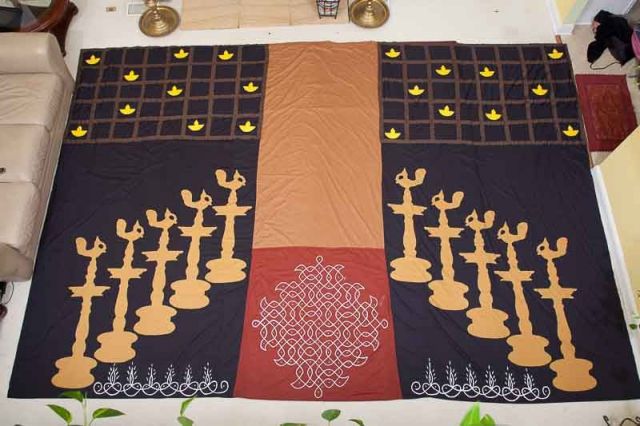
Here is picture taken using DIY globe with two Einstein, placed on 2ed floor, side of the back drop is about 15X15 foot of back drop and it is not Persian Rugs!!
I know it's not what you asked for, but I may suggest a different strategy. You could try to have at least one of the lights (if not both) fire from a lower angle ACROSS the rug. The cross lighting could show more texture and give a more interesting image than just an evenly lit rug. Just something to think about.
But, it may be difficult to evenly light the rugs from that angle given their size.
George Owens wrote:
...the owner requires photos of their Persian rugs too. Several other photographers were hired in the past and were unsuccessful at getting usable images (all manner of different white balances and oof images).
The key to getting proper white balance is to NOT use AWB (automatic white balance) because the camera can't know what the true color of the carpet is.
Instead, use a standardized target and do a custom white balance under the light that will be used, and then use that WB for all the subsequent shots under the same light. "Same light" means not only the type and number of lights, but also the power settings, because most lights will shift in color temperature as the power is changed.
Determining the correct power is also best done using a standard reference, because if you just try to use the histogram you'll know whether or not you have clipped highlights or blocked shadows, but you won't know if you've captured the true tone of the carpet. An incident light meter is the best bet, but you could also use a gray card and adjust the power of the lights and/or the aperture until a frame-filling shot of the gray card yields a spike in the center of the histogram.
So, set the exposure first, then set the white balance. Use a fast shutter speed to reduce ambient exposure (flash is unaffected by shutter speed, as long as it's within the sync limit of your camera). A fast shutter will also yield the sharpest image by minimizing motion blur from camera shake/vibration.
Lastly, if you have trouble getting even lighting you can take multiple shots with the light(s) moved around, and then combine them in post processing. You would move ONLY the lights; the camera should be on a sturdy tripod to make combining the images easier.
By the way, George, I (Brian Owens) have a distant relative with the same name as yours whom I've never met, but my uncle Claud has had contact with him since finding him while doing geneological research.
Concerning the last two ... I'm curious @ placing the two lights opposite each other across the width and shooting the rug in sections along the length (strategically spaced to provide consistently overlapping illumination) might be a way to use a "less soft" approach for a more contrast/texture/pop. It could also allow you to keep your lights closer to your subject (not as high) for more light @ subject.
Using the soft/bounce light will aid in even illumination strategy, but it comes at reduced contrast/texture reveal. If you can resolve the even illumination through light placement/movement (think like a manual scanning device), then you don't have to abandon direct light.
Opposing silver umbrellas @ height/angle to cover the width might be balance between direct vs. soft and more contrast/texture vs. even lighting. I think silver umbrella is your modifier of choice here, despite the big bounce/giant muslin seeming rather obvious @ first.
As a permanent solution, a "track" for your lights (adding more lights now or future) could allow you to accommodate placement/position for different lengths.
Persian rugs, imo deserve something better than "flat lighting" ... needing even illumination of course, but the uber-soft approach isn't going to "showcase" the texture.
If I've only got two matched lights to work with ... I'm going with Brian's light movement, Chuck's placement/position and Andrew's cross lighting, contrast/texture in silver (to show off texture of pile).
RustyBug wrote:
If I've only got two matched lights to work with ... I'm going with Brian's light movement, Chuck's placement/position and Andrew's cross lighting, contrast/texture in silver (to show off texture of pile).
HTH ... GL
Thanks to all the responses, this post is what I'll be doing which is a hybrid of several solutions and than experiment from there. I've got to get even lighting while showcasing the true color and look of the rugs since the images will be the vehicle used for marketing/selling them. I'll be using a color checker to get as close to true color as possible. I'm going shoot tethered but I understand programs such as Lightroom doesn't allow for remote triggering of the shutter which is what I'll need to do for the overhead shots. I'll just need to work out how to trigger remotely and I seem to remember the software included with the 5D Mk2 has software that allows this.
I'll try shooting straight down and balance the lighting for the overhead shot but I'll also be shooting from the side at an angle to show how they look on the floor from a normal perspective but I may or may not use the same lighting setup. It was mentioned to build a light tent of sorts which I can do and will need to build it large enough for the largest rugs but any suggestions on height as far as bouncing light off the makeshift ceiling?
ravisrajan wrote:
Here is picture taken using DIY globe with two Einstein, placed on 2ed floor, side of the back drop is about 15X15 foot of back drop and it is not Persian Rugs!!


 I'm guessing at least two strobes firing from opposite ends but not sure so I'm looking for some ideas or some actual experience with a similar setup.