khwaja wrote:
imho light source too big and non directional.
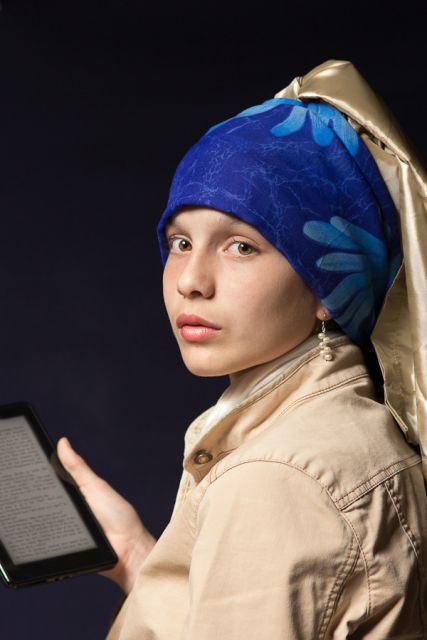
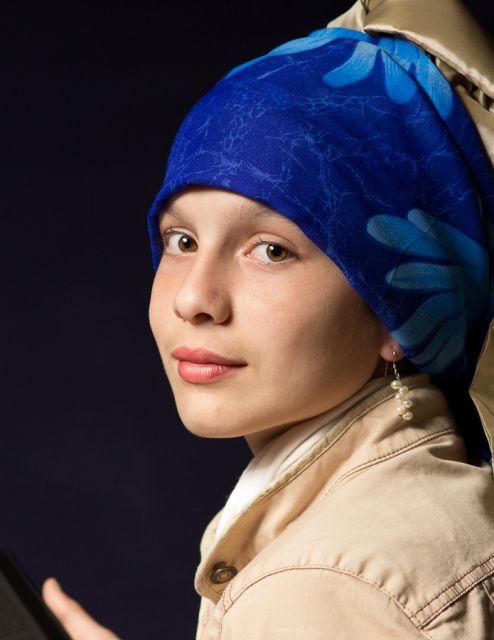
If you look at the catchlights/nose shadow in the photos above and in the original painting, light source size and direction are close. The big difference is ratio, there's more fill in the photos.
I don't know if the photographer added the fill or if it is spill. If it is spill, a negative reflector would help darken the shadows if the aim is to come closer to the painting.
Pose is good and the choice of model is also good. Trying to recreate photos and paintings is a good learning exercise.
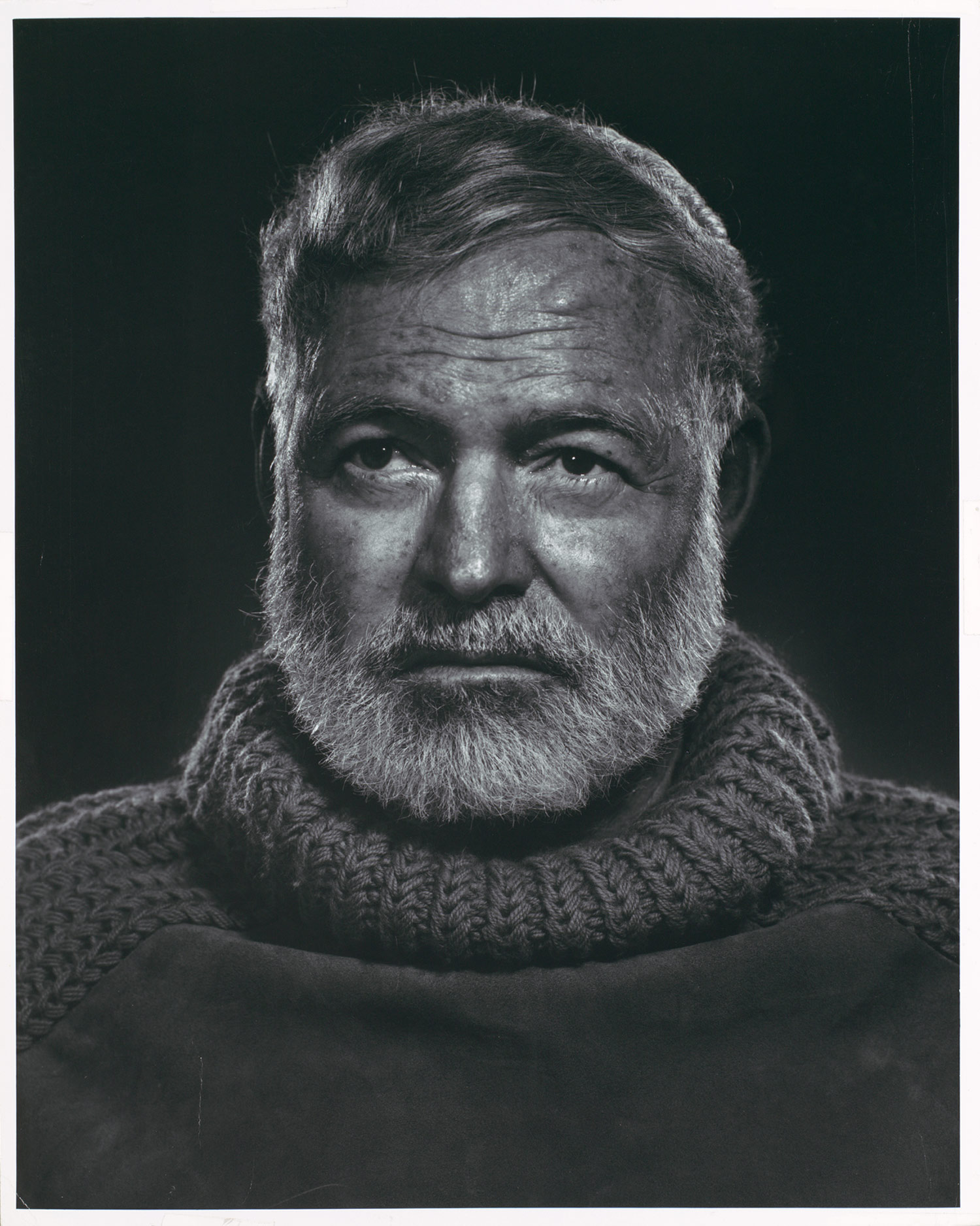
I once had a customer who was a huge Hemingway fan. He wanted to have a portrait similar to Karsh's Hemingway portrait:
He sent off for the same sweater, grew a beard and had his hair cut the same way. The portrait looks straightforward, but took a fair amount of effort to recreate. I shot it large format. They no longer made ortho film, so I had to result to filtration to simulate. Nowadays with digital, similated ortho is simple.
Great exercise, Macmillan. Thank you for suggesting that I compare both. I had not done that. The spill light was not intentional, but my eyes did not pick up that difference. I am very green at portraiture and the use of strobes in general, and I tend to go too fast (meaning, I do not slow down enough to see all that I need to see). Still quite "nervous" at this. I can't wait until the moment I do this with more confidence. That portrait of your Hemingway fan is nothing short of amazing. I am still struggling with getting my subject in focus, if you can believe that.... So I get giddy just with that little bit of success.
Khuaja. Big umbrella. It may have been appropriate for this photo with a negative reflector, but I need to get something smaller as well. I feel it lights too much for what I want to do typically.
FredVf wrote:
That portrait of your Hemingway fan is nothing short of amazing. I am still struggling with getting my subject in focus, if you can believe that.... So I get giddy just with that little bit of success.
Khuaja. Big umbrella. It may have been appropriate for this photo with a negative reflector, but I need to get something smaller as well. I feel it lights too much for what I want to do typically.
Fred
Fred, I'm sorry for the confusion. I guess I should have credited Mr. Karsh. That is Ernest Hemingway. My attempt pales in comparison.
Your source size if fine. Look at this Wikipedia post. Notice the paintings on the right. You can see his light source. His studio was on the second floor and that's north light. I've always wanted to have a studio with a big north light window.
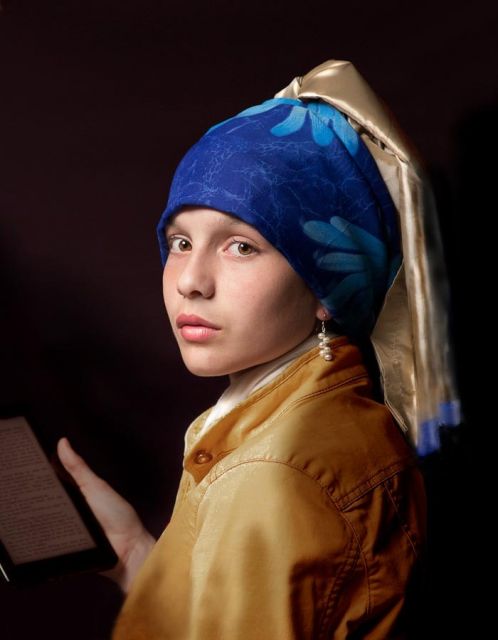
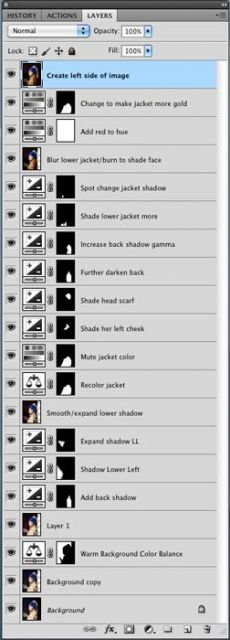
I've made some changes in post that would have best been done in set-up, especially lighting and framing and color choice, including negative space color and lighting which are significant in Vermeer's. Having the subject tip her head (chin receding and forehead towards the camera) would have also been a plus but a bit more difficult to simulate in post to illustrate.
The thing that comes to mind for me is that the position of your lighting was at more of an oblique to match that angle of the face, whereas the original had the lighting as sidelighting from the left (frontal to the torso), with her head turned obliquely.
Pose and right / left camera position is good match to the painting but vertically your camera is lower to the face as if viewing her in person from upward below her eye level. The POV in the painting is more downward as seen typically by a person standing in front of a seated subject. What the higher POV changes most in the appearance of a face is how the tip of the nose is modeled, hiding the nostrils.
The "tell tale" to watch for when setting the key light is the shadow it creates on the nose. The nose shadow is one of the more obvious perceptual clues the brain uses to discern 3D shape in 2D reproductions. The subject in the painting is turned way from the key light more than your subject, with the shadow that creates modeling the 3D shape of the nose more effectively.
In terms of workflow unless the angle of the subject to the background environment is critical it's easier to just set the key light in one place, like the window Vermeer used, pose the subject's face to it, then move the camera around the face to find the ideal camera angle horizontally and vertically.
Shadow tone is a function of fill. Vermeer used none and just depicted what is adapted vision saw in the natural light in the room. A problem that can occur when using large artifical sources in small reflective rooms is that even when only one light is used the footprint of light it creates is so large it bounces off the walls and ceiling, especially the opposite wall, and creates too much fill making the shadows too light.
I solve that problem in my small finished basement studio by hanging black draping (a flat king sheet from Walmart) on the wall opposite the key light and using a medium SB with a circle mask creating footprint which illuminates the subject, but doesn't bounce unwanted "spill fill" off the ceiling. I then precisely adjust fill "to taste" as the mood of the subject I wish to convey dictates using a second fill source under the raised camera lens about chin level with the subject.
The subject in the painting is turned way from the key light more than your subject,
Shadow tone is a function of fill. Vermeer used none and just depicted what is adapted vision saw in the natural light in the room.
+1
These two combine to yield the primary difference between yours vs. Vermeer's. Casual observation alone and I likely would not have noted the diff. Doug's prompting to compare the lighting diff revealed the same as Chuck has stated (likely a bit better than my effort to do so).
Still ... a very worthy effort, and likewise useful for study.