Many medium format cameras, Leica and Hasselblad correct distortion in software, as do Sony with the RX1 and RX100 as it is often the easiest and best outcome of the various trade-offs on the road to stellar image quality.
Maybe I have a cache problem (or CZ have again re-arranged their website) but the MTF data for the Touits show distortion levels where it counts - the final image in either jpeg or RAW - as being 0.1% or so.
'Every single Hasselblad H-series body (those with a dedicated digital back) corrects for its 28mm f/4 lens this way, as has Phase One. And that Leica S system? Yup. All the lenses are imperfect and corrected digitally.'
I like seeing them mount the lens on the QC gear, and there is something special about the human hand assembling a fine piece of machinery. Effective soundtrack also.
I like seeing them mount the lens on the QC gear, and there is something special about the human hand assembling a fine piece of machinery. Effective soundtrack also.
Hmmm. I doubt my Sony 35/1.8 got such loving care. That may be why all five of Roger's samples have one (different) corner slightly out of focus.
I've looked at many MTF50 results on Photozone for many lenes, but these values seem quite low. Even zooms wide open at the bad end and in the corners are better than 1200.
Roger, thanks for the detailed comparison. It is interesting that the corner resolution of these 2 lenses looks very similar. Also have you checked the slr magic 35mm 1.4? The bokeh looks very good on the test below. The reviewer impressed by the lens and purchased one for his apsc camera: SLR Magic 35mm 1.4 review at the phoblographer
Jman13 wrote:
Yeah, I shoot with it regularly and it still blows me away. On that shot above, which is sort of a throwaway shot for me (which is one reason I posted full size...I never post full size shots of my 'keepers'), I looked at the lower left corner and just stared. Crazy good corners.
The corners are exceptionally good indeed. But had I taken that shot, I'd have been disappointed/frustrated that the excellent corner performance was being negated by the watercolor effect of the X-Trans sensor -- to my eyes, that foliage looks nowhere near as detailed as it should. Or, do I have unrealistic expectations? I consistently obtained stellar results from my Fuji RF film cameras (6x4.5 and 6x9) but nothing I've seen from the Fujifilm X system has tempted me to switch from my current NEX cameras.
Glenn NK wrote:
I've looked at many MTF50 results on Photozone for many lenes, but these values seem quite low. Even zooms wide open at the bad end and in the corners are better than 1200.
Am I reading something wrongly?
Glenn
Glenn,
I present line pairs / image height while they present lines / image height so double my results to get in the ballpark of their results. Just a matter of which button is pushed on Imatest's graphing results.
They test processed jpgs while I test unprocessed raw images, so even with the doubling their results will be higher numbers. Their reason is they feel processed jpgs will give a result more similar to a processed image. Mine is I'm more interested in the lenses than the camera's sharpening.
genji wrote:
The corners are exceptionally good indeed. But had I taken that shot, I'd have been disappointed/frustrated that the excellent corner performance was being negated by the watercolor effect of the X-Trans sensor -- to my eyes, that foliage looks nowhere near as detailed as it should. Or, do I have unrealistic expectations? I consistently obtained stellar results from my Fuji RF film cameras (6x4.5 and 6x9) but nothing I've seen from the Fujifilm X system has tempted me to switch from my current NEX cameras.
I don't really see the watercolor effect issue in that particular shot. In fact, with a little more sharpening for the foliage, that result looks about as good as it probably gets with that wide of a focal length on APS.
If your reference is MF film, you should probably be looking at FF 35 and really exceptional glass to satisfy your expectations beyond what you are already using.
I present line pairs / image height while they present lines / image height so double my results to get in the ballpark of their results. Just a matter of which button is pushed on Imatest's graphing results.
They test processed jpgs while I test unprocessed raw images, so even with the doubling their results will be higher numbers. Their reason is they feel processed jpgs will give a result more similar to a processed image. Mine is I'm more interested in the lenses than the camera's sharpening.
Roger
Ahh, thanks for the explanation. I was sure there was something wrong as I just couldn't see Zeiss putting out inferior lenses.
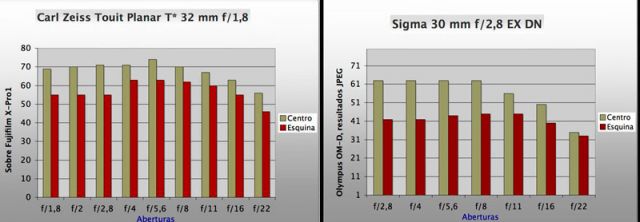
Thanks for the test Roger it is much appreciated. Could you help me understand your numbers as they compare to the ones on the Spanish test site please? I have the 32mm Touit on order and agree with your statement that the Zeiss has an amazing quality to it.
Thanks, Dennis
They're comparing jpg - and from different cameras.
I find it slightly disturbing that the results from the X-Pro w. Touit are indicated to have 55lp/mm left at F22. And also that it indicates higher results at F5.6 than at F4.0. The slow diffraction slope (how much the lens loses from F8 to F22 indicates quite a lot of preprocessing.
Thank you for the 'jpeg usage in Imatest by photozone et al, wow that is poor practice in a statistical sense due to high variability across cameras. You cannot anticipate the post processing performed by users, and most viewers of theirs are surely RAW based.
I have seen MTF data from Zeiss who have measured that have been sharpened specifically for MTF - the differences can be very large. They could at the very least do both, but label the jpeg as a 'facsimile'.
From p18 of the Zeiss paper 'How to Read MTF Curves':
'In digital image processing it is even possible to exaggerate this edge enhancement and to generate a transfer function which increases with increasing spatial frequency. In the language of transfer theory it then has a partial high-pass
character...'
Yes, you can manufacture MTF with sharpening algorithms. Even tailor it to your desired results to some extent.
The untouched image sets a kind of upper limit to how far you can push things; a sharper original image will require less post sharpening, and hence also have lower noise at medium ISO and less artificial sharpening trouble.
Less noise > you need less noise reduction > double whammy on the image detail.
On base ISO, good contrast material, I can do a lot in post. Especially with the new generation of very-high DR cameras. The limitations show up later, when you're starved for light and really need to push your shutter speed limits.
Some base sharpening is the norm for MTF curves outside the lab, even companies like Kodak and Fuji used them on their film white-papers. They had a kind of mutual agreement on MTF105 (5% over-sharpening) between 5-10lp/mm.
Am I te only one to follow the Zeiss Touit launch campaign, with 4 photographes with Touit in Bangkok?
I am never seen Zeiss do something like this, yet they launched other lenses recently (135 f:2.0, 15mm)
Either this means that the company expects great things from their Touit range comemrcially, or their marleting has taken on a new approach. Or both.