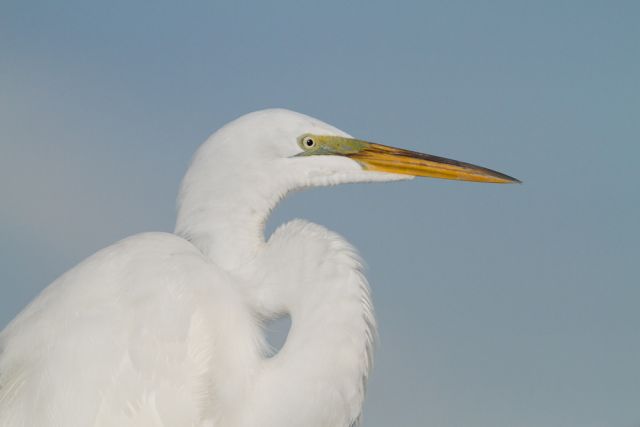
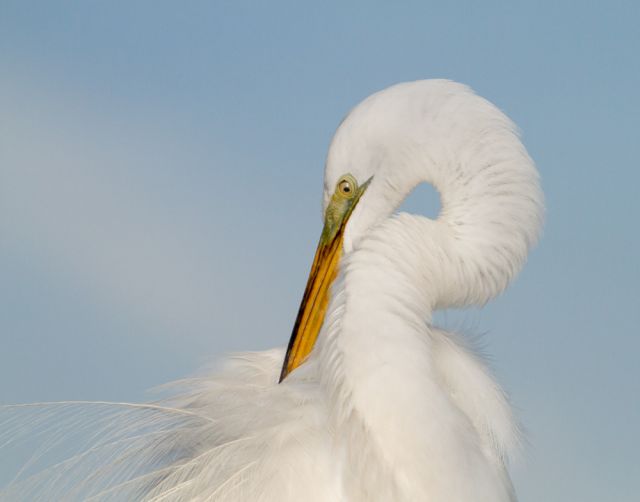
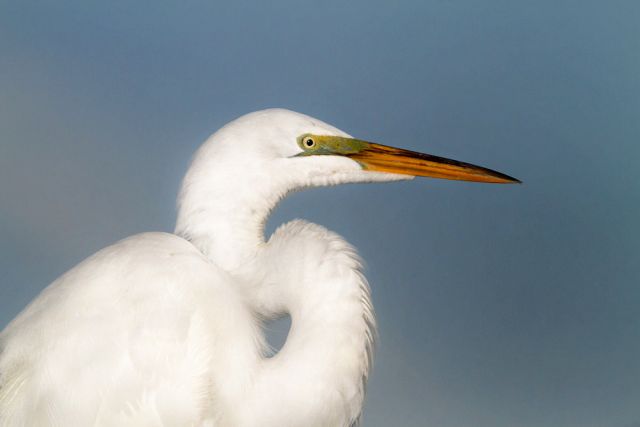
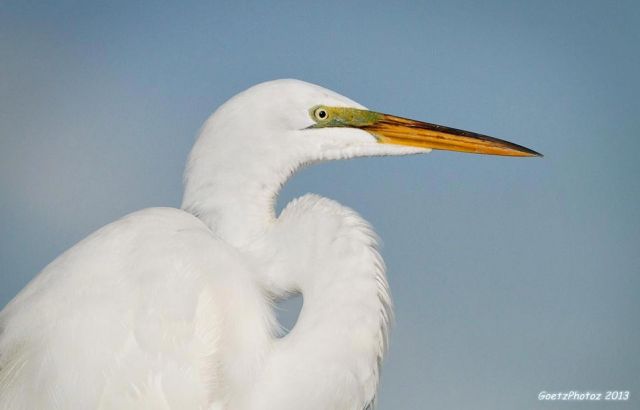
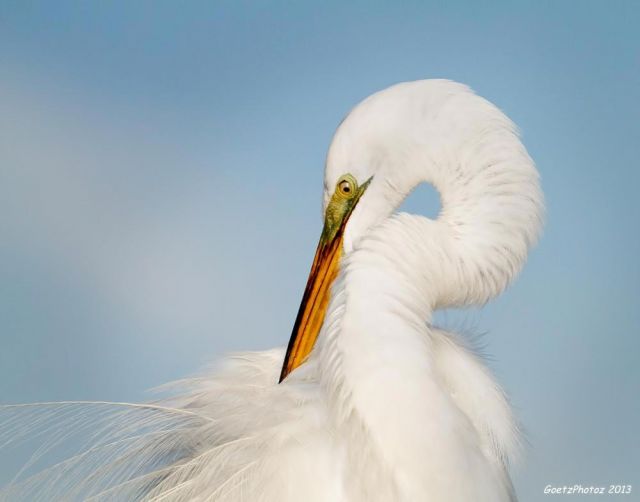
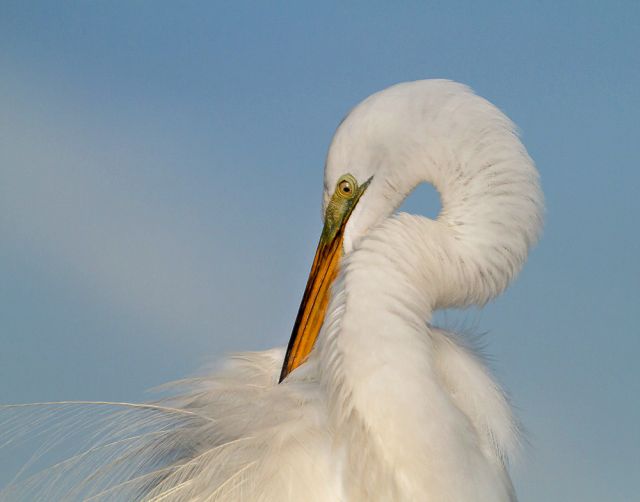
Not knowing the actual white levels of the feathers, I reworked #1 - not sure if this moves closer to or departs fromyour vision. CS6 and 'lights' luminosity masks - haven't touched them in some time.
I just got back from Florida viewing Egrets etc. My question: are the egrets actually pure white? Cattle egrets have a bit of reddish brown, and to my eye the white-adjusted ones above look too white. I like the first one-- it seems the most realistic. But it may just be my eye or my monitor.
Karen, Bob, Kent
Thanks for the reworks, tweaks, suggestion. Clearly needed a bit more sharpness at the eye.
Karen, your tweaks are very subtle. They look better, but I cannot readily identify how.
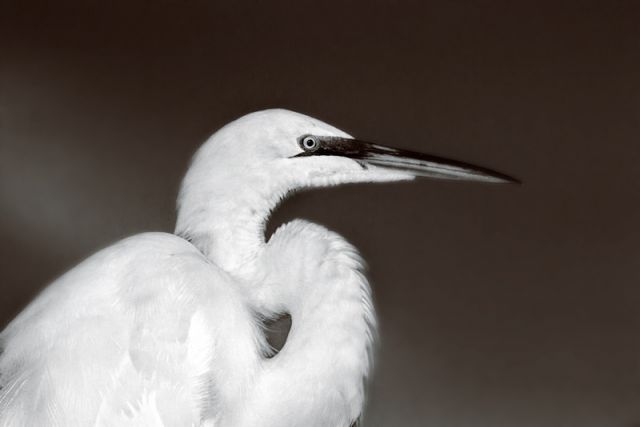
Bob, as you have seen at least one BW egret version on the BW forum, you know I like this direction. How did you darken the sky?
Keith,
These, and the series of bird images I have been posting, were all taken at Gatorland in Orlando. I was surprised over and over again at how white the feathers were. I hope you have a cattle egret shot to share because me efforts fell short. They have a reddish, orange tint as you mentioned, and do contrast with the snowy and great egrets.
Where were you?
sbeme wrote:
Karen, Bob, Kent
<snip>
Bob, as you have seen at least one BW egret version on the BW forum, you know I like this direction. How did you darken the sky?
<snip>
Scott
You're asking for recall beyond my 2 or 3 hour retention horizon
I think this is generally the sequence for the background.
Took the color re-work and converted to BW in LR. Next in HSL-Color-BW (I think the BW option) took the Blue slider all the way left, darkening blues. At that point the background was fairly ugly showing squares of tone rather than a smooth gradation. After trying other techniques with no success, I went into CS6, copied layer, and applied Gaussian Blur filter, ~10px, Multiply blend mode. Created mask, in this case I inverted to black, and using a soft brush at 10-15% opacity, brushed in the now darkened background. As an experiment, I think I tried selecting the background and darkening the mask derived from the selection but couldn't get that to work properly. I really don't know much at all about selections and derived masks, just tend to use a soft brush and apply from it.
The net effect is a nice, softly graduated background.
Think that is about it, I am sure there are many and better alternatives but the fewer options I have to get into trouble, the better off I am.
Bob Jarman wrote:
in the neighborhood, devil in the details
+1
I can never remember exactly what I did, and ask me to do it again exactly the same way ... fat chance. But I do have my methods of approach that do keep me in the ballpark. It's becoming more & more about "feeling" where I want to take it, and less about precise methodology.
I never painted, but it reminds me of mixing oils to get the the color and consistency you want. It isn't exactly a perfectly repetitive result that you get every time you squeeze some out of the tube ... i.e. squeeze out some red, add some black, a little thinner, a bit more black, add some white, a touch of yellow, and now some orange, then a hint more black ... yup, that's what I was looking for. Now, try and get that color again tomorrow.
I was at Alligator Farm in St. Augustine, Circle B Bar Preserve southwest of Orlando, and Viera Wildlife Sanctuary (or something) near Melbourne. I was told by everyone who talked to me about it that the Alligator Farm is much better than Gatorland in Orlando, so I gave Gatorland a pass. I had never been to any of those places before. I also spent a day at the Avian Rehabilitation Center in Apopka. "Rehabilitation" is the wrong word, but it's close. If you're down there on a weekend afternoon be sure to see their trained Harris Hawks -- they fly them and they're gorgeous and fun to watch.