uz2work
Offline
• • • • • •
Upload & Sell: Off
|
JeffAUSTIN wrote:
I want to be educated. where is the science or facts that say feeding animals is harmful to the animal fed?
link i found from birder website on feeding birds
birder website for feeding birds
First, a number of people in this thread on the anti-baiting side of the discussion have made a clear distinction between baiting raptors in the wild and putting up a bird feeder (provided that those who put up the feeder are making a commitment to keeping it filled, keeping it clean, etc.).
With regard to owls, it really doesn't take more than common sense, when you see a location where the photographers are outnumbering the owls by ratios of 10 to 1 or much higher, where the same birds are being baited with dozens of mice each day for several weeks, and where you can see that the birds are clearly associating people and their vehicles as a source of food and showing no fear toward either, to conclude that these birds are being put at risk. If you are looking for more than common sense, I'd suggest contacting a place like the University of Minnesota Raptor Center, which has done some of the most respected raptor research in the world. I'm sure that they will be able to provide you with their research and that they will also share with you strong feelings against baiting.
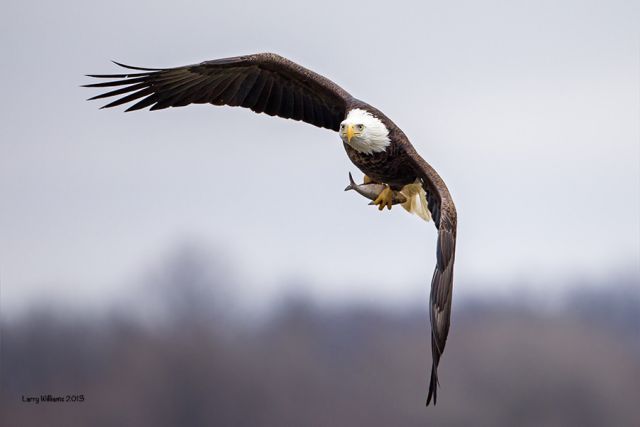
With regard to feeding the eagles, a major issue is that eagles, like most birds, are attracted to an area where they see other birds of their species because they assume that, if the other birds are there, food must be there also. When baiting of the eagles is done, more eagles are attracted than the natural food supply can sustain. On a Saturday or Sunday, when the masses of baiters are present, the eagles can fill their bellies. On Monday, however, when no one is there with the bait fish, those eagles may have to fly for hours to find another source of food, and, especially on the coldest days of the winter, they don't have the energy reserve to be able to so, and their survival is being put at risk. Again, I'm certain that those at a place like the University of Minnesota Raptor Center would be better able to explain the concept than am I.
I also know that I've been to responsible raptor recovery facilities where, while birds were recovering from injuries and being prepared to be released back into the wild, those facilities have taken care to make certain that the bird does not see that its food source is humans because they do not want the bird to develop an association between humans and a source of food.
Unfortunately, though, those who feel that it is there right to get pictures, even if they are the virtually identical pictures that dozens of others are getting, aren't really interested in being educated, and they are only interested in rationalizing why what they are doing is okay. As someone who is opposed to baiting, I could also ask a similar question and ask those who support baiting to give me concrete research that shows that baiting is not harmful.
Even though I don't think that baiting raptors is either appropriate or ethical under any circumstances, I'm much less concerned about the negative impact of a single photographer who comes across a raptor in the wild and baits it with one or two "snacks" than I am about the negative impact of continuous and repeated baiting over a long period of time by larger groups of photographers.
|