p.1 #1 · Wedding with Blood Orange Walls and Ceiling
I shot a small wedding (less than 20 people) for a friend of a friend this weekend and it was crazy. The room had a low ceiling that I could bounce light off, the only problem was that it was red/orange, therefore it created a nice red cast over everyone. To make matters worse the main light in the room was a red glass chandelier thing that also produced red light. Oh ya, and may I also mention there was some big windows/doors on one side of the room that let in natural light (from an overcast day). When the two mixed, there was a nice purple light .. ug!
Anyway, I was able to bounce the light and do some serious white balance adjustments in lightroom but I wish I could have done something more in camera (rather than in post). I plan on getting some additional off camera flashes in the future to put into the corners of the room to really enhance the lighting, however, with a red ceiling, I don't know if even that would have done any good.
I had a gary fong lightsphere on my flash most of the time.... I put the dome on sometimes and took it off for other shots. I found that having the dome on produced a very flat light (not much better than would have been produced without a modifier). So I mostly ended up bouncing the light.
Anyway, I would appreciate any suggestions you all might have. I am mostly a portrait photographer but my goal is to be a wedding photographer and I am just learning right now. I did this for a friend of a friend (who wasn't even planning on hiring a photographer) so it was not a HUGE deal. I want to second shoot before I do any wedding on my own... but each situation is kind of a new learning experience for me!
p.1 #2 · Wedding with Blood Orange Walls and Ceiling
Coloured walls and ceilings are no problem, it takes just one click of a mouse to correct in LR/DPP etc. - just adjust the white balance using the eye dropper tool or something - not sure why you had to do heavy editing unless you had some major mixed lighting issues or something?
The reason dome on looked like bare frontal flash is because that's what it is - the dome prevents light escaping out the top so it eliminates a lot of the bounce component, leaving only the direct fill component.
Coloured walls and ceilings are easy - just do as you did - bounce and correct in PP
The difficulty is with high ceilings/far away walls, and tungsten spotlights that are strong - they are tough!
p.1 #3 · Wedding with Blood Orange Walls and Ceiling
my solution to this is to use a bounce card or light scoop where your lighting is not bouncing off of the weird colored ceiling or walls, if I were doing portraits in a room like this and time permitted, I would use a softbox modifier to control the light.
p.1 #4 · Wedding with Blood Orange Walls and Ceiling
Sometimes you just need to bring your own light. Last night O shot in a room that had yellow and orange uplights all over and tan walls. I used a pair of Q-flashes on either side of the band/stage set at 25 ws and an on camera flash on a bracket. The combination gave me 1/50th F5.0 at 1250 ISO and the flash coming from different directions gave nice shape to the people, while still picking up the backgrounds and design of the room.
p.1 #6 · Wedding with Blood Orange Walls and Ceiling
The problem with adjusting your WB to get rid of orange/red/green/purple or whatever color cast from the walls is that you also affect the color of the rest of the shot. So when you deliver an image to the client, they may look at it and proclaim that; "my flowers/venue walls/table settings, etc. were not this color!"
When you bring your own lights, you eliminate the problems associated with bouncing your flash. You will also want to gel your lights to closer match any ambient lighting.
p.1 #7 · Wedding with Blood Orange Walls and Ceiling
I agree with the geling. I have done that before just for typical tungsten lighting. I guess I could have gel'ed my flash red. The problem is that my gels are for my rogue flash bender and don't exactly work with the lightsphere. I haven't found a good set of canon flash gels that just work with a regular diffuser. I know Nikon flashes come with a diffuser and there are standard gels for it. I wish that Canon had something similar... so far I haven't found anything so I have been testing out different diffusers but that means having to buy different gels for the different types.
p.1 #8 · Wedding with Blood Orange Walls and Ceiling
LPortugalPhoto wrote:
I agree with the geling. I have done that before just for typical tungsten lighting. I guess I could have gel'ed my flash red. The problem is that my gels are for my rogue flash bender and don't exactly work with the lightsphere. I haven't found a good set of canon flash gels that just work with a regular diffuser. I know Nikon flashes come with a diffuser and there are standard gels for it. I wish that Canon had something similar... so far I haven't found anything so I have been testing out different diffusers but that means having to buy different gels for the different types. ...Show more →
If you gelled your flash red, what do you think would happen to the colors once you corrected for skin tone?
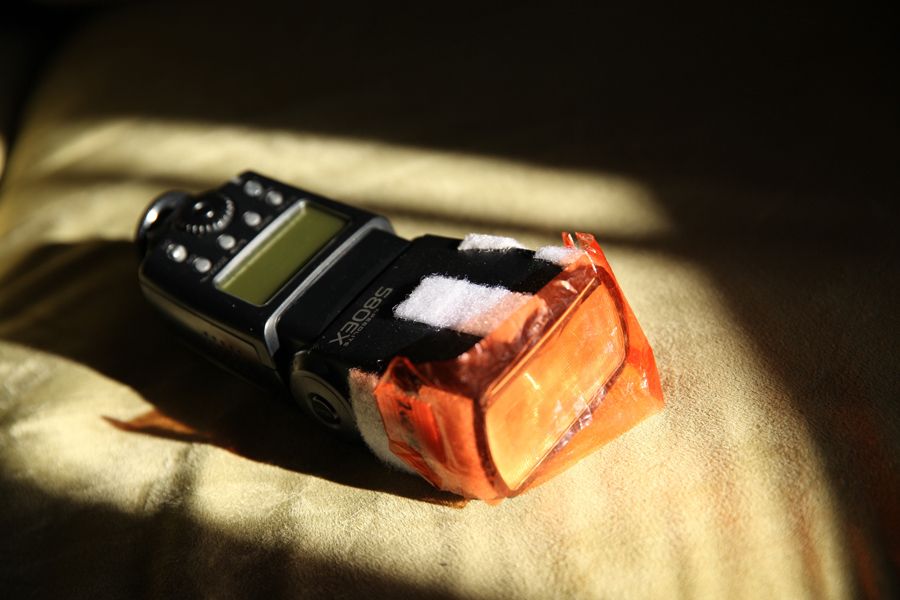
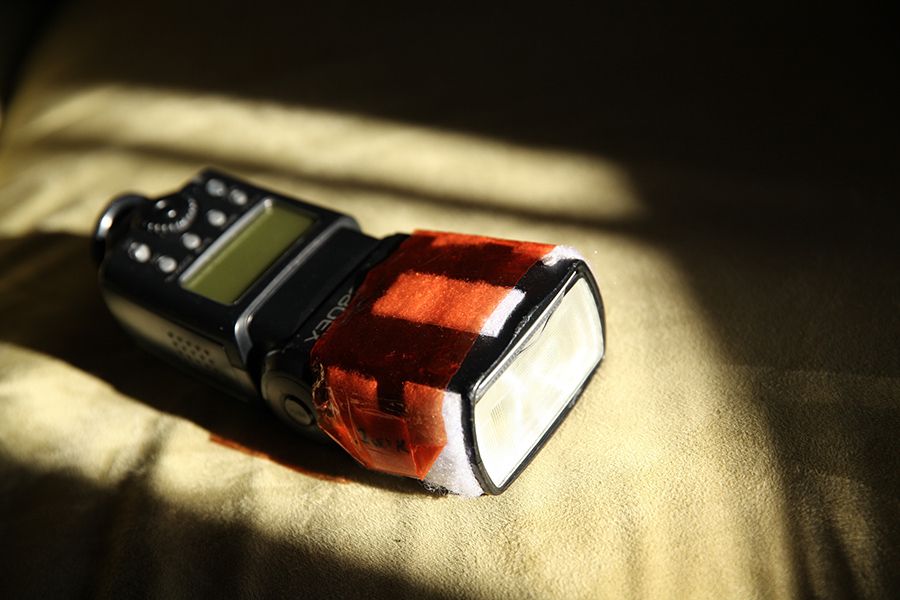
The only gel you really need is some CTO in either full or half. You can purchase a large sheet for about $10 and cut strips to fit your lights.
I keep some velcroed to all my lights so it's always available.
p.1 #9 · Wedding with Blood Orange Walls and Ceiling
The CTO would probably have helped if the OP had continued to bounce off the red ceiling since it would simulate the (assumed) incandescent lights of the chandelier combined with the red glass elements of the chandelier. Shooting the flash direct or off the OP's own provided reflector though would probably cause a mis-match to the red light.
The OP still would likely have problems with:
- proper color balance - particularly skin tones as Jim mentioned. The problem is the green and blue channels may be so low (and noisy) that it gets very difficult to recover a proper color balance.
- daylight contamination from the windows
If the conditions were as extreme as it sounds, the only "perfect" solution may have been for the OP to provide his or her own ambient with additional speedlights or strobes.
p.1 #10 · Wedding with Blood Orange Walls and Ceiling
Dawei Ye wrote:
The difficulty is with high ceilings/far away walls, and tungsten spotlights that are strong - they are tough!
+1 , and then there is the halogen down lights.... they are my worst enemy. They are always around where the getting ready happens, and I've started letting clients family know we don't need them turned on.
p.1 #12 · Wedding with Blood Orange Walls and Ceiling
I think the other question is how would the client want the files to be delivered? Their memory of the night is that everything they saw had a red tint to it due to the red chandelier, but (assuming the majority of the wedding was in that room) would they really want all of their wedding pictures to retain the red skintones from the chandelier? Possibly, but possibly not.
I agree with delivering files that stay true to how it looked in reality, but in this case I'm tempted to use mostly ungelled or CTO off camera flash (not bounced) and thus skintones will be normal and the walls will remain red (since they're painted red and not via uplighting).
Matt, if you gel red, don't you agree a white balance is going to mess up the walls as Jim said?
-Lincoln
p.1 #13 · Wedding with Blood Orange Walls and Ceiling
Here's an example of colored walls and off camera lights. This wedding was held in a reception hall that had constantly changing color lights (ugh) In order to keep the light on the B&G constant I had to use direct flash instead of bouncing my light. Here I had set up to shoot a couple of quick shots of the B&G. Notice that the color changes in the background, but the light on the B&G stay constant. I used a couple of speedlights gelled with CTO.
p.1 #14 · Wedding with Blood Orange Walls and Ceiling
So you used a direct flash with no gel? did you diffuse in any way or just use a low exposure compensation to keep them from being looking too flat (always my fear with direct flash)?
p.1 #15 · Wedding with Blood Orange Walls and Ceiling
LPortugalPhoto wrote:
So you used a direct flash with no gel? did you diffuse in any way or just use a low exposure compensation to keep them from being looking too flat (always my fear with direct flash)?
I used an umbrella on the key light (camera right) and and bare flash camera left. Both lights were off camera as I don't use direct on-camera flash except in some instances where I need a little fill.
p.1 #16 · Wedding with Blood Orange Walls and Ceiling
Direct ON camera flash is a big no no.
Direct OFF camera flash is what you want, though if you're not diffusing this light I would recommend having multiple off camera lights (i.e. cross lighting or another arrangement).
-Lincoln
p.1 #17 · Wedding with Blood Orange Walls and Ceiling
Ya... off camera flash was a bit difficult since I was moving around the room (the couple wanted pics with every guest that attended). But, for any portraits .. this set up is definitely doable!
p.1 #18 · Wedding with Blood Orange Walls and Ceiling
LPortugalPhoto wrote:
Ya... off camera flash was a bit difficult since I was moving around the room (the couple wanted pics with every guest that attended). But, for any portraits .. this set up is definitely doable!
That's why you would set up 2-3 off camera flashes in a way so that the lighting is great no matter where you are in the room.
-Lincoln
p.1 #19 · Wedding with Blood Orange Walls and Ceiling
LPortugalPhoto wrote:
Ya... off camera flash was a bit difficult since I was moving around the room (the couple wanted pics with every guest that attended). But, for any portraits .. this set up is definitely doable!
For the wedding I posted, I had also set up three mono lights around the room to light the dance floor. That way I had most of the room lit. For the cake cutting (which took place outside of the area I had already lit) I simply set up one of my speed light/umbrella combos. When I'm working a reception, I keep a couple of speed lights on stands ready for impromptu shots. It doesn't take me but 20 seconds to position a light and and I'm ready to go.