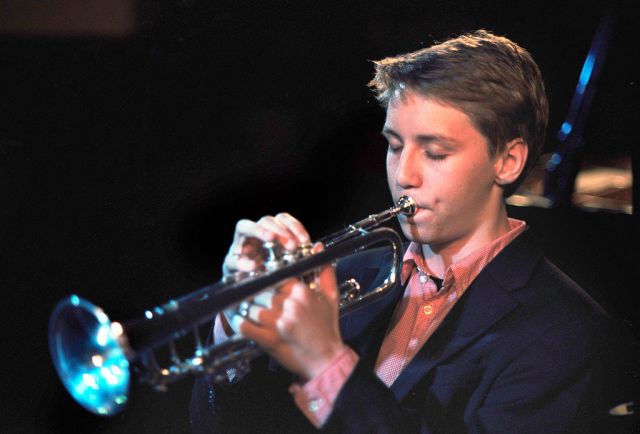
The biggest problem with this is that it's really flat. Your blackest black is only around 55 or so. Other than that it's a nice snapshot, but needs more in terms of angle, emotion and excitement to bring it to the next level. Ektar 100, while being a fine film, seems a curious choice for performance photography. This is an area where high ISO digital completely dominates what we used to do in film. It's great that you pulled of the shot with this film, but it does seem the wrong tool for the job - in this case. I'm attaching a slightly spiced up version so you can see the difference. You should probably also convert to sRGB for web.
The low contrast was intentional, although it looks a bit too extreme on the web. Ektar 100 was all I had on hand, but it's definitely not the perfect film for low light. Thanks for the crit!
What are some appropriate uses for low-contrast images? I tried it here to give the photo a more "oldschool" look, but I guess I executed it poorly. Thanks!
Typical types of low or lower contrast images can be images shot in fog, which diffuses the light and makes low contrast seem natural. Images shot with extreme backlighting where the light source is hitting the lens causing flare, thereby reducing the contrast. Those images usually have a veil of flared light (defined by an old instructor as non image forming light) that reduces the contrast and helps create mood. A third type would be images that are made artificially low contrast, usually by raising the black point, to be used under type or other images as part of a graphic solution.
Human eyes naturally want to see a certain amount of contrast, and if it's not there, there needs to be a reason for it for us to accept it. That's why, with few exceptions, master print makers would tell you that you needed to have a black black and a white white to please the eye. With your trumpet image, we see a background that is obviously black with no detail at all and with no visible reason (lens flare, etc.) to alter that, so when it's just a darkish gray, it tends to look like a mistake.
In your case, the next time you're shooting live music, you might try getting low and look up at your subject, maybe even with a wide angle lens, and don't be afraid to include the actual stage lights themselves in the shot, but don't forget to compensate your exposure, as you meter will get fooled.
You can also experiment with Fill Layers in Photoshop that can add a lot of mood to an image. Adding color to the shadows can be very effective but it helps a lot to have something in those shadows. But a solid color Fill Layer set to a reduced opacity and a Blending Mode like Lighten, Screen, Hard Light, Linear Light, etc, can be very effective.
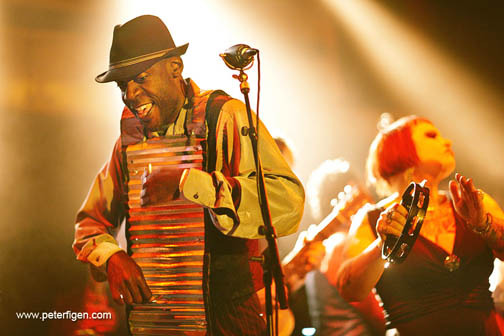
Here's a small example of the type of thing I'm talking about. It might not be as low contrast, but it has the vibe of the band and tells a story. The way the lighting in the background complements the performers helps the overall composition.
I spent a year and a half photographing this band - the time my girlfriend was in the band - probably shot 30,000 frames, and what I found out is that you have to shoot a ton of images in order to get a few good ones. But by going back week after week, you also learned to anticipate where the good shots were going to be and what you didn't get this week, you'd probably pick up the following.
Fast lenses - f/1.2, f/1.4 and f/1.8 paired with high iso and shitty lighting most nights. Every once in a while you get a good image.
This is more just using the stage lighting to effect. There's some flare going on - in his hat and face, and then the flaring drops off as it gets lower in the frame. It's getting harder and harder to get good flare with modern lenses. The coatings are so good now on many of them that you can have direct light sources in the frame and still not get much flare. Filters, especially not too clean filters can help.