joe88 wrote:
I think Leica still get lots of value from people buying used Leica bodies, not only used M8/9s but also the older film Ms. Secondary revenue and profit will be generated with the sale of their lenses (where there is little or no competition) and also for servicing and repairs of existing cameras, especially the digital Ms.
I think the bodies are not where most manufacturers make the most profit, rather it is in selling lenses. We may buy one Leica M9 or M whatever, but how many of us end up with more than a few M mount lenses and a few of those could be Leica ones? Maybe in the beginning one would start with more affordable CV lenses and slowly realize some of the limitations and then progress next to Zeiss and some eventually end up buying a few Leica lenses. It never ends does it? Else I don't think you many of you will be spending your time here on the forums?
I also think that many here mistakenly think that Leica M owners are either very wealthy or that they are irrational enough to buy whatever premium cameras Leica produces. I can tell you that this is probably not true. For instance although I am willing to fork out some hard earned savings for a Leica M body (which by the way is not that much more expensive than a D4 or 1DX), I just don't see the value of paying extra $$ for a Leica X2 or a DLux 6 and I think quite a few of my fellow M shooters agree with me?...Show more →
i'm sure leica hopes that used m8s act as a gateway to their new lenses and maybe even their new cameras and i agree they make more selling lenses than cameras. leica has a very fierce competitor in this market too though: legacy leica. i suspect most of the people that are not willing to buy a new m body are also not willing to buy a new m lens. one of the downsides of solidly built manual focus lenses (from a manufacturers perspective) is they last pretty much forever. there is a pretty big market for used leica glass as well (including modern asph designs).
i don't think that leica owners are necessarily wealthy or irrational, i'm not making any judgement on them. i just think that leica's main source of revenue is the small market that is willing to pay $5000+ camera and $3000+ lenses and they aren't able to compete easily in the larger market for cheaper cameras without drastically changing their company (which would be foolish).
rscheffler wrote:
One thing about Leica's lens philosophy is it has always been about making the smallest size and highest quality lens possible. For example, compare the 50AA with the new Zeiss 55 f/1.4 (ignoring the one stop difference).
I'm really curious about the new German made Schneider lenses. They are supposedly super high resolving but, unlike the Zeiss above, are not built like oversized MF lenses in order to achieve their performance but are much smaller - I'm guessing roughly the size of Leica R lenses.
From Nick Devlins Photokina Report on LL (hopefully, his price range is correct as I thought they might go for more than that):
"The lenses are manual focus, and have a similar feel to excellent Zeiss offerings. They are also likely to be priced similarly: i.e. between $2,000 and $3,000. What is interesting is that they are much smaller than the new Zeiss 55mm f1.4. Unlike the Zeiss, these are likely not MF lenses masquerading as 35mm. (Not to be critical of Zeiss – simply cutting out the corners is a good solution but-for size)." http://www.luminous-landscape.com/essays/photokina_2012.shtml
rscheffler wrote:
It's not just the look that's a differentiator, but also how the sensor toppings are optimized for RF lenses. It will be really interesting to see how the M's sensor compares against the M9's with some unfriendly lenses, such as the CV15 and ZM21 f/4.5.
The ZM 21/4.5 always looked so appealing to me. Really hope the M can handle it well.
"I just trust Leica to get it right. Sure, there was that whole IR debacle with the M8, but we can blame Kodak for that, and, with the filters the image quality was (and still is) excellent."
They blame Kodak for not testing their camera before release?
Guys, if the EVF is made by Olympus,
that means when there is a new better model,
it should work with M, right?
For that reason I think it's a good choice
to stick with the attachable one.
snowboarder wrote:
Guys, if the EVF is made by Olympus,
that means when there is a new better model,
it should work with M, right?
For that reason I think it's a good choice
to stick with the attachable one.
Unfortunately, the main limitation with EVF+M is in the camera electronics, which will always limit whatever EVF is attached to a slow 30FPS. Other IQ aspects of course could improve, (resolution,DR, color, brightness and so on).
Tariq Gibran wrote:
"I just trust Leica to get it right. Sure, there was that whole IR debacle with the M8, but we can blame Kodak for that, and, with the filters the image quality was (and still is) excellent."
They blame Kodak for not testing their camera before release?
According to most reviewers the magenta cast only occured in about 1-3% of cases and only when shooting man made fabrics. So both Kodak and Leica can be somewhat excused for that mistake, even though I also find it strange that Kodak, as a film and sensor manufacturer, did not see this happening.
I don't know, Edward, I'd be surprised if the M8's IR issue only cropped up in 3% of photos that had deep black materials. Heck, even the M9 isn't totally safe from IR issues, compared to most DSLRs. The M9 was majorly improved, but it can still show purplish blacks.
edwardkaraa wrote:
... I also find it strange that Kodak, as a film and sensor manufacturer, did not see this happening.
I guess that would depend on what Kodak's exact role in the design of the filter pack used was for the specific application of the M8. Don't most camera companies make the choice of filter pack themselves and not the sensor supplier? Ultimately, it's up to the camera maker to do any final QA/ control before release. It was a major blunder that I don't believe Leica is justified in passing the buck onto one of their suppliers. The upside I guess is that hopefully Leica does some pretty major testing before release after that incident. I think with the M, they know it must be right/ glitch free upon release since it's such an important/ visible product that will appeal to a broader market.
Bijltje wrote:
Hmmm, I thought the Gorrila glass was an update against sapphire, but its only to reduce costs..
Should be enough trough, 90% as strong.
The problem with Gorrilla glass - as my wife has proven to me recently with MY! smartphone - is that while it is scratch resistant, it shatters very easily (it's very brittle). I'm guessing that's one area where Sapphire is much better.
Tariq Gibran wrote:
I guess that would depend on what Kodak's exact role in the design of the filter pack used was for the specific application of the M8. Don't most camera companies make the choice of filter pack themselves and not the sensor supplier? Ultimately, it's up to the camera maker to do any final QA/ control before release. It was a major blunder that I don't believe Leica is justified in passing the buck onto one of their suppliers. The upside I guess is that hopefully Leica does some pretty major testing before release after that incident. I think with the M, they know it must be right/ glitch free upon release since it's such an important/ visible product that will appeal to a broader market. ...Show more →
I am not disagreeing with you. What you are saying does make sense. But in the same time, I can't ignore also the cracking sensor cover on the M9, another huge screw up by Kodak. Luckily they are out of business, and no wonder why.
I have a question guys. It's OT, but since I'm the OP, I guess I have extra privileges
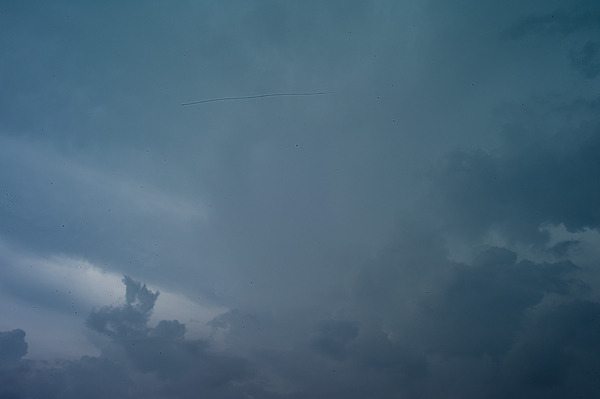
I bought today a mint M9, only to discover that huge scratch on the sensor withnin a couple of hours. (picture below with ZM 35 at f/22). I immediately returned it to the shop but now I'm thinking could it be just dirt? Like a piece of junk got stuck under the swab and made this artistic stroke? What do you think?
The shape of it is suspicious to me (it does not look like junk on the swab that is removable but....). Is that at 100% or greater? That's at F23? Do you see it at F8 for example?
Tariq Gibran wrote:
The shape of it is suspicious to me (it does not look like junk on the swab that is removable). Is that at 100% or greater? That's at F23? Do you see it at F8 for example?
Yes, at 100%. At wider apertures it gets wider and less defined. I noticed it in a infinity test shot at f/4.
I don't know that much about the M9, cover glass and so on but I have never seen anything that large on any of my camera sensors. I guess you could always ask the shop owner to see if it cleans off with something like a sensor/lens pen.
Tariq Gibran wrote:
I don't know that much about the M9, cover glass and so on but I have never seen anything that large on any of my camera sensors. I guess you could always ask the shop owner to see if it cleans off with something like a sensor/lens pen.
I'm sure the shop owner will try that anyway. They will contact me again if it's only dirt, but from the face of the shop clerk, I somehow noticed he wasn't very surprised when I mentioned the scratch.
But definitely, that's the longest scratch I have ever seen
edwardkaraa wrote:
That's what it looks like at f/4:
Darkening that image with levels, I see the dust spot and what I guess is the flaw you are referring to. That to me does look like it might be able to be cleaned off (seems like it would be more defined if it were a physical defect like a crack). You could try or have the shop owner try to clean it for sure. I suspect it might come clean. I'm very curious what it turns out to be now.