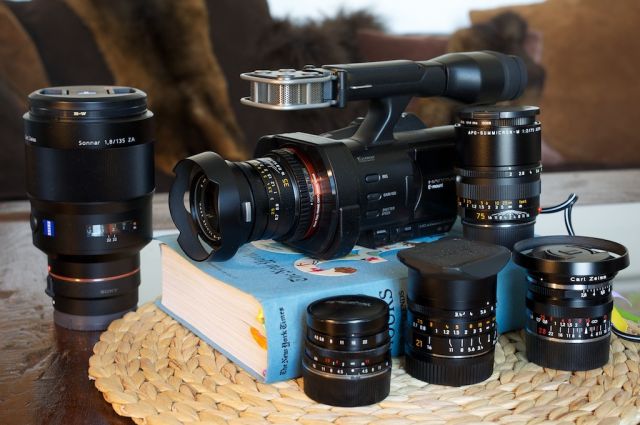
yes, but i think that is just a quality of the lens (and compositions). i don't see any color shift. can't tell if there is any smearing at this size, especially since it's shot at f/1.2 where the corners will suck no matter what.
The lens doesn't have issues on the NEX 7, so it just tells us it's not worse @ FF with this lens, we well need more lens tests to judge color shift on this sensor.
Also the future NEX 9 may have a different sensor.
Yeah, the 35/1.2 is probably one of the most telecentric 35mm rangefinder lenses out there. It's great news that it doesn't appear to have issues with the VG900, but I wouldn't put much stock into it when considering other 35mm rangefinder lenses on the VG900.
If it is so difficult to have FF sensors work with wide angle lenses close to the sensor (like with range finder lenses) how come Sony was able to build the RX1 with a 35mm f/2 lens that sits almost on top of the sensor and have this work without shading and color shifting problems?
I don't think the RX1's 24mp sensor has very fancy microlenses and the Zeiss 35mm f/2 lens is quite compact and has a very, very short flange distance. So how did Sony make it all work out?
What I'm getting at is that if it is possible to build a non-problematic wide angle lens with extremely short register distance as on the RX1 how much more difficult could it be to design a range of small full frame lenses with the E-mount register distance for a hypothetical FF e-mount camera? Thanks
HopeIsEternal wrote:
If it is so difficult to have FF sensors work with wide angle lenses close to the sensor (like with range finder lenses) how come Sony was able to build the RX1 with a 35mm f/2 lens that sits almost on top of the sensor and have this work without shading and color shifting problems?
I think it's probably because the RX-1 has microlenses adjusted to that particular lens. It might also be that while 35mm is considered to be a wide angle lens it's not a ultra wide angle that would cause large amounts of color shifting like the Voigtlander 15mm f4.5.
jonrock wrote:
I think it's probably because the RX-1 has microlenses adjusted to that particular lens. It might also be that while 35mm is considered to be a wide angle lens it's not a ultra wide angle that would cause large amounts of color shifting like the Voigtlander 15mm f4.5.
It's because the lens was designed specifically for the camera, and has an element at the back which a. practically touches the sensor, b. is as large as the sensor, and c. bends all the light rays so that they are perpendicular to the sensor surface.
It's been suggested that the problems are simply because the engineering constraints have never properly been examined before the popularity of mirrorless cameras with large APS-C sized sensors two or three years ago.
Prior to this, APS-C and FF digital cameras have all been DSLRs. They all use lenses that have rear elements placed at a distance from the sensor to provide mirror clearance. The M8/M9/Kodak experiment is an exception. But even here for a low volume/one-off product, the Kodak sensor mostly succeeded (sharp, no color shift, and only requires software correction of vignetting as I understand it).
There is an incentive for manufacturers to get this right. Since it provides lens designers more choice in their native-mount designs, and this includes the prospect of smaller lenses.
If anything the RX1 can be seen as one manufacturer aggressively responding to how they see the market for mirrorless evolving (even with the help of a large rear corrective element).
Also keep in mind that micro lenses designed for rangefinder lenses that are 135mm and wider may cause more vignetting for lenses longer than 135mm. I'm not sure how bad the trade off would be, so it may still be worth it, but it may not be something that the mirrorless companies want to mess with.
As was mentioned above, the RX1 has the advantage of a sensor and lens being designed optimally for each other.
_julian_ wrote:
But even here for a low volume/one-off product, the Kodak sensor mostly succeeded (sharp, no color shift, and only requires software correction of vignetting as I understand it).
The M8/M9 certainly do have color shift and this is software corrected in-camera for coded Leica lenses by altering the RAW file. Not the most elegant solution but it's hard to do better I suppose. This leaves the wide Zeiss ZM and Voigtländer lenses with color shift.
I still don't understand how a large rear element almost touching the sensor can provide better telecentricity than a smaller rear element a good distance away from the sensor (such as from an "M" range finder 35mm lens)
Is the large rear element on the RX1 acting like a teleconverter?
Taylor Sherman wrote:
It's because the lens was designed specifically for the camera, and has an element at the back which a. practically touches the sensor, b. is as large as the sensor, and c. bends all the light rays so that they are perpendicular to the sensor surface.
HopeIsEternal wrote:
I still don't understand how a large rear element almost touching the sensor can provide better telecentricity than a smaller rear element a good distance away from the sensor (such as from an "M" range finder 35mm lens)
Is the large rear element on the RX1 acting like a teleconverter?
The large rear element is likely a correcting element that directs the angled light coming into it straight down into the sensor. The Fuji RX100, Sony DSC-R1, etc, have a similar thing going on.
The angled light ray issue with various M lenses has never strictly been about the distance of the rear element to the sensor. It's about the distance of the exti pupil from the sensor, and it appears that the exit pupil in the RX1 is closer to the front of the lens, like many of the current mirrorless lenses. Making the RX1 fixed lens allows Sony to shave length off of the lens compared to a interchangeable version, because they can put that rear element right up against the sensor.
A small lens at some distance away from the sensor physically limits:
a) usable aperture size
b) the "amount" of telecentricity, i.e how far away from the image plane the apparent aperture can seem to be.
Simple trigonometrics: If you have a 10mm rear lens situated 30mm in front of the sensor, the absolute minimum ray angle at the corner of a 36x24mm image is about the arctangent of sensor corner distance (diagonal/2) divided by rear lens surface distance.
atan((sqrt(36^2+24^2)/2) / 30) >>> atan(22/30) = 36º
36 degrees is quite a lot. Most sensors like to keep angles below 25º. And you need glass to bend light, the rays HAVE to come from the rear lens surface.
Now if the front groups of the lens focuses the rear projection at some distance away in stead (long back focal distance), the lens would have to be far away from the sensor plane and the sensor would have to be huge. Add in a positive group at the rear end, and you get two things - The physical lens aperture gets moved in closer to the sensor (giving a smaller lens length from sensor to front lens), the projection gets smaller (you need a smaller sensor) - and the rear principal point can be moved off as far as you like. You could even move it beyond infinity, and get inverse angles - rays at the edge of the sensor would then strike the surface as if coming from the outside, not from the center of the optical axis.
So it's not really a teleconverter, a TC keeps the back focal distance the same but moves the main lens forward.
What you could think of it as is a bog standard magnifying diopter. It allows a lens (now the rear of a lens, but it's just the same!) to focus closer, and it keeps the principal point the same physical point in relation to the sensor as before you added the diopter
So what you basically have is a medium format lens with a macro diopter on the front of it, but used with the rear end forward in stead...