for alot of us on a budget the 7D is as good as it gets in canon land (factoring in performance and features).
I bought mine about 9 months ago for just on £800 as lightly used example (maybe the previous owner was another 100% obsessed measurebater ) .
Now I wont try and say its a noisless wonder compared to a 5D3 / 1D4 or 1Dx . but then at £3K or more for any of them they are also just not a consideration.
anyway:
This is @ 800iso . its had no work done on it at all. just imported the raw into LR and exported to a jpeg
100% crop
Now here is the main reason why I like my 7D
and here is the original shot I cropped it from . .
after the crop im left with a still usable 7-8meg file. I wonder what I would have had left with a 1D4 file or a 5D3 file? or even worse a 12mb FF nikon file ?
as a 'normal' user 400mm (100-400) is probably the longest lens I'm ever likely to own. and that was as close to the action as I could get without having a press pass .
Infact in my bag I had a 1D2n which didnt even see the light of day due to being so reach limited .
Oh and on the 1D2n. Ive tried and failed with 2 now. comparing the 1D2n and the 7D at higher ISO's the 'n seemed noisier. and thats at normal viewing on screen. not comparing 100% crops
So the argument between a 7D and stuff like 1D4's 5D3's or 1Dx's or even the 1D3 for most of us is not even a consideration. and comparing any of them at 100% is just plain silly. as someone above pointed out get both to the same res and then compare if you really feel the need .
And from what Ive seen at the last few events ive been to , it seems that im not in a minority either. By far the most popular combo at any of them was a 7D+100-400 . Infact at the big cat open day (where the lion shot came from) it seemed to be the ticket for entry
Oh and for those 100% measurebaters out there. do you ever go into an art gallery and just walk up as close to a work of art and look at 1 tiny portion of a painting? or do you stand back and admire the whole thing ?
One consideration in all of this 7D discussion is what we use this camera for - big glass and difficult conditions. I've been reading 7D threads like this for years but have never seen a similar one about the 60D. Like many here, I use a 5D2 for the majority of my photography and switch to the 7D + 100-400 when reach is of concern. Hence all my 7D photography is already pushed, big slow lens requiring higher shutter speeds and therefore higher ISO. And we are shooting feathered and furred critters where the fine detail is easily deteriorated by noise or motion blur. My 5D gets to do all the easy photography, so I have to tailor my expectations about my 7D.
Conrad's kestrel is a good example. It is not a perfect 100% pixel level capture and it requires careful PP to optimize the image, but the result looks good at normal viewing whether screen or print. I would be happy to add an image like this to my collection. I like kestrels and so far haven't been able to lay glass on one.
Edit: Ian.Dobinson wrote:
...
+1
And to clarify my 12 MP camera statement above. If I take a decent 7D image and do a final reduction to 12 MP then I usually have an image that looks good viewed at 100%, comparable to viewing a 5D image at 100%. Put an image on an iPad and people zoom it 100%; I just limit their ability to pixel peep.
I can't quite escape the impression that I have annoyed you a great deal, please accept my apologies.
Mike Engles
There is absolutely no need for an apology. You have every right to think whatever you want and to express those thoughts in a forum thread, but others also have the right to conclude that your thinking is based on a complete refusal to accept reality and to express their thoughts to that effect.
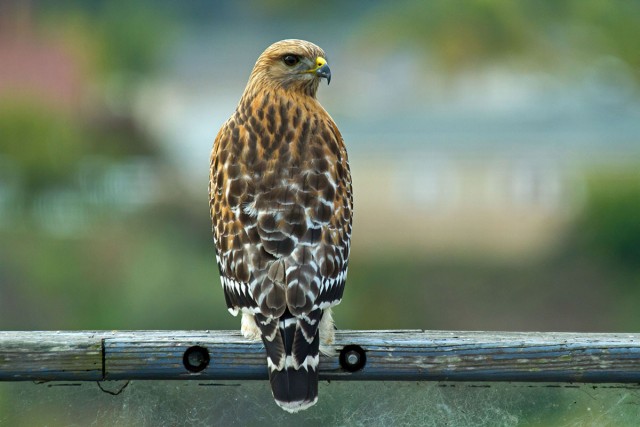
I moved my 12 MP edit of Conrad's kestrel to my iPad and looked 100%, a little motion blur in the head but not bad at 264 ppi. In looking through my recent captures, I find I use ISOs 160, 320, and 640 quite a bit. Gochugogi and others have suggested that these are cleaner ISOs. Here is a red shouldered that hangs around my back yard shot at ISO 640 with a final reduction to 5Dc image size (this copy reduced for WEB). The background looks much cleaner to me without much loss in shutter speed. D'ya think I need to paint my fence?
I only shoot full ISOs and use EC +1/3 or +2/3 depending on the situation. Something else that Conrad could try the next time is to expose for ISO 800 and the desired shutter speed needed in manual mode, then very simply move the ISO up one stop and take a shot. In the raw, bring the exposure back down, and the resulting ISO 1600 image may be cleaner than the corresponding ISO 800 shot, almost to the point no noise reduction would be needed.
TeamSpeed wrote:
I only shoot full ISOs and use EC +1/3 or +2/3 depending on the situation. Something else that Conrad could try the next time is to expose for ISO 800 and the desired shutter speed needed in manual mode, then very simply move the ISO up one stop and take a shot. In the raw, bring the exposure back down, and the resulting ISO 1600 image may be cleaner than the corresponding ISO 800 shot, almost to the point no noise reduction would be needed.
uz2work wrote:
In my case, I appreciate the strengths of both my 7D and my 1D Mark IV, but I also recognize that each one can be a better tool for getting the job done depending on the situation at hand. And I would be making the case just as vigorously against someone who tried to make equally closed-minded arguments that the 1D Mark IV does not have advantages over the 7D in many situations.
Les
Touche!
Exactly how I see my 7D and 1D4 as well, Les.
At action shots, when my lenses/TCs have sufficient reach, the 1D4 is my body of choice. I'm enthusiastic in discussing the noise of the 7D (and that might make me appear as a 7D fanatic) only because there is so much inaccurate info floating around the net regarding this body's noise characteristics.
Here's a couple of samples from my 1D4.
Little Egret (Egretta garzetta)
Shooting info - 1D4 + 500 f4 L IS + Canon 1.4x TC, 700 mm, f/7.1, ISO 400, 1/1600 sec, manual exposure in available light, 475B/516 support, near full frame.
Thanks to many in this thread for the good information. I can really relate to Ian's assessment of a lot of 7d owners. As a hobbiest wildlife shooter I can't really afford anything better than a 7d paired with a 100-400.
For wildlife in particular I am growing more and more picky on lighting. I rarely go out on overcast days and usually shoot first thing in the morning or late evening. I feel like my 7d is noisier than my 40d was below ISO 400, especially in blurred backgrounds and blue skies. I use more selective sharpening more now and that helps.
At ISO 800 and above my 7d produces better images with much more detail to work with. I try to keep my shots at ISO 1600 and below when possible. With the 40D my max was usually ISO 800. These are my opinions based on the copies of these cameras I've owned. I have also used a 30D and found it similar to the 40D.
I have a 7D and appreciate the extended reach it gives me. Please to help me understand. This thread is about 7D high ISO noise. Yet: most of the images presented here are of subjects in daylight. Why should images taken in good light need so much post processing?
Good light or poor light, noise characteristics have everything to do with your ISO and exposure. Underexpose in good lighting at low ISO will yield similar results to ettr/hamsttr in poor lighting at higher ISO. I never understand that question when it comes up because it all comes down to exposure, the camera knows nothing about "good" or "bad" light.
That being said, most of the samples are not in daylight or sunlight. I, for example, posted several low or indoor lighting shots. What more would you like to see, I have quite a bit to share if want more.
Thank you all for this thread. I have learned a lot and will try stuff out as soon as I get home. It gives me new confidence in my 7D, seeing what has been posted and explained here.
Question: Teamspeed uses DPP for Raw conversion but you do all sharpening in a different programme (PS I suspect). I use LR 4 for my conversion, so I would like to understand whether sharpening outside of raw conversion is also done by those ACR users here, who get these great results with high ISO picture PP. If not, is this a difference of the two programmes or a preference for a one-programme-approach or is the difference to smal for the use you intend for the pictures to consider complicating your workflow? Or some other explanation?
misterOphoto wrote:
I have a 7D and appreciate the extended reach it gives me. Please to help me understand. This thread is about 7D high ISO noise. Yet: most of the images presented here are of subjects in daylight. Why should images taken in good light need so much post processing?
Typically, what might be considered "good" daylight lighting for other subjects is not necessarily such for wildlife shooting. Many/most of the best wildlife shooting opportunities come shortly after dawn. While it may be sunny at that time, the level of light is still quite low. Further, with wildlife shooting, most photographers are going to place a high priority toward having high shutter speeds. Thus, to get shutter speeds of 1/1500 or higher, even in (early) daylight, it can be necessary to kick the ISO up to higher levels.
40Driggs wrote:
For wildlife in particular I am growing more and more picky on lighting. I rarely go out on overcast days and usually shoot first thing in the morning or late evening. I feel like my 7d is noisier than my 40d was below ISO 400, especially in blurred backgrounds and blue skies. I use more selective sharpening more now and that helps.
I believe that I said something similar earlier in this thread. There was a time when I would go out and, regardless of the quality of the light, I would point the camera at anything that moves and start pressing the shutter button. Now, I, too, am much more picky about the light. I find that, if there is not, at least, some sun hitting the face of the subject, I'm not going to be happy with the picture for reasons that have nothing to do with noise. Without light hitting the eye and without some "sparkle" in the eye, the shot, to my tastes, loses its visual appeal. Thus, I won't shoot backlit subjects except if my purpose is documentary, and, if it is cloudy, I'm happy to put the camera down and to just enjoy with my eyes what is happening in front of me.
However, I don't necessarily agree with what you say about the 7D noise below 400 compared to the 40D. See below.
40Driggs wrote:
At ISO 800 and above my 7d produces better images with much more detail to work with. I try to keep my shots at ISO 1600 and below when possible. With the 40D my max was usually ISO 800. These are my opinions based on the copies of these cameras I've owned. I have also used a 30D and found it similar to the 40D.
I agree 100%. If I compare 40D files to 7D files in the totally meaningless way of looking at both at 100%, the files might look similar, or the 40D files might even look like they have a slight edge. But, in a genuinely meaningful comparison at the image level, the 7D easily beats the 40D with regard to noise.
Les
40Driggs wrote:
I feel like my 7d is noisier than my 40d was below ISO 400, especially in blurred backgrounds and blue skies. .
The 7D seems to have a problem with blue skies. That is one area that you will notice noise even at ISO 200 and 400. There have been other cameras with this particular problem in the past. I believe it was the Nikon D300 that was really bad at blue skies also. I have no idea what causes this but I think it is one variable that adds to the 7D's poor noise reputation out on the internets.
BluesWest wrote:
Yes, and if you know what you're doing in PS, this particular 7D noise problem is solved in seconds (literally).
John
I agree, since I switched over from Aperture to LR4, all I have to do on my older 7D files is just nudge the NR slider slightly and it is back to clear blue skies. With Aperture it was harder to do this as the NR sucks.


 ) .
) . 


 .
.