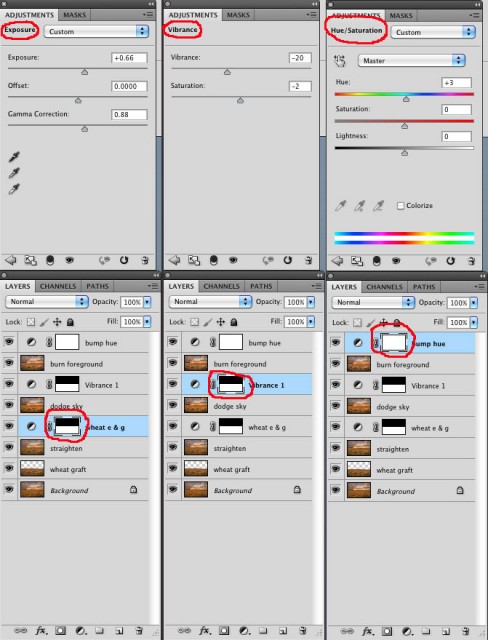
Notice the selections associated with each of the three adjustment layers for exposure, vibrance and hue/saturation. The exposure selection was the wheat (white part of the mask thumbnail is where the layer is applied). The vibrance changes were applied using the same wheat selection. The black part represents the portion of the image where the layer isn't applied the background and sky. The hue bump adjustment layer shows as all white, meaning it was applied to the whole image.
Gotcha, thanks. I made a quick version last night to see how it looks. I will do a more careful one today with your clarifications. I zipped up one and got some pretty wild colors.
dmacmillan wrote:
What matters is which represents your interpretation best.
Another way of saying:
"What's your point?" or "What is the message that you are trying to convey to your viewer?"
Whichever one better represents what YOU are trying to show us ... that's the better one.
If I'm trying to show the range of colors in the sky and they are "kinda subtle" ... I may need to crank them up a bit so you can better see that range. If I'm trying to show you the delicateness of wispy clouds ... I may not want to crank them up at all. What "point" or "message" that I want to convey can be a significant factor in making such decisions.
I prefer to ask "which image better delivers my intended point/message" rather than "which one looks better". It might not sound like much of a difference, but even in "pretty pictures" ... there is usually a point that compelled you to take the image in the first place. Remembering that can be helpful in deciding how you want your final presentation ... to convey your message/point vs. "looks better". Of course, then there is always the battle @ emotive response (intended) vs. actual/factual/informative/realism (intended).
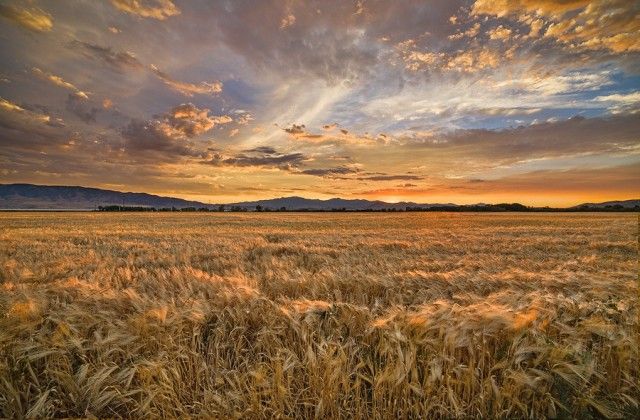
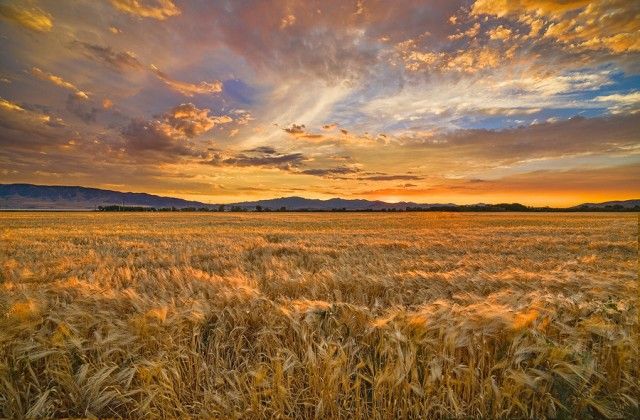
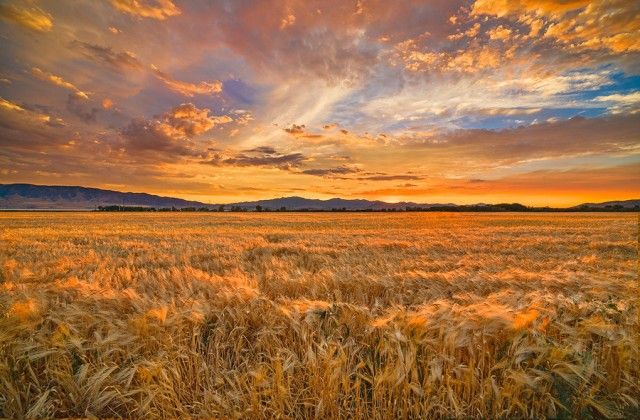
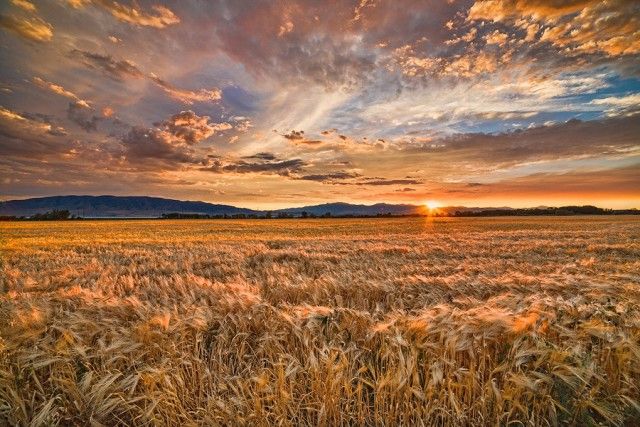
One thing I see @ these three is that while the increased color can be a more dramatic representation of the "golden light" on the golden grain that is experienced at that time of day ... the fact that we can "see" that it is back lit by the setting sun behind the mountain in this perspective is a bit incongruous with the front or side lighting that would render such a strong "glowing" of the golden grain.
The clouds are certainly at an angle of illumination from the sun to take on an EXTRA GOLDEN flavor, but the grain is going to be illuminated by a lesser amount from the sun as part of it is obscured by the mountain. I can probably "cheat" plenty on the clouds and nobody could say whether or not it was/wasn't so ... probably not so much on the grain.
That being said, the last one stretches my sense of "plausible realism" a bit ... but that doesn't make it right or wrong or counter to your objective, depending upon your objective for the image.
"What's your point?" or "What is the message that you are trying to convey to your viewer?"
Whichever one better represents what YOU are trying to show us ... that's the better one.
If I'm trying to show the range of colors in the sky and they are "kinda subtle" ... I may need to crank them up a bit so you can better see that range. If I'm trying to show you the delicateness of wispy clouds ... I may not want to crank them up at all. What "point" or "message" that I want to convey can be a significant factor in making such decisions.
I prefer to ask "which image better delivers my intended point/message" rather than "which one looks better". It might not sound like much of a difference, but even in "pretty pictures" ... there is usually a point that compelled you to take the image in the first place. Remembering that can be helpful in deciding how you want your final presentation ... to convey your message/point vs. "looks better".
One thing I see @ these three is that while the increased color can be a more dramatic representation of the "golden light" on the golden grain that is experienced at that time of day ... the fact that we can "see" that it is back lit by the setting sun behind the mountain in this perspective is a bit incongruous with the front or side lighting that would render such a strong "glowing" of the golden grain. The clouds are certainly at an angle of illumination from the sun to take on an EXTRA GOLDEN flavor, but the grain is going to be illuminated by a lesser amount from the sun as part of it is obscured by the mountain.
That being said, the last one stretches my sense of "plausible realism" a bit ... but that doesn't make it right or wrong or counter to your objective, depending upon your objective for the image....Show more →
The light angle is wrong for the wheat given the sky. This was one reason I did not combine them to start with. When the sun was still up it lit up parts of the wheat tops and in some cases flare did the job.
So this is a made up image. Perhaps just jazzing up the second image would be a better approach.
I am not sure what I want. I print on art mat paper and don't use any glass. This is intended to prevent reflections. When people see them hanging, they always assume they are paintings because they lack the glossy look of a photo. This is the cases even for light processing.
I look at landscapes with polarized sun glasses, so that also skews my recall of the scene. Then I have a preference for saturated colors. The last is the way I wish it had looked.
The fact is, the Topazed version is how I remember the sky, but for a realistic view, I can't really combine the two images because the wheat requires a believable light source and the second image was rotated so that the light angle is off. .
Edit, you inspired me to do this version. I started with the first image and added the sky from the second using the process I provided a few posts up. I then added added Topaz color pop and 20% Lab Soft.
YUP ... plausible realism with artistic rendering (S&P to taste) ... works for me.
I definitely like the congruity of the specular sunlight with the light skimming across the wheat tops and the cloud illumination. Each which is believable from the sun in that position and the cloud layering to get different colors. Judiciously dial in your colors where you want them ... and it will be very hard to say whether it was real or not ... yet still affording the artistic rendering of your choosing, to elicit emotive response.
Kinda like playin' poker ... its okay to make a winning hand out of nothing (nobody knows what you started with) ... you just gotta be really good at hiding your "tells" along the way so people will think it "could" be.
RustyBug wrote:
YUP ... plausible realism with artistic rendering (S&P to taste) ... works for me.
I definitely like the congruity of the specular sunlight with the light skimming across the wheat tops and the cloud illumination. Each which is believable from the sun in that position and the cloud layering to get different colors. Judiciously dial in your colors where you want them ... and it will be very hard to say whether it was real or not ... yet still affording the artistic rendering of your choosing, to elicit emotive response.
Kinda like playin' poker ... its okay to make a winning hand out of nothing (nobody knows what you started with) ... you just gotta be really good at hiding your "tells" along the way so people will think it "could" be. ...Show more →
Thanks for the nudge that took me to the next level.
I still don't understand your comment, "The light angle is wrong for the wheat given the sky." Once all the cues of lens flare are removed, the light reflected and shadows cast on the wheat in the composite look very reasonable to my eyes for the smallish sun peeking over the mountains, ...with the artistic license to brighten.
Also, notice I rotated the wheat horizon slightly clockwise to level it, which helps, to my eyes, although a small nit.
If my suggestions have helped you find a version you prefer, they've done their job.
I think the problem is that there needed to be some direct light rather than reflected light from clouds for the first wheat shot to look natural.
I leveled the version I did per your recipe. It made it easier to cut and paste the wheat field and I thought that was your reason as well. The camera was level, but I understand sloping terrain sometimes looks better when tilted to look level.
I also see that you covered/eliminated the sliver of lake at the left. I left it in. If I were printing this, I might level it and clone out the power lines and work on the flare some more.
I doubt I print this however. It was more an exercise in what can be done. I stay more natural for my prints. I only have 10 or so places to hang prints anyway.
You helped me a lot on this image. I used your exposure/sat etc on this. I still don't know how you saw the need for it, but it does improve it.
In the end, training my eyes to know when to stop and when changes are required is my major goal for post processing.
Seeing the need: I look at the image as a whole. Then I look at its components. What should be different? What could be better? Does it need contrast? Does it need to be lighter? Does it need to be brighter? A combination? A sub-selection? It's an iterative process. Lather. Rinse. Repeat.
ben egbert wrote:
... training my eyes to know when to stop ....
I've only managed to learn temporary stops. Then later I think of something else.... Another lather. Rinse. Etc..
P.S. Don't remember removing the lake. Strange things happen. Probably thought it was an artifact I accidentally added when compositing and removed it with the clone stamp. I admit I do the edits rather quickly to illustrate ideas and rarely spend more than a few minutes on each. It often takes longer to document them than execute them. For my own images, I work on them large and take a lot more time. Whether it shows...?
Wow Ben ... these are very nice images. Great field and great sky.
I did not know that there was such a nice spot for sunsets in our area. I'm trying to figure out where it is. If I was still living in Utah I'd be back there every evening until I had snapped something half as good.
This was looking west from the same spot we first met up on the road to the marina.
I had just gotten a new 14mm Sanyang lens and wanted to try it out on something where I could use a UWA. I intended to take that same shot of Timp as I always did. As I arrived a bride was getting some wedding pictures taken with the wheat field backdrop. They left well before any color.
I decided this was a good subject and then I saw the color develop and stayed long enough to get the dramatic sky.