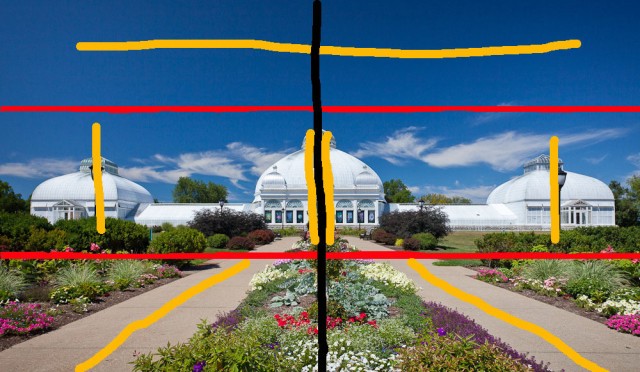
p.2 #1 · Buffalo and Erie County Botanical Gardens
The gardens are a three part symmetry ... left, middle, right.
They are not perfect mirror images as the middle is inverted, but because of their triangular shape and parallel lines of at least two of the three sides, the symmetry is a combination of actual and implied.
Obviously, not the readily noticeable symmetry of the mirror imagery provided by the structure itself and the sidewalks, but it is a complementing three part symmetry that only strengthens the excellence of the composition.
p.2 #2 · Buffalo and Erie County Botanical Gardens
Here I seem to be cast in to the role of Doug, countering arbitrary assertions to defend the broad and imprecise nature of art.
Symmetry is a word with precise, if rather complex, meaning in mathematics and physics. In art and language its meaning is varied and frequently imprecise. Chuck, in the short form, you've added arbitrary and unnecessary requirements to the meaning of "symmetry" and then asserted that the image doesn't comply with the arbitrary requirements.
A quick trip to dictionary.com, for example, finds:
2. the proper or due proportion of the parts of a body or whole to one another with regard to size and form; excellence of proportion.
3. beauty based on or characterized by such excellence of proportion.
...
Notice no requirement for and exact match, precision or exactitude?
Lets examine the image. Notice it can reasonably be observed as having three parts. The first is the sky. It is bank and uniform. (It need not be exactly so. It's visually close enough. Something that is uniform exhibits left/right symmetry, even in the precise mathematical sense.) The second part is the building. Notice it also exhibits left/right symmetry. Notice the third part, the garden foreground. It also has very obvious left/right symmetry. There are three parts. All exhibit left/right symmetry. That alone justifies my remarks about symmetry. But there's more. Judging art is opinion. Always. In my OPINION, the three parts of the image qualify for symmetry definitions 2 and 3.
You can play without me in the sandbox of argument for the remainder of the thread if you wish. I leave it to the readers to judge whether there's symmetry. To *ME* there is no doubt there's symmetry in the fair and reasonable use of the term.
p.2 #3 · Buffalo and Erie County Botanical Gardens
Karen you omitted the first definition:
1. the correspondence in size, form, and arrangement of parts on opposite sides of a plane, line, or point; regularity of form or arrangement in terms of like, reciprocal, or corresponding parts.
The building and sidewalks are have that form of symmetry. What the sky has is visual balance with those symmetrical elements.
The point of disagreement is the question of how much sky is needed to achieve that balance. The answer depends on what whether the goal is to have the viewer go past the building and search the sky (in vain) for something interesting to look at, or alternately to use the sky as a buffer to bounce the eye back and forth between building and garden.
That's exactly why the third's placement of the primary focal point works so well in scenic shots. The viewer will find a strongly contrasting focal point wherever it is in the frame. The primary focal point in this photo is the huge white building. Making the foreground larger or smaller than the sky provides the clue which is the more important secondary focal point — the clue where to go next.
Given the way Scott described his impression in person of the big clear sky a vertical crop with the building on the bottom 1/3 and the top 2/3 filled with sky would better create that same impression the photo.
In the original the building and it's dome dominates the core. In my crop the dome is missing but there's more balance between the building entrance and the garden and I find it much easier to appreciate the details in the windows I'd overlooked with the over powering contrast of the dome and sky.
The edit below is based on Scott's in-person description of being inspired by the big blue sky:
Because the sky dominates so much the building and the garden in the lower 1/3 become unified as a single focal point the brain more easily processes together.
YMMV but opinions and ideas where solicited and if the goal is telling an interesting story I think either of my edits work better than the exercise in "breaking" the rule of thirds in the original.
My less sky crop puts the base of the building dead center in the frame. The crop done by eye for balance tries to create a flow of the eye up the ^ of the sidewalk to the top of the dome but not into the sky, so the eye gets to the peak of the roof in the center and the brain decides there's nothing more of interest up higher and sends the eyes back down and sideways for another look at the foreground.
In my more sky crop the intent is the opposite, to pull the eye all the way out of focal points (searching in vain for a bird, a plane, or superman.... anything interesting) then not finding anything interesting going back down to the more unified focal points below and staying there. The viewer isn't likely to go to the sky a second time once it knows nothing of interest is there.
In both crops the sky acts as a buffer to bounce the eye down. The difference between them? The time it takes for that to happen. That difference in pace of eye movement and the the fact the eye will dwell on the bottom in the more sky crop and bounce repeatedly from building <> garden in the less sky crop tells will create different impressions.
It's the same story told different ways. I don't compose according to rules I compose based on the goal of the story and what I feel in most effective in telling it. I've learned the eye will generally go first to the area of strongest contrast (e.g. building) so the question to answer with the composition choices is where I want the eye to go next and how to guide it back to the main focal point so it is the first and last impression of the photo.
The "rules" are explanations formulated by teachers over the ages to try to explain why a composition works to meet the goals of the intended message or not. Compositions don't break rules they just deliver a different message. There are no rules, just cause and effect...