snapsy wrote:
Both the D800 and EM-5 are soft on the right side of that one image. It's a function of the Jeffrey Pine vegetation's detail frequency/distance rather than lens softening. Here's a new comparison image, both upsampled to 50MP and sharpened with ACR 6.7 amt=40, detail=35, masking=20 and CS5 USM of 30%, radius=30.
E-M5 50MP sharpened D800 50MP sharpened
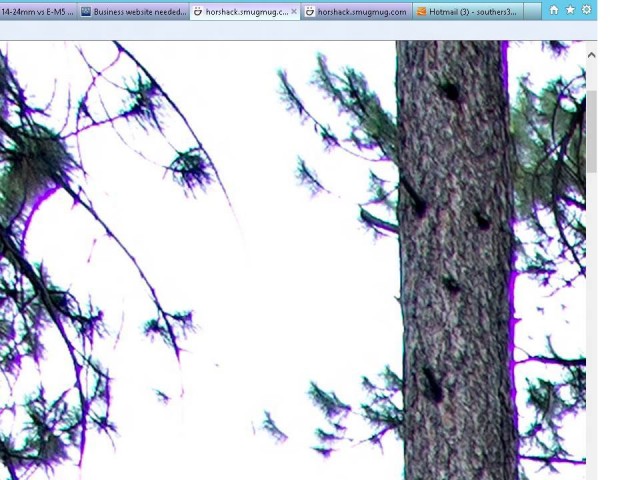
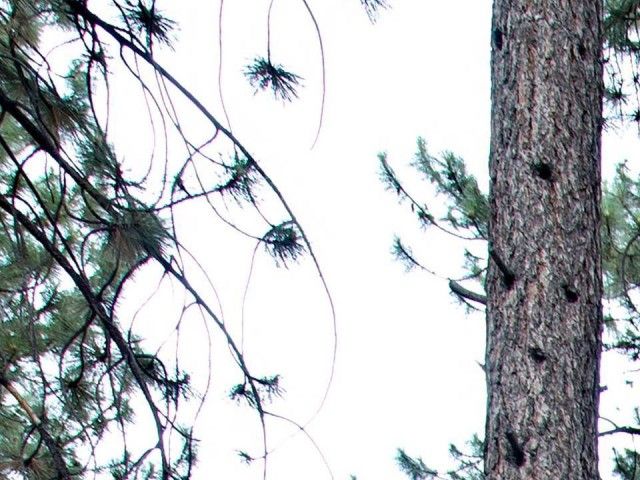
thanks for the smaples. I am looking at the samples in LR. first off, the OMD, has some serious CA/purple fringing. fortunately, this was, for the most part correctable. in LR. Not sure why you chose to up res both to 50 MP, rather than just upresing the OMD to 36 Mp.
as one would expect, the Nikon does better in detail, viewed at 100% surprisingly, the OMD does pretty well.
the foreground is bit of a mush with the Nikon. I have a copy of 14-24 on my 5d2, and honestly have found there is some degree of field curvature. my 16-35 II does a bit better in foreground. Here, the OMD does a fair bit better at the very bottom of the image. where is the nikon does much better at the top corner.
lastly, it would have been interesting if you have exposed for the highlights and pushed the shadows and see how each camera did. even as it is now, the nikon has clearly better shadow seen in the windows of the distant house.
rscheffler wrote:
What was the point of focus in the second set of images? The house? The 14-24 certainly looks better here than the previous comparison set and am wondering if I'm seeing a bit of field curvature towards the camera at the edges?
I'm not sold on "Jeffrey Pine vegetation's detail frequency/distance rather than lens softening" for the first set. If you look at the itty bit of infinity horizon beyond the vegetation on the top right, you'll see it's smeared compared to the same landscape at the center of the frame. Same with the left hand side. Where was the focus set for this one? The jet ski/infinity or on the tree at left? ...Show more →
That is weird, like field curvature gets worse as it's stopped down, something I haven't heard of before... I read your dpr thread and think it would be worth a retest with focus set wide open and leaving it at that for all tested apertures. You'd think that depth of field at f/8 would nullify any differences with the lens focused slightly closer than at f/4, but you never know... Might be interesting to test the new Zeiss ZF15 against the zoom to see if there is much difference.
However, for those test chart photos, camera to subject distance was probably extremely close and not necessarily a good indication of 'real world' use and shooting distances....
kevindar wrote:
Not sure why you chose to up res both to 50 MP, rather than just upresing the OMD to 36 Mp.
It is essentially impossible to resample without either sharpening or smoothing (intentionally or otherwise) which means that only resampling one image will typically corrupt the comparison. A better, but still imperfect, way of doing things that is still quick to execute is to upsample or downsample both.
Thanks for the house comps ... makes things very clear to me as to the "limits" of the smaller format. Not so much at a single issue ... but at the combination of issues, i.e. CA, distortion, resolution, etc.
Certainly, "not bad" for it's size / price ... and while it might seem kinda fun to poke at the diff being "small" while the price is "big" ... performance curves aren't exactly linear.
For instance ... You might be able to toss a $1,000 into a car and get it run 1 second faster in the quarter mile from 16 sec down to 15 sec. But when you get down to the sub 6 sec range, another $10,000 might only get you 1/10th of a second gain. Now, if you only need a 15 second 1/4 mile performing car ... it's easy to laugh at spending $10,000 for .1 second gain when you only spent $1,000 for a 1 second gain ... since that is a 100x delta. Of course, that's why the pay-off is just a bit different for Saturday Night Brackets vs. NHRA Top Fuel.
If you're looking for a bracket car for some weekend fun, that's one thing. If you and your crew make their living in the realm of top fuel, that's quite another.
3.The Nikon D800 and 14-24 are better than either of their MFT counterparts in terms of pure IQ.
4.If one does a comparative test showing the 0M-D5 and 7-14 to be "better" than there is either something wrong with the test or wrong with one or both of the Nikon products.
5. The Nikons being "better" does not make the OM-D any worse.
6. The OM-D5 / 7-14 combo may be a "better" combo to use in any number of situations.
7. The OM-D5 combo being "better" in some circumstances does not make the Nikon products any worse.
8. We are very fortunate that both systems are so capable in their own ways.
I would absolutely agree that the OM-D cannot compete with a FF DSLR (even against a D700) ... and the OM-D sample against the D800 sample certainly does not "look like shit". If you are referring to the test samples IMO they both look crappy to me. I wouldn't say the the D800 test image is "much better" ... it is only slightly better, to me.
Lotusm50 wrote:
I didn't say that. It's just MUCH better than the E-M5 image -- and that is to be expected.
bobbytan wrote:
And you honestly think the D800 image is good?
The D800 and 14-24 produces Medium Format rivaling and in some ways exceeding images.
The OM-D with 7-14 produces incredible images for the size and especially the price.
A more realistic comparison would perhaps be comparing a D7000 to a Sigma 8-16mm which would be much closer in price and size.
The OM-D with a battery grip is pretty close in size to a D7000 and while the Sigma 8-16mm is long its one of the sharpest UWA made for APS-C it also has a 2mm advantage on the wide which is Significant in UWA.
bobbytan wrote:
it is only slightly better, to me.
The intense "purple (& green) fringe" in the house images (tree branches & trunks) are not exactly what I would call a "slight" difference.
Resolving capability doesn't seem "slight" here either ... and given the format "dof advantage, an attempted argument @ "slight" focal point variance doesn't hold much water to explain the detail difference (at least not for me).
Then the distortion variance of the trees and even the fence make for three things that are significantly different:
Aberration
Resolution
Distortion
Sure, depending on your usage, they might not be "as noticeable" or "as critical" ... and yes, they can be somewhat corrected in post ... but these aren't "slight" differences in my book. Of course, if you are reading from a different book ...
I don't use or view my images at 100% or 200% so it doesn't really bother me.
RustyBug wrote:
The intense "purple (& green) fringe" in the house images (tree branches & trunks) are not exactly what I would call a "slight" difference.
RustyBug wrote:
The intense "purple (& green) fringe" in the house images (tree branches & trunks) are not exactly what I would call a "slight" difference.
Resolving capability doesn't seem "slight" here either ... and given the format "dof advantage, an attempted argument @ "slight" focal point variance doesn't hold much water to explain the detail difference (at least not for me).
Then the distortion variance of the trees and even the fence make for three things that are significantly different:
Aberration
Resolution
Distortion
Sure, depending on your usage, they might not be "as noticeable" or "as critical" ... and yes, they can be somewhat corrected in post ... but these aren't "slight" differences in my book. Of course, if you are reading from a different book ...
rscheffler wrote:
That is weird, like field curvature gets worse as it's stopped down, something I haven't heard of before... I read your dpr thread and think it would be worth a retest with focus set wide open and leaving it at that for all tested apertures. You'd think that depth of field at f/8 would nullify any differences with the lens focused slightly closer than at f/4, but you never know... Might be interesting to test the new Zeiss ZF15 against the zoom to see if there is much difference.
I've posted more to the dpreview thread. Here are my findings so far:
* When using CDAF/LV focusing on an infinity subject, at f/2.8 through f/5.6 (LV stops down aperture so focus is obtained at the aperture), the camera selects the same infinity position of the lens as PDAF/VF focusing does. When using CDAF/LV focusing on an infinity subject at f/8.0, the camera selects a lens position that is .51m closer than infinity, as indicated in the EXIF data and on the distance indicator on the lens.
* Regardless of the two above lens focus positions, I'm seeing very complex focus plane characteristics, which I describe here: http://forums.dpreview.com/forums/read.asp?forum=1021&message=42031887&refresh=1165
bobby, under lens correction, under middle tab (color) click on remove ca box, and also there is a defrings slider. I pulled the top one (purple) all the way to the left. you can also decrease teh green fringing, but b/c its the trees, it will desaturate greens. so it was a click and slider I guess.
I find this is really nice, and allows me to use the nikon 14-24 with great results on my 5d3.
this is are lr 4.1
Ah ... okay - just realized that I have LR-3 on my laptop. Have to try it on my desktop computer where I have LR-4.1. Thanks!
kevindar wrote:
bobby, under lens correction, under middle tab (color) click on remove ca box, and also there is a defrings slider. I pulled the top one (purple) all the way to the left. you can also decrease teh green fringing, but b/c its the trees, it will desaturate greens. so it was a click and slider I guess.
I find this is really nice, and allows me to use the nikon 14-24 with great results on my 5d3.
this is are lr 4.1