retrofocus wrote:
The moire pattern can be removed easily in post processing software
Wrong. It can be faked out, but Aliasing is false image data. When you remove the false image data, there is no real image data behind it. So the software has to guess. An educated guess, but not a context-aware guess, and only a guess based, ... you guessed it ... on the Aliased (false) data.
Monito wrote:
Wrong. It can be faked out, but Aliasing is false image data. When you remove the false image data, there is no real image data behind it. So the software has to guess. An educated guess, but not a context-aware guess, and only a guess based, ... you guessed it ... on the Aliased (false) data.
Finally a real answer. To the OP: aliasing is loss of information. It's not hiding, blurring, or masking information, it's loss, and you can't get it back. As Monito says, software moire tools work by fabricating data and replacing the offending parts of the image.
As for the question about lens sharpness, yes, you have to consider the whole system MTF, which includes the AA filter. BTW, if you look at test results from Imatest or similar (such as photozone and a number of other sites use) you'll note that sometimes they get results beyond the "Nyquist limit", the resolution limit beyond which you get aliasing. That's because Imatest uses sharpening on a well-characterized target and "knows" what the target is supposed to look like. The software doesn't have to guess.
1. Has anyone used the LR4 Moire brush? Does it help when you have an image from a non AA cam that has Moire?
2. I don't know to much about less moire as pixels get smaller. I'll trust Pixel on that as he knows far more than I ever will on many subjects . But I saw a thread on the Nikon forum that said a guy used a D800 (standard NOT the E) and was shocked at the Moire it gave from people clothing. The assumption was/is if the standard one gives moire then how bad will the d800E be?...Show more →
Maybe I spoke too soon. I was experimenting in Matlab interfering two patterns at a slight angle and varying their relative spatial frequencies and the moire got worse the larger the discrepancy in spatial frequency. I was thinking more along the lines of AA on a computer monitor where you get jaggies due to the low res of the monitor and use AA to smooth out these jaggies. As the monitor res increase the need for AA lessens. In the case of camera sensor and real world repetitive patterns it's much more complex and my assumption is not valid.
Well maybe my assumption was right. I've come across an article which says a similar thing to my previous post. As pixel pitch is reduced you should see less instances, but that doesn't mean when it happens it won't still be severe. What I'd like to see is an example where it is apparent with say a 12MP camera and take shots with higher res cameras. I think I need to reinterpret my example. Moire occurs when the scene pattern exceeds the resolution of the camera. If you think of the pattern projected onto the sensor, if the pattern is smaller than the pixel pitch you will get aliasing, but as that pixel pitch drops the interference patterns starts to disappear as the spatial frequencies become similar. So there a lot of factors that could affect whether you see moire such a lens magnification, which determines spatial frequency of projected pattern. You may see moire at 50mm and not at 100mm or 20mm.
BTW moire is worse for bayer sensors and Fuji's semi random bayer may alleviate moire. Also different raw converters do a better job than others.
What is really needed is a sensor with a Poisson Distribution of sensels and probably variation of sensel sizes. This would much more closely approximate the human retina. It would reduce or eliminate moiré, but not entirely eliminate the need for AA filters.
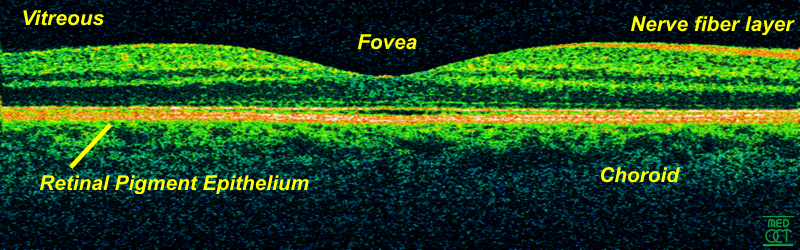
The human retina has a builtin AA filter because the light passes through a layer of cells and nerve cells before it reaches the rods and cones which are the sensels.
Rods, cones and nerve layers in the retina. The front (anterior) of the eye is on the left. Light (from the left) passes through several transparent nerve layers to reach the rods and cones (far right). A chemical change in the rods and cones send a signal back to the nerves. The signal goes first to the bipolar and horizontal cells (yellow layer), then to the amacrine cells and ganglion cells (purple layer), then to the optic nerve fibers. The signals are processed in these layers. First, the signals start as raw outputs of points in the rod and cone cells. Then the nerve layers identify simple shapes, such as bright points surrounded by dark points, edges, and movement. (Based on a drawing by Ramón y Cajal.)...Show more →
Note that the retina is thinner at the fovea (less filtering):
Generally speaking, the sharper the glass, the more potential for moire' ... the wider the glass the less potential for moire'.
While I can get moire' with my 24L TS-E II, the 17-40 may not induce it the same. There seems to be a bit of an oxymoron / doulbe edged sword @ the quest for the holy grail of sharpness, where non-AA is a sharper capture than an AA capture, but using sharper glass coupled with non-AA increases the risk of moire'.
For most people (general application) ... I'd suggest they step up to investing in sharper glass/primes (with AA filter bodies) first, rather than switching to non-AA. Once you've maxed out your glass ... and that still isn't sharp enough for you, then look at non-AA. Great glass lives forever ... sensors and software change daily (so it seems).
Pixel Perfect wrote:
Well maybe my assumption was right. I've come across an article which says a similar thing to my previous post. As pixel pitch is reduced you should see less instances, but that doesn't mean when it happens it won't still be severe. What I'd like to see is an example where it is apparent with say a 12MP camera and take shots with higher res cameras. I think I need to reinterpret my example. Moire occurs when the scene pattern exceeds the resolution of the camera. If you think of the pattern projected onto the sensor, if the pattern is smaller than the pixel pitch you will get aliasing, but as that pixel pitch drops the interference patterns starts to disappear as the spatial frequencies become similar. So there a lot of factors that could affect whether you see moire such a lens magnification, which determines spatial frequency of projected pattern. You may see moire at 50mm and not at 100mm or 20mm....Show more →
I think it's much simpler: moire is a function of RELATIVE frequencies of the pattern of light *at the sensor* (that's why focal length matters) and the pixel/sensel grid.
Just making pixels smaller will do nothing for moire (assuming perfect lens, no diffraction, etc.) because while "coarser" patterns will now go above the Nyquist limit and become distinguishable and moire-less, the "finer" patterns which used to be so far below Nyquist as to just disapper, now rise to prominence and create moire of their own.
In practice, though, because of lens imperfections and diffraction, at some point the MTF of the optical system before the sensor will become the limiting factor for the sharpness (as opposed to the pixel density) and will function as a pseudo-AA filter preventing moire.
Monito wrote:
What is really needed is a sensor with a Poisson Distribution of sensels and probably variation of sensel sizes. This would much more closely approximate the human retina. It would reduce or eliminate moiré, but not entirely eliminate the need for AA filters.
While a variation of sensel sizes is a good idea (mostly for DR reasons, though), I don't see at all what do you mean by the Poisson distribution of sensels (do you want to re-introduce gaps between sensels?) and why would that be a good idea.
Sure, randomization of sensel placement (doesn't have to be Poisson) will deal with the moire issue (see, e.g. film :-) ) but it would give rise to inefficiencies in the usage of the sensor surface.
retrofocus wrote:
The moire pattern can be removed easily in post processing software, too. Is anybody aware of another reason why AA filters are used?
Tell you what - next time I'm doing a wedding on a non AA filter and producing 350 photos, I'll send them to you to have the moire removed ... and the wedding after that ... and so on.
Then you might not see it as such a trivial problem
retrofocus wrote:
Why do manufacturers (e.g. Canon) really use this AA filter? It lowers the resolution of the sensor up to 30%...
To a certain extent, it is true that an anti-aliasing filter "lowers resolution" compared to not having one, but a couple of important caveats are in order.
1. The anti-aliasing filter provides some important functionality that you would have to replicate in post if it weren't there, namely dealing with some image issues that result from digital sampling. They would come up more often than you might think, especially with subjects that contains small details and patterns. (Even with the AA filter, with critical and careful work you'll still occasionally have to deal with these issues.)
2. The "lost" in resolution isn't really an issue in photography. A 20+MP full frame sensor with a great lens, used with excellent technique and good post-processing and printing workflow is hardly handicapped at all by this supposed "loss," and can produce excellent image sharpness at very large print sizes. And at these large sizes, the resolution issue that might result from the AA filter is swamped by a number of other issues that also affect image resolution when making very large prints from DSLR originals.
In the end, it is one of those "issues" that is mainly theoretical rather than practical.
That said, one of the potential advantages of increasing photo site density that people sometimes overlook is that less aggressive AA filtering would be needed and with some imagined very high density no AA filter at all might be required. In the meantime, if you imagine that removing the AA filter will make your photographs better, you are almost certain to be disappointed.
KaaX wrote:
While a variation of sensel sizes is a good idea (mostly for DR reasons, though), I don't see at all what do you mean by the Poisson distribution of sensels (do you want to re-introduce gaps between sensels?) and why would that be a good idea.
Sure, randomization of sensel placement (doesn't have to be Poisson) will deal with the moire issue (see, e.g. film :-) ) but it would give rise to inefficiencies in the usage of the sensor surface.
Nope. Nothing I said suggested introducing gaps between sensels. Expand your mind a little bit to non square sensels.
Monito wrote:
Nope. Nothing I said suggested introducing gaps between sensels. Expand your mind a little bit to non square sensels.
<mind expaaaaAAAAnding>
There's quite a limited selection of the geometric shapes which would cover a 2D plane without gaps. And moire is a function of sampling high frequencies, going to, say, hexagonal sensels would give you different moire but not get rid of it altogether.
And I still don't understand what does Poisson distribution have to do with all this.
Monito wrote:
Nope. Nothing I said suggested introducing gaps between sensels. Expand your mind a little bit to non square sensels.
<mind expaaaaAAAAnding>
There's quite a limited selection of the simple geometric shapes which would cover a 2D plane without gaps. And moire is a function of sampling high frequencies, going to, say, hexagonal sensels would give you different moire but not get rid of it altogether.
And I still don't understand what does Poisson distribution have to do with all this.
PhilDWedding wrote:
Tell you what - next time I'm doing a wedding on a non AA filter and producing 350 photos, I'll send them to you to have the moire removed ... and the wedding after that ... and so on.
Then you might not see it as such a trivial problem
Cloth can lead to moire patters in a huge extent without AA filter, yes. My point in this thread was not to discuss if moire patterns can be removed and to which extent (I observed that even RAW converter programs handle this differently, sometimes moire patterns were visible, sometimes not!). My question above was directed towards the purpose of an AA filter itself and if it had an additional function other than removing moire.
And for wedding photography too much of sharpness might rather be a drawback, too. But this is not a concern for me since wedding and sports photography are the only two styles of photography I have no interest in at all.
gdanmitchell wrote:
To a certain extent, it is true that an anti-aliasing filter "lowers resolution" compared to not having one, but a couple of important caveats are in order.
1. The anti-aliasing filter provides some important functionality that you would have to replicate in post if it weren't there, namely dealing with some image issues that result from digital sampling. They would come up more often than you might think, especially with subjects that contains small details and patterns. (Even with the AA filter, with critical and careful work you'll still occasionally have to deal with these issues.)
2. The "lost" in resolution isn't really an issue in photography. A 20+MP full frame sensor with a great lens, used with excellent technique and good post-processing and printing workflow is hardly handicapped at all by this supposed "loss," and can produce excellent image sharpness at very large print sizes. And at these large sizes, the resolution issue that might result from the AA filter is swamped by a number of other issues that also affect image resolution when making very large prints from DSLR originals.
In the end, it is one of those "issues" that is mainly theoretical rather than practical.
That said, one of the potential advantages of increasing photo site density that people sometimes overlook is that less aggressive AA filtering would be needed and with some imagined very high density no AA filter at all might be required. In the meantime, if you imagine that removing the AA filter will make your photographs better, you are almost certain to be disappointed.
Dan, thanks for your reply! I am just wondering why other camera manufacturers like Leica avoid the AA filter. Looks like they want to get the best out of their lenses. On the other hand Leica uses a lower MPixel full frame sensor which might be better then to avoid Moire pattern formation.
Currently I can only compare my two 5D II cameras where one of them was converted to a full frame IR camera. The AA filter was removed in my IR camera but it is still inside my regular color camera. I am stunned by the sudden sharpness of the converted IR camera, especially in the infrared range which normally blurs photos a lot due to the longer wavelenghts to cover between 720 and over 1000 nm. This blur effect is obviously well compensated by removing the AA filter. My impression is that the photos in fact get sharper when the AA filter is removed, but we might suffer from a bit more noise, too.
Since you've got an IR and a regular 5D II ... any chance you could post up some comps. I'm considering converting my 5D to IR, and would appreciate seeing the difference. I'd like to convert it to 100% monochrome, but that isn't a practical endeavor according to my dialogue with maxmax.
retrofocus wrote:
Cloth can lead to moire patters in a huge extent without AA filter, yes. My point in this thread was not to discuss if moire patterns can be removed and to which extent (I observed that even RAW converter programs handle this differently, sometimes moire patterns were visible, sometimes not!). My question above was directed towards the purpose of an AA filter itself and if it had an additional function other than removing moire.
And for wedding photography too much of sharpness might rather be a drawback, too. But this is not a concern for me since wedding and sports photography are the only two styles of photography I have no interest in at all. ...Show more →
it fixes moire and aliasing in general, you don't get jagged stair-stepped edges, but natural transitions, just like for computers, you turn off AA or turn it on and it's easy to see the difference between the natural look and a jaggy digital look even ignoring moire issues
RustyBug wrote:
Since you've got an IR and a regular 5D II ... any chance you could post up some comps. I'm considering converting my 5D to IR, and would appreciate seeing the difference. I'd like to convert it to 100% monochrome, but that isn't a practical endeavor according to my dialogue with maxmax.
I should mention moire is not an entirely artificial phenomenon only seen due limitations of the camera. It's a real effect and it's easy to see it with your own eyes. If you own one of those fine mesh teas strainers you'll see it very easily. So even if the camera would not produce moire moire itself, if you took a photo of a subject that exhibits moire it will still reveal it.
KaaX wrote:
I think it's much simpler: moire is a function of RELATIVE frequencies of the pattern of light *at the sensor* (that's why focal length matters) and the pixel/sensel grid.
Just making pixels smaller will do nothing for moire (assuming perfect lens, no diffraction, etc.) because while "coarser" patterns will now go above the Nyquist limit and become distinguishable and moire-less, the "finer" patterns which used to be so far below Nyquist as to just disapper, now rise to prominence and create moire of their own.
In practice, though, because of lens imperfections and diffraction, at some point the MTF of the optical system before the sensor will become the limiting factor for the sharpness (as opposed to the pixel density) and will function as a pseudo-AA filter preventing moire.
Yes, but this means moire will change from one pattern scale to another. You may see moire where you didn't with a lower res camera and vice versa. The real situation is so complex and the spatial frequencies span an enormous scale it's hard to know what will or won't prodcue moire. But if a given scene say like fine vertical structures on a skyscraper cause moire on a low res camera, it is often the case a higher res camera won't exhibit the moire at all.
Another example is downsizing. Take a photo of a bird whose feather exhibit no moire at full res and down size it to a lower res and all of a sudden you have shocking moire, because the feathers have started interfering with the grid of the monitor.
AA filters don't necessarily lose huge amounts of resolution if implemented as desired. Canon's descrptions always imply that the filter is deigned to split an incoming ray into 4 distinct rays at the corners of a square with sides that are the pixel pitch - ensuring each ray is ampled by 4 sensels. It creates 4 separate overlaid images - not the same as blurring one image out so eachvray covers 4 sensels. I once was curious to see the effect, mimicked in PS, of this compared to a blur. The image below shows what the AA filter does* - and how Canon's suggested "undo" for the AA filter performs (200 or 300%, 0.3 radius, 0 threshold USM) the 1 pixel Gaussian blur is waaaay worse while the AA filer effect is indeed largely undone by the mild, subpixel USM. The AA effect is actually quite mild and largely recoverable.
* the original image copied , moved one pixel right, 50% opacity, flatten, rinse repeat with one pixel up.
I agree that the worries about huge losses from this filtervare overstated or over worried! The examples I've seen if before and after filter removal were underwhelming, to say the least.
.


 . But I saw a thread on the Nikon forum that said a guy used a D800 (standard NOT the E) and was shocked at the Moire it gave from people clothing. The assumption was/is if the standard one gives moire then how