p.1 #1 · Occurance of Aliasing (Moire) and Postprocessing...
In the last couple of weeks, I have read so much about moire and anti aliasing. But something felt missing from i understanding and ability to make a rational choice between 800/800E.
Why are people saying moire is not an issue with high MP camera? what ever MP it is when used with the sharpest lenses (which out resolve the sensor) there will be aliasing if there are repetitive patterns and the detail will be corrupted. Occurrence of visible moire depends on the Bayer pattern though...
How can aliased signal be ever corrected in post processing. The DSP processor will have no idea what is original component of signal and what is aliased component. It may only be possible to reduce the color fringing which shows up...
Though 800E will be terrific for most applications... I am thinking MOST (almost all) photos with clothing should show moire when a sharp lens is used... ??
I am looking for comments and experience of people who had used cameras without AA filter. It will be great if some of you can also show some examples.
p.1 #5 · Occurance of Aliasing (Moire) and Postprocessing...
You can see Thom Hogan's comments on his site, bythom.com. In short, moire can be mostly corrected in software but aliasing cannot be corrected after the fact. Nikon Rumors had some links a few days ago to articles on both moire and aliasing.
p.1 #6 · Occurance of Aliasing (Moire) and Postprocessing...
Given the shiny fabric in the photo above, I'd be interested in seeing if a polarizer has any effect. Might make the moire worse. Also not sure if that photo has been corrected or is straight from the camera.
p.1 #7 · Occurance of Aliasing (Moire) and Postprocessing...
Nikon actually uses that image in false color and moire section to show difference between 800/800E. Looks like they have done some post processing on their full size samples.
In any case if that is the worst we are going to see and if we can get rid of it in post as cleanly as in the above sample then its no brainier to get 800E..??
p.1 #9 · Occurance of Aliasing (Moire) and Postprocessing...
derry1 wrote:
sure don't hear M9 owners complaining about it,,??
It's out there, and yes they do mention it. However, they are less prone to complaining or moaning and more prone to take counter-measures because they know what they are doing and anticipate it.
p.1 #10 · Occurance of Aliasing (Moire) and Postprocessing...
The DSLRs of the last few years have weak anti-aliasing filters already. Thus they produce aliasing. Most people don't know what to look for or aren't photographing things that make it prominent or don't have sharp technique (since shake and de-focus act as anti-aliasing filters) or never print larger than 8x10 or web size.
There is no cure for anti-aliasing other then avoiding it in the first place by using an AA filter bonded to the sensor or less than bitingly sharp optics (when we are talking 36 MPx). For example, shooting at f/16 on full-frame is enough diffraction blur to anti-alias.
Software fudging after the fact is only fudging. You can blur slightly in post or desaturate but it is not completely effective.
The reason aliasing is a problem to be aware of is that when the image is aliased it has recorded false data: aliased spatial frequencies. This is due to the Sampling Theorem (math speak for what is actually a fact) which states that frequencies above half the sampling frequency will be folded back under half the sampling frequency.
It's easier to consider in audio. With a sampling frequency of 44 KHz, a frequency of 26 KHz will get folded around 22 KHz and appear at 18 KHz: audible and out of place and very annoying. 44 / 2 = 22. 26 - 22 = 4. 22 - 4 = 18.
Another example is wagon wheels going backwards in movies due to time-sampling aliasing.
Image data is rarely as regular as audio data, leading people to get lulled into thinking it is a non-issue. It is less of an issue at 36 MPx pictures shown at web size or printed 8x10.
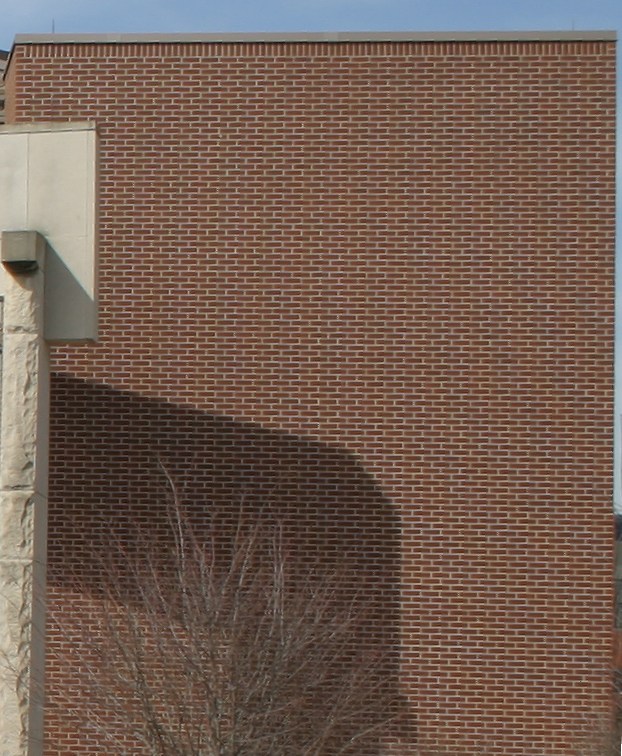
Aliasing shows up in brickwork, window blinds, screens, and fine fabric, among other areas.
Aliasing also produces "jaggies" in diagonal lines, most noticeably around 10 degrees or 80 degrees. It's false data. There are no jaggies on that edge in the real world.
Expect to see more "noise" in shadow areas like grass. The grass is not regular enough to make a pattern of aliasing stand out, but the false data does show up and it is false. Since it is irregular it seems like ISO noise.
p.1 #12 · Occurance of Aliasing (Moire) and Postprocessing...
Monito wrote:
Expect to see more "noise" in shadow areas like grass. The grass is not regular enough to make a pattern of aliasing stand out, but the false data does show up and it is false. Since it is irregular it seems like ISO noise.
Interesting. I have been wondering whether the D800E would have an advantage in preserving detail at high ISO?
p.1 #14 · Occurance of Aliasing (Moire) and Postprocessing...
that plus the fact that they are paid a huge amount for their camera and lens and aren't about to admit that maybe it was the wrong thing to do. my Leica dealer says that they have sold a significant number of M9s to owners who have one just because they can afford the best and heard that Leicas are the best. i find shadow noise much more troubling than moire in my M9 shooting but then i haven't shot a lot of things where it could even come up.
Herb...
Monito wrote:
It's out there, and yes they do mention it. However, they are less prone to complaining or moaning and more prone to take counter-measures because they know what they are doing and anticipate it.
p.1 #15 · Occurance of Aliasing (Moire) and Postprocessing...
Monito wrote:
Un-AA sensors don't preserve detail. They preserve the illusion of detail. ISO noise is an issue that is additive (think of it as layered on top).
Yeah, ISO noise is additive in killing the detail, but the absence if a AA-filter should have some barring on the amount of detail that you are able to extract during PP. I just have no clue whether removing the AA will be for the better of the worse?
p.1 #16 · Occurance of Aliasing (Moire) and Postprocessing...
Baywing wrote:
You can see Thom Hogan's comments on his site, bythom.com. In short, moire can be mostly corrected in software but aliasing cannot be corrected after the fact.
Can you point to that precisely or quote it? I read his remarks on the D800E and didn't see what you are referring to. I went looking because it runs counter to logic, at least the way you stated it. Moire is an example of aliasing, unless you are using the word "moire" to mean only colour moire. Moire shows up in Black and white with black and white subject matter too.
p.1 #18 · Occurance of Aliasing (Moire) and Postprocessing...
I have had it show up in my pictures of people's clothing, pin-stripped shirts, stripped ties, bridal veils, and similar subjects. But I could take 10 pictures of a fellow in a pin-stripped shirt and have Moire visible in only one of the pictures. It is a function of the subject, the distance, and lighting all coming together in a perfect "Moire storm".
With a couple hundred thousand pictures taken with the D1x, D2h, D2x, D3, D100, D200, and D300 cameras I have had to post process Moire in only 3 pictures where I did not have substitute images I could use for the clients. It is a minor problem and as others have mentioned the anti-aliasing filter is not used for the Leica or the D3x and in fact there is a low-pass filter with the D800E but with less of an influence on aliasing and the possibility of Moire appearing in an image.
I have seen banding with the D3 at low ISO and strong light settings and this was very much evident in RAW images converted with ACR but was not visible at all with the same images converted from RAW using Capture NX2. I expect this will be true to a degree with the conversion of RAW D800E files to minimize both Moire and specular highlights. With each new generation of sensor it takes some experimentation to find the sweet spot to get the most out of the camera.
p.1 #19 · Occurance of Aliasing (Moire) and Postprocessing...
I think Monito has covered all the bases. My own experience with moire relates primarily to fabric and the weak AA filter of the Canon 1Ds (which I still use in the studio). In short, chroma/luminance moire is a nightmare when it hits, and it can hit without warning. Even when not present in those forms, oversampled images have a nasty, grating impact. I finally went about a proper test, and managed to generate large-area moire that cannot be removed using automated smoothing.
Image #1 shows the test result. Image is reduced in size, but uncropped. The wild colors on the test sheet taped to the wall are entirely false. Image #2 was shot closer and is a 1x-scale crop. Note the lack of colors. Image #3 are 1x-scale crops at the original test distance, with focus bracketing. Note disappearance of moire as high frequencies (detail) attenuates. Image #4 is a sample of my real work where moire can strike.
I was using a Zeiss Sonnar 100/3.5 lens for this test which has extremely high performance. One way to reduce moire is to stop down until diffraction suppresses the high frequencies; another way is to use a crappy lens. Finally, pick a camera with a decent AA filter and stop fooling yourself that false data is real data.





 My own experience with moire relates primarily to fabric and the weak AA filter of the Canon 1Ds (which I still use in the studio). In short, chroma/luminance moire is a nightmare when it hits, and it can hit without warning. Even when not present in those forms, oversampled images have a nasty, grating impact. I finally went about a proper test, and managed to generate large-area moire that cannot be removed using automated smoothing.


