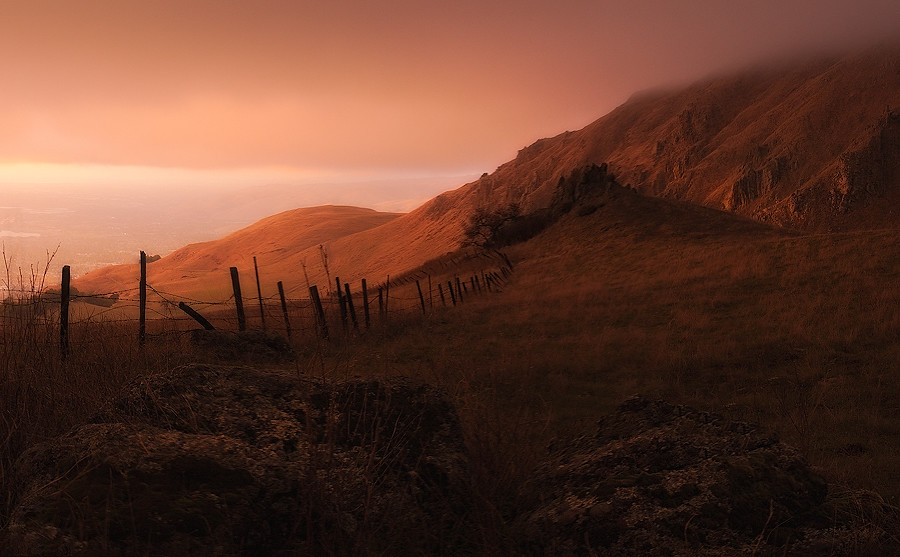
p.1 #1 · Landscape and Wide-Angle ... Why do they two often go hand in hand?
Well, I just wanted to have a discussion about why most landscapes that leave an impression (on me at least) seem to have a Wide field of view (about 10mm on 1.6x or 16mm on Full Frame)
I know there are landscapes taken with telephotos and normal lenses, but usually, the landscapes taken with a Wide field of view just leave a different impression.
I've really been limiting myself to only shooting with my Wide-Angle ... I just wanted to know if anyone shoots landscapes with a normal lens?
You see, I shoot a 7D and I would like to sell my 10-22mm as I don't shoot with it often anymore. However, should I want to shoot the occasional landscape/cityscape scene, I'll have to rely on my 17-55mm ... Which I don't think is ideal for landscape photography.
Am I being too short sighted in believing I can only shoot decent landscapes with my 10-22mm and not my 17-55mm?
I'm not too good at it, so perhaps you can give me some tips on how to compose differently ... Currently I stick to the basics (find a vanishing point, compose to rule of thirds, etc).
p.1 #2 · Landscape and Wide-Angle ... Why do they two often go hand in hand?
Personally I love a large view without distortion and hate the magnificationof near objects and tiny size of far objects that occurs with use of WA lenses.. But a large view and no distortion with a 35mm type sensor aren't compatAble until stitching and (tilt) shift lenses have become more available and easier . I love shifting my lens and stiching to create a wider view but imagining the composition is tricky
I would love to work with large format but it's beyond me practically ...can't afford digi large format or manage the weight and I'm not a film girl.
It's too easy to use the WA as a crutch to create dramatic landscapes. Don't fall into the trap and spoil your creativity. WA gives an easy other worldly perspective that creates dramatic effect. Yes I am
A WA user but I like to use other focal length I find 60mm very pleasing which I can combine with stiching.
David clapp is a great user of WA but also longer focal lengths to beautiful effect and if you go to his blogg he explores how to use longer focal lengths effectively to achieve the depth of field required.
Dont be so prescriptive with Your vanishing points subtle movement into the frame is just as effective
p.1 #3 · Landscape and Wide-Angle ... Why do they two often go hand in hand?
It's an extreme difference from our 50mm human eye. If used well it can be very dramatic but so can other focal lengths at all ranges of the zoom.
When I switch from Nikon to Canon all I had was a wide angle. I loved for certain shots but I did feel crippled when I wanted to go beyond 35mm focal length.
p.1 #5 · Landscape and Wide-Angle ... Why do they two often go hand in hand?
I use my 17-55 frequently for landscapes; it my default lens for most applications. But I frequently move to the 10-22 if the particular shot would benefit from a wider view or the ability to emphasize foreground objects. In other cases I use the 17-55 (or the 10-22 for that matter) for a panorama, to gain even more control of field of view and aspect ratio. For what its worth, I also occasionally use the 70-200 for isolated landscape shots. I've even used the 100-400 for shots like this: http://www.pbase.com/dsjtecserv/image/132561404/original. "Landscape" isn't inherently limited to a narrow range of focal lengths or fields of view.
So I think the answer is not what other people use, but what you find yourself using to realize your vision for a particular photo. You may find that you don't often need the wider view to create the photo you have in mind, while others do, and either is fine. On the other hand, you may find the narrower view of the 17-55 too constricting for your style, and that's OK too. Since you have both, your best guide is to look over the shots you've already taken, and determine the range of focal length you have gone to most often. You might also look over your wider shots and examine them to see if a narrower view might have opened up additional possibilities. Don't be afraid to push yourself outside of your habitual box, at least occasionally. For instance, purposely use the 17-55 to see how you can make it work for a particular scene. If you find yourself constantly frustrated, you will have your answer!
Incidentally, I'd say that you have put whatever lens was used for the shots above to good use.
p.1 #6 · Landscape and Wide-Angle ... Why do they two often go hand in hand?
First of all I really like the comp and color in your images. They do follow the pattern you mentioned.
In answer to your question its like asking which is better for dessert ice cream or cake? In other words there is no right answer or rule in landscapes. Typically its good to have lenses to cover a full range and then let the scene and your vision dictate the lens. Much also depends on personal photographic style and vision. Here is just one example of the same shoot in which I chose *both* wide and telephoto:
Botton line is there is no better, just your vision and what you wish to convey to the viewer. And this can evolve over time as well. So why limit yourself? If you sell the wide you may end up finding a scene that calls for it.
p.1 #7 · Landscape and Wide-Angle ... Why do they two often go hand in hand?
If losing wide view concerns you, realize that you can always create panos with the 17-55 , which you can stitch easily with software. Most times, you don't even need a tripod.
Here is a shot that I took with a 50mm handheld! I believe I've achieved around 20mm (just a guess) by stitching 3-4 shots together. On fullframe camera.
p.1 #9 · Landscape and Wide-Angle ... Why do they two often go hand in hand?
Steve Sieren wrote:
I like my wide angle for shrinking large and dramatic mountains!
The curse of the UWA - "they looked so big when I was there, what went wrong with my picture?"
Both UWA and telephoto cause perspective distortion which can have a positive visual effect when carefully used in composition. Often with WA it can help lead the eye through the composition when done "right". When done wrong, when the photographer just tries to "vacuum up" the view, it underwhelms.
Years ago I tended to shoot WA almost exclusively and my images suffered as a result. I didn't really have a clue as to what I was doing and just thought landscape = WA. Sometimes by coincidence it was the right thing to do and I got a decent image, but in general the results were poor.
With experience I understand perspective and WA is just another tool to use when appropriate. I find I use focal lengths from 14mm to 400mm roughly evenly distributed. In fact, I now often compose without my camera and only discover what focal length and lens I need once I've composed with my eye and start trying to get the camera FoV to match.
As others pointed out for landscape stitching can work for UWA pretty well and save buying and carrying an extra lens. That said, UWA is the one place where I find composing on camera is very helpful - small camera movements make big changes at UWA and it is awkward to compose and perceive those changes when stitching.
p.1 #10 · Landscape and Wide-Angle ... Why do they two often go hand in hand?
Thanks for all the feedback guys!
Ken, I think your experience describes mine perfectly. I honestly don't know what I'm doing sometimes, and coincidentally get good pictures from time to time.
I think I'll just force myself to start using other lenses for landscape instead of falling back on what I am comfortable with.
I'll try to stick with my 17-55mm and see how it goes. Hopefully I learn to compose differently.
p.1 #11 · Landscape and Wide-Angle ... Why do they two often go hand in hand?
Just wanted to say thanks... this thread is resonating with me and am enjoying the contributions. Perhaps I too feel as though I use the WA more than I should. Note to self... think more
p.1 #12 · Landscape and Wide-Angle ... Why do they two often go hand in hand?
Depends on what you are after. I shot this at about 50mm on a crop body because by zooming into the rock with a longer lens I could make the background mountains larger in the frame. If I had used a wide angle and gotten close to the rock, the mountains would have looked insignificant in the background. Now if there had been some awesome clouds, I may have gone wide instead...
p.1 #13 · Landscape and Wide-Angle ... Why do they two often go hand in hand?
akin_t wrote:
I think I'll just force myself to start using other lenses for landscape instead of falling back on what I am comfortable with.
I'll try to stick with my 17-55mm and see how it goes. Hopefully I learn to compose differently.
I can strongly recommend "The Photographer's Eye" by Freeman as an exceptionally good book on composition. You can keep coming back to it again and again there is so much in there.
p.1 #15 · Landscape and Wide-Angle ... Why do they two often go hand in hand?
For a long time the only lens I used was Canon 50mm f1,8, simply because I didn't have a wider lens that produced photos that were acceptably sharp. And that was on 1,6x crop so I was effectively shooting at 80mm. I even went to Venice and managed to produce a decent portfolio that was received rather well. Since I got 24-70L I've been shooting mostly on the wide end and recently, began thinking about adding a 16-35L to my bag for scenes that require even wider approach.
So you can still get lots of shots with focal lenghts that people on the gear forums wouldn't even bring on a landscape shoot Honestly, my 24-70L (effectively 38mm on my current camera) is sufficient for about 90% of my work. The key word here is *my* though. Your mileage may vary, but 17-55 should be just fine given it provides 27mm equivalent on the wide end.
p.1 #16 · Landscape and Wide-Angle ... Why do they two often go hand in hand?
I usually don't think for more than a few seconds when choosing my lens, I go with my immediate feelings and impressions and go with it. Sometimes I have my 17mm on all day, sometimes I don't see it for days.
It also depends on where I am. In southern Utah's canyon country I use my 17mm a lot (my 28mm was never wide enough) for cliff dwellings etc.
Greg
Charlie Shugart Offline • • • • • • • Upload & Sell: Off
p.1 #17 · Landscape and Wide-Angle ... Why do they two often go hand in hand?
Here is perhaps a slightly different look at your basic question (not that I think it's the only valid view- I don't):
Over the last two generations the US has become an "attention-seeking" society. It manifests itself almost everywhere in our daily lives, our entertainment industries, etc.
When I was young, almost all quality scenic photographers worked hard at depicting the world as it was... creatively, but virtually without noticeable distortions of the truth. Their thinking seemed to be: if you can't get excited by the world as it is, well.... ?
Nowadays- especially in the world of digital cameras and computer magic- it's easy to exaggerate photography. Using extra-wide angle lenses is just one of the many ways of doing it.
Please note: Although I abhor our becoming a show-off society, I'm not condemning super-wide lenses, digital cameras, OR computer skills.
My main point is that sometimes temptation is not a good thing, and we are surrounded by temptations.
Also, please note that these are my opinions .
Charlie
p.1 #18 · Landscape and Wide-Angle ... Why do they two often go hand in hand?
kwalsh wrote:
I can strongly recommend "The Photographer's Eye" by Freeman as an exceptionally good book on composition. You can keep coming back to it again and again there is so much in there.
p.1 #19 · Landscape and Wide-Angle ... Why do they two often go hand in hand?
@Charlie - Interesting thoughts and perspective (pun intended)!
One issue though - in the past was there were no good UWA lenses, it has only been relatively recently (by which I mean in the past few decades) that optical materials and design methods have allowed for decent UWA. So in some sense UWA wasn't really an option before, just like Photoshop wasn't either. So I think some of the reason we saw the advent of UWA landscapes around the 80's was that was the first time reasonably sharp UWA lenses existed!
Similarly in the past the limitations of the emulsions and optics had most landscape photographers using 4x5 or larger and as a result it was difficult to do anything past short to moderate telephoto. So the lack of extremely "compressed" landscapes was again more a function of the availability of the tools than any aesthetic choice by the photographer.
p.1 #20 · Landscape and Wide-Angle ... Why do they two often go hand in hand?
I've found that sometimes I go for total inclusion when I'm in the wild, the more width I can include the better, because the natural world is just like that, beauty everywhere. One advantage of super wide is that one can give the viewer place or personal perspective in the fore ground of an image.
But often, it's not about what to include, but it's what to exclude, eliminating what you don't necessarily need with constant simplifying to to tell your story.
Sometimes we go out with a preconceived concept of what we want to get, what's embedded in our DNA, other times we let the image find us. I've found that if I only have one lens with me I can usually find a shot regardless of the focal length, btw, a good discipline.