p.1 #1 · Seeing Ultraviolet after Cataract Surgery
So I just finished having a Cystalens implanted in my 2nd eye for Cataract Surgery - so far, everything is going well and as someone who has worn glasses all their life, it's wonderful to be able to get uncorrected crisp vision.
One interesting oddity is I can see a violet glow around some things that everyone else says is black. Combined with a few other situations and I wonder if I'm seeing in the Ultraviolet ... somewhat similar to as described in this article.
p.1 #2 · Seeing Ultraviolet after Cataract Surgery
It would seem that your preliminary experiment in which you look through a UV filter would strongly suggest that you have photoreceptors that are at least partially sensitive to wavelengths below 400 nm.
This is quite interesting and I am eager to hear of any further experiments you might conduct to shed further light (pun intended) on this phenomenon.
p.1 #3 · Seeing Ultraviolet after Cataract Surgery
If it were me, I'd be sure to wear good UV blocking sunglasses out of doors from this point on. UV has been shown to damage the retina, and is thought to be one of the factors in developing age-related macular degeneration. If your own crystalline lens, the one(s) you've had removed, kept you from seeing UV before, they probably screened out most of what could reach our retinas. If the new lens implants are truly letting in UV radiation, you'll want to protect yourself from it.
One thought occurred to me, though. Cataractous changes to the crystalline lens tend to cause a yellowish cast to develop, although so slowly that a person is in no way aware of it. One of the things you hear from patients undergoing cataract surgery is that colors suddenly seem wonderfully clear and intense. I wonder if that is what you are experiencing instead?
p.1 #4 · Seeing Ultraviolet after Cataract Surgery
If that were the case, one would not observe a change in color perception when looking through a UV filter. That's why that experiment is the most conclusive evidence so far that there is some kind of ability to see wavelengths that are not normally visible.
p.1 #5 · Seeing Ultraviolet after Cataract Surgery
" changes to the crystalline lens tend to cause a yellowish cast to develop, although so slowly that a person is in no way aware of it. One of the things you hear from patients undergoing cataract surgery is that colors suddenly seem wonderfully clear and intense. I wonder if that is what you are experiencing instead?"
My experience exactly! Everything became so vivid and bright. I did not see anything like what the OP is talking about.
p.1 #7 · Seeing Ultraviolet after Cataract Surgery
wickerprints: You are on my "fab five" list of top people at FM since on numerous occasions, you have provided detailed, analytical posts on a variety of subjects ... so a treat to have your chime in. I outlined a couple of experiments (the Prism test is pretty nifty IMHO) so hopefully I can do some of these - thanks in advance for any other ideas.
Soenda: There's a strong recommendation to wear sunglasses after the Crystalens ... because yes, UV not only damages the natural lens (which is now removed!) but can cause issues with the Retina. I think this applies to anyone (not just me) who has this done because the UV is still getting there - it's just not being detected by most people's photoreceptors.
Mickey: I talk a bit about the yellow cast from the cataract (and just your natural lens after 48 years) and "clear and intense" view that one gets post-op ... see about halfway down on my main Cataract Surgery page. Note that this is based on a direct comparison between my right eye (new lens) and my unoperated left eye (48 year old natural lens) which did not have a vision impairing cataract. I.e. the cataract was probably causing even more dullness!
The "violet glow" is something different.
EB-1: I mention it on the page, but unlike most IOL's, the Crystalens does not block UV light (per their literature) and I suspect this may have been intentional by design in order to provide the clearest possible vision, especially in low-light.
p.1 #8 · Seeing Ultraviolet after Cataract Surgery
The ability to see somewhat into the UV spectrum is a well known observation in aphakic individuals. This is because the natural lens has been blocking radiation in the UV range. In fact, that probably the basis for the development of cataracts, i.e., the damage to the lens through long term absorption of UV radiation.
Intraocular lenses have had UV and blue blocking for many years. The degree to which this occurs is dependent on the brand of the lens. I found an interesting article using PubMed that talks about the controversy related to whether how much blue or violet should be blocked. The tradeoff is photoreception vs retinal protection. You might ask your ophthalmologist about the specific properties of your IOL.
Blue-blocking IOLs: a complete review of the literature.
Surv Ophthalmol. 2010 May-Jun;55(3):284-9.
Henderson BA, Grimes KJ.
Ophthalmic Consultants of Boston, and Harvard Medical School, Boston, MA, USA.
Intraocular lenses (IOLs) that block both ultraviolet and blue wavelength light (<500 nm) were introduced in the 1990s. Since then, the potential benefits and harm from blocking blue light has been debated. We report the results of a complete review of all peer-reviewed published studies regarding the impact of blocking the transmission of blue light. Fifty-six published reports on subjects related to blue-blocking lenses including sleep disturbance, visual outcomes, cataract surgery, lens transmittance, sunlight exposure, and macular disease were found in peer reviewed journals from 1962 to 2009. Eleven reports specifically compared visual outcomes between blue-blocking IOLs and nonblue-locking IOLs. Of these, 10 independent studies (10/11, 91%) concluded that there are no significant effects of blue-blocking IOLs on various meters of visual performance including visual acuity, contrast sensitivity, color perception, and photopic, mesopic, and scotopic sensitivities. Only one group of authors reported that the use of blue-blocking IOLs may have detrimental effects on scotopic vision and circadian rhythms. However, the actual clinical significance of these potential negative effects on scotopic vision and on sleep patterns is uncertain. The benefits of blocking the transmission of blue light to the macula and the relationship between progression of age-related macular degeneration remain unclear. However, the published studies clearly state that the use of blue-blocking IOLs is not detrimental in visual acuity, color perception, and contrast sensitivity. The reported potential negative effects on scotopic vision and sleep disturbance appear to be minimal and may not be clinically relevant. ...Show more →
No matter how much blue, violet, or UV blocking are provided by your IOL's, sunglasses will provide more protection.
p.1 #10 · Seeing Ultraviolet after Cataract Surgery
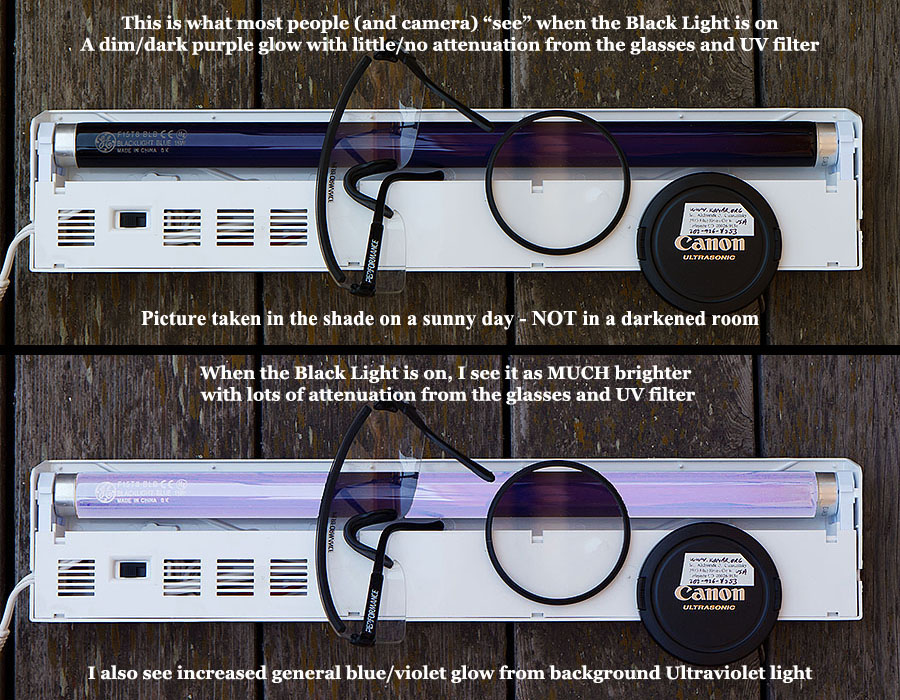
So I went out and bought a Black Light which dramatically shows the difference I see compared to others - please see image below. I've updated my commentary/analysis of seeing Ultraviolet after Cataract Surgery here.