Acon Cheng
Offline
•
Upload & Sell: Off
|
 p.3 #9 · D700 vs. CoolScan5000ED p.3 #9 · D700 vs. CoolScan5000ED | |
Hi everybody, I am new here and glad to find this forum and this thread, because I do some slide coping test with my DSLR too, so happy to find someone interested in this field.
My equipments are so similiar to jhinkey's, here are my gears:
Nikon D3s
Nikon AF-S micro 60mm f/2.8G ED (one of the sharppest digital AF lens)
Nikon Nikkor AIS 55mm f/2.8 micro (one of the sharppest old MF lens)
Nikon ES-1 slide copier (with a 62mm-52mm adaptor you can mount it to 60mm f/2.8G)
Nikon PB-6 bellow + PS-6 slide copier
Nikon R1C1 (which include a SU-800 wireless commander and two SB-R200 small flash unit)
a CRI>85 LED light source
some stuffs bought from the carema shop here or made by myself to finish the whole setup
In the beginning I expect the PB-6+PS6+AIS 55mm micro to get best result, but it turn out that it won't work with my D3s. Because of it's large profile camera body, you need to add a nikon pk-13 extension tube between the D3s and PB-6 or the the PB-6 will damage the camera mount. This pk-13, however, add the distance between camera and lens so the angle of view and the distance of focus is changed. No matter how you adjust the position/length of bellow or PS-6, you won't get full-frame cover of the slide, something like a APS crop of the image. As you can see in jhinkey's setup picture, the bellow must be squeeze to minimal distance to get the view in viewfinder to cover the slide's whole frame, but the pk-13 just make this distance longer. It's a design issue of Nikon. So if you want to shoot slides with PB-6+PS6+55mm micro digitally, the only way is to get a small-profile (no vertital grip) full-frame DSLR, that means D700 (the only one in the market by now).
So I turned to the ES-1. I used my laser cutter to make some adaptors with acrylic plates to work with ES-1 to get it work perfectly, that means (1)it's round front part won't turn anymore and will always be maintained horizontally, (2)mounted slides inserted in the ES-1will be fixed to a place perfectly matched the camera view, (3)I even made a special slide holder that can be inserted into ES-1 to shoot unmounted slides, just like the PS-6.
The best thing to copy slides with ES-1 is you can retain the autofocus function with the new nano-coated 60mm f/2.8G micro lens. The sharpness is VERY good.
About the light source, Nikon SB-R200 and my LED both worked well, the good side of LED is you can clearly see the images before shooting, from the viewfinder the slides look so beautiful and you can even change the exposure setting through Live-view w/ histogram to get the right exposure setting before shooting, that's what a flash can't do. The down side of the LED is it's so harsh to my eyes, so again I use my laser cutter to make a paper shade to cover between the LED and the end of the ES-1 diffuser. It works perfectly now, shooting slides becomes so comfortable and fast.
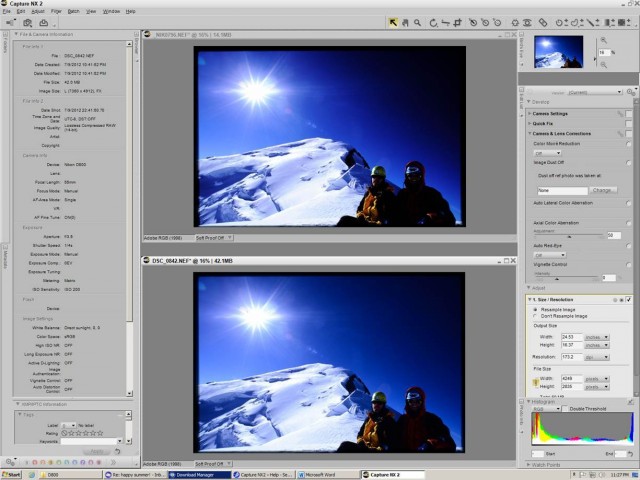
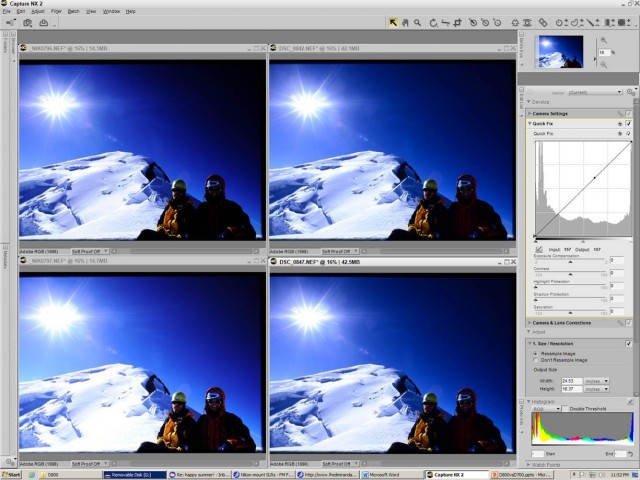
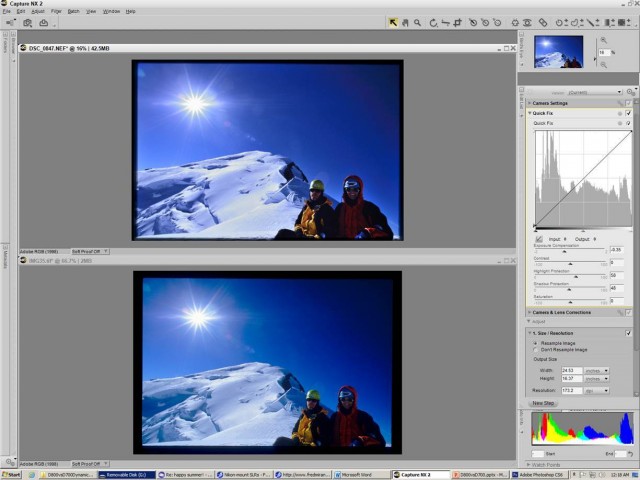
BUT, I encountered the same issue of the dynamic range, I tried so many way to solve this problem, but it seems impossible to get a single image which can retain both the highlight and shadow details. With RAWs I can adjust with Lightroom or Capture NX2, but the result seems unatural. So I turn to the HDR thinking, I found a interesting video to teach people using Nikon DSLR shoot in-camera HDR with multiple exposures:
but it turn out to be a fake, because no body can repeat the result of the video with D3/D3s. By now the only Nikon DSLR which can do in-camera HDR is D5100:
http://www.nikon.com/news/2011/0405_d5100_01.htm
So, my advise to jhinkey: don't buy a flash. Just wait the next full-frame DSLR with in-camera HDR (D5100 won't work with PB6+PS6 since it's APS sensor size), or you can spend some time in post-shoot HDR making skill, like Photomatix or something.
That's my experience in slide shooting, hope it will help.
|